
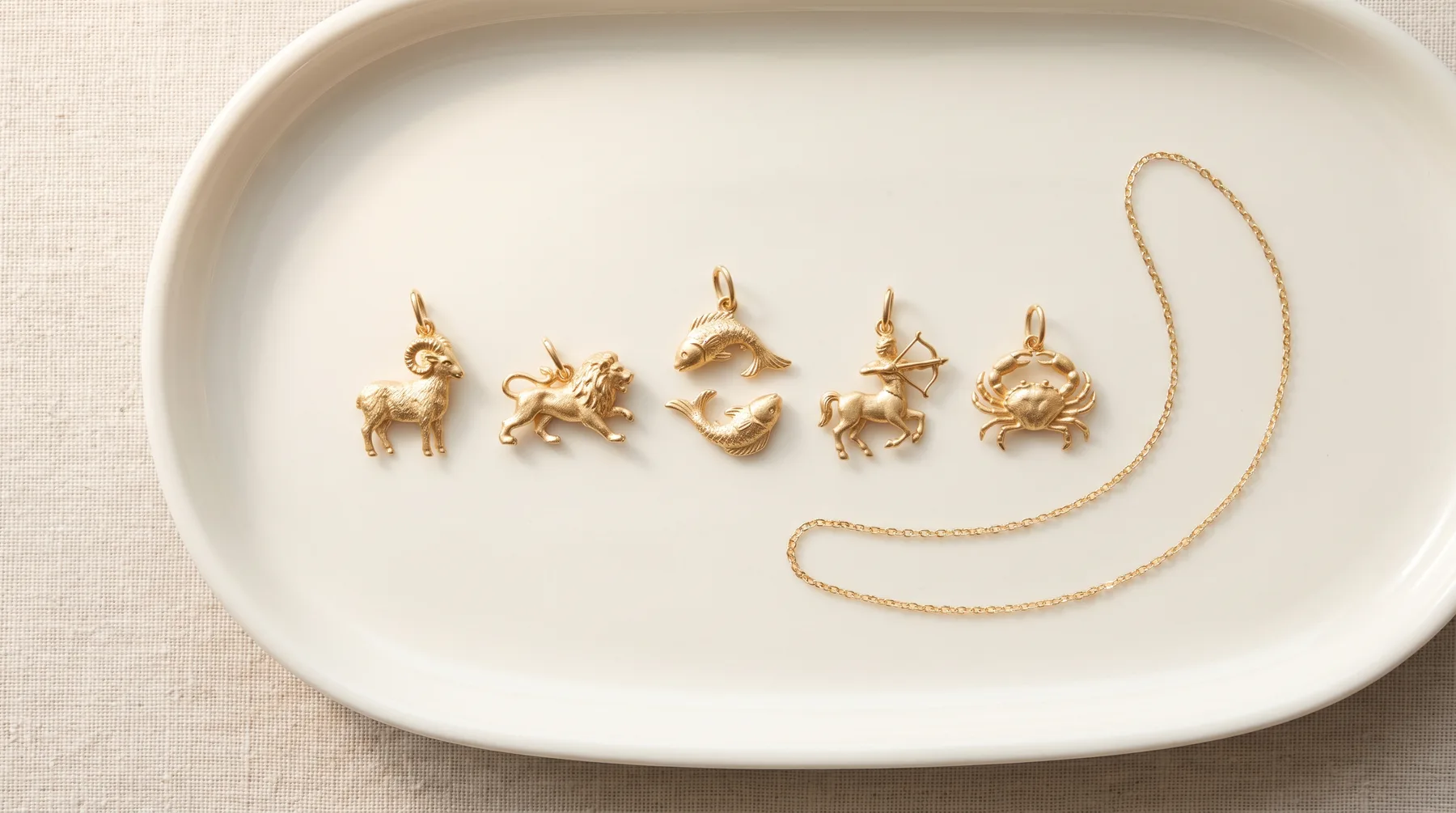
Zodiac jewelry is jewelry that carries a sign of the Western zodiac, most often as a charm or pendant showing the sign's symbol: the ram for Aries, the archer for Sagittarius, the water-bearer for Aquarius. People wear it as a small, personal emblem of their birthday, and give it because it is one of the few gifts that is specific to the person without needing to know their taste in anything else. The sign you buy for is the sun sign, set by birth date, and the only hard part is a birthday that falls within a day of the line between two signs.
This guide covers the twelve signs with their dates, symbols, elements and birthstones, where the system comes from, how to choose between a charm and a pendant, how to buy one as a gift without guessing wrong, and which gold holds up to being worn every day. It opens a series: one article for each sign follows through November and December 2026.
What is zodiac jewelry, and why do people wear it?
1 min
Zodiac jewelry is a wearable sign: a charm, pendant, medallion, ring or pair of earrings built around the symbol, figure or name of one of the twelve signs. Most of it is worn the way a monogram or birthstone is worn, as a quiet marker of identity rather than a statement of belief. Plenty of people who never read a horoscope still like wearing the lion of their August birthday.
The motif is old and keeps coming back. Writing in JCK on 26 April 2021, Victoria Gomelsky traced the modern love of zodiac jewels to the 1970s, when the symbols of the twelve signs entered the mainstream, and named fine jewelers such as Foundrae and Jemma Wynne who were working them into new collections. The gold zodiac medallion on a chain is the piece many people picture, and the format has never really left the jewelry case.
It also solves a gifting problem. A zodiac pendant is personal without being intimate, suits any age and any gender, and does not depend on knowing someone's ring size or whether they wear silver. All you need is a birthday.
Where the twelve signs come from
1 min
The zodiac is a Babylonian invention that the Greeks systematized. Babylonian astronomers divided the band of sky the Sun travels through, the ecliptic, into twelve equal parts of 30 degrees each, a scheme historians generally date to around the fifth century BCE. Greek astrologers borrowed it along with a good deal of Babylonian technique; a 2011 study by Alexander Jones and John Steele, published in ISAW Papers, traced one Greek astrological device directly back to Babylonian tablets.
The fullest classical statement of the system is Ptolemy's Tetrabiblos, written in Alexandria in the second century CE. Ptolemy assigned each sign a ruling planet, with Saturn ruling Capricorn and Aquarius and Jupiter ruling Sagittarius and Pisces, and grouped the signs into four triangles of three: Aries, Leo and Sagittarius; Taurus, Virgo and Capricorn; Gemini, Libra and Aquarius; Cancer, Scorpio and Pisces. Those triangles became the four elements of modern astrology, fire, earth, air and water, though the element names and the modern rulers Uranus, Neptune and Pluto are later conventions layered on top. Chapters 17 and 18 of the first book are online in the Loeb translation.
Most of the symbols are older than any of this. The goat-fish of Capricorn and the water-pouring figure of Aquarius both appear in Babylonian star lore, and the jeweler's version of each sign is a distant descendant of those images.
The twelve zodiac signs at a glance
1 min
Each sign covers about a month, and because the signs change around the 20th, every sign straddles two calendar months and two birthstones. The dates below are the convention most references use; the exact changeover can move a day either way depending on the year and the time zone.
| Sign | Usual dates | Symbol | Element | Birthstones of its two months |
|---|---|---|---|---|
| Aries | Mar 21 – Apr 19 | Ram | Fire | Aquamarine, diamond |
| Taurus | Apr 20 – May 20 | Bull | Earth | Diamond, emerald |
| Gemini | May 21 – Jun 20 | Twins | Air | Emerald, pearl |
| Cancer | Jun 21 – Jul 22 | Crab | Water | Pearl, ruby |
| Leo | Jul 23 – Aug 22 | Lion | Fire | Ruby, peridot |
| Virgo | Aug 23 – Sep 22 | Maiden | Earth | Peridot, sapphire |
| Libra | Sep 23 – Oct 22 | Scales | Air | Sapphire, opal |
| Scorpio | Oct 23 – Nov 21 | Scorpion | Water | Opal, topaz |
| Sagittarius | Nov 22 – Dec 21 | Archer (centaur) | Fire | Topaz, turquoise |
| Capricorn | Dec 22 – Jan 19 | Sea-goat | Earth | Turquoise, garnet |
| Aquarius | Jan 20 – Feb 18 | Water-bearer | Air | Garnet, amethyst |
| Pisces | Feb 19 – Mar 20 | Two fish | Water | Amethyst, aquamarine |
Where a month has more than one birthstone, the table shows one of them. The full Gemological Institute of America (GIA) list adds bloodstone for March, moonstone and alexandrite for June, spinel and sardonyx for August, tourmaline for October, citrine for November, and tanzanite and zircon for December.
Why the zodiac dates change by a day
1 min
The signs are defined by the Sun's position, not the calendar, so the changeover day drifts. Each sign begins when the Sun reaches the next 30-degree mark counted from the March equinox, and the Sun crosses those marks at a slightly different moment each year because the calendar year and the solar year do not line up exactly. Time zones add another wrinkle: a changeover late in the evening in California has already happened after midnight in London.
The December solstice shows how this plays out. The solstice is the moment the Sun enters Capricorn, and in 2026 it falls on the afternoon of 21 December in US time zones, according to EarthSky. A baby born in New York on the evening of 21 December 2026 is therefore, by the usual reckoning, a Capricorn, even though most printed charts give that date to Sagittarius. Birthdays like that are what astrology calls the cusp.
One more source of confusion is worth clearing up. The constellations that gave the signs their names have drifted against the calendar over two thousand years, because Earth's axis slowly wobbles, so the Sun is no longer in the constellation Capricornus at the December solstice. Western astrology deliberately keeps its signs tied to the seasons rather than the stars. When a headline announces that everyone's sign has changed, it is describing the constellations, and the signs on zodiac jewelry have not moved.
Zodiac charm or zodiac pendant: which should you buy?
2 min
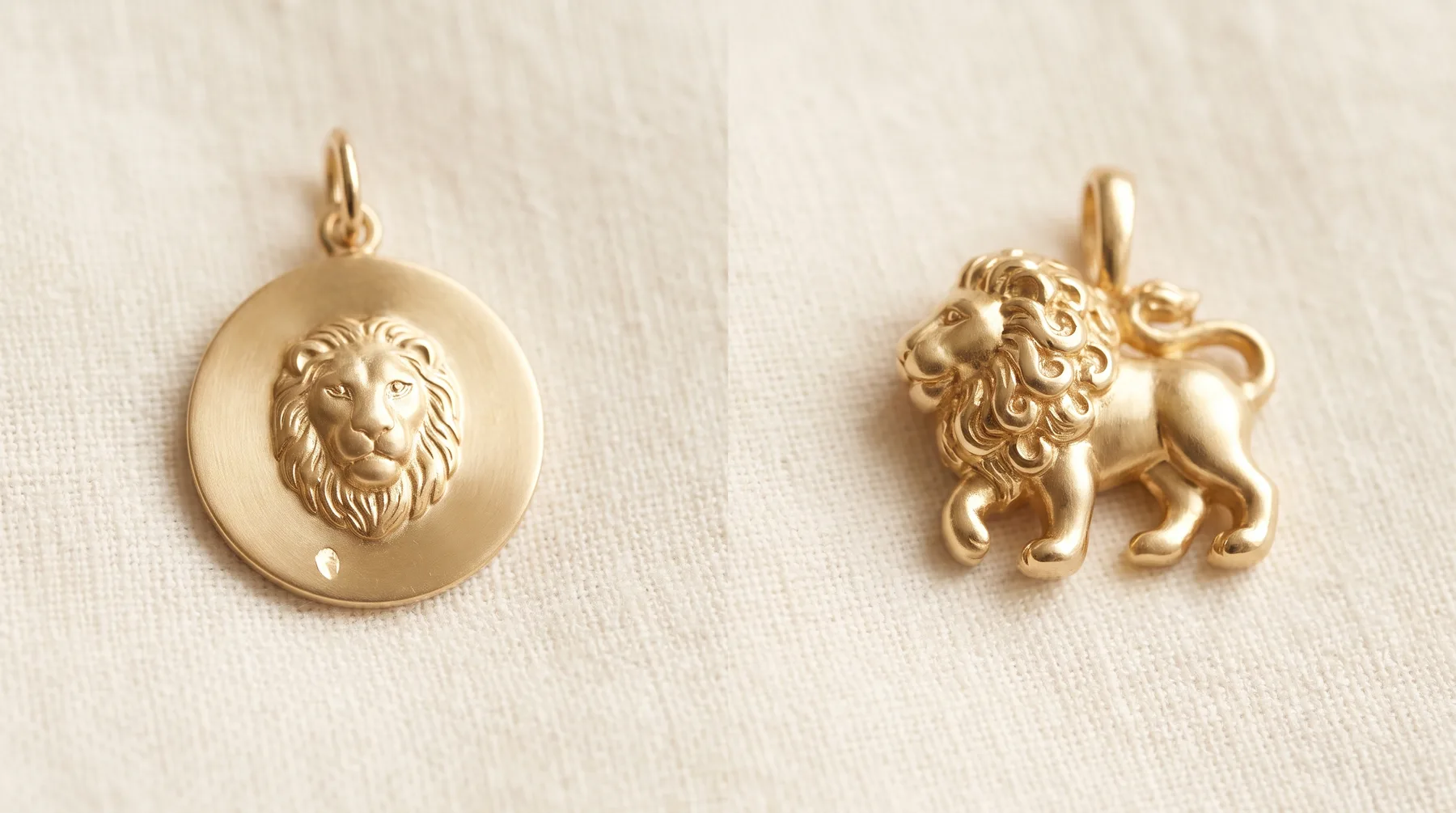
Buy a flat charm if it will be layered, worn small or hung on a bracelet, and a sculpted pendant if it will be the only piece on the chain. The difference is depth. A flat charm is cut from sheet gold and reads as a silhouette, light enough to sit on a fine chain and to share it with other charms. A three-dimensional pendant is cast as a small sculpture, with weight, texture and a profile that catches light from every angle, and it looks best with the neckline to itself.
Three practical checks settle most choices:
- Weight and chain. A charm under a gram hangs well on a fine cable or box chain. A pendant of a gram and a half or more wants a chain with a little more body, such as a wheat, rope or heavier cable; our guide to gold chain types covers which links carry weight without kinking.
- Bail size. The bail is the loop the chain passes through. A bail of about 5 by 4.5 mm takes most fine chains with room to spare. Check the bail against the clasp, not the chain, because the clasp has to pass through it.
- Whether the name is spelled out. Some designs carry the sign's name in letters, which makes the piece unmistakable from across a room. Others carry only the figure and read more like a quiet talisman. It comes down to how much the wearer likes to announce things.
The three 10k zodiac lines we carry
1 min
We carry all twelve signs in three designs, each in 10k yellow gold with a polished finish, so the same sign can be bought as a small lettered charm, a classic charm or a sculpted pendant. The figures below come from the specifications of the pieces themselves.
- The "100%" charm. A flat, cut-out silhouette of the sign's figure above the words "100%" and the sign's name in raised letters. It is the playful one and the lightest, at roughly half a gram and about 14 to 18 mm across, made for the person who treats their sign as a personality trait. It layers easily.
- The classic charm. The sign's figure as a flat cut-out, with the sign's name arched beneath it in block letters. A little larger and heavier than the "100%" charm, at roughly 0.7 to 0.95 grams and 17 to 20 mm long, it is the traditional zodiac charm in its most recognizable form.
- The 3-D pendant. A cast, fully sculpted figure with a textured surface, so the archer's drawn bow stands out from the body and the sea-goat has scales on its tail. These are the heaviest of the three, about 1.4 to 1.75 grams and 19 to 23 mm long, and the ones to choose when the pendant will be worn on its own.
Each sign's article in this series describes that sign's three pieces in detail, with measurements.
What gold karat is best for zodiac jewelry?
1 min
For a charm or pendant worn every day, 10k or 14k gold is the practical choice, and 10k is the more durable of the two. 10k gold is 41.7% pure gold alloyed with harder metals, which makes it the toughest of the common karats against scratches and dents, and in the US it is the minimum fineness that may be sold simply as "gold" under the Federal Trade Commission's Jewelry Guides. That toughness matters most on a small, detailed piece, where a dent in a tiny figure's arm or a worn-down letter is hard to repair.
The trade-off is color. 10k reads slightly paler than 14k and much paler than 18k, and the extra alloy means more of whatever base metals the recipe contains, which matters to people with metal sensitivities. Our comparison of 10k, 14k and 18k gold covers both sides in full.
How to buy zodiac jewelry as a gift
1 min
Buy the sun sign, which is the sign the birthday falls under in the table above. When someone says "I'm a Leo," that is the sign they mean, and it is the only one you can work out from a birth date alone. Astrology also assigns a moon sign and a rising sign, which need the time and place of birth to calculate; unless the recipient talks about theirs, the sun sign is the safe and expected gift.
The one real trap is the cusp, a birthday within about a day of a changeover. For those birthdays:
- Ask, lightly. Someone born on 22 November usually already knows whether they call themselves a Scorpio or a Sagittarius, and it is an easy question to slip into conversation weeks ahead.
- If you cannot ask, give the birthstone instead. Birthstones run by calendar month, so a November birthday is topaz or citrine whichever sign the day falls under.
- Or give both signs. Two small charms on one chain is a real style, and it turns the cusp into the point of the gift.
Our broader guide to buying jewelry as a gift covers chain length, budget and what to do when you do not know their taste.
Pairing a zodiac piece with a birthstone
1 min
A zodiac charm and a birthstone are two halves of the same idea, and they pair naturally: the sign for the season of the birthday, the stone for the month. Because every sign spans two months, the table above shows which birthstone goes with which half of the sign. An Aquarius born in January pairs with garnet, one born in February with amethyst.
Our birthstone series covers each month in depth: January garnet, February amethyst, March aquamarine, April diamond, May emerald, June pearl, July ruby, August peridot, September sapphire, October opal and November topaz.
Caring for a gold zodiac charm
1 min
Solid gold does not tarnish the way silver does, but a detailed charm collects lotion, soap and skin oil in its recesses, and that film is what makes old gold look dull. Soak it in warm water with a drop of dish soap, work a soft toothbrush into the details, then rinse and dry it with a lint-free cloth. Our full guide to cleaning gold jewelry at home explains what to avoid, chlorine above all, which attacks the alloy metals in lower-karat gold.
Two habits keep a charm looking new. Take it off before swimming, cleaning or the gym, and store it apart from other jewelry, since a loose chain will scratch a polished figure in a jewelry box faster than it ever would on the neck.
The series, sign by sign
1 min
An article for each sign follows this guide, in the order the signs' seasons arrive: Sagittarius on 6 November, Capricorn on 10 November and Aquarius on 13 November 2026, then Pisces, Aries and the rest through the winter, with Scorpio closing the series on 15 December. Each one covers the sign's story and symbol, what it says as a gift, its birthstones, and its three pieces in detail.
Frequently Asked Questions
2 min
How do I know my zodiac sign?
Find your birthday in the table of usual dates above. That gives your sun sign, the one meant by "what's your sign?" If your birthday falls within a day of a changeover, use an online calculator that takes your birth year, time and place, because the boundary moves slightly from year to year.
Is it bad luck to wear a different sign's jewelry?
No. People often wear a child's, partner's or parent's sign as a keepsake, the same way they wear a family member's birthstone. A zodiac charm is a symbol you choose to carry, and anyone may wear any sign.
Should I buy someone their sun, moon or rising sign?
Their sun sign, unless they have told you otherwise. The sun sign comes from the birth date alone and is the sign most people identify with. Moon and rising signs need an exact birth time and place, and only someone who already knows theirs will expect a gift based on one.
What if a birthday is on the cusp of two signs?
Ask the recipient which sign they claim, since most people born on a cusp have settled the question. If you cannot ask, give a birthstone piece, which follows the calendar month and cannot be wrong, or give both signs as two small charms on one chain.
Is 10k gold good for a zodiac necklace?
Yes. 10k gold is real gold, 41.7% pure, and it is harder than 14k or 18k, which helps a small detailed figure resist dents and keep its edges. It is slightly paler in color, and people with base-metal sensitivities may prefer a higher karat.
Does gold zodiac jewelry tarnish?
Solid gold does not tarnish the way silver does, though lower karats can darken slightly over time from their alloy metals, especially after contact with chlorine. A warm soapy soak and a soft brush restore the shine. Gold-plated pieces are different, because the plating wears through with daily use.