
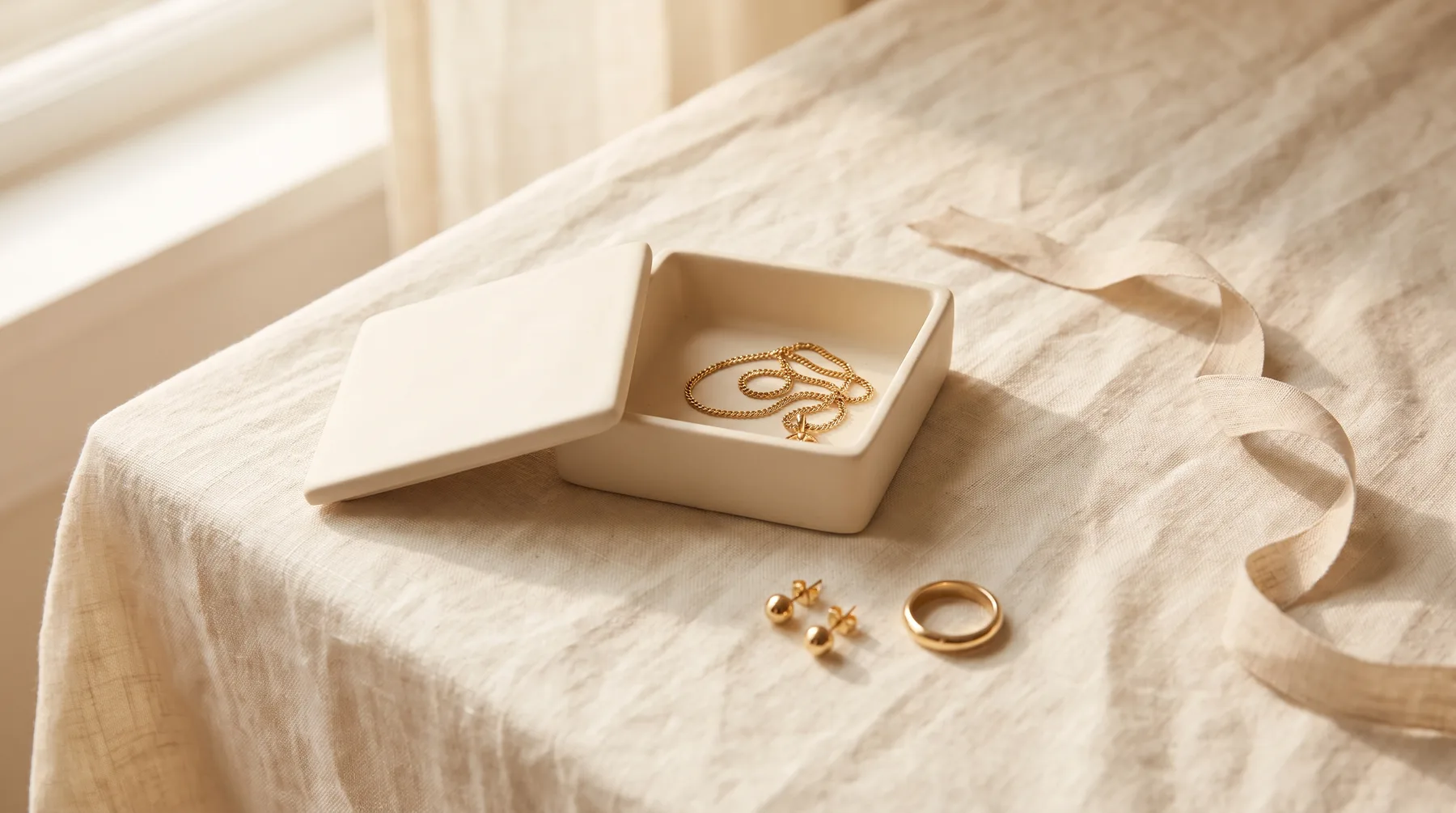
To buy jewelry as a gift without guessing wrong, copy the metal they already wear every day, pick a category that needs no size (a pendant on an 18-inch chain, a bracelet, studs if their ears are pierced), and buy from a seller whose exchange window is still open on the day the box is opened. Rings and bangles are the two categories where a size guess can fail outright, so leave them for people whose size you can actually find out. Everything else in this guide is detail on those three rules, including the two places people most often go wrong: metal color and earrings for ears that turn out not to be pierced.
One honest note on timing before the detail. According to a McKinsey & Co. ConsumerWise survey of 4,013 U.S. consumers taken in late July and early August 2026 and reported by JCK, 43% of shoppers expected to spend less on jewelry over the following three months, even as Bain & Co. projected total U.S. holiday spending above $1 trillion for the first time. People are still giving jewelry; they are being careful about it.
What should I look at before buying jewelry for someone?
2 min
Look at the piece they never take off. The ring, chain, or studs someone wears on an ordinary Tuesday tell you their metal color, their scale, and their tolerance for anything that catches on a sweater. Going-out jewelry is aspirational; weekday jewelry is the truth.
Metal color is the single decision that most often sinks a gift. Someone who wears only silver-toned pieces (sterling, white gold, platinum, steel) will put a yellow gold pendant in a drawer, and the reverse is just as true. If the weekday pieces are warm, buy yellow gold. If they are bright and silvery, buy sterling silver or white gold. Rose gold is its own answer: give it only to someone who already owns some. The same goes for mixed-metal pieces; they are a safe gift only for someone whose jewelry box already proves the taste.
A trade habit worth borrowing: read the stamp. Gold jewelry sold in the United States is usually stamped with its karat, and the Federal Trade Commission's Jewelry Guides (16 CFR 23.3) say that when a gold alloy is described as "gold", the karat must come immediately before the word. A tiny "14k" or "585" inside their everyday ring tells you what to buy; a "925" means sterling silver; "GP" or "GF" means a plated or filled piece, which usually means they bought it for the look, not the metal. Our guide to 10k vs 14k vs 18k gold explains what the numbers change, and vermeil vs plated vs filled vs solid covers the rest of the stamps.
Then scale. A person whose whole collection is small and fine will not wear a big medallion, however good it is, and someone who wears a substantial chain daily will read a hair-thin one as fragile.
How do I find someone's ring size without asking?
2 min
Borrow a ring they already wear on that finger for an afternoon and have a jeweler put it on a mandrel. No home trick comes close, and the jeweler can also tell you whether it is a narrow or wide band, which changes the size you should order. The Gemological Institute of America (GIA) gives the same first answer in its ring-size guide: borrow a ring from the ring finger, or press it into a bar of soap and bring the impression in, or ask a friend who knows. GIA's other advice matches ours: if you must guess, guess large, because "it is easier to remove metal from a ring that's too big than add metal to a ring that's too small."
Three cautions that save most blind ring purchases.
- Measure a ring from the finger it will live on. Fingers on the same person rarely share a size, so a ring borrowed from the middle finger or the other hand can easily put you a size out.
- Do not trace the ring on paper. The pen line sits outside the metal, and one full US ring size is only about 0.8 mm of inside diameter, so a wobbly line is easily a whole size.
- Skip the sleeping-string trick that forums love. String stretches, it cannot tell you whether a ring will pass the knuckle, and GIA warns against string and paper for exactly that reason. Our ring-sizing guide compares the home methods and where each one goes wrong.
If you cannot get a ring, the trade's working assumption in the United States is roughly size 6 to 7 for women and 9 to 10 for men. Averages are nearly useless for one specific hand, but a stock size 7 for a woman or 10 for a man is the least-wrong blind guess, and a plain band is the easiest design for a jeweler to move later. Some designs, such as full eternity bands, cannot be resized at all, so avoid them as a blind gift.
One policy detail that matters more for gifts than for anything else: at Karat & Kin, a ring that has been resized is final sale, like any custom or engraved piece. So never have a gift ring sized before you give it. Give it as shipped, have them try it on at home, and if it does not fit, keep it unworn and use the 30-day exchange window to swap it for the right size. More on that window below.
What necklace length should I buy as a gift?
3 min
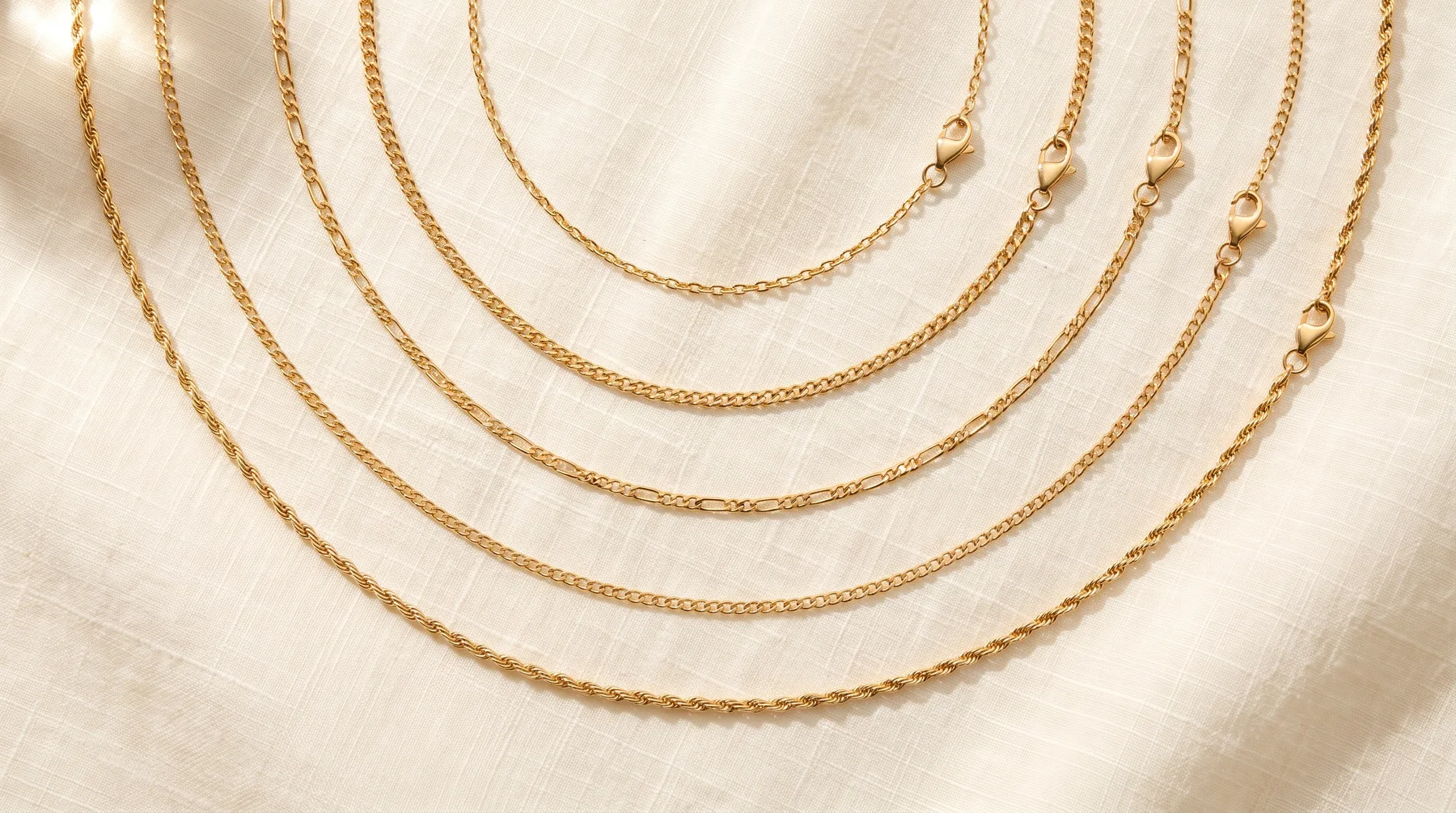
Buy 18 inches for a woman and 20 or 22 inches for a man unless you know otherwise. An 18-inch chain sits at or just below the collarbone on most women, holds a pendant where it can be seen, and clears every neckline. On many men a 20-inch chain sits at the collarbone and a 22 rests a little below it, which clears an open shirt collar. The trade calls these by old names, which the International Gem Society's necklace size chart lists as collar (12 to 13 inches), choker (14 to 16), princess (17 to 19), matinee (20 to 24), opera (28 to 35) and rope (anything longer). Nobody says "princess" across a counter any more, but the inch numbers still rule.
| Length | Where it sits on most women | Where it sits on most men | Gift verdict |
|---|---|---|---|
| 16 in | Base of the neck, above the collarbone; a choker on a larger frame | Too short for nearly everyone | Only for someone who already wears short chains |
| 18 in | At or just below the collarbone | Snug at the base of the neck | The default for women; the most-stocked length in our catalog |
| 20 in | A couple of inches below the collarbone, over the top of the chest | At the collarbone | Safe for a taller woman or a layering piece; the default for a slim man |
| 22 in | Upper chest, at the top of a crew neck | Just below the collarbone | The default for many men |
| 24 in | Mid-chest, usually worn over clothing | Top of the sternum | Larger builds, or a chain meant to hang over a shirt |
Those positions move with neck size, height and build, so if you can read the length of a chain they already own, do that instead. Lay it flat, measure clasp to end in inches, and buy the nearest standard length.
Our own stock backs the defaults. Across the chain and necklace variants in the Karat & Kin catalog as of October 2026, 18 inches is the most-stocked length (199 variants), followed by 16 (182), 20 (154), 24 (133) and 22 (67), and the chains cut for men come in 20, 22 and 24 inches only. The shelf leans the same way as the defaults; 22 inches is the scarcest length we stock, so a man's chain is easiest to find at 20 or 24.
Two more chain questions a gift buyer should settle. First, does the pendant come with a chain? Read the listing for the words "chain included" or "sold separately", and if neither appears, ask before you buy. Plenty of pendants are sold bare because the buyer already owns a chain. Second, which chain. A pendant wants a chain that can hold its weight and pass through its bail; a very fine chain under a heavy pendant is the pairing most likely to break. Our guide to gold chain types covers which links hold up and which ones kink.
Which jewelry is safe to give at each relationship stage?
2 min
The further a piece is from the hand, the less it says, and that is the whole map. Earrings and pendants are the quiet categories; a bracelet is warmer; a ring on anyone you are dating reads as a question, whether or not you meant to ask one. The worry that shows up most on gift forums is the first holiday together, where a ring bought "because it was pretty" starts a conversation nobody planned.
- New or casual: small sterling or 14k studs, a simple pendant on a chain, a thin bracelet. Keep it to a style they already wear, and keep it modest.
- Established, not married: a pendant with a stone that means something (their birthstone, see the pointer at the end), a better chain than the one they wear, hoops in their metal. Still not a ring, unless it is the ring.
- Married or long-term: this is where a ring becomes safe, because you can get the size and because the message is not ambiguous. A right-hand ring, an anniversary band, an upgrade of the chain they have worn thin.
- Parents and grandparents: match exactly what they wear; this group changes least. Children's and grandchildren's birthstones in a pendant suit this group well, and a pendant avoids the problem of enlarged knuckles, where a ring that clears the knuckle sits loose above it.
- Friends, siblings, colleagues: earrings if pierced, otherwise a bracelet or a small pendant. Never a ring.
- Children and teenagers: stainless steel or sterling, small, with secure backs. Children lose earrings, so keep the price modest.
Why do earrings need pierced-ear intel?
2 min
Because an earring is the one gift that can be impossible to wear rather than merely wrong. Before buying, you need three facts: whether their ears are pierced at all, how many piercings they have and where, and whether they react to cheap metal. The first fact is not as safe to assume as it looks. Plenty of adults let old piercings close, and clip-on alternatives are scarce in fine jewelry; of the 3,629 earring styles in the Karat & Kin catalog as of October 2026, only 31 are clip-ons, under one percent. If their ears are not pierced, buy a different category rather than hunting for a clip.
The second fact decides the style. Someone with a single lobe piercing per ear wears a pair. Someone with a stack of lobe and cartilage piercings is usually building a look, and a single small hoop or a lone stud in their metal is the better gift than a matched pair of statement earrings they will have nowhere to put. Count the holes in a photo. It feels odd and it works.
The third fact is medical. The American Academy of Pediatrics' 2020 policy statement on nickel allergy calls nickel "the No. 1 confirmed contact allergen nationwide in all age groups" and names earring posts among the everyday sources (AAP, May 2020). Peer-reviewed dermatology puts nickel sensitivity at roughly 8 to 18% of the general population in Europe, with young women affected far more often than men (Ahlström et al., Contact Dermatitis, 2017). If the person you are buying for has ever said an earring "made their ears itch," buy solid yellow or rose gold, sterling silver, platinum, or surgical stainless steel, and avoid plated fashion earrings entirely, because once plating wears, whatever base metal is under it sits against the piercing. Read past "hypoallergenic", which has no fixed standard behind it; "nickel-free" is the claim worth looking for, and in our catalog it appears on 86 earring styles.
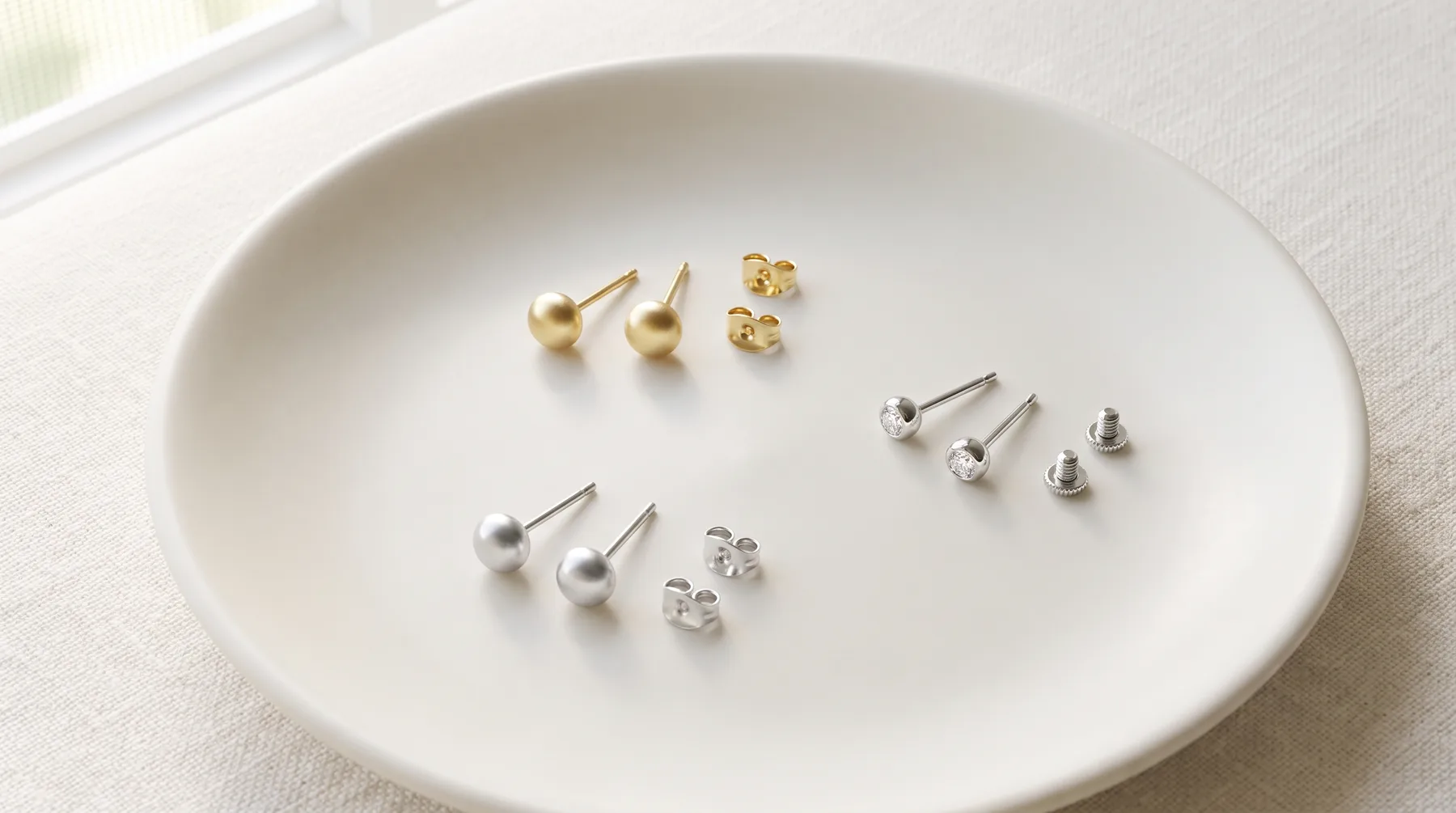
Last, the backs. Friction (butterfly) backs are the default on small studs. Screw backs hold more securely, which makes them the sensible choice for children and for anyone who sleeps in their earrings. Lever backs and French wires suit drops. If a gift pair arrives with backs that feel loose, a jeweler can fit firmer ones, which is a cheaper fix than losing one of the pair.
How much should I spend on jewelry as a gift?
3 min
Spend what buys a solid piece in the category you have chosen, and let the category set the number rather than the other way round. There is no rule tying a gift to a salary, but there is a floor under each category below which the piece stops being fine jewelry, and it is set by the metal. Gold traded between about $4,175 and $4,195 an ounce on Friday, October 9, 2026 (Trading Economics); take $4,180 as a round figure. At that price the gold alone in one gram of 14k is worth about $78, and in 18k about $101, before anyone has drawn a chain or set a stone. A 4-gram 14k chain therefore carries more than $300 of metal; a "14k" chain of that weight offered at $120 is either not 14k, not solid, or not 4 grams.
Real buyers have noticed. The World Gold Council's Gold Demand Trends for the second quarter of 2026 (published July 30, 2026) reported jewelry demand down 17% year on year "as consumers bought less gold and shifted towards lighter products." Lighter is a fine answer for a gift, provided it is honest: a 1.2 mm solid 14k chain is a better present than a 3 mm plated one at the same price, because the first is still gold in five years.
Here is where the middle of the market actually sits, from our own shelf. Across the Karat & Kin catalog as of October 2026, the median earring style lists at about $40 in stainless steel, $135 in sterling silver, $525 in 14k yellow gold and $560 in white gold; the median pendant lists around $300, and the median chain around $560, with the cheaper quarter of chains under $100 because they are silver. Those are list prices for our stock, not industry averages, but they show the shape of the thing: silver buys a real piece for the price of dinner, 14k gold starts in the hundreds, and the jump between the two is the metal, not the design.
A few budget rules by category that hold up:
- Chains: buy solid gold or sterling; never plated for a gift meant to be worn daily. If the budget only reaches plated gold, buy a silver chain instead, and read our guide to how to tell if gold is real before buying any "gold" chain from a marketplace.
- Earrings: small sterling studs are the least expensive way to give solid precious metal; 14k studs cost several times more for the gold alone.
- Pendants: a stone pendant's price rises fast with the stone, so a small natural or lab-grown stone in 14k is a better gift than a big simulant in plate. Our lab-grown vs natural guide covers that choice.
- Rings: only once you have the size. Two rings that look alike can differ several times over in price, and our piece on why rings that look alike cost different amounts explains what you are actually paying for.
- Anything over about a thousand dollars: ask for an appraisal or at least a detailed receipt, and read our guide to jewelry insurance and appraisals, because a gift that valuable should be on someone's policy within the month.
What are Karat & Kin's return and exchange terms for gifts?
2 min
At Karat & Kin you have 14 days from delivery to return a piece for a refund, or 30 days from delivery to exchange it or take store credit, and the clock starts the day the carrier confirms delivery. The full terms are on our shipping and returns page; the short version that matters for a gift buyer is this.
- The window runs from delivery, not from the day the gift is opened. A piece delivered on November 25 is on its 30th day on December 25, so for a Christmas gift, aim for delivery on or after November 25 and expect the exchange route, not the refund route, to be the one still open on the day. A refund on a December 25 gift needs delivery on or after about December 11.
- Exchanges and store credit ship back free on a prepaid, insured, tracked label we send you. A refund has a flat $9 label charge deducted and the original shipping is not refunded.
- The piece must be unworn and undamaged, in its original packaging with every tag, certificate and appraisal it came with. Unworn earrings qualify; that surprises people who assume pierced earrings are never returnable.
- Custom, engraved, made-to-order and resized pieces are final sale. Do not resize or engrave before the gift is opened and accepted.
- Email [email protected] with the order number to start; every return begins with that authorization, and the prepaid label comes back by email.
Buying somewhere else? Ask the same four questions before you pay, wherever you buy: when does the window start, does the exchange window differ from the refund window, who pays the return shipping, and does resizing or engraving void the return. The answers vary more than people expect, and the last one is the one that quietly turns a thoughtful gift into a final sale.
Standard shipping from us is $7.95, complimentary on orders of $150 or more, and quoted at 5 to 8 business days, so an order placed in mid-December is cutting it close for December 25. Our checkout opens on November 12, 2026.
The one-minute decision rule
1 min
Match their metal. Pick a category that needs no size unless you have the size from a ring they wear on that finger. If it is earrings, confirm the piercings and the metal reaction first. Spend what buys solid metal in that category, lighter rather than plated. Order with the exchange window in mind, and never resize or engrave before they have said yes. Do those five things and the worst case is a swap for a different length, which is one email, not a gift gone wrong.
If you want a theme to hang the choice on, birth months are the oldest one in the trade and the easiest to get right: our birthstone guides run from January's garnet through October's opal and November's topaz, and each one says which cuts and settings hold up to daily wear.
Frequently Asked Questions
2 min
Is jewelry an appropriate gift early in a relationship?
Yes, if it is small, in their metal, and not a ring. Studs, a simple pendant or a thin bracelet say "I paid attention" without saying anything you did not intend. A ring on someone you are dating reads as a question no matter how it is wrapped.
Should I size a gift ring up or down if I am unsure?
Up. GIA's advice and ours agree that removing metal from a ring that is too large is routine, while adding metal costs more and is not possible on every design. A slightly loose ring at least goes on, and can be exchanged unworn or brought down later; a ring that will not clear the knuckle cannot go on at all. Do not have it resized before giving it, because a resized piece is final sale.
Can earrings be returned if they do not work out?
At Karat & Kin, unworn earrings in their original packaging qualify for the same return and exchange terms as any other piece: 14 days from delivery for a refund, 30 days for an exchange or store credit. Other stores vary, and some treat pierced earrings as final sale, so ask before you buy.
What do I do if the chain is the wrong length?
Exchange it for the right length if the window is open; the difference between two standard lengths is only two inches, so the swap is usually one step up or down. A chain extender is a stopgap that works on a short chain, but it adds a visible length of plain links at the back, so treat it as a bridge until the exchange, not the fix.