
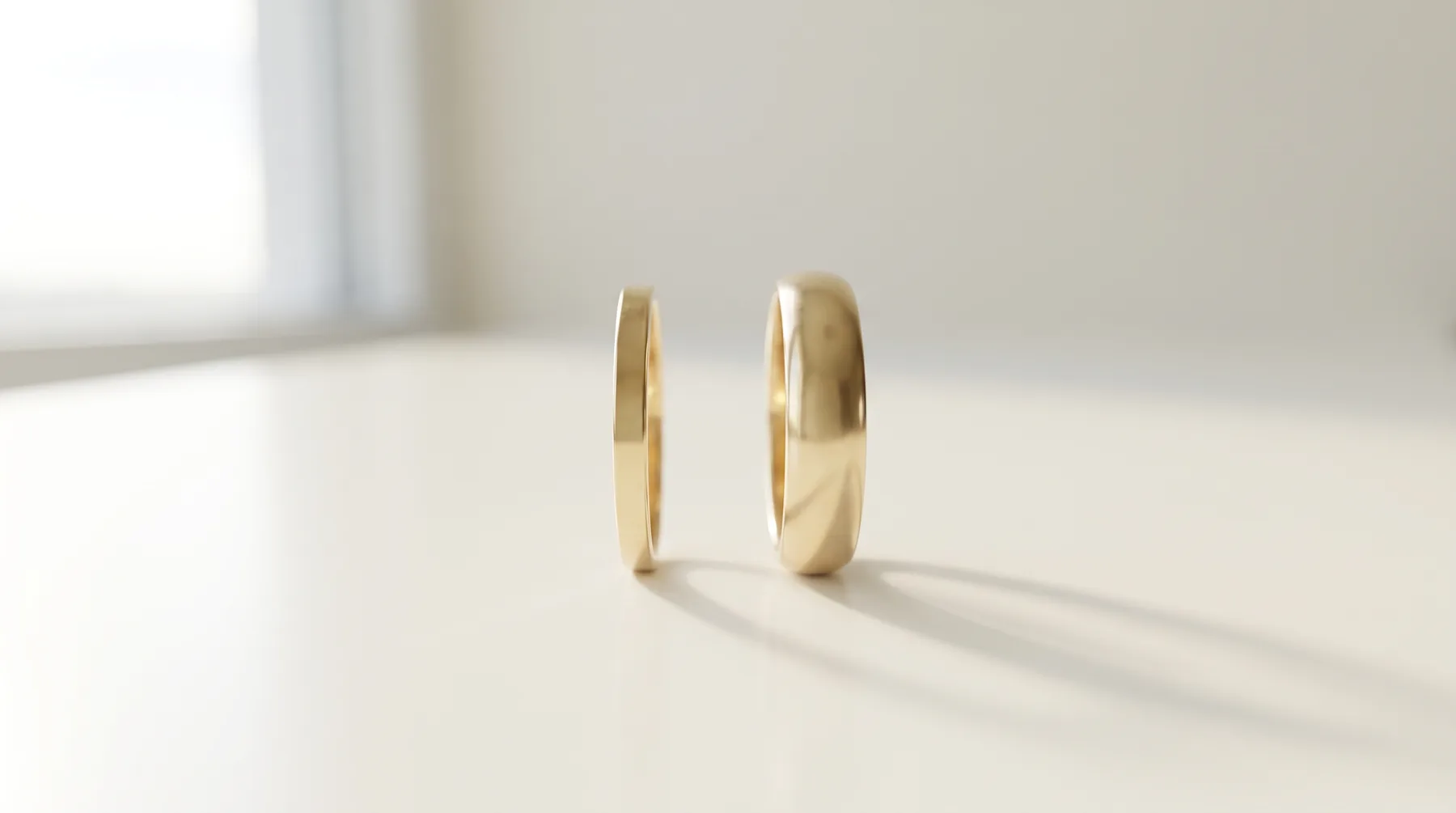
Two rings can look identical at arm's length and differ in price by a factor of ten. Four things account for almost all of it: how many grams of metal are in the piece, the quality of the stones inside the same grade names, how the ring was manufactured, and who is selling it to you. Three of those four are invisible from across a counter, which is exactly why the question feels like a trick.
None of this requires trusting anyone. Every one of the four is checkable before you buy, and the rest of this article is how to check them. We will start with the one that is easiest to prove, because we can prove it with our own data.
Fourteen identical bands, one price driver
1 min
Our catalog contains 14 plain 14k yellow gold wedding bands that are all exactly 4 mm wide, all in size 7. Same metal, same width, same finger. On a hand you could not tell them apart at conversational distance. The lightest weighs 2.50 grams and lists at $815.70. The heaviest weighs 5.52 grams and lists at $1,801.08.
Now the part that makes the point. Every single one of those 14 styles prices out at $326.30 per gram. Not approximately: to the cent, across all fourteen. The $985 gap between the cheapest and the most expensive band is not design, brand, or craftsmanship. It is 3.02 grams of gold.
The vendor's own titles say so if you read them: the light ones are called lightweight, the heavy ones say standard weight or comfort fit. Comfort fit bands are domed on the inside, which takes more metal to make, feels better on the finger, and costs more for a reason you can feel and not see. That is the whole story of a plain band, and it is the cleanest example in jewelry of price tracking a physical quantity.
Where the money goes in a plain gold ring
2 min
Let us do the arithmetic in public. Gold spot sat around $4,390 per troy ounce on 13 August 2026, which works out to roughly $141 per gram of pure gold. A 14k alloy is 58.3% gold by weight, so the gold content in a 14k piece is worth about $82 per gram.
The median band in that group of fourteen weighs 3.35 grams, so it holds around $276 of gold and lists at $1,092. The gold is roughly a quarter of the price.
The other three quarters is real work, and this is where the trade earns or fails to earn its money: the alloying metals, casting or striking, filing and pre-polish, the finish, sizing, quality control, the inventory cost of holding thousands of sizes on a shelf, shipping, and the margins of everyone between the refinery and your hand. The jewelry trade's traditional retail conventions are keystone, meaning double the wholesale cost, and triple keystone, meaning four times. Bridal is the most price-shopped category in the store, so a center diamond very often sells at the thinnest margin in the case while a fashion piece next to it carries the fattest.
Two useful conclusions come out of this. A gold price quoted per gram is the most honest quote in jewelry, and anyone selling plain bands should be willing to tell you the gram weight. And a ring that is dramatically cheaper than a comparable one is usually not a bargain on labor. It is a lighter ring.
Two diamonds, the same four letters, twice the price
2 min
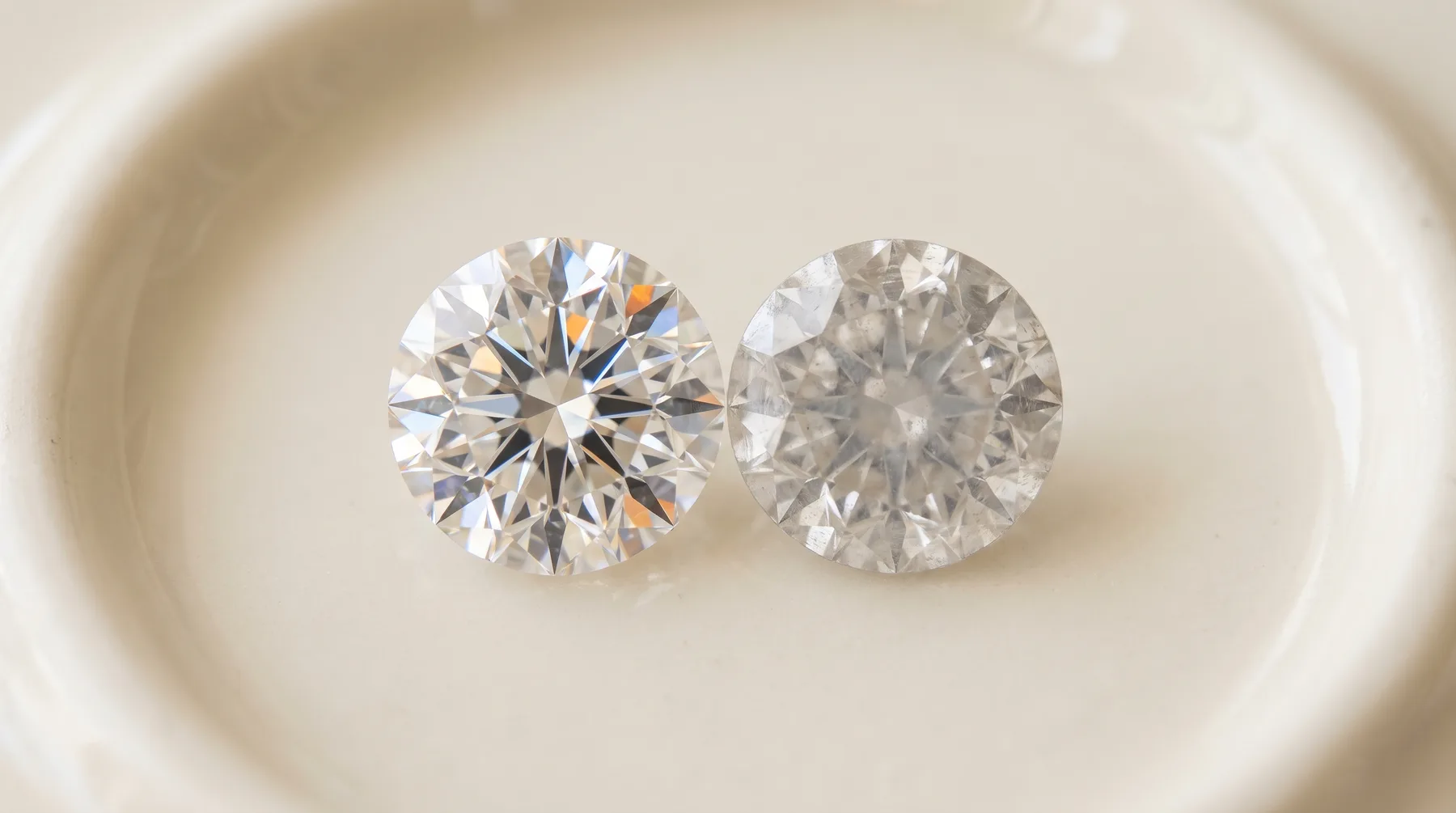
Grades are not prices. Two 1.00 carat stones can both be described as G VS2 and sell for very different money, for three reasons that all sit outside those four letters.
Cut quality. Carat, color and clarity are properties the stone was born with; cut is the only one a human controls, and it does most of the work in how a diamond actually looks. Across major US retailers in August 2026, an Excellent cut typically runs about 10% to 15% above a Very Good at the same carat, color and clarity, and 25% or so above a Good. That is the one premium in the entire 4Cs that reliably shows up to the naked eye.
Which laboratory graded it. Grading is a human judgment, and standards genuinely differ between laboratories. The trade settled this argument publicly in 2014: Rapaport's RapNet, the largest diamond trading network, announced on 9 September 2014 that it would stop listing diamonds with EGL reports of any kind, effective 1 October 2014, on the grounds that reports using GIA's grading vocabulary while applying looser standards misrepresent quality. A stone graded H VS2 by one laboratory and J SI1 by another is the same stone at two prices, and the paperwork is the only thing that changed.
The parts of the stone that never make it into the summary line. Fluorescence, the exact table and depth percentages, whether an inclusion sits under the table or hides at the girdle, and whether the stone is cut heavy to hold a carat weight it does not deserve. Our guide to reading a laboratory report line by line covers where each of those lives on the page.
Cast, die-struck, or hollow: how the ring was made
2 min
Casting pours molten metal into a mold. Die striking forces a solid bar into shape under enormous pressure, often around 50 tons. The two produce different metal, and the difference is not marketing: struck metal has a compressed, uniform grain and effectively no porosity, while cast metal can carry microscopic voids from the pour. In practice a struck shank holds a polish longer and resists thinning better, and struck prongs take longer to wear to the point of retipping.
Die striking costs more because tooling costs more and it does not adapt to one-off designs. That shows in the catalog: of the 103,413 styles that declare a manufacturing process, 62,990 are cast and only 3,172 are die struck. Cast is the industry default, and cast is fine for most jewelry. But a heavy cast band and a die-struck band of the same weight are not the same product, and a shop selling the struck one has a real answer to why it costs more.
The genuinely important thing to ask about is hollow construction. Hollow tubing and puffed hearts and lightweight hoops have their place, and they are the main reason a large-looking gold piece can be surprisingly cheap. They are also close to unrepairable. Once a hollow hoop earring cracks or a hollow shank dents, there is no metal to work with, and a jeweler who tries to solder it will blow a hole through the wall. Buy hollow knowingly, for the look, at a price that reflects it.
The parts of the ring you cannot see
1 min
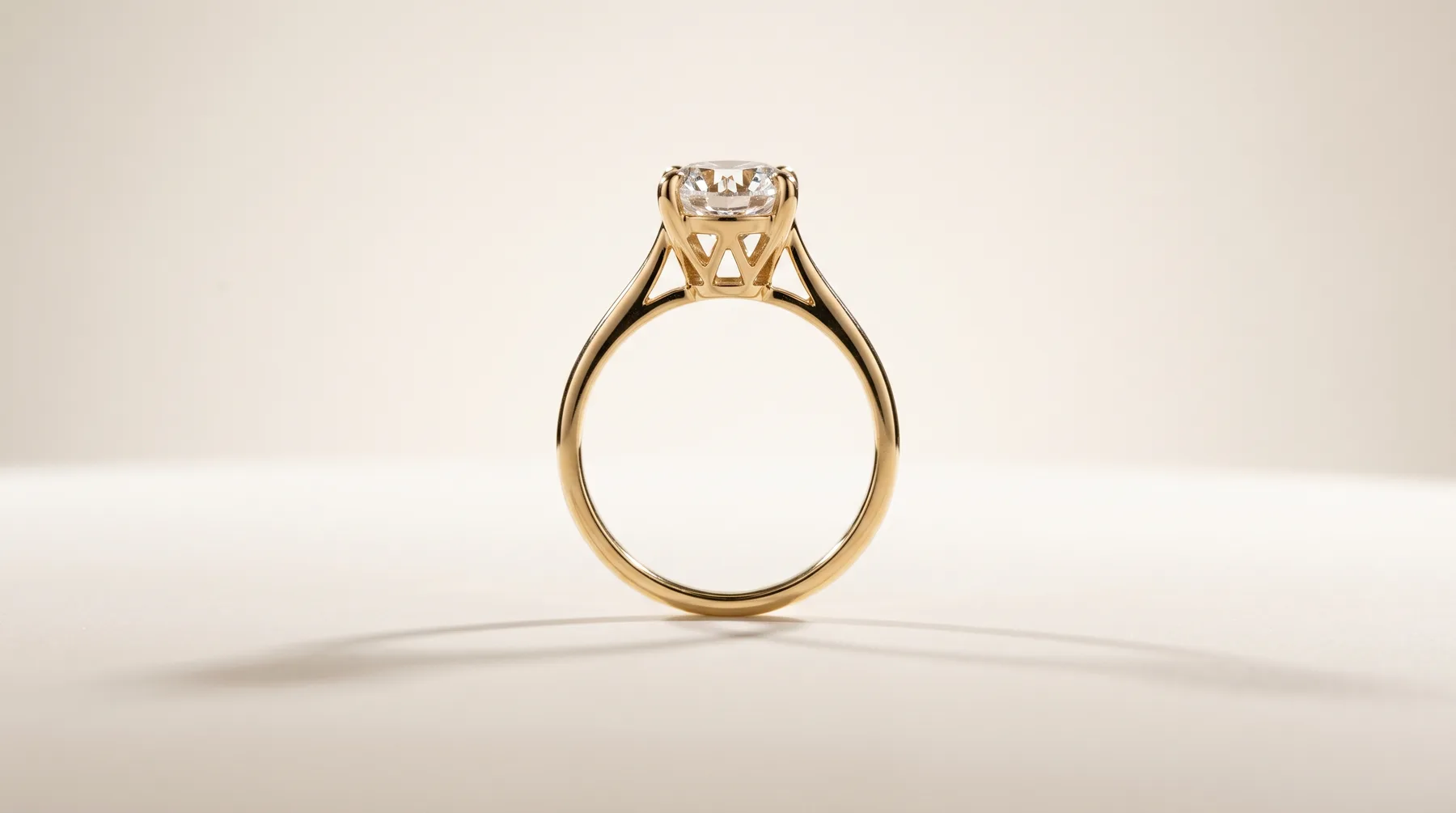
These are the details that separate a ring that lasts thirty years from one that comes back to a bench in three.
- Prong stock. Thin prongs on a heavy stone are the single most common cause of a lost diamond. Published shop prices for retipping run roughly $25 to $60 per prong in gold, more in platinum, and a head that needs it every few years is a design decision someone made to save metal.
- Shank thickness under the head. A 1.5 mm shank under a substantial center stone will go out of round. Look at the ring from the side, not from the top.
- Melee quality. The small stones in a halo or a pave band are graded and priced too, and they range from bright white and well matched to grey, included, and visibly uneven. Look at a pave row in daylight and see whether the stones match each other.
- Setting labor. Hand-set stones sit level with even spacing and tight beads. Machine-set rows sometimes do not, and crooked stones in a $400 pave band are not a defect you can have fixed cheaply.
- Finish. Run a fingernail along the inside of the shank. A properly finished ring is glassy inside where nobody looks; a rushed one is not.
What the brand and the store are charging for
1 min
Some of the gap between two similar rings is the store, and that is not automatically a rip-off. A shop with a bench in the back, a jeweler who sizes the ring for free for life, prong checks twice a year, and a person who will take your call in eight years is running a real cost structure. A drop-shipper with a stock photo is not, and that difference is worth money to some buyers and nothing to others.
What you should refuse to pay for is a name attached to nothing else. A branded ring priced at several times a comparable piece, with the same cast construction, the same commercial melee and a stone graded by a laboratory the trade does not respect, is charging for the box. Ask the question directly: what does this price include after I walk out. If the answer is a real service list, it is a legitimate premium. If the answer is a shrug, you have your answer too.
Where paying more is real, and where it is not
1 min
Worth it, most of the time:
- Metal weight in anything worn daily. Grams buy years.
- Cut quality on a diamond, ahead of color and clarity both. It is the difference you actually see.
- A report from a laboratory with a consistent reputation, on any stone over about half a carat.
- Heavier prongs and a well-built head. It is cheap now and expensive later.
- A jeweler who will inspect and maintain the piece.
Rarely worth it:
- Clarity above the point where the stone is eye-clean for its size and shape. Above that you are buying paper.
- Color grades chased one letter at a time on a stone that will sit in yellow gold.
- Brand markup with no service attached.
- Elaborate contour bands and fussy geometry that make future sizing hard. A plain sizing bar wears better than a clever one.
- Thicker rhodium plating sold as permanent. Beyond about a micron the coating turns brittle, as our guide to rhodium plating explains.
How to compare two rings honestly in five minutes
1 min
Take both listings and get these six numbers. If a seller will not give them to you, that itself is information.
- Gram weight of the finished piece in your size.
- Karat and whether the construction is solid or hollow.
- The center stone's laboratory, report number, and cut grade, not just carat, color and clarity.
- Total carat weight and quality range of the melee.
- How the piece was made, and what the head is made of if the ring has one.
- What service comes with it: sizing, prong checks, refinishing, and for how long.
Divide the price by the gram weight on a plain metal piece and you will know instantly whether you are looking at a fair metal price or a story. On a stone-set piece, price the stone and the mounting separately in your head; they are two purchases wearing one tag, and the answer to which one is inflated is almost always visible once you separate them.
Frequently Asked Questions
2 min
Why is one 1 carat diamond $4,000 and another $12,000?
Cut quality, the grading laboratory's standards, fluorescence and proportions, and whether the carat weight is carried in the depth of the stone rather than its face-up size. Two stones that share the same carat, color and clarity letters can differ substantially in all of those, and the letters are the part that gets advertised.
Is a heavier gold ring always better?
For a plain band worn daily, heavier is generally more durable and it will take more resizings and refinishings over a lifetime. It is not a quality grade, though. A well-made light ring beats a badly made heavy one, and comfort matters: some people dislike the feel of a heavy band and wear it less.
Are cheap rings on marketplaces real gold?
Some are, and the giveaway is arithmetic rather than suspicion. Work out what the gold content alone would cost at the current spot price for the weight claimed. If the whole ring sells for less than its own metal, the piece is plated, hollow, underweight, or not what the listing says.
Does a higher price mean better craftsmanship?
Not reliably. Price correlates with metal weight and stone quality, which are physical, and with brand and retail model, which are not. Craftsmanship shows up in things you can check by eye: the finish inside the shank, whether pave stones are level and matched, prong thickness, and whether the piece looks as good from the side as from the top.
How do I know if a store's price is fair?
Get the gram weight and the stone's report number, then compare the same two facts elsewhere. Fair pricing survives that comparison and honest sellers expect it. A shop that reacts badly to being asked for a gram weight has told you something useful for free.