
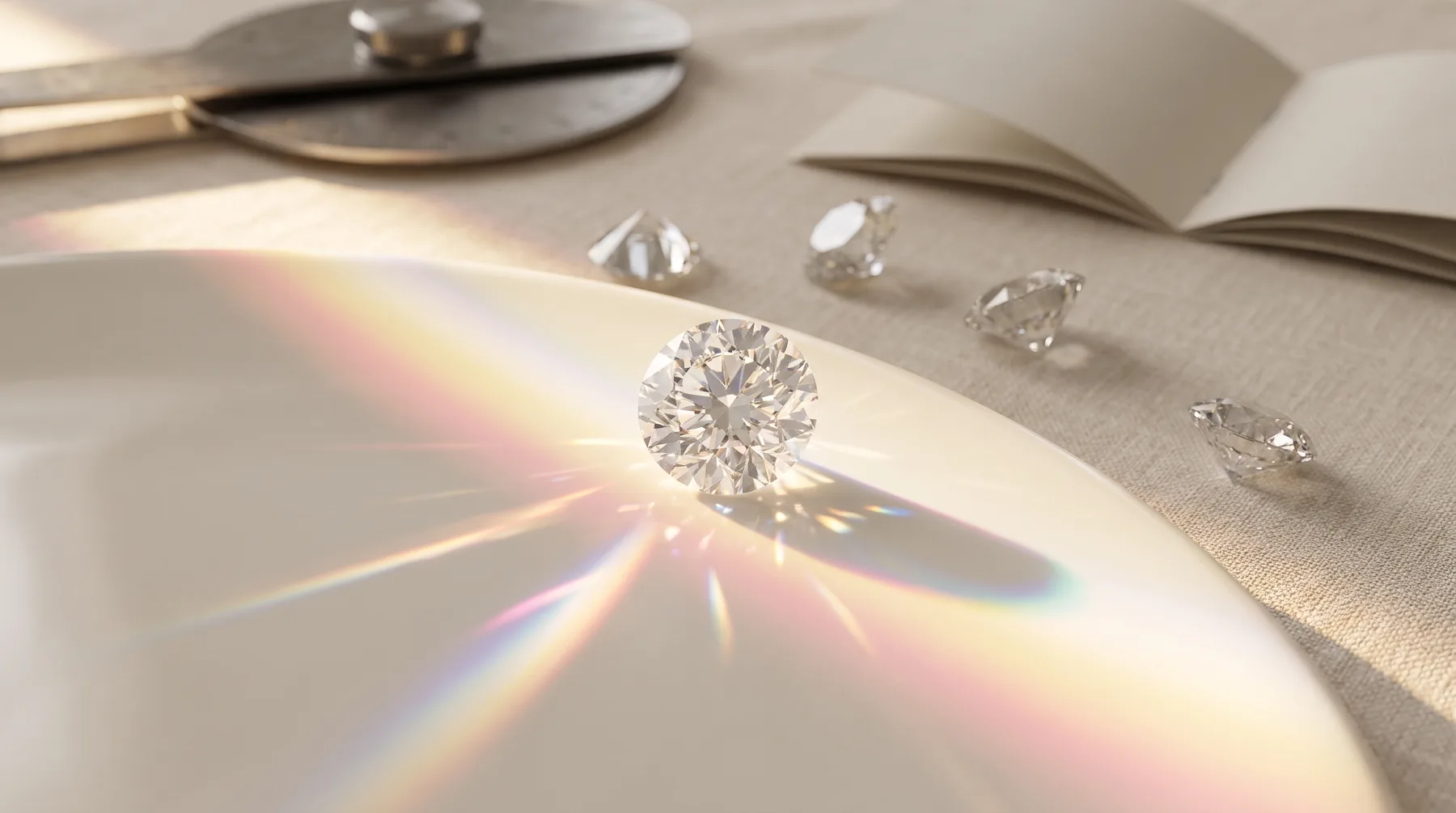
A diamond cut grade is the Gemological Institute of America's (GIA) one-word verdict on how well a round brilliant diamond handles light: Excellent, Very Good, Good, Fair or Poor. It is computed from the stone's proportions, polish and symmetry, and it is the only one of the 4Cs a human being decides at the cutting wheel. It outranks the others because it controls how much light comes back out of the stone, and a smaller, well-cut diamond will look brighter, livelier and often larger than a heavier stone that was cut to save weight. One catch to keep in mind from the start: GIA assigns that grade to standard round brilliants only, so ovals, pears and cushions have to be judged another way.
This piece finishes our 4Cs set. Clarity got its own article in September (what is actually worth paying for), the grading document itself is walked line by line in how to read a GIA report, and if the natural-versus-grown question is still open for you, start with lab-grown vs natural diamonds. Cut is the one we would protect first, and here is why.
What does the diamond cut grade measure?
3 min
The GIA cut grade measures how a round brilliant's proportions, polish and symmetry combine to return light to your eye, scored on a five-step scale from Excellent to Poor. It is not a grade for shape and it is not a grade for sparkle alone. According to GIA, the system folds seven components into one word: three about appearance (brightness, fire and scintillation) and four about design and craftsmanship (weight ratio, durability, polish and symmetry).
Those seven come out of a long piece of research. GIA published the foundation of the system in Gems & Gemology in fall 2004, and the paper describes more than 70,000 observations of almost 2,300 diamonds by over 300 people, on top of computer modeling of how light moves through a round brilliant. GIA's own summary puts the whole project at 15 years of work. The useful finding, in GIA's words, was that "most experienced individuals can consistently discern five levels of overall cut appearance and quality." That is where Excellent through Poor comes from: not a formula handed down, but the number of steps trained eyes could actually tell apart.
In practice the grade is driven by a short list of measurements that every GIA report prints in the proportions diagram:
| Measurement | What it is | GIA's published range for a well-cut round |
|---|---|---|
| Table | The flat top facet, as a percentage of the stone's diameter | 52% to 62% for Excellent |
| Crown angle | The slope of the upper facets above the girdle | 31.5° to 36.5°; the 2004 research paper puts the top-grade stones at roughly 32° to 36° |
| Pavilion angle | The slope of the lower facets below the girdle | 40.6° to 41.8° for Excellent |
| Star facet length | How far the small facets around the table reach toward the girdle | 40% to 70% |
| Lower girdle facet length | How far the pavilion's half facets reach toward the culet | 65% to 90% |
| Girdle thickness | The rim where crown meets pavilion | Medium to slightly thick |
| Culet | The point (or tiny facet) at the very bottom | None to small; larger culets lower the grade |
The ranges above are GIA's, from its diamond anatomy guide and the 2004 research paper. Two numbers matter more than the rest, and they are the two I look at before I read the word on the report: crown angle and pavilion angle. They have to work as a pair. A steep crown on top of a steep pavilion makes a dark, heavy stone even when each number sits inside its range on its own, which is exactly why GIA grades the combination and not the figures one at a time. The paper's own phrasing is that "attractive diamonds can be manufactured in a wider range of proportions than would be suggested by historical practice or traditional trade perception," and that is true, but it is also why two stones with the same grade can look different. More on that below.
Polish and symmetry are the craftsmanship half. Polish is the surface finish, the absence of wheel marks and scratches; symmetry is whether the facets meet where they should and the outline is actually round. GIA grades both separately on every report, every shape, and the research paper is blunt about their effect on the overall grade: "lower qualities of either can bring the grade of the diamond down." The reverse is not true. A stone with Excellent polish and Excellent symmetry but a 44° pavilion is still a dull stone with a beautiful finish.
Brightness, fire and scintillation in plain words
2 min
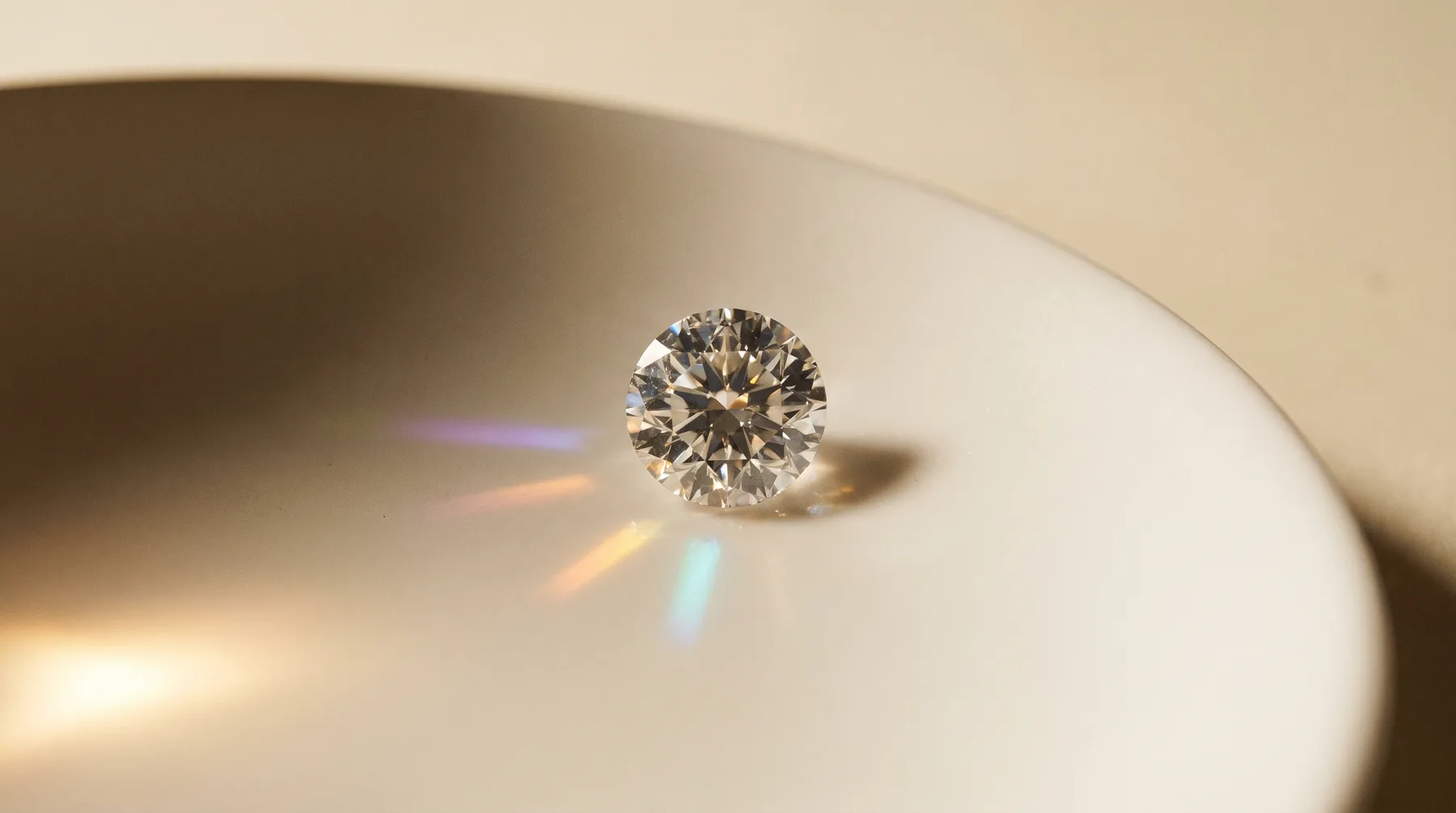
Brightness is white light coming back out of the stone, fire is that light split into rainbow flashes, and scintillation is the on-off pattern of light and dark you see when the stone or your hand moves. GIA's definitions are almost that short: brightness is "the total light reflected from a diamond," fire is "the dispersion of light into the colors of the spectrum," and scintillation is "the pattern of light and dark areas and the flashes of light, or sparkle, when a diamond is moved."
Here is how to think about each one at a counter.
Brightness is the one you notice from across the room. A bright stone reads white and lit from inside; a leaky one reads grey, or worse, you can see the setting through it. Hold the stone face-up under ordinary room light, not the jeweler's spotlights, and ask whether the center looks as alive as the edges. Light leaks out of the middle first.
Fire needs a point of light to show itself. Candle, a single bulb, low sun through a window. Under the diffused light of an office, almost no diamond shows much fire, which is why a stone that looked like a fireworks display in the store can seem calmer at your desk. Fire lives mostly in the crown, so a very shallow crown gives it up.
Scintillation has two halves, and GIA grades them differently. The sparkle half, the flashes, is modeled alongside brightness and fire. The pattern half, the arrangement of light and dark areas, is assessed "using a combination of determinations based on proportion ranges," per the 2004 paper. Pattern is also the one people have the strongest opinions about without knowing it. Some buyers love the crisp, high-contrast arrows of a tightly cut stone; others find it too busy and prefer a softer, more even twinkle. Neither is wrong. Both can be Excellent.
Dark areas, by the way, are not a defect. A diamond with no dark facets at all is a diamond with no contrast, and it looks flat, like a wet window. The dark bits are what make the bright bits read as bright. What a grader wants in an Excellent stone is an even spread of light and dark across the face, not an absence of dark.
Why cut matters more than carat, color or clarity
2 min
Cut is the only C that changes how a diamond behaves, and it is the only one made by a person. Carat, color and clarity describe the rough the stone came from; cut describes what a cutter did with it. A badly cut stone leaks light out of its sides and bottom no matter how white or clean it is, and no mounting, metal or lighting fixes that. A well-cut stone returns light so efficiently that it covers for a lower color and hides small inclusions in its own flashes.
The clearest way to see this is to put a Very Good or Excellent stone next to a Fair or Poor one of the same weight. The well-cut stone looks bigger, because light is coming off the whole face of it, and the poorly cut stone has a dead ring around the center or a dark center with a bright rim. The second stone may actually be wider across. It still looks smaller, because the eye measures sparkle, not millimeters.
That is the argument for buying a slightly smaller, better-cut stone over a heavier, worse one, and it is not a controversial position in the trade. The price side of the same argument lives in our piece on why the same-looking ring costs $800 or $8,000: as of August 2026 an Excellent cut typically ran about 10% to 15% over a Very Good of the same weight, color and clarity, which is a smaller gap than the jump to the next carat bracket and buys you something you can actually see.
One honest counterweight. Cut improves color and clarity in the sense that a lively stone distracts the eye, but it does not make a K stone a G or an I1 eye-clean. The right order of operations, which the clarity article spells out, is still: fix the cut first, then lower clarity until the stone stops being eye-clean, then lower color until it stops looking white in your chosen metal. Cut sets the ceiling; the other two decide how close to it you spend.
Can you see the difference between Excellent and Very Good cut?
2 min
In a round under about a carat, in everyday light, most people cannot reliably tell a Very Good from an Excellent, and the ones who can are usually comparing two loose stones side by side on a white tray. Over a carat and a half, under direct light, the difference starts to show, mostly as a slightly less even pattern or a bit of darkness under the table in the Very Good stone. That fits how the scale was built: GIA's research found five steps that trained eyes could separate, and Very Good is the step directly below the top, not a different kind of stone.
The complication is that Excellent is not a point. GIA says plainly that "each cut grade ... represents a range of proportion sets and face-up appearances." Two Excellent stones can sit at opposite ends of that range, one with a 34.5° crown over a 40.8° pavilion that snaps like a mirror, the other with a 36° crown over a 41.6° pavilion that is a shade darker and a touch heavier. Both say Excellent on the report. A well-cut Very Good stone can look better than the second one.
This is why the trade does not stop at the word. Dealers who care about light performance put a stone under an ASET or Idealscope, two inexpensive viewers that color-code where the stone's light is coming from (and where it is leaking), and run the proportions through calculators that predict performance from the angles. The American Gem Society (AGS) built the ASET and a light-performance grading system around it, and when AGS Laboratories closed at the end of 2022 and folded into GIA, that technology came along. Since January 2023 GIA has offered an "AGS Ideal" light-performance supplement to its reports, for round and fancy shapes, as a digital add-on, reported by both JCK and Rapaport at $25 per report when it launched. If a seller shows you an ASET image, a mostly red face with blue arrows and very little white or black near the center is what you want to see.
What to actually do with this: for a round under a carat on a budget, a Very Good with good numbers (table in the mid-50s, crown 33° to 35°, pavilion 40.6° to 41.2°) is a sensible buy. Over a carat, or for a solitaire where the stone is the whole design, pay for Excellent and look at the two angles before you look at the price.
The spread trap: why a shallow diamond faces big and looks dead
2 min
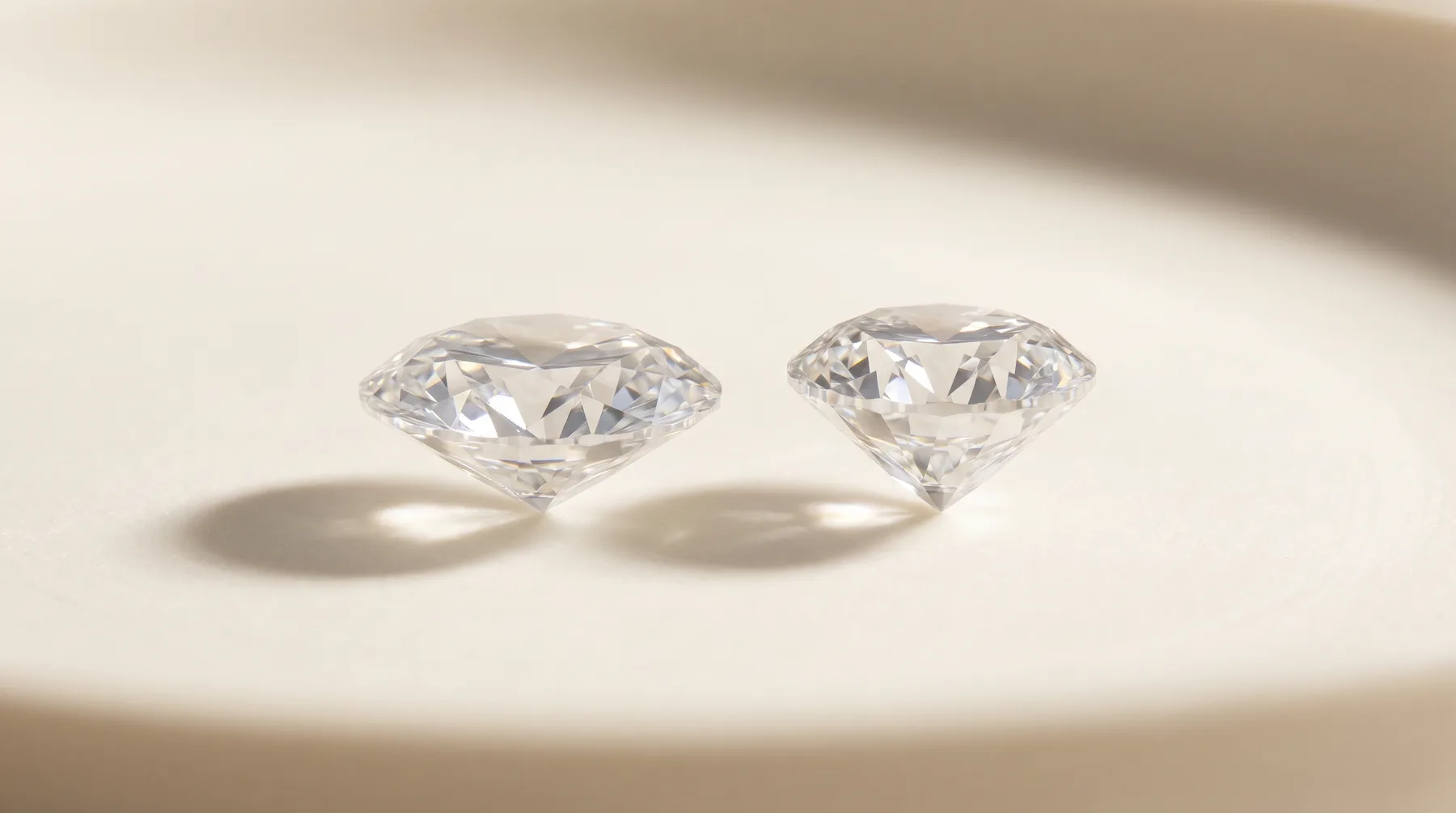
A shallow diamond spreads its weight across a wider face, so it measures bigger for its carat weight, and then it leaks light out of the bottom and goes glassy in the middle. That is the spread trap. "Spread" is trade shorthand for face-up size relative to weight, and a "spready" stone is one that measures more millimeters than its weight would predict. It sounds like a free lunch. It is usually the opposite.
The mechanism is the pavilion. GIA's anatomy guide says it in one sentence: "A pavilion depth that's too shallow or too deep will allow light to escape from the side or bottom of the stone." Below roughly 40.6° the pavilion facets stop acting as mirrors and start acting as windows. In a badly shallow round you can see the reflection of the girdle as a grey ring inside the table, which cutters call a fish-eye, and the stone reads as a flat disc of glass with a bright rim. Big, and dead.
The opposite trap is just as common and harder to spot from a listing. A deep stone, say a 43° pavilion under a steep crown, hides weight in its depth and in a thick girdle. GIA's research counts that against the stone directly: the weight-ratio component exists because "a diamond should not weigh more than its appearance warrants," and the paper calls out stones "that contain 'hidden' weight in their girdles." A deep stone faces small for its weight and goes dark under the table. You paid for carats you cannot see.
Why would anyone cut a stone that way? Because the cutter is paid by the carat and the price list steps up at the weight marks. A piece of rough that can yield a 1.02 carat stone with a thick girdle or a 0.92 carat stone with ideal proportions will, at most factories, become the 1.02, and the heavy girdle stays. The grading report records all of it honestly, which is the whole reason to read the proportions diagram instead of the headline weight.
The practical defense is simple. Compare stones by millimeters and cut grade, not by carats. A well-proportioned 1 carat round measures somewhere around 6.4 to 6.5 mm across; if a "1 carat" is quoted at 6.1 mm, the missing width is sitting in the depth, and if it is quoted at 6.8 mm, ask what the pavilion angle is before you get excited. Reports print the measurements on the first line for exactly this purpose.
Fancy shapes have no GIA cut grade, so how do you judge them?
3 min
GIA gives an overall cut grade only to standard round brilliants in the D-to-Z color range, so an oval, pear, cushion, emerald, princess, radiant or marquise arrives with polish and symmetry grades but no cut grade at all. GIA's buying guide for fancy shapes states it directly: "GIA does not grade the overall proportions of fancy cut diamonds," though every report carries the finish grades. The reason, in GIA's words, is that round brilliants "are the only cut that have standardized facets"; there is no single agreed geometry for a good oval the way there is for a round, so no one proportion set fits.
That is changing, slowly. GIA announced in June 2026 that it will introduce cut grades for marquise, oval and pear shapes in 2027, with details on eligibility and services promised in early 2027; Rapaport and Jeweller both covered the announcement, and Rapaport's report notes only stones within certain fluorescence, color, clarity and polish ranges will qualify. Cushions, emeralds and princesses are not in the first wave. Until then, and for those shapes after, you judge a fancy shape yourself, in this order.
Start with the length-to-width ratio
Length-to-width ratio is the stone's length divided by its width, and it decides whether an oval looks like an oval or like a slightly squashed round. GIA publishes the ranges it considers conventional: for ovals 1.33 to 1.66, for pears 1.50 to 1.75, for marquises 1.75 to 2.25, and about 1.00 for hearts. Its oval guide narrows the popular band to 1.40 to 1.50 and notes that very long ovals above 1.50 are rarely cut because the rough does not allow it. The ratio is on the report as two measurements; divide them yourself.
Then look for the bow-tie
A bow-tie is a dark band across the middle of an oval, pear or marquise, shaped like two triangles meeting at the center, and the goal is a faint one, not none. GIA explains the cause as obstruction: the facets act as mirrors, and the bow-tie appears when some of that light "is blocked, specifically by your own head and shoulders" as you look down at the stone. Because of the geometry, GIA says, "some degree of bow tie is always present" in an oval; a well-cut one minimizes it. Judge it face-up at arm's length, in ordinary light, and tilt the stone a few degrees each way. A bow-tie that stays black at every angle is the one to walk away from.
Check for windows and dead zones
A window is a see-through area, usually near the center, where a shallow pavilion lets light pass straight through instead of bouncing it back; the trade also calls it "glassy." Rest the stone on a printed page: if you can read the type through the middle of an elongated shape, it is windowed. Step cuts (emerald and Asscher) show this most honestly because they have so few facets to hide behind, and brilliant-faceted cushions and radiants hide it best, which is not the same as not having it.
Weigh the finish grades more heavily than you would on a round
With no cut grade, polish and symmetry are the only craftsmanship numbers you get, and symmetry matters more on a fancy shape than on a round. GIA's guidance: "Symmetry is an important factor for all fancy cut diamonds. Even the smallest difference can create an appearance that is not balanced." On a pear that means a lopsided shoulder; on a marquise, two points that do not line up; on a cushion, corners of different radius. These are visible without a loupe once you know to look.
Two last notes for the pointed shapes. GIA recommends V-shaped prongs on the points of pears and marquises because the tips chip, so budget the mounting accordingly (our settings guide covers prong styles). And if a seller lists a fancy shape with a "cut grade," ask who assigned it, because GIA did not; it is usually the seller's own estimate, and sometimes it is just the symmetry grade relabeled.
Do cut grades apply to the diamonds in everyday jewelry?
2 min
Mostly no. A cut grade is a report grade, and reports are issued for individual stones large enough to be worth grading on their own, which in practice means center stones. The small diamonds set into most jewelry, the accent rows on a band, the halo around a center, the sparkle in a pendant, are melee, which GIA defines as small diamonds under one-fifth of a carat, cut either as full cuts (the standard 57 or 58 facet round brilliant in miniature) or as single cuts, a 17 or 18 facet style with a table, eight crown facets and eight pavilion facets that gives a softer, more mirror-like shine. Melee is sorted by size and color in parcels and is not individually cut-graded by anyone.
Our own catalog shows what that looks like at the scale of a store. As of October 2026 we carry 210 active diamond-set pieces. Of the 194 that declare a stone shape, 191 are round. Not one carries a GIA cut grade, and the vendor feed's "stone cut" field, filled on only 21 of the 210, says "faceted," "single cut" or "checkerboard": a faceting style, not a grade. That is normal for finished jewelry, and it tells you where the cut grade belongs in your decision. It is a tool for choosing a center stone with its own report, from a certified listing or a loose-stone tray. For a diamond band or a pendant with accent stones, the questions are different: are the stones full cut or single cut, are they matched for color, and are they set well enough to stay put. Those questions get their own article.
How to use the cut grade when you buy
2 min
A short decision rule, and then you can close this tab.
- Round brilliant, with a GIA report: buy Excellent cut, Excellent or Very Good polish and symmetry, and read the two angles. Crown 32° to 35° over pavilion 40.6° to 41.2° is the heart of the range. Then lower clarity and color per the clarity article until the savings feel real.
- Round brilliant on a tight budget: a Very Good with numbers inside those bands beats an Excellent at the edges of its range, and you will not see the difference under a carat. Spend the gap on the setting.
- Fancy shape: ignore any "cut grade" a seller invents. Check the ratio against GIA's ranges, look for the bow-tie and windows in ordinary light, insist on Excellent or Very Good symmetry, and ask for an ASET image or a video in daylight. If the seller cannot show the stone moving, that is an answer.
- Any shape, any report: compare millimeters, not carats. Face-up size is what you see; weight is what you pay for.
- Lab-grown stones follow the same rules. The crystal is diamond, the optics are diamond, and a shallow lab-grown oval windows exactly like a mined one. The origin question changes the price, not the physics. The same goes for the simulants compared in our moissanite article, except that moissanite's higher dispersion changes what "fire" means for that stone.
If you only remember one thing: the grade on the report is the floor, not the ceiling. Read the numbers behind it, look at the stone in the light you actually live in, and let a smaller, brighter diamond win over a heavier, duller one every time.
Frequently Asked Questions
2 min
Is an Excellent cut diamond worth the extra money?
For a round brilliant over about a carat, or for any solitaire where the stone is the whole design, yes: the premium over Very Good was roughly 10% to 15% as of August 2026 and it buys visible brightness and a more even pattern. Under a carat, in everyday light, a Very Good with good crown and pavilion angles is hard to tell apart from an Excellent, and the money can go to the mounting instead.
What does "triple Excellent" or "3EX" mean?
It means a GIA report showing Excellent for cut, polish and symmetry on a round brilliant. It is a good sign but not a guarantee of a top performer, because GIA's Excellent cut grade covers a range of proportion sets. Two 3EX stones can look noticeably different, so read the crown and pavilion angles as well.
Is "Ideal cut" the same as GIA Excellent?
No. "Ideal" is the top grade of the American Gem Society's light-performance system, which is a different scale with different criteria; GIA's top grade is Excellent and GIA never prints "Ideal." Since AGS Laboratories merged into GIA at the end of 2022, GIA offers an "AGS Ideal" light-performance supplement to its reports. When a retailer uses "ideal" without a report behind it, it is marketing, not a grade.
Why does my oval or cushion diamond's report have no cut grade?
Because GIA assigns an overall cut grade only to standard round brilliants. Every other shape receives polish and symmetry grades but no cut grade, since there is no single agreed geometry for a good oval or cushion. GIA announced in June 2026 that marquise, oval and pear will receive cut grades starting in 2027; until then you judge the stone by its length-to-width ratio, bow-tie, windowing and symmetry.
Can a poorly cut diamond be recut?
Often, yes. A cutter can take a deep or shallow stone back to the wheel and re-proportion it, at the cost of weight, so a 1.05 carat deep stone might come back as a bright 0.90. It is worth doing on a large or sentimental stone and rarely on a small one, and it voids the existing report, so the stone goes back to the lab for a new one afterwards.
Does the cut grade apply to lab-grown diamonds?
The physics does, completely: a lab-grown round with a 44 degree pavilion leaks light exactly like a natural one. On paper, GIA reports lab-grown stones differently from natural ones and the details are in our GIA-report article, but the proportions diagram and the polish and symmetry grades are read the same way, and the buying rules in this article apply without change.