
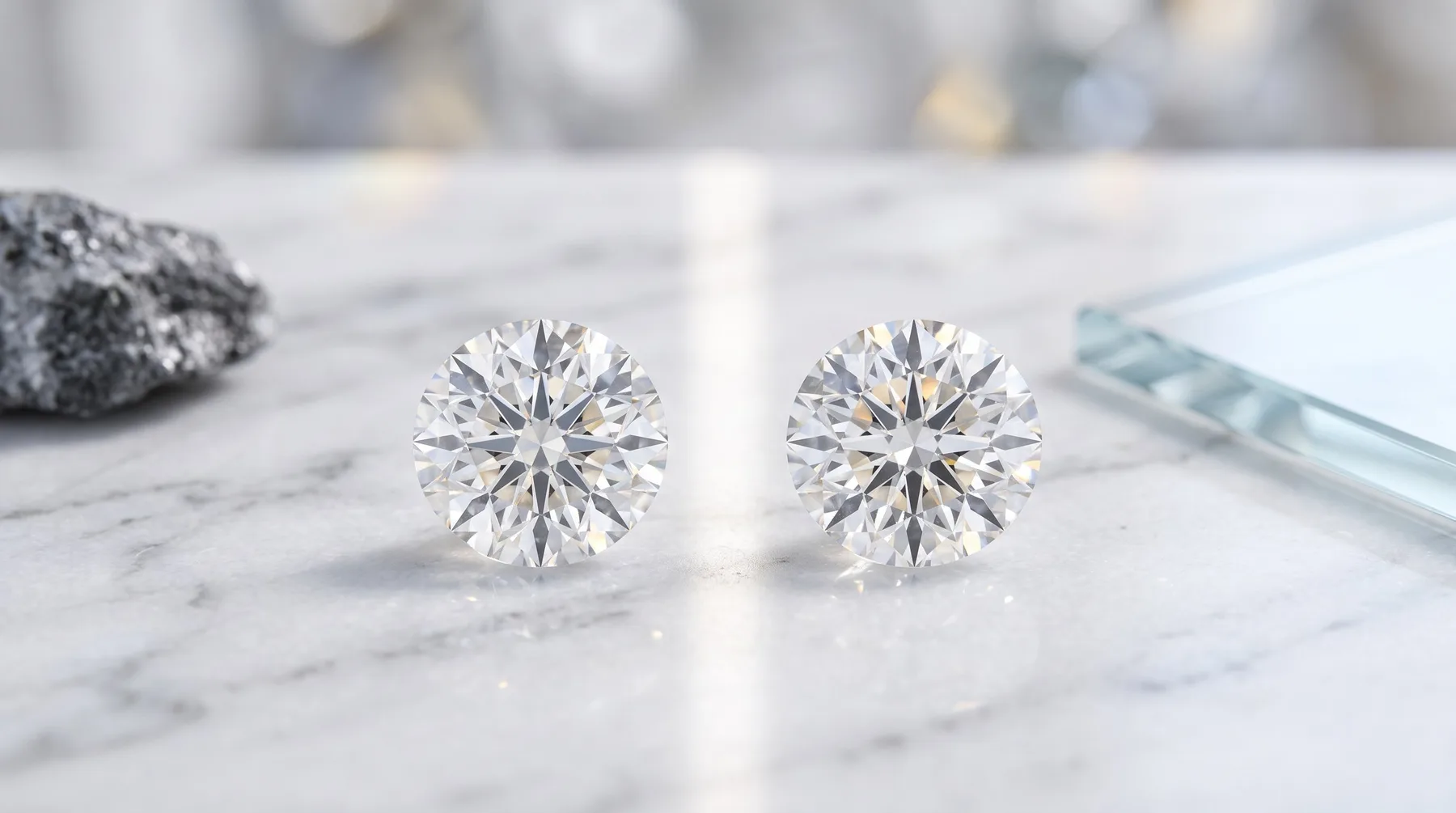
Chemically, they are the same stone. Commercially, they could hardly be further apart. A working jeweler's guide to what the split really means for your money, your ring, and your peace of mind.
A lab-grown diamond is a real diamond. Not an imitation, not a lookalike, not cubic zirconia with better marketing — the same crystallized carbon, the same perfect 10 on the Mohs hardness scale, graded on the same Four C's by the same laboratories. The differences that remain are three: where the stone came from, what it costs, and what happens to its value after you buy it. Those three differences are real, they pull in different directions, and which one should decide your purchase depends entirely on what you want the diamond to do.
This guide lays the two options side by side the way we would across a counter — no cheerleading for either. The lab-grown share of the market has grown too fast, and the price gap too wide, for a buyer in 2026 to make this decision on last decade's information.
Are Lab-Grown Diamonds Real Diamonds?
1 min
Yes, and this is no longer a matter of opinion. In its 2018 revision of the Jewelry Guides, the Federal Trade Commission removed the word "natural" from its definition of a diamond — a quiet edit with a loud implication: a diamond is a diamond by virtue of what it is made of, not where it formed. The same rules cut the other way, too. Per the FTC Jewelry Guides, a seller may not call a lab-grown stone simply a "diamond" without qualification. The lab origin must be disclosed clearly and conspicuously — "laboratory-grown," "laboratory-created," or "[manufacturer]-created" — every time, with equal prominence to the word diamond itself.
The Gemological Institute of America treats them accordingly. GIA reports on laboratory-grown diamonds and laser-inscribes the girdle with a statement that the stone is laboratory-grown. What it no longer does is grade them on the Four C's: since 1 October 2025 GIA describes qualifying lab-grown stones as premium or standard rather than issuing a color and clarity grade, while other laboratories, IGI among them, still grade them on the familiar scales. Our guide to reading a laboratory report walks through both documents.
So "real" is settled. What is not identical is everything downstream of origin — and that is where the actual decision lives.
How Lab-Grown Diamonds Are Made
1 min
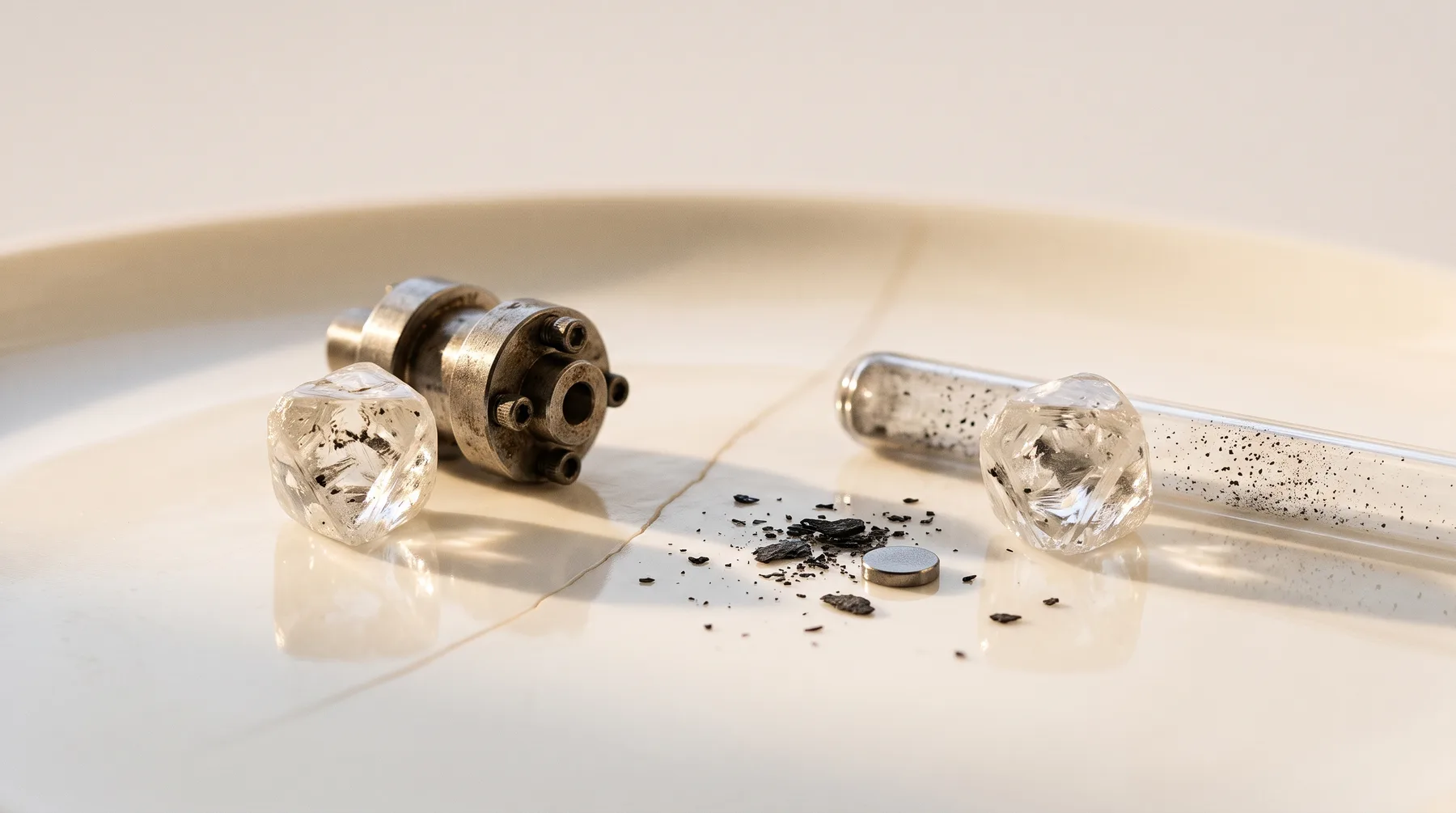
Two processes dominate, and knowing their names helps you read a grading report. HPHT (high pressure, high temperature) recreates the conditions of the earth's mantle: a carbon source dissolved in molten metal under enormous pressure, crystallizing onto a seed over days to weeks. CVD (chemical vapor deposition) works the opposite way — a carbon-rich gas is energized into plasma in a vacuum chamber, and carbon atoms rain onto a seed plate, building the crystal layer by layer.
Each method leaves its own fingerprints. According to GIA's research on the two growth processes, HPHT stones can carry tiny dark flux-metal inclusions from the growth chamber, while CVD stones often grow with a brownish cast and are routinely HPHT-treated after growth to improve their color. Neither fingerprint is visible to you, the wearer — which brings us to the question every buyer eventually asks.
Can Anyone Tell the Difference?
1 min
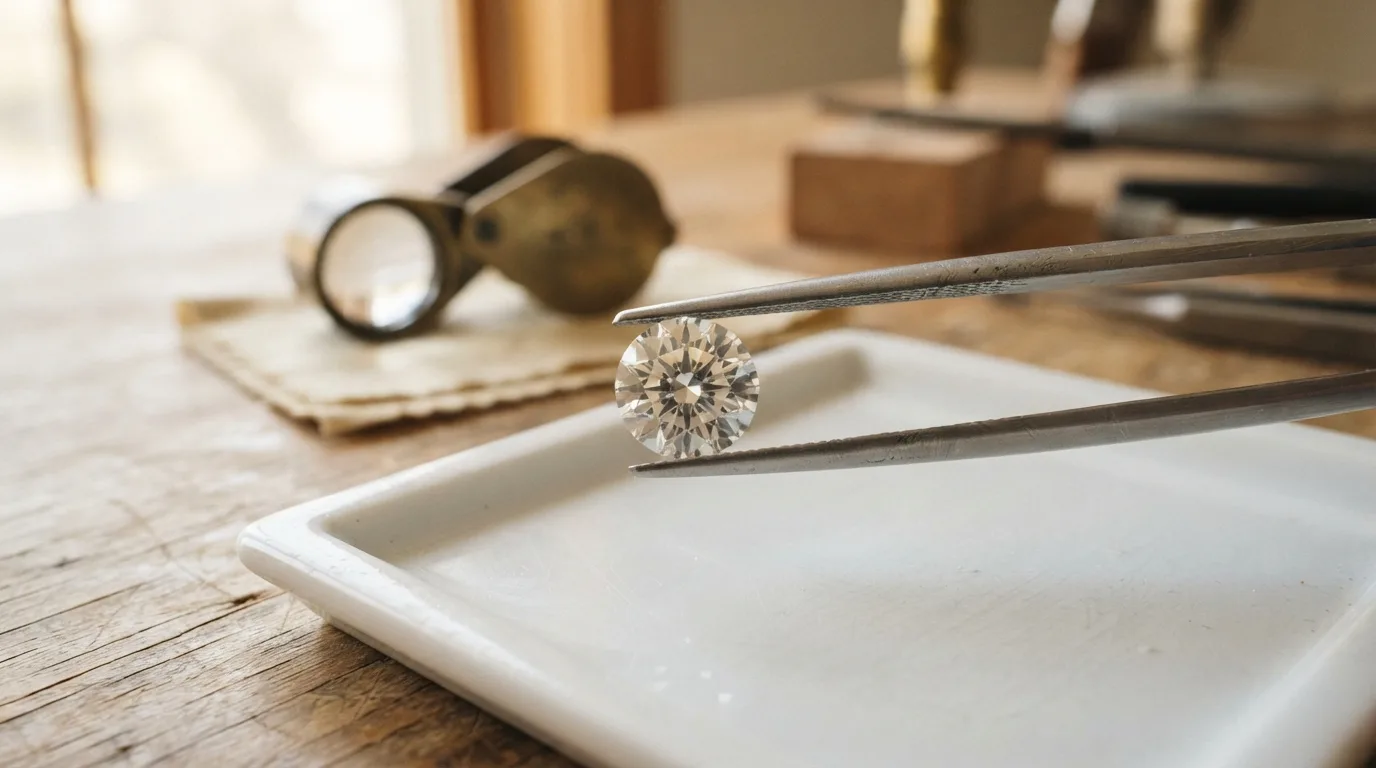
Not by eye. Not with a jeweler's loupe. Not with the handheld tester at the mall kiosk — a thermal diamond tester reads a lab-grown stone as diamond because it is diamond. This surprises people, and it shouldn't: if the material is identical, every test of the material comes back identical.
Telling the two apart is genuinely a laboratory exercise. Gemological labs use spectroscopy and deep-UV fluorescence imaging to read a stone's internal growth structure: HPHT diamonds tend to reveal a cross-shaped growth pattern and sometimes a lingering phosphorescent glow after UV exposure, while CVD diamonds show their layer-by-layer construction — GIA's scientists describe it as looking like a stack of pancakes. Instruments see it plainly. Eyes never will.
A handheld diamond tester reads a lab-grown stone as diamond because it is one. Origin is a laboratory finding — which is exactly why the grading report, not the sparkle, is where the truth lives.
The practical takeaway: buy the paper with the stone. A GIA or IGI report states the origin in writing, and on GIA-graded lab-grown stones the girdle inscription repeats it in laser-etched permanence. If a stone above roughly half a carat is offered without an independent report, the missing report is your answer about the seller.
What Lab-Grown Diamonds Cost in 2026
1 min
Here is where the two markets have truly split. As of mid-2026, a lab-grown diamond typically retails 70–90% below a natural stone of comparable size and grade. Market surveys this year put a quality 1 carat lab-grown stone at roughly $1,000 against roughly $4,200 for its natural counterpart, and the gap widens as carat weight climbs — at 2 carats, thousands versus tens of thousands. Wholesale prices for lab-grown goods have fallen further still, which is why the retail gap keeps stretching year over year.
The cause is not quality. It is supply. Natural diamonds are a finite geological inventory; lab-grown diamonds are a manufactured product whose production keeps getting cheaper and better. The market has answered accordingly: by 2025, industry surveys reported that more than half of new engagement rings in the United States featured a lab-grown center stone — the first time lab-grown crossed the halfway mark.
For a buyer, the consequence is simple and significant: the same budget buys a dramatically larger or better-graded lab-grown stone. A shopper with $4,000 for the stone alone is choosing between a good 1 carat natural diamond and a 2-plus carat lab-grown stone at equal or better color and clarity. That is not a marginal difference; it is a different piece of jewelry.
The Resale Question, Answered Honestly
1 min
This is the part of the conversation some sellers rush past, so let's not. Lab-grown diamonds have minimal resale value. A jeweler can buy a brand-new lab-grown stone from a supplier for less every year, so there is little reason for anyone to pay meaningfully for yours secondhand. Trade-in programs exist, but the numbers are small and shrinking with wholesale prices.
Natural diamonds keep a real secondary market — estate buyers, auction houses, trade-in programs that mean something — but honesty cuts both ways: a natural diamond bought at retail also resells well below its purchase price. The retail markup, not the stone, absorbs the first and largest loss.
The clean way to think about it: neither diamond is an investment. A natural stone is a store of some value; a lab-grown stone is a purchase, fully enjoyed on the day you buy it. If eventual resale or heirloom value is part of why you're buying, that weighs for natural. If the money saved would otherwise stay in your pocket — or go into the mounting, the band, or the honeymoon — that weighs for lab-grown, and it weighs heavily.
Side by Side
1 min
| Natural diamond | Lab-grown diamond | |
|---|---|---|
| Material | Crystallized carbon, Mohs 10 | Identical — crystallized carbon, Mohs 10 |
| Origin | Formed in the earth's mantle over geological time | Grown by HPHT or CVD in weeks |
| Grading | Full Four C's; GIA / IGI report | Full Four C's; GIA Laboratory-Grown Diamond Report or IGI report |
| Telling apart | Laboratory instruments only — never by eye, loupe, or handheld tester | |
| Price (mid-2026) | Baseline | Roughly 70–90% less at retail for comparable stones |
| Resale | Real but well below retail | Minimal |
| Supply | Finite, mined | Manufactured, expanding |
| Disclosure | "Diamond" | Must be labeled "laboratory-grown" or equivalent (FTC) |
How to Choose
1 min
After enough of these conversations, the decision usually comes down to one question: what is this diamond for?
- Choose lab-grown if the goal is the most stone for the money — maximum size, color, and clarity per dollar — and you are at peace with the piece having sentimental rather than resale value. This is why lab-grown now dominates engagement ring purchases.
- Choose natural if geological rarity, heirloom weight, or an eventual secondary market matters to you. Some buyers simply want the billion-year-old stone, and that preference needs no defense.
- Either way, the non-negotiables don't change: an independent grading report from GIA or IGI, a well-cut stone (cut is still the C that does the most work — our diamond cut guide covers why), clearly disclosed origin, and a mounting built to hold the stone for decades.
That last point is where we'll admit our bias, because it is the part of the trade we come from. Whichever stone you choose, it will spend its life in a setting — and a certified loose stone deserves better than an afterthought. A properly made solitaire mounting is built to take the stone you chose and keep it safe through years of daily wear. Buy the stone with your head; have it set by someone who builds mountings for a living.
Frequently Asked Questions
2 min
Are lab-grown diamonds real diamonds?
Yes. Lab-grown and natural diamonds are chemically, physically, and optically identical — both crystallized carbon scoring 10 on the Mohs scale. The FTC removed "natural" from its diamond definition in 2018, and most laboratories still grade lab-grown stones on the same Four C's, though GIA replaced its own lab-grown grades with a two-tier descriptive assessment on 1 October 2025. Sellers must, however, always disclose lab origin.
Can a jeweler tell a lab-grown diamond from a natural one?
Not by eye or loupe. Distinguishing them requires laboratory instruments — spectroscopy and deep-UV fluorescence imaging that reveal the stone's growth structure. This is why an independent grading report, which states origin in writing, matters more than any in-store test.
Will a lab-grown diamond pass a diamond tester?
Yes. Handheld thermal testers identify diamond by its material properties, and a lab-grown stone is diamond, so it tests as one. A tester can tell diamond from cubic zirconia or moissanite; it cannot tell lab-grown from natural.
Do lab-grown diamonds get cloudy or fade over time?
No. A lab-grown diamond is the same material as a natural diamond and ages the same way — which is to say, it doesn't. Like any diamond it will pick up skin oils and need regular cleaning to keep its brilliance, but the stone itself does not cloud, yellow, or fade.
How much cheaper are lab-grown diamonds?
As of mid-2026, roughly 70–90% less than comparable natural stones at retail — market surveys put a quality 1 carat lab-grown at around $1,000 versus roughly $4,200 natural. The gap widens with carat weight and has grown every year as production scales.
Which is better for an engagement ring?
Neither is "better" — they answer different priorities. Lab-grown maximizes size and quality per dollar, which is why over half of new engagement rings now feature one. Natural carries geological rarity and real, if modest, resale value. Both need an independent grading report and a well-made mounting.
The lab-grown question gets framed as a fight, and it isn't one. It is a fork: the same stone, reached by two roads, priced by two different kinds of scarcity. Buyers who understand that fork stop asking which diamond is real — they're both real — and start asking which kind of value they actually want to hold. Answer that honestly, insist on the report either way, and set the stone in something built to outlast the question.