
A gem older than every empire that ever loved it, traded out of Indian rivers two thousand years before it was ever set in an engagement ring — and still the most enduring piece of April birthstone jewelry you can give.
Diamond is the gemstone everyone thinks they understand and almost no one actually does. The standard story — sparkle, engagement ring, "a diamond is forever" — is a marketing campaign less than a hundred years old, layered on top of a stone that humans had already been pulling out of Indian riverbeds for at least twenty-three centuries before that. The real history is older, stranger, and more interesting. So is the question of how to buy one well.
April birthstone jewelry rests on that long lineage. A diamond pendant, a pair of studs, a tennis bracelet, an eternity band — these are gifts that exist completely independent of the wedding industry, and they are arguably the truer expression of what diamond has meant to people for most of recorded time. The engagement ring is one chapter. April birthstones are another.
This guide handles diamond as a birthstone, a gift, and a wearable object — not as a betrothal symbol. The engagement-ring conversation belongs somewhere else.
A Gem Older Than the Wedding Ring
2 min
The name comes from the Greek adamas, meaning "invincible" or "unbreakable" — a reference to the fact that diamond is the hardest natural material on Earth, scoring a perfect 10 on the Mohs scale. According to the Gemological Institute of America, diamonds were first traded out of India's rivers as early as the fourth century BCE, where they were gathered, polished only lightly, and worn as protective talismans long before the technology existed to facet them properly. By the medieval period, Venetian merchants were carrying Indian diamond stock north into European markets, and by the 1400s, diamonds were a fixture of royal European wardrobes.
The first recorded diamond engagement ring did not appear until 1477, when Archduke Maximilian of Austria gave one to Mary of Burgundy, per the American Gem Society. That is roughly two thousand years after diamonds were already being treasured. The point is not that engagement rings are wrong — it is that the betrothal symbolism is a recent overlay on a much older relationship between humans and this particular stone. April-baby gifts, milestone gifts, anniversary pieces, and inheritance jewelry sit closer to the original tradition than the diamond solitaire ever has.
Diamond was officially adopted as the modern American birthstone for April in 1912, when the National Association of Jewelers (now the Jewelers of America) standardized the modern birthstone calendar. The 60th wedding anniversary is also traditionally a "diamond anniversary" — a marker for the kind of partnership most people will never see, and a reasonable reason to give a diamond piece that has nothing to do with engagement rings at all.
Humans were treasuring diamonds for two thousand years before the first one ever sat on an engagement finger. The wedding-ring chapter is a recent footnote on a very long story.
The Meaning Beneath the Sparkle
1 min
Diamond's symbolic register has been remarkably stable across cultures: invincibility, clarity, courage, and the kind of strength that does not need to perform itself. An anonymous second-century poet wrote that diamond warded off the evil eye. Medieval Europeans believed it was an antidote to poison and a shield against plague. Hindu tradition associated diamond with Vajra, the thunderbolt of the gods, a symbol of indestructible spiritual force.
Modern symbolism keeps the same shape, with softer edges. Diamond is the gemstone of clarity of thought, balance, abundance, and inner strength — the kind of attributes a parent might wish for an April baby, or an adult might quietly wish for themselves at a moment of transition. None of that requires a proposal.
For an April birthday, diamond suits the wearer who values permanence over trend. April is a renewal month, the moment spring is genuinely committed rather than threatened. Diamond — physically the hardest natural substance on Earth, symbolically tied to clarity and constancy — is well-cast for that register.
Beyond the Engagement Ring
1 min
The most useful thing a buyer of April birthstone jewelry can do is briefly set aside the engagement-ring industry and consider what diamond actually does well as ordinary, wearable jewelry. Three categories are worth knowing.
Diamond pendants and studs are the gifts diamond was made for. A solitaire diamond pendant in 14k white or yellow gold reads as luxurious without committing to any specific event or relationship. Diamond stud earrings — the universally flattering 0.25 to 1.00 carat range — are arguably the most-worn piece of fine jewelry in the world for the simple reason that they go with everything and signal taste rather than occasion.
Eternity and half-eternity bands are diamond rings that exist outside the engagement-ring conversation. A half-eternity band of small round diamonds set in 14k gold works as a milestone gift, a self-purchase, a stack-with-other-rings piece, or a quiet companion ring. None of those scenarios require a proposal.
Tennis bracelets are the underrated diamond purchase. A line of evenly-cut diamonds in white gold or platinum is a piece that wears every day, glows quietly under a sleeve, and holds its visual impact decade after decade. Tennis bracelets are the diamond that disappears into a wardrobe rather than announcing itself, and they are arguably the most enduringly worn piece of fine diamond jewelry on the market.
The Four C's: How Diamonds Are Actually Graded
2 min
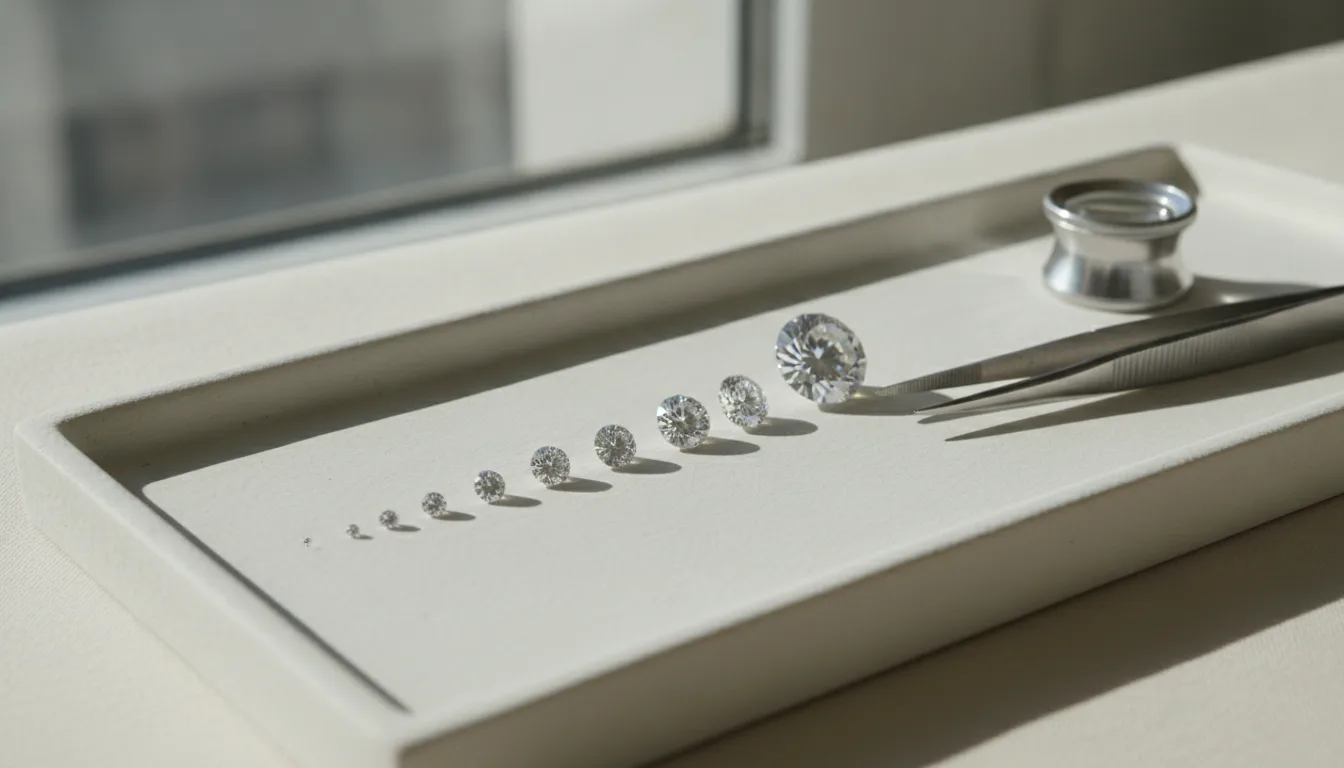
The Four C's were created by the GIA in the mid-twentieth century as a universal grading system, and they are still the only objective shorthand a buyer needs. The order in which they matter is not the order they are usually listed.
- Cut is the C that does the most actual work and the one most consumers underweight. Cut determines how a diamond's facets interact with light — its brilliance, fire, and scintillation. The GIA grades cut from Excellent to Poor. A well-cut diamond at a lower color or clarity grade visibly outperforms a poorly cut diamond at a higher one. If you optimize one C, optimize this one.
- Color is graded D (colorless) to Z (light yellow or brown). Most fine jewelry uses diamonds in the D–H range, where the stone reads as colorless to the unaided eye. Below H, a faint tint becomes visible, which is fine in some settings and undesirable in others. For everyday white-diamond pieces, G or H is the value sweet spot — visually indistinguishable from D, at a meaningful price difference.
- Clarity ranges from Flawless (FL) to Included (I). The GIA scale has eleven grades. Most diamonds in commercial jewelry sit between VS (Very Slightly Included) and SI (Slightly Included), where inclusions are not visible to the unaided eye. Clarity is the C where buyers most often overpay — there is no visible difference between VS1 and Internally Flawless to anyone not holding a 10x loupe.
- Carat is weight, not size. One carat equals 200 milligrams. Diamond price scales nonlinearly with carat — a 2-carat stone of the same quality is significantly more than twice the price of a 1-carat. Smart buyers shop just below the round numbers (0.95ct vs 1.00ct, 1.95ct vs 2.00ct) for visual equivalence at a meaningful discount.
One non-negotiable. Any diamond purchased above roughly 0.50 carats should come with an independent grading report — ideally GIA or IGI. The report verifies that the stone matches the seller's claims, and the absence of a report from a recognized lab is itself the answer to whether the seller is trustworthy.
Choosing April Birthstone Jewelry by the Piece
2 min
The right diamond piece is a match between how the wearer lives and where the gem behaves best. Diamond's hardness (10 on Mohs) makes nearly every setting viable for daily wear; the decisions are aesthetic.
Diamond pendants
A solitaire diamond pendant in the 0.25 to 1.00 carat range is the most universally flattering piece of April birthstone jewelry. A bezel setting protects the stone and reads modern; a four-prong basket setting shows more of the diamond and lets light enter from below. White gold and platinum read crisp and modern; yellow gold reads classic and slightly warmer; rose gold pulls a faint pink undertone that suits some skin tones unusually well.
Diamond studs and earrings
Stud earrings are the easiest entry point into diamond jewelry. The 0.25–0.50ct per ear range is the universal "everyday" size. Above 1.00ct each, studs become statement pieces and require more careful setting. For drop or chandelier earrings, consider that diamond's brightness near the face is unusually flattering — and that diamond drops in 14k yellow gold sit beautifully against a wider range of complexions than white-metal versions.
Diamond bracelets
Tennis bracelets are the underrated diamond purchase. A line of 1mm to 3mm round brilliants in white or yellow gold reads timeless and wears well daily. Station bracelets — small diamonds spaced along a fine chain — work as quieter alternatives. Both stack beautifully with other bracelets.
Diamond rings (the non-engagement kind)
Eternity bands, half-eternity bands, signet rings with small diamond accents, and stackable diamond rings are all categories that exist completely outside the engagement-ring conversation. A half-eternity band of small diamonds in 14k gold makes a meaningful birthstone gift, a milestone ring, or a self-purchase, and it stacks with almost anything.
Men's diamond pieces
Diamond is increasingly worn by men in pinky rings, signet rings with small accent stones, tennis bracelets, and pendants. The cultural lock between diamonds and women has loosened considerably in the last decade, and men's diamond pieces — particularly tennis bracelets and chain pendants — have become a real category.
Lab-Grown vs. Natural: What the FTC Actually Requires
1 min
The single biggest change to the diamond market in the last decade is the arrival of lab-grown diamonds at scale. Lab-grown and natural diamonds are chemically, physically, and optically identical — both are pure crystallized carbon, both grade on the same Four C's, both score 10 on the Mohs scale. The only difference is origin.
Per the FTC Jewelry Guides, sellers of lab-grown diamonds must clearly and conspicuously disclose the lab origin using terms like "laboratory-grown," "laboratory-created," or "[manufacturer]-created" — and the disclosure must appear with equal prominence to the word "diamond" itself. The FTC has explicitly disallowed marketing lab-grown diamonds as "real," "genuine," "natural," "precious," or "semi-precious." A seller who uses any of those terms for a lab-grown stone is in violation of federal trade rules.
The honest framing for a buyer: lab-grown diamonds are real diamonds. They are also priced 60–80% below comparable natural stones, which means a buyer can move up significantly in size, color, or clarity for the same dollar. Natural diamonds carry the geological scarcity, the mining-history, and the long-term resale market that lab-grown stones do not. Neither is wrong; they answer different questions. The minimum requirement is that any seller — and any grading report — clearly identifies which is which.
Fancy Color Diamonds: Yellow, Pink, Blue
1 min
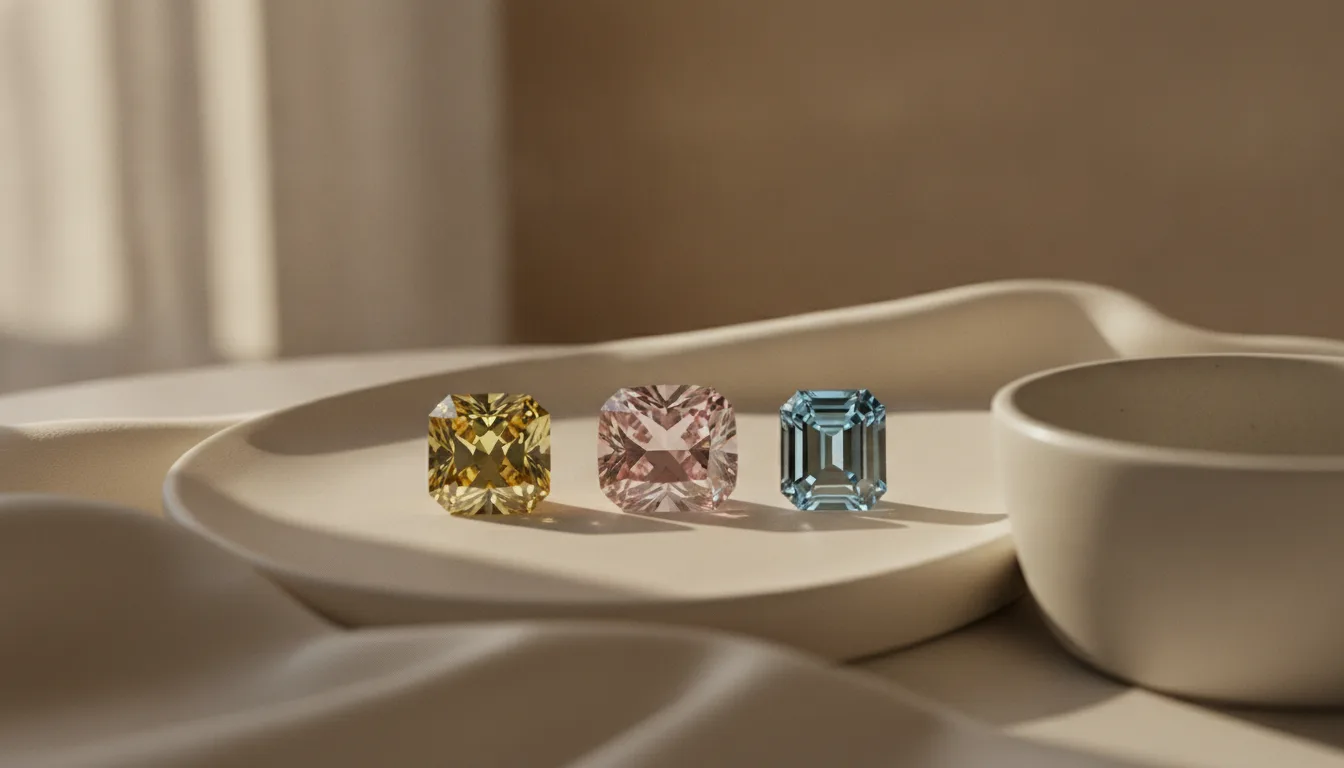
Most April birthstone jewelry uses white (colorless) diamonds, but fancy colored diamonds — yellow, pink, blue, green, even red — are an unusual and meaningful direction for buyers who already own white diamonds or who want something genuinely rare.
The most famous fancy-color story is the Argyle mine in Western Australia, which operated from 1983 until its closure in November 2020 and produced more than 90% of the world's pink diamonds. Of roughly 15 million carats of rough mined annually, less than 1% was pink — and with the mine now closed and no comparable source identified, Argyle pink diamonds have moved from rare gemstones into finite legacy assets. Argyle-certified pinks have appreciated significantly since the closure.
Yellow diamonds (often called "canary diamonds" at the most saturated end) are the most accessible fancy color and pair beautifully with yellow gold settings. Blue diamonds — colored by trace boron — are extraordinarily rare and priced accordingly. A small fancy-yellow diamond in a halo pendant or a pair of fancy-yellow studs is a genuinely unusual April birthstone gift that most jewelry boxes do not have.
Caring for Diamond Jewelry
2 min
Diamond is the hardest natural material on Earth, but it is not invulnerable. The two genuine vulnerabilities are surface grease (which dulls brilliance) and direct impact along certain crystal directions (which can chip the stone). Care is straightforward.
- Clean diamonds frequently. Diamond is hydrophobic — it attracts grease and skin oils that build up on the stone's underside (the pavilion) and dramatically reduce light return. Warm soapy water and a soft toothbrush every two weeks will keep a diamond performing the way it did the day it was cut.
- Ultrasonic and steam cleaners are usually safe for natural and lab-grown diamonds in standard settings. Skip ultrasonic for diamonds with significant inclusions near the surface (the vibrations can propagate cracks) and for fragile antique settings.
- Take diamond rings off for impact-prone work. Despite the 10-on-Mohs hardness, a sharp blow along the right crystal axis can chip a diamond. Gardening, weight training, and rock-climbing are the activities most likely to do real damage.
- Store diamonds separately. Diamond can scratch every other gemstone — including other diamonds. A divided box or individual pouches prevents an expensive collision.
- Have prongs checked annually. The most common way diamonds are lost is not the stone failing but the metal holding it failing. A jeweler can tighten or replace prongs in minutes.
A well-cared-for diamond is the most genuinely permanent piece of jewelry a person can own. Estate cases routinely circulate diamonds set in the 1800s that look identical to the day they were cut. That is the part of "a diamond is forever" that happens to be true.
Frequently Asked Questions
3 min
What is the April birthstone?
Diamond — recognized by the GIA, the American Gem Society, and the modern birthstone calendar standardized in 1912. Diamond is also the traditional gemstone for the 60th wedding anniversary.
What does diamond symbolize?
Invincibility, clarity, courage, and constancy. The Greek root adamas means "unbreakable." Medieval Europeans believed diamond warded off the evil eye and acted as an antidote to poison; modern symbolism ties it to inner strength and clarity of thought.
Do I have to buy an engagement ring for an April birthday?
No. Diamond pendants, studs, tennis bracelets, eternity bands, and signet rings all sit completely outside the engagement-ring conversation and are arguably truer to diamond's two-thousand-year history. April birthstone jewelry covers all of these categories.
Which of the four C's matters most?
Cut. A well-cut diamond at a lower color or clarity grade visibly outperforms a poorly cut diamond at a higher one. If you optimize a single C, optimize cut. Our guide to diamond clarity grades covers where clarity stops being visible. Most buyers should target G–H color, VS–SI clarity, and the highest cut grade their budget allows.
Are lab-grown diamonds real diamonds?
Yes. Lab-grown and natural diamonds are chemically, physically, and optically identical. Under FTC rules, sellers must clearly disclose lab origin using terms like "laboratory-grown" or "laboratory-created" with equal prominence to the word "diamond." Lab-grown diamonds are typically priced 60–80% below comparable natural stones.
Should a diamond come with a grading report?
Any diamond above roughly 0.50 carats should come with an independent grading report from GIA or IGI. The report verifies the stone matches the seller's claims. Absence of a report from a recognized lab is itself an answer to whether the seller is trustworthy.
What are Argyle pink diamonds?
Pink diamonds from the Argyle mine in Western Australia, which operated from 1983 until its closure in November 2020 and produced more than 90% of the world's pink diamonds. With the mine closed and no comparable source identified, Argyle pinks have transitioned into finite legacy assets and have appreciated significantly since closure.
Can diamond chip or break?
Yes, despite being the hardest natural material on Earth. Diamond has cleavage planes — directions of weakness — and a sharp impact along the right axis can chip a stone. Take diamond rings off for impact-prone activities like gardening, weight training, and rock-climbing.
Diamond does not need help selling itself, but it has spent the last hundred years getting flattened into a single story about engagement rings. The other story — the older, stranger, more interesting one — is about a stone humans have treasured for two thousand years for its hardness, its clarity, and its quiet refusal to fade. That is the story April birthstone jewelry tells. A diamond pendant, a pair of studs, a tennis bracelet — these are gifts that honor the longer history, and they are the kind of pieces that stay in a jewelry box for the rest of a wearer's life and the next person's after that.