
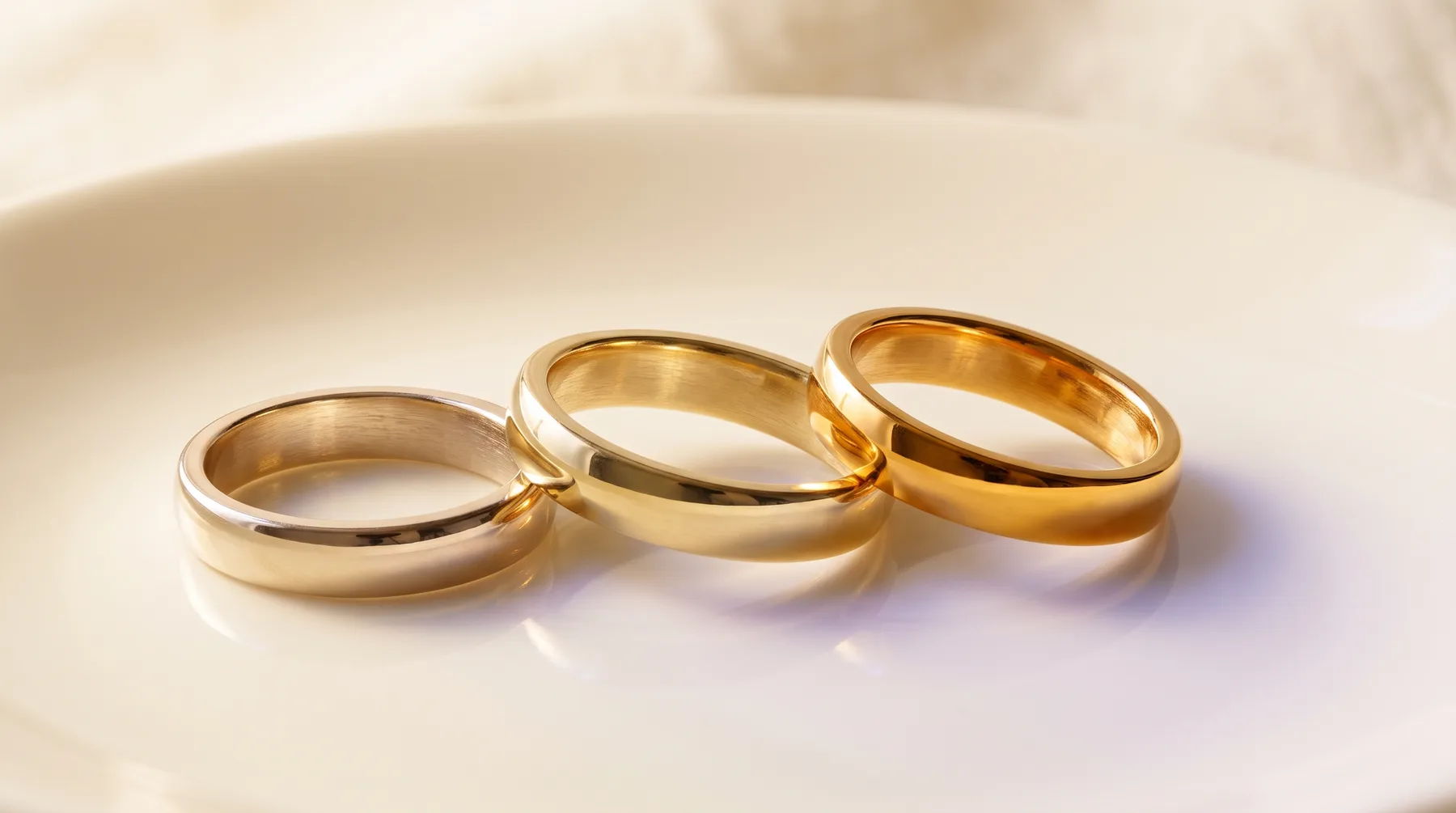
For a ring or bracelet that lives on your body every day, buy 14k gold. Buy 18k when deeper color and a little more heft matter more to you than scratch resistance. Buy 10k when the budget is the deciding vote and the piece will be worked hard. That is the short answer, and it is the same advice most working jewelers give their own families.
The longer answer is worth ten minutes, because the karat number changes several things at once — purity, hardness, color, price, and what the law lets a seller stamp into the metal — and one of them runs opposite to instinct. The more gold in the alloy, the softer the jewelry.
What do 10k, 14k, and 18k actually mean?
1 min
Karat measures gold content in twenty-fourths. 24k is pure gold. 18k is 18 parts gold to 6 parts other metals — 75% pure. 14k is 58.3% gold, and 10k is 41.7%.
The non-gold parts are not filler. Pure gold is so soft that a 24k ring scuffs and bends under ordinary life, which is why jewelry gold is alloyed with metals like copper, silver, zinc, nickel, and palladium. The alloy is what makes gold wearable at all; the karat just says how much of the mix is gold.
You will meet these numbers stamped as fineness marks — parts per thousand. 18k is stamped 750. 10k is 417. 14k is usually 585 rather than the mathematically expected 583: according to the World Gold Council, most manufacturers follow the European practice of alloying 14k slightly over the minimum, and mark it 585.
| Karat | Gold content | Fineness stamp | Wear character | Best first pick for |
|---|---|---|---|---|
| 10k | 41.7% | 417 | Hardest of the three; palest yellow; most prone to discoloration from the alloy metals | Budget chains and hard-worn pieces |
| 14k | 58.3% | 585 (sometimes 583) | Hard enough for daily wear with a full yellow color | Engagement rings and everyday jewelry |
| 18k | 75% | 750 | Softest and heaviest of the three; deepest color; scratches and dents sooner | Pendants, earrings, dress pieces |
| 24k | 99.9% | 999 | Too soft to hold a stone securely | Bullion and some cultural traditions |
Which karat of gold is most durable?
1 min
14k out-wears 18k, and 10k out-wears them both — on hardness, at least. The Gemological Institute of America (GIA) puts it directly: metals with a higher amount of gold "will have richer color, be heavier, softer (slightly more prone to dents and scratches) and more costly."
We've sold and serviced a lot of gold across retail and wholesale over the years, so let us translate that into what happens on a hand. A prong is a few tenths of a millimeter of metal doing a security job for decades. Catch a 14k prong on a sweater or a door frame and it mostly holds its shape; an 18k prong in the same life takes a set, opens a little, and meets the retipping torch years sooner. Wedding bands tell the same story more slowly — an 18k band picks up dings and loses its crisp edges faster than a 14k one worn identically.
Two honest caveats. Hardness is not toughness: bench literature is full of warnings that some very hard alloys — certain nickel white golds especially — are hard the way glass is hard, and setters dislike them because they can crack rather than flex (the trade journal Ganoksin covers this well). And the exact hardness of "14k" varies with each maker's alloy recipe, so treat the precise hardness numbers you see quoted online with suspicion. The karat sets the range; the recipe sets the point.
How does karat change the color of gold?
1 min
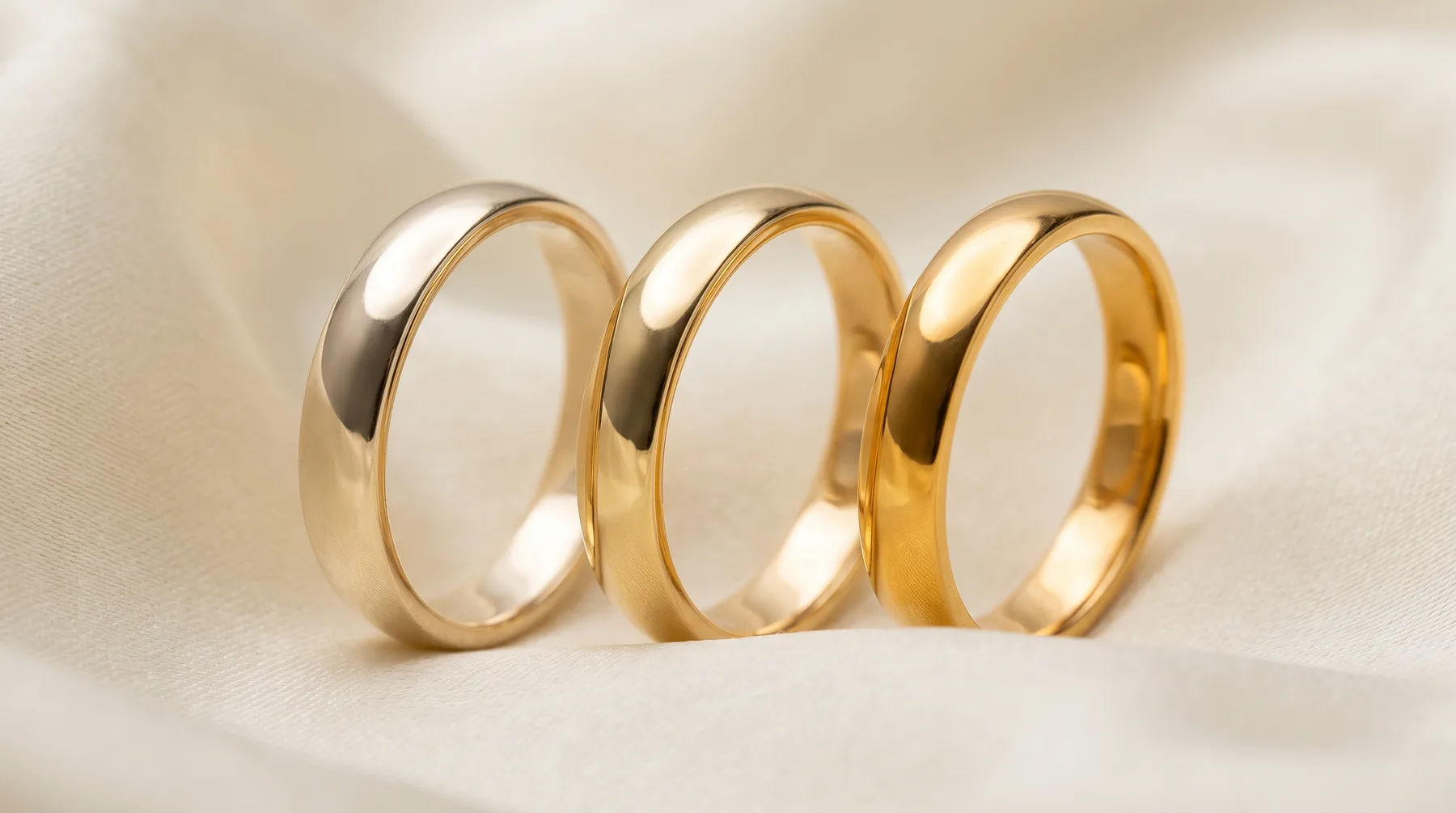
More gold means a deeper, warmer yellow. Set a 10k and an 18k yellow band side by side and the 10k reads paler and slightly brassy while the 18k glows — that is 33 extra points of gold content doing the work. 14k sits in the middle, and its color is what most Americans picture when they picture gold.
Rose gold gets its blush from copper in the alloy — the World Gold Council credits copper for the "soft pink complexion" — so a lower-karat rose piece, carrying more copper, actually leans a touch pinker.
White gold is the exception that simplifies your decision: its color mostly isn't the gold's. Most white gold wears a plating of rhodium, a bright white metal, and when that plating thins, the piece shows the faintly warm alloy beneath — at 14k and 18k alike. If you are buying white gold, karat is a durability-and-price decision, not a color one. (More on rhodium in our guide to cleaning gold jewelry at home.)
Which karat is best for sensitive skin?
1 min
The alloy recipe decides that, not the karat number. The usual culprit in metal reactions is nickel, which appears in some white gold alloys at every karat. Peer-reviewed dermatology puts nickel sensitivity at roughly 8 to 19% of adults in Europe, women far more often than men (Ahlström et al., Contact Dermatitis, 2017) — and while the EU restricts how much nickel jewelry may release, the United States has no equivalent rule.
So be skeptical of "10k is hypoallergenic" marketing. Lower karat means more alloy metal, so if nickel is in the recipe, 10k carries more of it than 18k, not less. Buyers with reactive skin have reliable routes: yellow and rose gold (normally nickel-free), palladium white gold, or platinum — and it is always fair to ask a seller what is in the white alloy.
The related worry — a green or dark mark on the skin — is chemistry, not counterfeit. As the International Gem Society notes, the gold itself doesn't cause these reactions; the copper and silver in the alloy do, usually with help from perspiration, lotion, or pool water. Lower karats do it more because they carry more base metal.
How much does karat change the price?
1 min
Quite a lot, at 2026 gold prices. Spot gold traded around $4,350 an ounce on August 7, 2026 (per CNBC and USAGOLD's daily report). At that level the metal in a piece is real money: an 18k piece contains about 28% more gold than the same piece in 14k, and 14k about 40% more than 10k — straight arithmetic from the purity fractions.
Finished-jewelry prices don't track the metal linearly, because labor, stones, and brand ride on top. But the metal difference is why the same design is often offered in two or three karats at meaningfully different prices — you are genuinely buying more gold, not more markup.
What does the stamp inside your ring legally guarantee?
1 min
In the United States, a karat stamp is a regulated claim under the FTC Jewelry Guides (16 CFR Part 23), and the guarantees are specific:
- The tolerance is tiny. Under the National Gold and Silver Stamping Act, an article without solder may run at most 3 parts per thousand under its stamped fineness; with solder, 7 parts per thousand.
- A quality stamp must name its maker. Federal law (15 U.S.C. § 297) requires a registered trademark or the maker's name alongside the karat mark. A bare "14K" with no maker's mark next to it is a small but real red flag.
- 10k is the working floor. The World Gold Council notes 10k as the minimum standard caratage in the US. Since a July 2018 revision of the Guides, a seller may market something below 10k as gold only by disclosing the karatage plainly (say, "9k gold") — an unqualified "gold" still means 10k or better.
None of this tells you a piece is well made. It tells you the metal is what the stamp says — which is exactly the part you cannot check yourself.
So which karat should you buy?
2 min
Match the karat to the life the piece will live, not to a prestige ladder.
- Engagement rings and daily-wear rings: 14k. GIA calls 14k the most popular fineness in the US, and the popularity is earned — it holds prongs tight and edges crisp through the life a ring actually leads. It is the same head-over-heart logic we recommend for choosing between lab-grown and natural diamonds: spend where the difference shows.
- Pendants and earrings: 18k earns its place. They hang; they don't hit desks or door frames. Low-contact pieces are where 18k's deeper color is all upside.
- Chains and bracelets: 14k, or 10k when budget rules. A 10k chain is a perfectly honest object — hardest of the three, real gold, real value. Accept the paler color and give it the occasional wipe-down, since more base metal means a bit more discoloration.
- Heirloom and dress pieces: 18k. Worn a dozen nights a year, an 18k piece will look extraordinary for a century.
And our own honest disclosure: of the roughly 140,000 karat-gold styles in our catalog as of August 2026, about three in four are 14k, one in five is 10k, and barely 2% are 18k. That mix is not an accident of taste. It is what American manufacturers overwhelmingly build, because it is what holds up on American hands at prices people will actually pay. When 18k is the right call — a dress pendant, a color-first buyer — we will say so, but we will never pretend the default is wrong.
Frequently Asked Questions
2 min
Is 10k gold real gold?
Yes — 10k is 41.7% pure gold, and in the US it is the minimum fineness a seller can call simply "gold" without extra disclosure. It is the hardest common karat, the palest in color, and the least expensive.
What is the actual difference between 14k and 18k gold?
14k is 58.3% gold and 18k is 75%. The 18k piece is heavier, richer in color, and about 28% more gold by content — but softer, so it scratches and dents sooner. 14k trades a little color depth for meaningfully better wear.
Is 18k gold too soft for an engagement ring?
Not too soft — millions are worn happily — but its prongs bend and wear faster than 14k prongs, so plan on more frequent inspections and earlier retipping. For a ring worn around the clock, we recommend 14k; if you choose 18k for its color, just treat prong checks as routine maintenance.
What does the 585 stamp on my jewelry mean?
585 parts gold per thousand — 14k. Manufacturers commonly alloy 14k slightly above the 583 the math suggests, following European practice. Likewise 750 means 18k and 417 means 10k.
Does 14k gold tarnish or turn skin green?
The gold doesn't; the copper and silver alloyed with it can. A dark or greenish skin mark is the alloy reacting with perspiration, lotion, or chlorine — more common in lower karats, and it cleans away with soap and water.
Which karat looks the most yellow?
18k has the deepest, warmest yellow; 10k reads noticeably paler; 14k is the familiar middle. In white gold, karat barely changes the color you see, because that color is mostly rhodium plating.
One sentence to carry out of all this: buy 14k unless you can say exactly why this piece should be something else. When you can — an 18k pendant chosen for its glow, a 10k chain chosen with open eyes — the other karats are not compromises. They are the right tool, picked on purpose.