
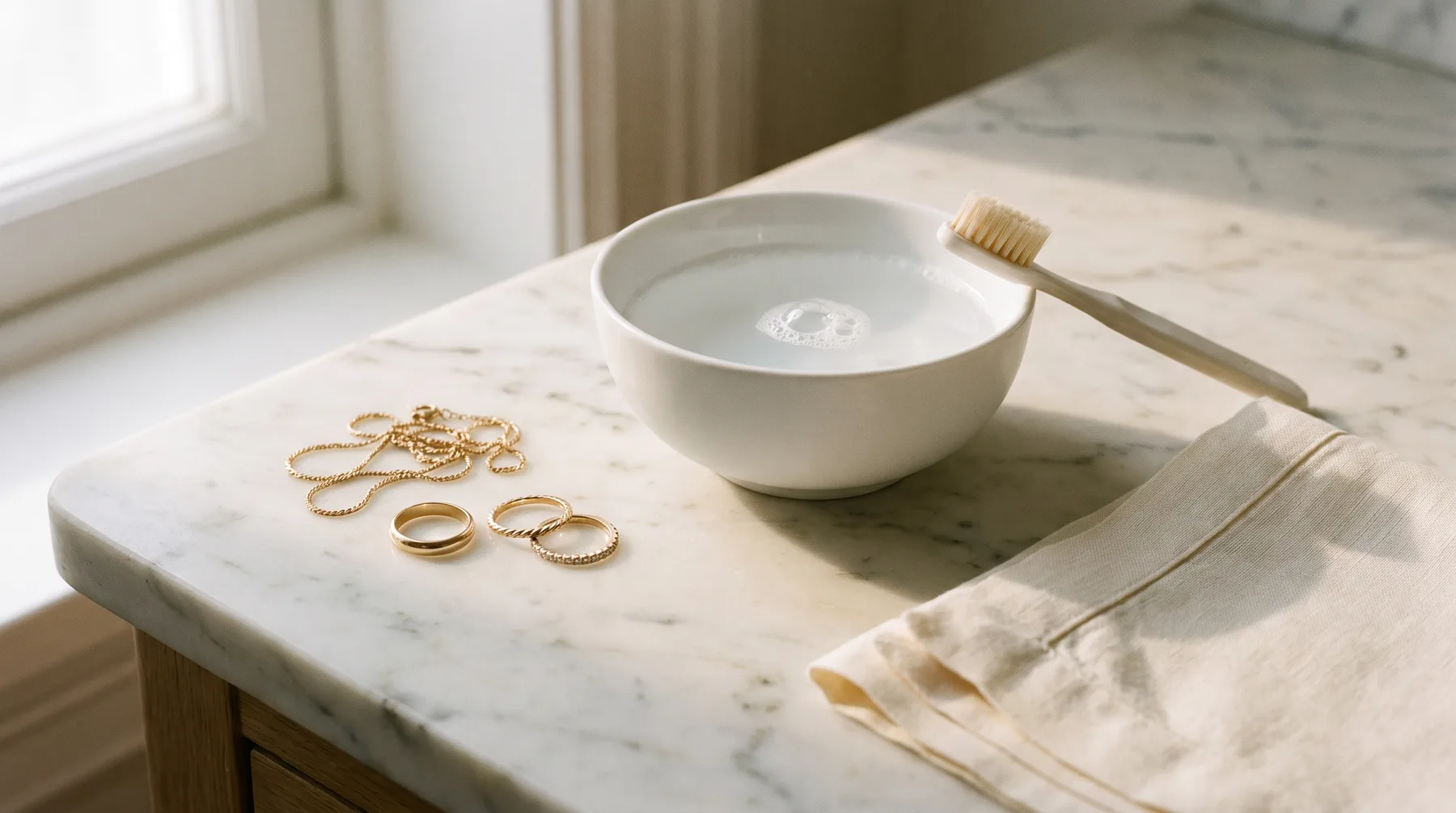
Fill a small bowl with warm water, add one drop of plain dish soap, and let your gold jewelry sit in it while you make coffee. Then work a soft brush gently around the stones, rinse in clean water, and pat dry with a lint-free cloth. That is the entire method — the same one used at jewelry benches everywhere before anything fancier comes out — and it is safe for nearly every piece of gold jewelry you own.
The rest of this guide is what that summary leaves out: the handful of household products that genuinely damage gold, the stones that change the rules, and the moments when a jeweler's ten-minute inspection is worth more than any amount of home cleaning. We've spent years in this trade — behind retail counters, inside a jewelry manufacturer on the wholesale side, at a light repair bench, and running a jewelry business of our own — and most of the damaged gold we've seen come back was damaged by cleaning, not by wear.
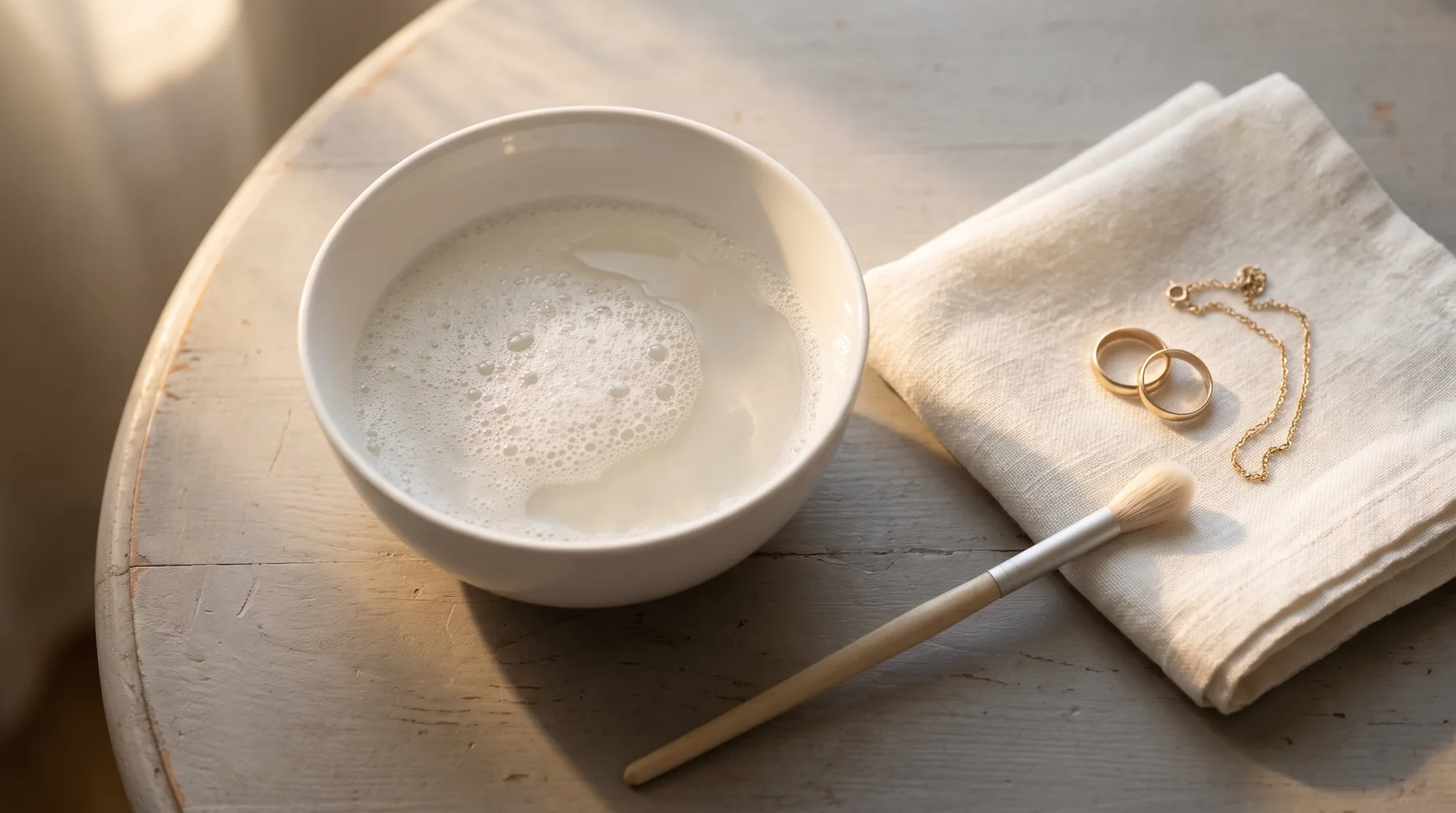
How do you clean gold jewelry with dish soap?
2 min
Soak, brush, rinse, dry. The International Gem Society calls warm water, a mild detergent, and a soft brush the safest cleaning materials for almost all gems, and no bench we know disagrees. Here is the version that avoids the small mistakes:
- Use a bowl, not the sink. If you must use the sink, close the drain first. A surprising share of "lost" rings were last seen next to a faucet.
- Warm water, one drop of mild dish soap. Warm, not hot — sudden temperature swings are hard on many colored stones. Skip "moisturizing" soaps; the additives leave film.
- Soak for about 15 to 20 minutes. That range comes from the insurer Jewelers Mutual, and it matches what works at the bench: the soak does the real work of loosening skin oil, lotion, and sunscreen so the brush doesn't have to scrub.
- Brush gently with a soft baby toothbrush. Spend your time behind the stones and under the setting. The gray paste that packs in under a ring head is skin oil, soap film, and dead skin — it blocks light from entering the stone from below, which is why a dirty diamond looks dead even when the top is clean.
- Rinse in a second bowl of clean water. Soap film left to dry is most of the reason freshly "cleaned" jewelry still looks dull.
- Pat dry with a lint-free cloth and let it air-dry fully before it goes back in the box. Chains especially — moisture trapped in links stays there.
Between deep cleans, the best habit costs nothing: Jewelers of America recommends wiping jewelry with a clean, soft, slightly damp cloth after every wear. Thirty seconds of that prevents most of the buildup the soak exists to remove.
What should you never use to clean gold?
2 min
Toothpaste, baking soda, and anything containing chlorine bleach. Those three cause more cleaning damage than everything else combined.
Toothpaste and baking soda are abrasives. Toothpaste scrubs with hydrated silica — a material dentists rate on an abrasiveness scale precisely because it is hard enough to wear down enamel. Gold is a soft metal; every pass drags micro-scratches across the surface, and a high polish turns hazy one cleaning at a time. On gold-plated pieces, abrasives don't scratch the finish — they remove it.
Chlorine is worse than abrasive: it attacks the metal itself. Jewelers of America warns plainly that chlorine and salt water can damage and discolor gold, and the mechanism is nastier than discoloration. Karat gold is an alloy, and chlorine dissolves the non-gold metals in it — a process the manufacturer Stuller documents as stress-corrosion cracking. The attack concentrates exactly where the metal holds stress: prong bends, ring shanks, solder joints. Heat accelerates it, which makes a hot tub the single worst place your gold ring can spend an afternoon. Take rings off before the pool, every time.
Ammonia and glass cleaner are the genuinely contested one. Jewelers of America lists window cleaner as safe for most metals and gems, and plenty of diamond owners swear by it. We come down against the habit, for two reasons: ammonia can strip the oils and fillers used to treat many colored stones and some diamonds, and it is unkind to the rhodium plating on white gold. Dish soap does the same job with none of those risks, so the upside never pays for the downside.
As for the internet's rotating cast of hacks — ketchup soaks, beer baths, vodka rinses, a rolling boil: acids, sugars, and thermal shock, applied to an object you care about, to save two dollars of dish soap. Skip them all.
Are ultrasonic cleaners safe for gold jewelry?
1 min
Safe for the gold, yes. The decision is never about the metal — it is about the stones and the settings attached to it.
An ultrasonic machine cleans by cavitation: microscopic bubbles collapsing thousands of times a second. On a plain solid-gold band or chain, that is harmless and thorough. On the wrong stone it is destructive. The International Gem Society's list of gems that should never go in an ultrasonic includes opal, pearl, emerald, tanzanite, coral, turquoise, malachite, and amber — and any stone treated with oils or fracture-filling, because the vibration drives the treatment out. Peridot stays out of the tank too — its care rules are in our August birthstone guide. GIA is blunt about the most common victim: never put an emerald in an ultrasonic cleaner; most emeralds are fracture-filled, and the machine can sweat the filler out of the stone.
The second risk is the one nobody mentions on the box: vibration loosens stones. Small pavé stones held by beads of metal, and older prongs that have quietly worn thin, can rattle loose in the tank. This is exactly why a bench cleans jewelry with the machine and then checks every stone before handing the piece back — and why we'd rather you use the bowl-and-brush method at home and let the ultrasonic live at the jeweler's, where that inspection follows it.
Why did my white gold ring turn yellow?
1 min
Because the plating wore through — the ring is fine. Most white gold is plated with rhodium, a bright white metal that gives the ring its mirror finish. Underneath, the gold alloy itself has a faint warm cast, and as the rhodium thins with wear, that warmth starts to show — usually first on the shank, where skin contact is constant. It looks like damage; it is maintenance. A jeweler replates the ring, and daily-worn rings commonly need it every year or two.
Two cleaning notes follow from that. Harsh chemicals and abrasives thin rhodium faster, which is one more reason the dish-soap method wins. And no amount of cleaning will bring the white back once the plating is gone — that is a plating service, not a cleaning problem.
Rose gold is the opposite case: nothing to replate, because the color runs through the metal. Its copper content can deepen slightly with years of wear, and copper-rich alloys are a little more responsive to perspiration — but the cleaning method is the same bowl and brush.
How do you clean gold-plated and vermeil jewelry?
1 min
With a soft cloth, soapy water, and nothing else — the gold layer is too thin to survive scrubbing. Under the FTC Jewelry Guides, "gold electroplate" can be as thin as 0.175 microns, and even vermeil — the premium tier, sterling silver under gold — requires only 2.5 microns. For scale, a human hair is roughly thirty times thicker than a vermeil layer. A toothbrush is a belt sander at that scale.
So for plated and vermeil pieces: brief lukewarm soapy dip, wipe with a soft cloth, rinse, dry. No brush, no ultrasonic, no polishing cloth with compound in it (those are mildly abrasive by design). Gold-filled jewelry is the sturdier cousin — the law requires the bonded gold layer to be at least 1/20 of the piece's weight — and it tolerates the gentle brush method, but it still isn't solid gold, and the layer is still finite.
If you aren't sure which you own, treat it as plated until a jeweler tells you otherwise. The gentle method is never wrong; the aggressive one is only sometimes right.
When should a professional clean it instead?
1 min
Once a year at minimum — and not mainly for the cleaning. Jewelers of America recommends a professional cleaning at least annually, and the quiet value of that visit is the inspection that comes with it: worn prongs, thinning shanks, and loose stones get caught while they are still cheap to fix. Insurers tend to suggest every six months for rings worn daily, and having seen what a prong looks like the week before a stone falls out, we think the six-month cadence earns its keep for engagement rings.
A few jobs should always go to the bench:
- Anything with a loose or clicking stone. Cleaning agitation finishes what wear started.
- Polishing out scratches. Real polishing removes a whisper of metal every time. Done occasionally, it is how gold stays beautiful for decades; done every month, it is how prongs and hallmarks disappear.
- Hollow chains and lockets. Water and soap residue sit inside them and wick back out for days. A bench has steam and knows where it can point it.
- Anything you'd cry about losing. Not a technical criterion, but it is the honest one.
Frequently Asked Questions
2 min
Can I clean gold jewelry with toothpaste?
No. Toothpaste is abrasive by design — its silica scrubbing agents micro-scratch gold and strip gold plating entirely. Warm water and a drop of dish soap clean better and remove nothing.
Is it safe to wear gold jewelry in a pool or hot tub?
No. Chlorine attacks the alloy metals in karat gold and can cause stress-corrosion cracking at prongs and solder joints, and heat speeds the reaction up. Take gold off before pools, hot tubs, and cleaning with bleach.
How often should gold jewelry be cleaned?
A quick wipe with a soft, slightly damp cloth after wear, the dish-soap soak about once a month for pieces in regular rotation, and a professional cleaning and inspection at least once a year, per Jewelers of America.
Can gold-plated jewelry go in an ultrasonic cleaner?
No. The plating layer can be thinner than a hundredth of a human hair, and cavitation plus handling wear it through. Plated and vermeil pieces get a soft cloth and soapy water only.
Does 14k gold tarnish?
Pure gold doesn't tarnish, but the copper and silver alloyed into 14k can discolor slightly with exposure to perspiration and chemicals. It wipes away with the standard soap-and-water clean; higher karats discolor less because they carry less base metal.
What do jewelers use to clean gold professionally?
Typically an ultrasonic bath, a steam cleaner, and — the part you can't buy — a trained look at every stone and prong afterward. The machines are quick; the inspection is the service.
Gold is one of the few things you own that is genuinely designed to last longer than you. Give it thirty seconds with a cloth after it comes off, a bowl of soapy water when it looks tired, and one professional visit a year — and the piece your grandchildren inherit will need nothing more than the same.