
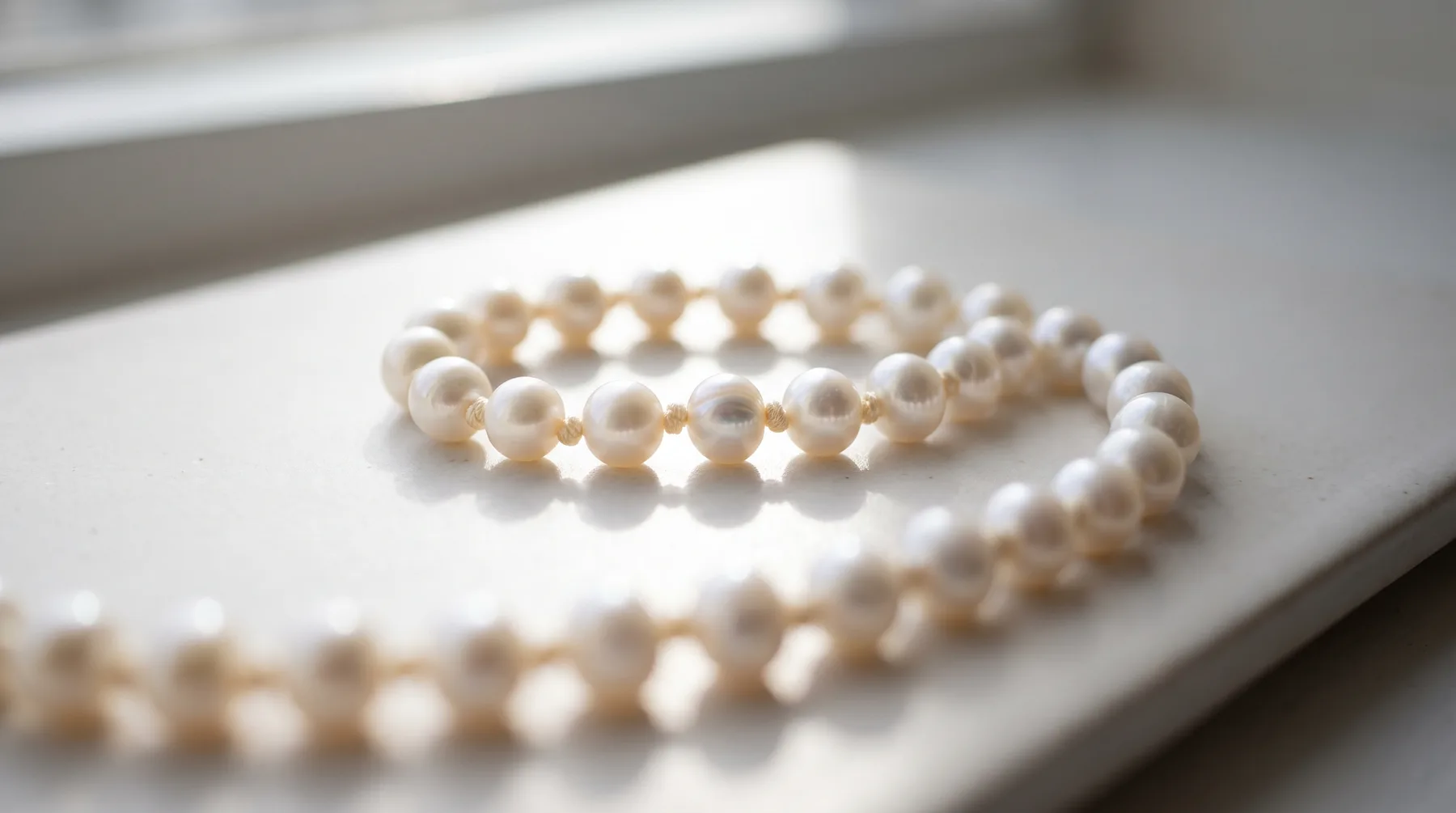
June's birthstone is pearl, and it is the only gem in the case that was made by a living animal rather than by geology. That single fact drives everything else about it: pearls are soft, they are organic, they dislike almost every chemical in a bathroom, and they are graded on a set of factors that has nothing in common with the 4Cs.
If you remember one thing from this guide, make it luster. Luster is the sharpness of the reflection on the pearl's surface, and it is the factor that separates a pearl that looks alive from one that looks like a painted bead. Size gets the compliments and luster is what people are actually reacting to.
The only gem grown by an animal
1 min
A pearl forms when an irritant lodges inside a mollusk and the animal coats it, layer after layer, with nacre: microscopic platelets of aragonite held together by an organic binder called conchiolin. Those platelets are roughly the thickness of a wavelength of visible light, which is why nacre does not simply shine but seems to glow slightly from inside. The effect has a name, orient, and no manufactured bead reproduces it convincingly.
Natural pearls, formed with no human involvement, were among the most valuable objects on earth for most of recorded history. The fisheries of the Persian Gulf, the Red Sea and the Gulf of Mannar supplied that trade from antiquity into the twentieth century, and then it ended within a generation. Kokichi Mikimoto produced his first cultured pearl in Japan in 1893 and a fully round one by 1905; round cultured pearls reached the market in commercial quantity in the 1920s, and by the 1930s, with the Depression on top of them, natural pearls had largely lost their market. Practically every pearl you will be offered today is cultured, and that is not a lesser thing. It is the reason a jeweler can sell you a matched strand at all.
The meaning behind the stone
1 min
Pearls have carried associations with purity, integrity and wisdom across a remarkable range of cultures, and they are the traditional gift for the third and thirtieth wedding anniversaries. Ancient writers being ancient writers, there were also stories: Roman authors treated pearls as solidified moonlight or dew, and one Persian tradition held they were tears.
The modern association worth mentioning is a sadder invention. Pearls became a rule about age at some point in the twentieth century, and a whole generation grew up thinking of them as their grandmother's necklace. That has gone into reverse over the last decade, and the pearl jewelry selling now is baroque, mixed-metal, single-pearl and asymmetric rather than the twin strand of the 1950s.
Natural, cultured, and imitation are three different things
1 min
These three words get used loosely and the difference is money.
Natural means the pearl formed without human intervention. These are rare, sold mostly at auction, and require laboratory testing to confirm, because the only reliable way to tell a natural pearl from a bead-nucleated cultured one is to look inside it with X-ray imaging.
Cultured means a technician inserted a nucleus, usually a shell bead or a piece of mantle tissue, and the mollusk did the rest over months or years. The nacre is real nacre. This is what the trade sells.
Imitation means glass, plastic or shell coated with a pearlescent finish. It should be described as simulated or faux, never as a pearl without qualification, and the giveaway at a counter is simple: real nacre feels faintly gritty against the edge of a tooth, while an imitation feels glassy and smooth.
The four families of cultured pearl
1 min
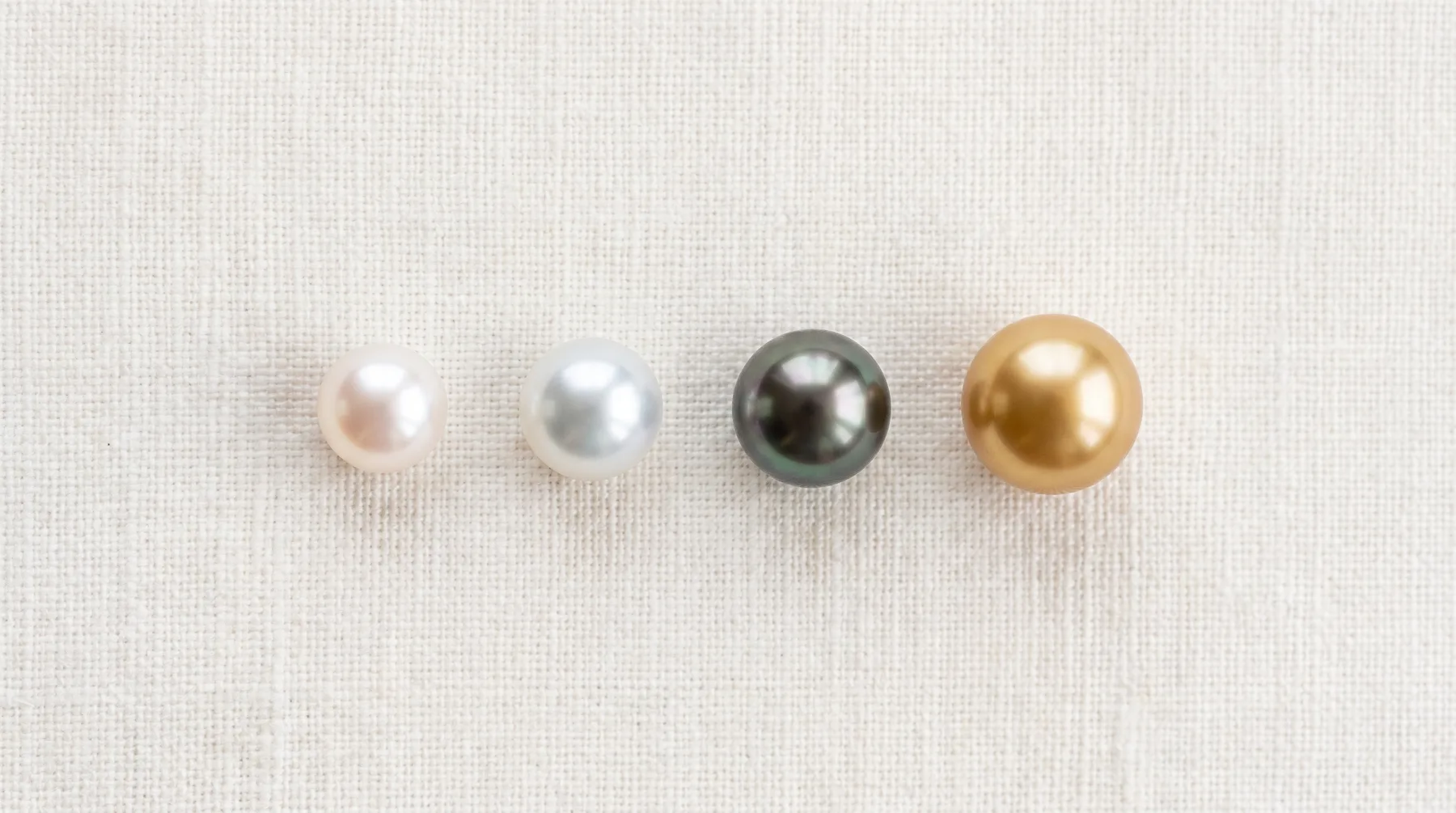
Almost everything sold falls into four groups, and knowing which one you are looking at explains most of the price.
| Type | Usual size | Typical colors | Character |
|---|---|---|---|
| Akoya | 2–10 mm | White and cream, often with rose or silver overtone | The classic round strand. Highest, sharpest luster of the four; thinnest nacre, so quality varies most |
| Freshwater | 2–12 mm | White, pink, lavender, dyed colors | Grown in mussels, largely in China. Enormous supply, wide quality range, the best value in pearls by a distance |
| Tahitian | 8–18 mm | Grey to black with green, aubergine and peacock overtones | From the black-lipped oyster of French Polynesia. Naturally dark; no dye needed |
| South Sea | 8–20 mm | White, silver, deep golden | The largest and most expensive, from Australia, Indonesia and the Philippines. Thick nacre, soft satiny luster |
Bead-nucleated freshwater pearls, sold as Edison or Ming pearls, sit slightly outside that scheme. They are freshwater pearls grown around a bead, reaching sizes and roundness that used to require saltwater, and they are the most interesting value in the market as of August 2026.
What actually decides a pearl's value
1 min
GIA classifies nacreous cultured pearls on seven value factors: size, shape, color, luster, surface, nacre quality, and matching. They are not equal, and the order people care about them in a shop is usually wrong.
- Luster first, always. Hold the pearl under a point light source and look at the reflection. Sharp, bright, with clearly defined edges means high luster; soft, blurry, milky means low. This is the difference you see across a room.
- Nacre quality second, because it is what luster is made of and what determines whether the pearl still looks like this in fifteen years.
- Surface third. Small blemishes are normal and a clean-looking pearl with dull luster is a worse buy than a lightly marked pearl that glows. Blemishes near a drill hole matter less than blemishes on the face.
- Shape, color, size and matching after that, and mostly as preferences rather than quality. Round costs the most because it is hardest to grow, not because it is better, and a well-matched strand costs a premium for the sorting labor behind it.
Nacre thickness, the factor you cannot see
1 min
This is the one that separates a pearl worth owning from a pearl that will disappoint you, and no photograph shows it. A bead-nucleated cultured pearl is a shell bead wearing a coat of nacre, and the coat can be thick or thin depending on how long the animal was left to work.
Akoya is where this matters most, because akoya oysters are small and cultivation periods are short. Quality akoya is generally expected to carry at least about 0.4 mm of nacre; South Sea and Tahitian pearls are typically grown for far longer and can carry 2 mm or more. Thin nacre is why some pearls develop a faint dull banding, chalky patches, or eventually peel near the drill hole. When it happens there is no repair.
You cannot measure it by eye, so use proxies. Ask the seller directly. Look at the drill hole under magnification if you can. Be suspicious of a very cheap round white saltwater pearl with high shine, and be aware that a strong blink or a slight blue cast under the surface can indicate the bead showing through.
Treatments and what has to be disclosed
1 min
Pearl treatment is routine and it is not all equal. Light bleaching to even out color is near universal in akoya and freshwater production and is generally accepted without comment. Dyeing is very common in freshwater pearls, and the bright pinks, greens and blacks in inexpensive jewelry are almost always dyed. Irradiation darkens pearls from the inside and produces grey and blue-grey tones. Coating with a lacquer or polymer, sometimes described as luster enhancement, is the one to avoid: it wears off.
All of these require disclosure in the United States. A black pearl at a supermarket price is a dyed freshwater pearl, not a Tahitian one, and the word Tahitian is a source term rather than a color term. If a seller cannot tell you whether a color is natural or added, treat the answer as added.
What our catalog says about pearls at the counter
1 min
Our catalog carries 3,260 styles that name a pearl as the stone. Of those, 2,846 are cultured, 159 natural, and about 120 simulated or synthetic. That distribution is the entire history of this gem compressed into a stock list: the cultured pearl went from a Japanese experiment in 1893 to 87% of what an American jeweler stocks.
The type breakdown is just as blunt. Style descriptions naming freshwater pearls run to 2,591, against 175 that name akoya, 58 Tahitian and 22 South Sea. The American pearl counter is a freshwater counter, and it is worth saying why plainly: a mussel can be nucleated with multiple pieces of mantle tissue and grow several pearls at once, which is why freshwater pearls cost a fraction of akoya at the same size. If your budget is under a few hundred dollars, freshwater is not the compromise, it is the category.
Japanese akoya deserves a note in the other direction. Japan's akoya farms have been hit by repeated red tides and by an infectious disease that, in the worst episode, cut national production to about a third of previous levels according to Japan's Ocean Policy Research Institute, and the trade has reported sharply higher akoya prices in the seasons since. Akoya strands are unlikely to get cheaper.
Choosing June birthstone jewelry by the piece
1 min
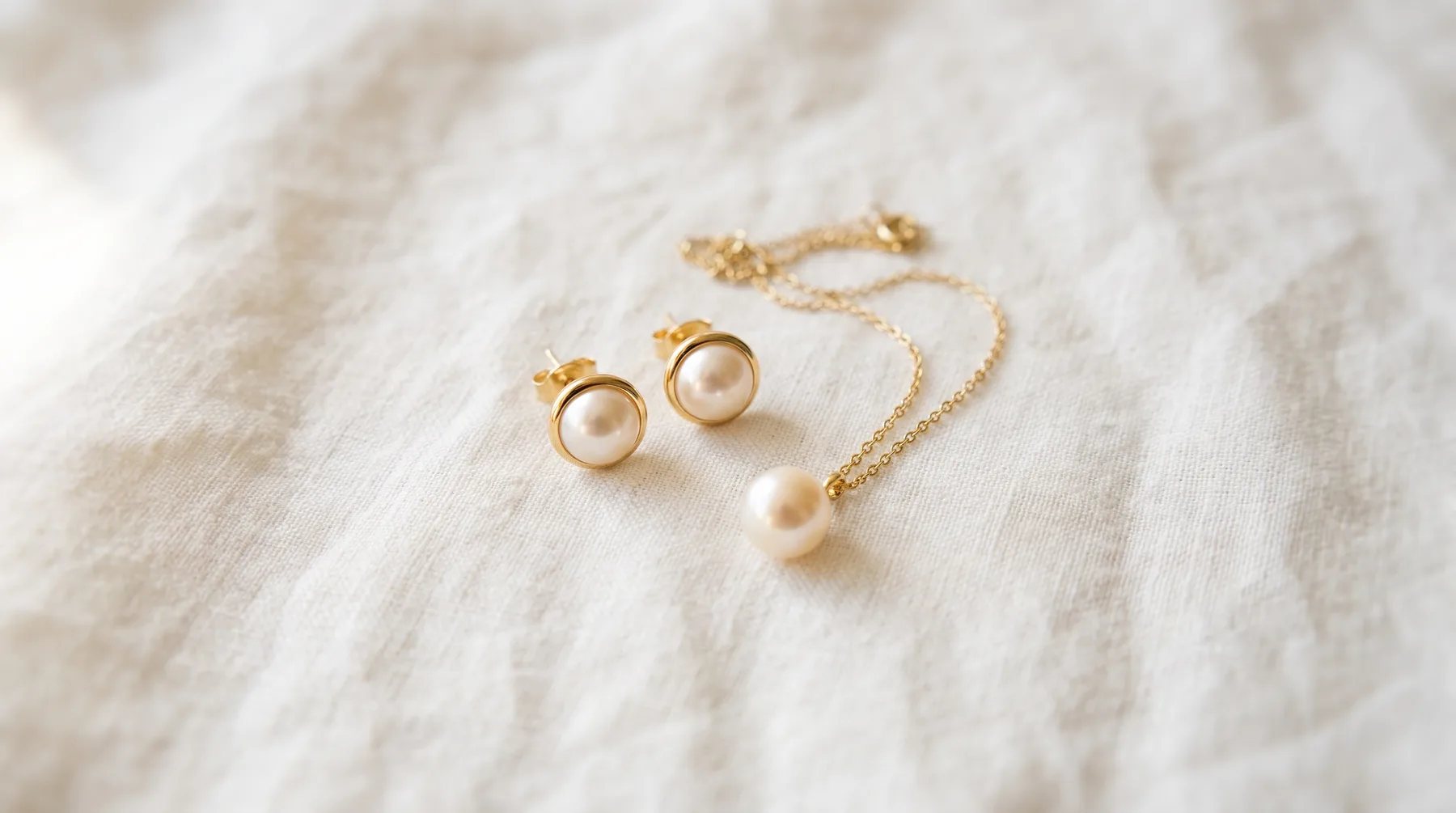
Studs are the correct first pearl for most people. They survive daily wear because nothing rubs them, they suit every age, and the money goes into luster instead of size. A 7 to 8 mm freshwater or akoya stud is the piece that gets worn.
A single pearl pendant is the modern answer to the strand. One good pearl on a fine chain reads current in a way a graduated strand does not, and it lets you buy one excellent pearl instead of forty average ones.
Strands are still the heirloom, and matching is what you are paying for. If you buy one, buy it knotted between pearls and expect to have it restrung during your lifetime.
Rings are the category to think hardest about. Pearl sits at 2.5 to 4.5 on the Mohs scale, softer than a fingernail file and far softer than the dust in ordinary air, so a pearl ring worn daily will abrade. Buy pearl rings for occasional wear, or accept replacing the pearl eventually. A jeweler can re-glue a new pearl onto a post; that is a normal repair, not a failure.
How to buy a pearl worth keeping
1 min
Everything below happens in front of the seller, in about three minutes, and none of it requires equipment.
- Find a point light and look at the reflection. If you can nearly read the shape of the light source in the pearl's surface, the luster is good. A soft glow with no defined edge is not.
- Roll it. Blemishes, flat spots and drill-hole damage show up as the pearl turns, not when it sits still.
- Ask the four questions: what type, freshwater or saltwater, what nacre thickness, and what treatments. Any seller worth buying from answers all four without hesitating.
- Check the colour claim. Natural or dyed. On anything grey, black, gold or vivid, ask it explicitly.
- On a strand, check the knots. Silk knotted between each pearl means one broken thread loses one pearl instead of all of them, and it stops the pearls abrading each other.
- Compare two strands side by side rather than judging one alone. Pearl quality is nearly impossible to assess in isolation and obvious in comparison.
Caring for pearl jewelry
1 min
Pearls are the most fragile thing most people own, with the possible exception of opal, and the rules are correspondingly strict. Nacre is calcium carbonate held together with an organic binder: acid dissolves it, solvents attack the binder, and dry heat shrinks it.
- Last on, first off. Pearls go on after perfume, hairspray, lotion and makeup, and come off before you undress. This one habit does more than everything else here combined.
- Wipe them after wearing with a soft damp cloth. Skin oils and perspiration are mildly acidic.
- Never use an ultrasonic or steam cleaner, and never anything containing ammonia, alcohol, bleach, or vinegar. Our gold cleaning guide covers the metal; the pearl gets water and a cloth, nothing else.
- Store them flat and separately, in a soft pouch rather than a hard box, and never in a plastic bag or a dry safe. Nacre needs a little humidity, and hanging a strand for years stretches the silk.
- Restring a regularly worn strand roughly once a year, or whenever the silk between pearls looks grey or stretched.
- Wear them. This is genuine trade advice and not a sales line: pearls do better against skin than in a drawer, because the small amount of moisture keeps the nacre from drying out.
Alexandrite and moonstone, June's other stones
1 min
June has three birthstones, which is unusual, and the other two are worth knowing.
Alexandrite is colour-change chrysoberyl: green in daylight, red to purplish-red under incandescent light, because of how chromium in the crystal interacts with different light sources. It was found in Russia's Ural Mountains in the 1830s, the original deposit is long exhausted, and fine natural alexandrite is one of the most expensive gems on earth per carat. Almost all affordable alexandrite jewelry is laboratory-grown or is colour-change synthetic sapphire sold under the name, which is a disclosure question worth asking directly. At 8.5 on the Mohs scale it is genuinely durable.
Moonstone is feldspar with a floating blue-white sheen called adularescence, caused by light scattering between microscopic layers inside the stone. It is beautiful, inexpensive, and fragile: 6 to 6.5 on the Mohs scale with a cleavage plane, so it chips. Treat it like pearl and wear it in earrings and pendants rather than in a daily ring.
Frequently Asked Questions
2 min
What is June's birthstone?
Pearl, with alexandrite and moonstone as the other two recognized June stones. Pearl is the traditional choice and the one nearly all June birthstone jewelry uses.
Are cultured pearls real pearls?
Yes. A cultured pearl is real nacre laid down by a live mollusk around a nucleus a technician inserted. The distinction between natural and cultured is about how the process started, not about the material. Roughly 87% of the pearl styles in our own catalog are cultured, and natural pearls are essentially an auction category now.
How can I tell if a pearl is fake?
Rub it gently against the edge of a tooth. Real nacre feels faintly gritty because of its microscopic crystal layers; glass and plastic feel smooth. Imitations also tend to be perfectly matched, unusually light, and warm rather than cool to first touch.
Why are some pearls so much cheaper than others?
Type and nacre. Freshwater mussels can grow several pearls at a time, so freshwater pearls cost a fraction of akoya at the same size, and a short cultivation period produces a thin nacre coat that shines now and may not later. Size and roundness add cost too, but luster is what you are really paying for.
Can I wear pearls every day?
Earrings and pendants, yes. Rings and bracelets, with care: pearl is 2.5 to 4.5 on the Mohs scale, so ordinary dust will dull the surface of a ring worn constantly. Take them off for cleaning, swimming, the gym and sleep.
How often should a pearl strand be restrung?
About once a year for a strand worn weekly, and sooner if the silk looks dirty, stretched or slack between the pearls. Always ask for it to be knotted between each pearl.