
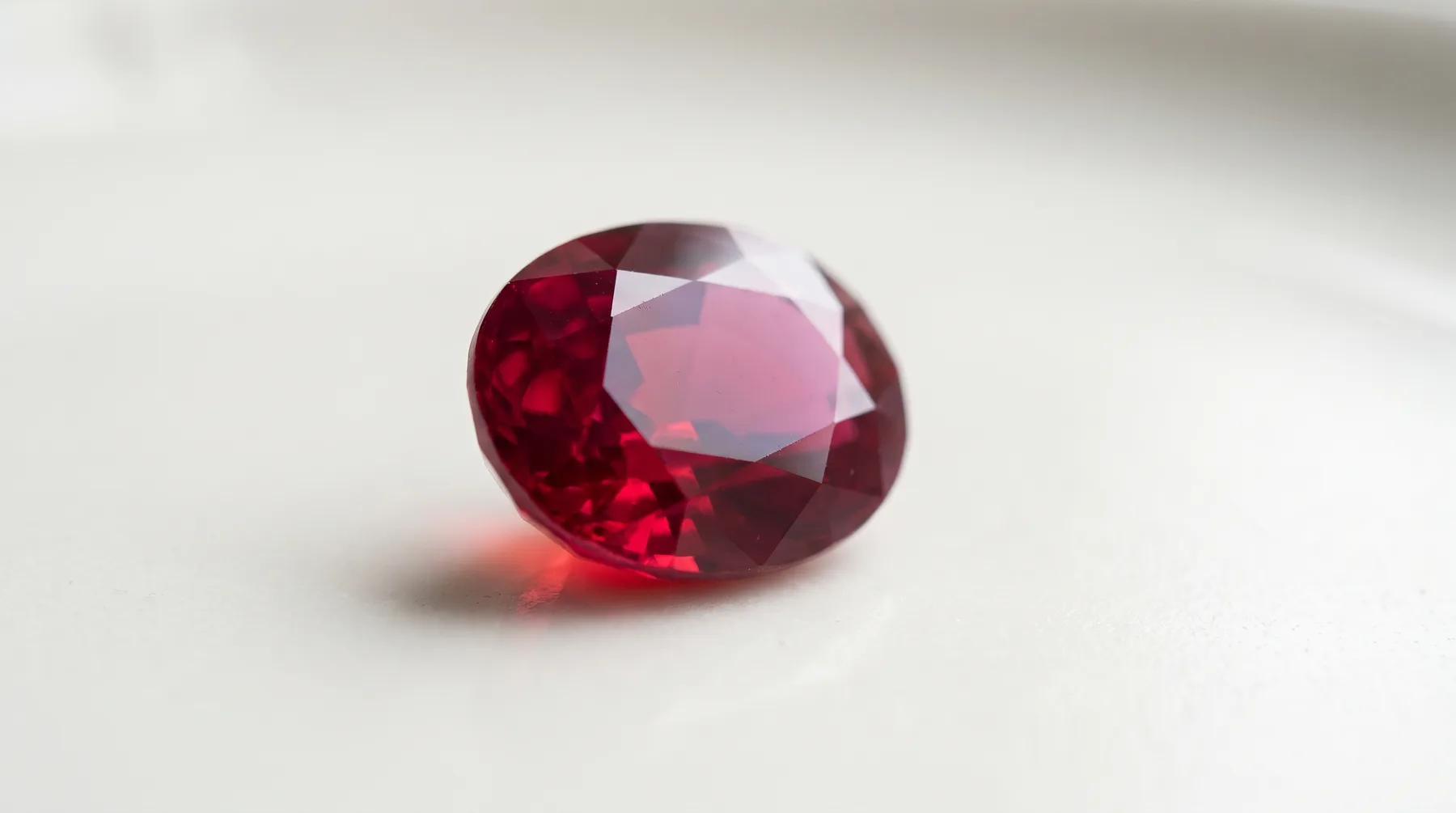
July's birthstone is ruby, and it is red corundum. That is the whole definition. The same mineral in any other color is sapphire, which makes ruby the only gem whose identity depends on a single hue rather than on a chemistry of its own.
Two things follow from that, and they matter more than anything else you will read about this stone. Ruby inherits corundum's hardness of 9 and its lack of cleavage, which makes it one of the best colored stones on earth for a ring worn every day. And because the whole value of a ruby sits in its color, ruby attracts more treatment, more optimistic naming, and one genuinely dangerous product category that a shopper needs to be able to recognize.
The same mineral as sapphire, one element apart
1 min
Corundum is aluminium oxide. Pure, it is colorless. Add traces of chromium and it turns red, and the same chromium that produces the color also makes the stone fluoresce, which is why a fine Burmese ruby seems to glow in sunlight rather than merely reflect it. Add iron and titanium instead and the same mineral becomes blue sapphire.
Chromium comes with a cost. It distorts the crystal lattice as it substitutes into it, so ruby crystals tend to grow with more internal strain, more inclusions and smaller clean sizes than sapphires from the same deposits. That, and not scarcity of the mineral, is why a large clean ruby is far rarer than a large clean sapphire.
Where red stops and pink begins
1 min
This is the most consequential argument in colored stones, because the word on the receipt changes the price by multiples. GIA's position is that red must be the dominant hue: purplish red through red to slightly orangy red is ruby, and corundum that reads distinctly pink is pink sapphire.
The trade does not agree with itself about where that line sits. The same stone can be sold as ruby in one market and pink sapphire in another, and dealers have obvious commercial reasons to lean one way. There is no scientific test that settles it, because there is no chemical difference to test. For a buyer, the practical answer is unglamorous: on a stone of any real value, buy the laboratory report along with it, and understand that you are buying one laboratory's judgment of a boundary rather than a fact.
The meaning behind the stone
1 min
Ruby is the stone of blood, life and courage in almost every tradition that had access to it. Burmese warriors are said to have inserted rubies into their flesh before battle in the belief that the stone made them invulnerable, which is at least a vivid way of expressing confidence in a gem. Sanskrit texts call it ratnaraj, king of gems.
It carries the fifteenth and fortieth wedding anniversaries, and it has a second modern life as an alternative engagement stone for people who want color without leaving the durability of corundum. Ruby is July's birthstone in every modern list; older and regional lists sometimes name carnelian or onyx for the month.
Pigeon's blood, and what the term actually means
1 min
Pigeon's blood is the trade's name for the finest ruby color: a pure, vivid red with a slight blue undertone and strong fluorescence, historically associated with the Mogok valley in Myanmar. The term dates back to the early nineteenth century and it started as poetry rather than a standard.
It is now a grading term used by several gemological laboratories, and it is worth knowing that laboratories define it differently and that its appearance on a report adds substantial money to a stone. Stones from Mozambique and Madagascar have been given the designation too, so it describes color rather than origin, whatever a seller implies. If a shop uses the phrase, ask which laboratory said so and see the report.
Where rubies come from today
1 min
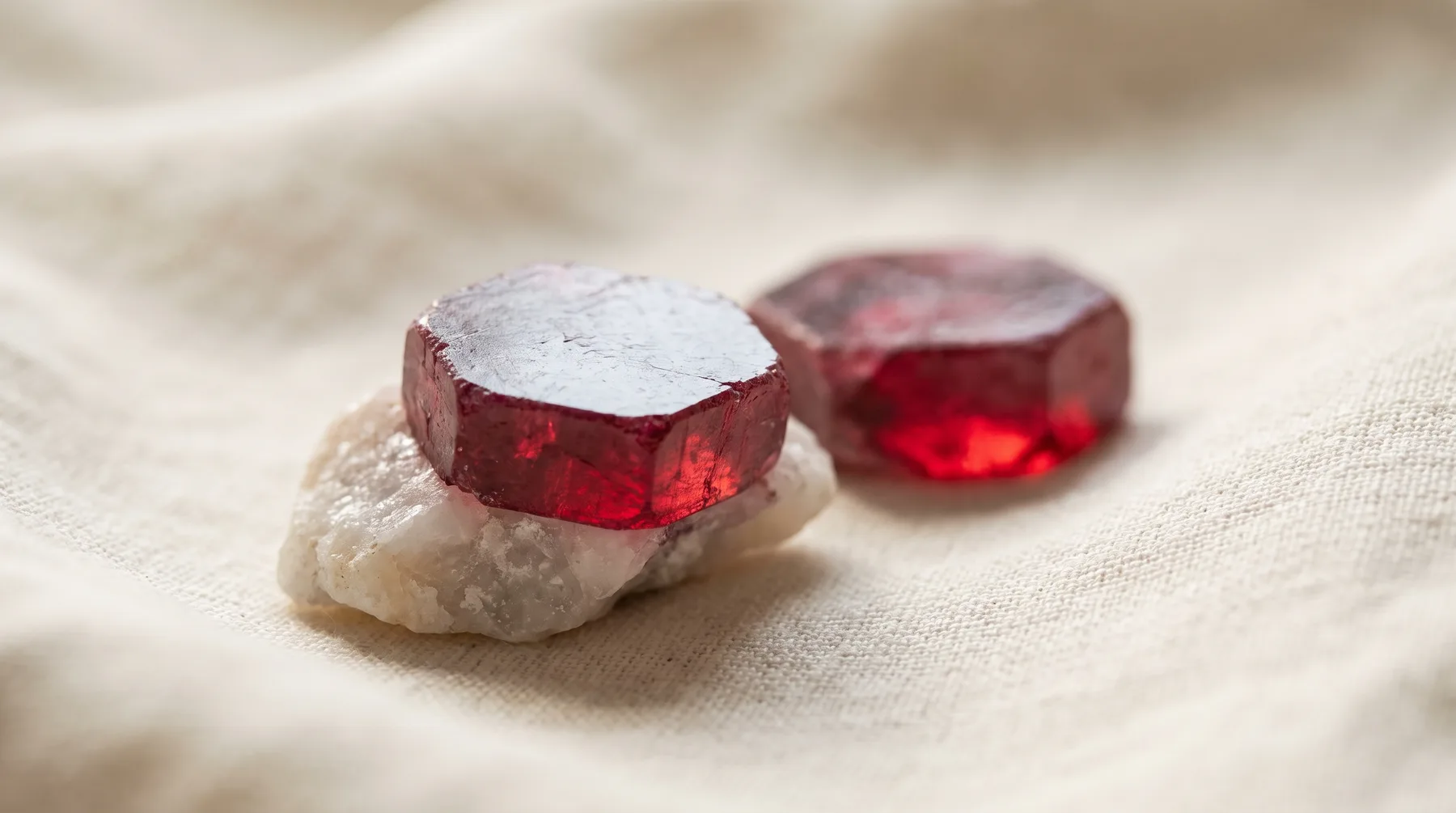
Myanmar's Mogok valley remains the historical reference point for fine ruby, and Burmese origin still commands a premium of its own. It also brings ethical and legal complications, and buyers should ask specifically about origin and import documentation on any significant Burmese stone.
The bigger commercial story of the last decade is Mozambique. The Montepuez deposit, mined by Gemfields, has become the dominant source of ruby by volume, and the stones are good enough that top Mozambican material now competes directly with Burmese at the highest levels. The numbers are public: Gemfields' Trade Select auction of mixed-quality Montepuez rough ran 22 to 29 June 2026 and sold 348,409 carats for $23.1 million, an average of $66.30 per carat, and the company reported $102.9 million of auction revenue across the first half of 2026. Thailand, Madagascar, Tanzania, Sri Lanka and Greenland fill in the rest.
Heat, flux, and the treatment you should refuse
2 min
Nearly all commercial ruby is heated. Heat treatment is stable, permanent, accepted by the trade for centuries, and it improves color and dissolves some internal silk. An unheated ruby with fine color carries a large premium precisely because it is unusual, and that status needs a laboratory report to claim.
Flux healing goes a step further: heating with a flux that seeps into fractures and heals them as the stone cools. It leaves residue in the fissures, it is disclosable, and it sits in a grey zone that the trade tolerates when it is declared.
Then there is the product that gives ruby its worst reputation. Lead-glass-filled ruby, also called composite ruby, starts as fractured low-grade corundum that would otherwise be worthless, and fills the fracture network with high-lead-content glass until it looks like a gem. Sometimes half the volume of the finished stone is glass. It is not durable in any normal sense: household acids such as lemon juice can etch it, a jeweler's torch can wreck it during a routine repair, and an impact that would chip a real ruby can shatter a composite along its glass planes.
The Federal Trade Commission's Jewelry Guides address it directly. It is deceptive to describe these as ruby without qualification, or as treated, lab-grown or hybrid ruby; acceptable descriptions must name the lead-glass filling and the special care requirement, in language such as composite ruby, lead-glass-filled, special care required. If you are looking at a large, clean-looking, brilliantly red ruby at a price that seems impossible, this is what it usually is. Ask the question in exactly those words: is this stone lead-glass filled?
How ruby wears in real life
1 min
Very well, which is the good news after that section. At 9 on the Mohs scale ruby is second only to diamond and moissanite among stones you will meet in a shop, and corundum has no cleavage plane waiting to split. A natural, heated ruby in a well-built setting is a legitimate everyday engagement stone, which is not something you can say about emerald or opal.
The caveats are about the stone in front of you rather than the species. A heavily included ruby with fractures reaching the surface is fragile in the way any fractured stone is, and a composite ruby is not durable at all. Cabochon-cut star rubies, which show a six-rayed asterism from needle inclusions, are typically more included by definition and worth setting protectively.
Why fine ruby outprices diamond
1 min
Per carat, top ruby is more expensive than top diamond, and by a distance. The record is the 25.59-carat Sunrise Ruby, a Burmese pigeon's blood stone that sold at Sotheby's Geneva on 12 May 2015 for $30.3 million, about $1.19 million per carat.
The reason is supply. Gem-quality diamond, whatever else is true of it, is produced in industrial volume by several large mining companies across several continents. Fine unheated ruby above a few carats appears in tiny numbers from a handful of deposits, and the crystal habit of chromium-bearing corundum works against large clean material in the first place. Scarcity at the top of the market is real in ruby in a way it is not in diamond, which is worth remembering when someone tells you a colored stone cannot be an investment.
What our catalog says about ruby at the counter
1 min
At the counter, July's birthstone is mostly grown in a factory. Our catalog carries 405 styles declaring natural ruby against 554 declaring laboratory-created ruby: 58% of the ruby styles we can classify are synthetic. Across every style whose description names ruby in any form, the figure is 1,806, of which 422 were in stock as of 13 August 2026.
There is real history behind that ratio. Ruby was the first gemstone to be commercially synthesized: Auguste Verneuil's flame-fusion process, published in 1902, was making synthetic ruby in quantity more than a century ago, and flame-fusion ruby has been the standard birthstone material in mass-market jewelry ever since. A laboratory ruby is genuine corundum with genuine hardness, and in a $150 birthstone pendant it is the honest choice. What it must not be is described as a ruby with no qualifier.
The practical shopping rule that falls out of this: at low price points, expect synthetic and check that it says so. Above roughly a thousand dollars, ask what makes this stone worth that, and expect an answer involving origin, treatment level, and a report.
Choosing July birthstone jewelry by the piece
1 min
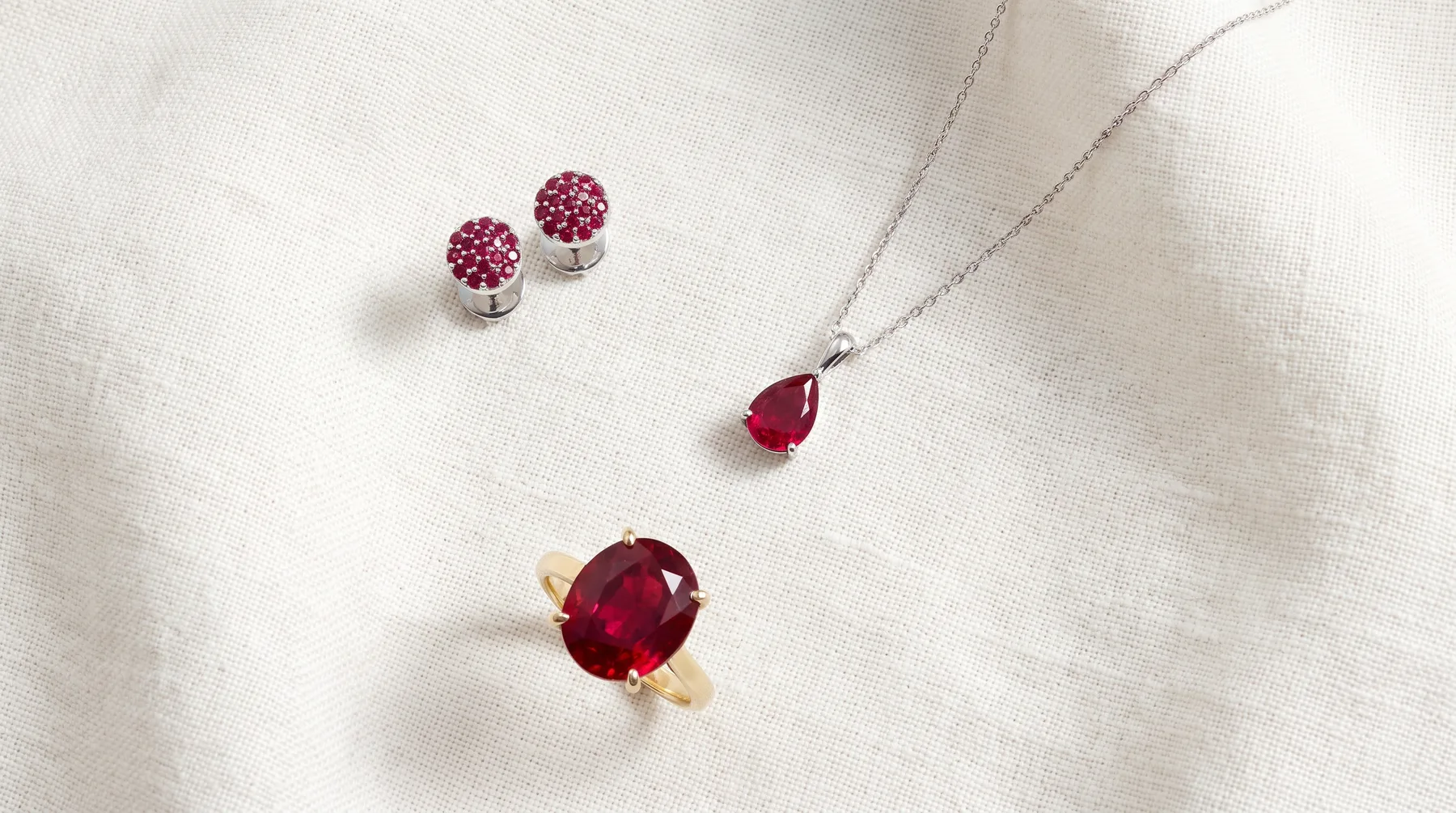
Rings are the category ruby earns. Hardness 9 with no cleavage means a well-set natural ruby can be worn daily for decades, and ruby's saturated red holds up in every light, which is rarer than it sounds among colored stones. Prong or bezel both work; keep the girdle protected.
Stud earrings are the easiest gift in the July catalog and the place where a good synthetic makes the most sense, because size reads more than origin at earlobe distance.
Pendants suit ruby particularly well in yellow gold, which pushes the red warmer, or in white metal, which reads cooler and cleaner. Both are correct; it is genuinely a preference.
Bracelets and tennis lines are where the composite-ruby problem concentrates, because the format needs many matched stones cheaply. Buy these with the lead-glass question asked out loud.
How to buy a ruby worth keeping
1 min
Ruby buying is mostly one skill, judging red honestly, plus three questions that protect you from the rest.
- Look at the color in daylight and then under a lamp. Fine ruby holds its red in both. A stone that goes brownish under warm light or greyish in daylight is telling you about its saturation.
- Ask whether it is natural or laboratory-created, and get the answer written on the receipt.
- Ask whether it is lead-glass filled. Every time, at every price, in those words.
- Ask about heat. Heated is normal and fine. Unheated is a premium claim that needs a report, not a sentence.
- Check the surface with a loupe for fractures reaching the girdle or the table, and look at the stone from the side for a window through the middle where the cut is too shallow.
- On anything substantial, get an independent report covering natural versus synthetic, treatment, and origin if origin is part of the price.
Caring for ruby jewelry
1 min
An untreated or simply heated ruby is one of the easiest stones to care for. A composite ruby is one of the hardest, which is the real reason the question matters.
- Warm water, mild dish soap, a soft brush handles ordinary cleaning. Our home cleaning guide covers the metal around it.
- Ultrasonic cleaning is usually safe for a natural, heated ruby that has no surface-reaching fractures, and is a bad idea for anything fracture-filled, flux-healed or heavily included. If you do not know which you own, do not use one.
- Never let a composite ruby near heat, acid, or an ultrasonic tank, and tell any jeweler before they light a torch anywhere near it.
- Store it separately. At hardness 9, ruby will scratch nearly everything else in the box, including your gold.
- Have prongs checked once a year on a ring worn daily. Ruby survives impacts that loosen the metal holding it.
Frequently Asked Questions
2 min
What is July's birthstone?
Ruby, the red variety of corundum. It is July's birthstone in every modern list; older and regional traditions sometimes name carnelian or onyx for the month.
What is the difference between a ruby and a pink sapphire?
Only color. Both are corundum, and the split is a judgment about whether red is the dominant hue. GIA treats purplish red through slightly orangy red as ruby and distinctly pink stones as pink sapphire, and laboratories and dealers genuinely disagree about the border cases.
Are lab-created rubies real rubies?
They are real corundum with the same hardness, chemistry and color mechanism, and they must be described as laboratory-created or synthetic. They are not natural rubies and cost a small fraction as much. In our own catalog, 58% of the classifiable ruby styles are laboratory-created.
What is a composite or lead-glass-filled ruby?
Low-grade fractured corundum whose fracture network has been filled with lead glass, sometimes amounting to a large share of the stone's volume. It looks like a bargain ruby and it is not durable: acids can etch it, a repair torch can destroy it, and an impact can shatter it. The FTC requires it to be described with the lead-glass filling and the special care requirement disclosed.
Can I wear a ruby ring every day?
Yes, if it is natural or laboratory-grown corundum rather than a composite, and the setting protects the girdle. Ruby's hardness of 9 and its lack of cleavage make it one of the few colored stones a jeweler will recommend for daily wear without qualification.
Are all rubies heated?
Close to all commercial rubies are heated, and the treatment is stable and accepted. Unheated rubies with fine color carry a substantial premium, and that claim should always be backed by a laboratory report rather than a verbal assurance.