
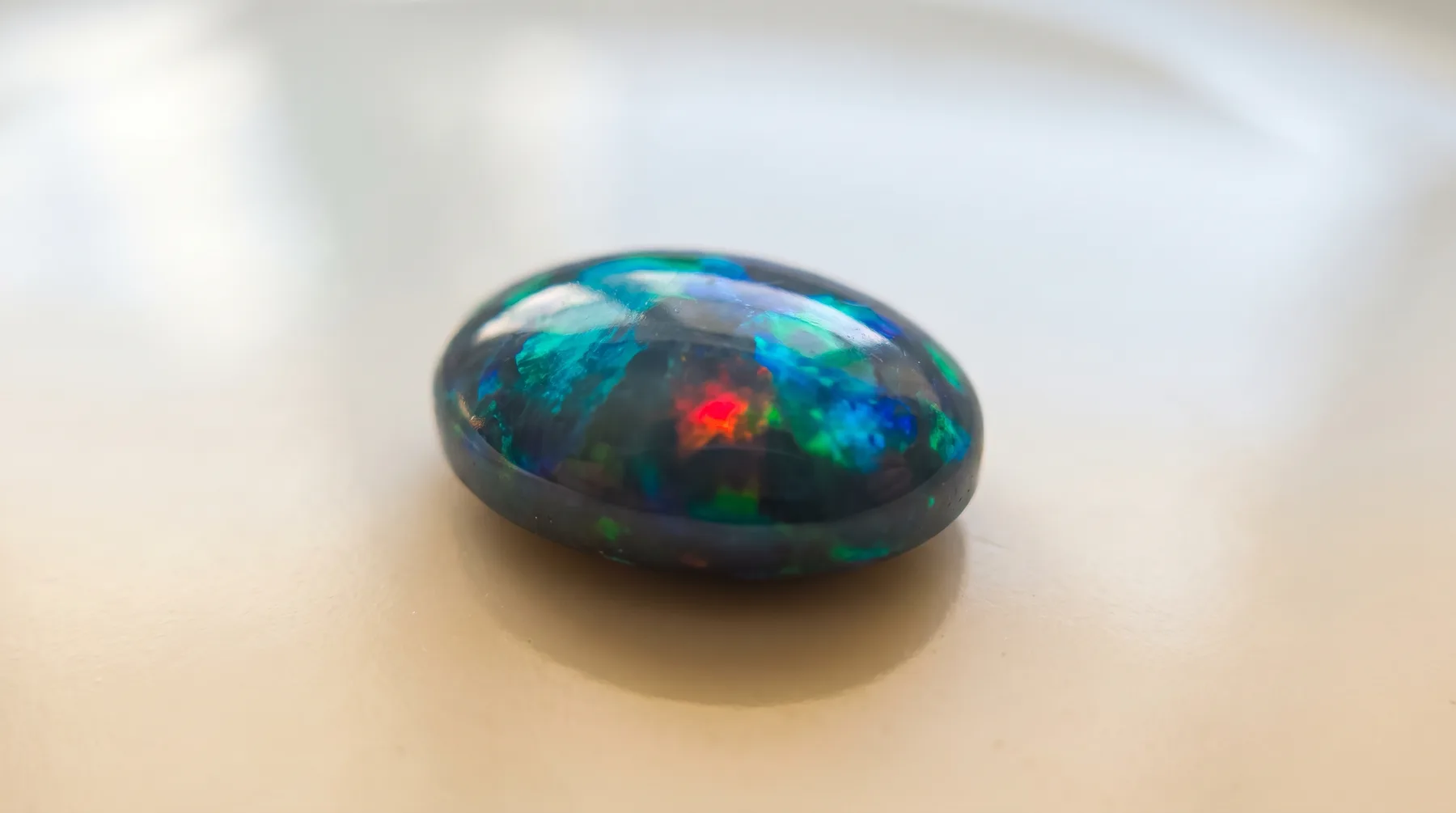
October's birthstone is opal, and opal breaks most of the rules the rest of the case follows. It is not a crystal. It contains water, sometimes a lot of it. Its color does not come from a chemical impurity but from the physical structure of the stone diffracting light, which is why no two opals show the same thing and why photographs of opal are always slightly dishonest.
It is also the most fragile gem most people will ever be sold as an everyday stone. At 5.5 to 6.5 on the Mohs scale, softer than the quartz dust in ordinary air, opal wants a protective setting, a sensible position on the body, and an owner who knows what not to do with it. Get those three right and an opal will outlive you. Get them wrong and you will be looking at a network of fine cracks in five years.
What opal actually is
1 min
Opal is hydrated silica: spheres of amorphous silicon dioxide with water bound in the structure, with the chemical shorthand SiO2·nH2O. Water content is typically a few percent and can run much higher, and that water is the source of nearly everything difficult about the stone.
Because opal has no crystal lattice, it has no cleavage plane, which is one small mercy. What it has instead is porosity and internal stress, so opal fails by crazing, a fine network of surface cracks caused by drying or thermal shock, rather than by splitting cleanly.
The trade splits opal in two before anything else. Precious opal shows play-of-color. Common opal, known in Australia as potch, does not, and it is the material almost all opal is. Precious opal is the thin exception in a very large amount of ordinary silica.
How play-of-color actually works
1 min
This is the one gemological explanation worth reading twice, because it explains the price. Precious opal is built from silica spheres of uniform size stacked in a regular three-dimensional grid, separated by tiny voids. That structure is a diffraction grating: white light entering it is split into its component wavelengths, some reinforced and some cancelled, and what comes back out is spectral color that moves as you move.
The size of the spheres decides which colors appear. Around 138 nanometers of sphere diameter produces violet, the shortest visible wavelength, and as the spheres get larger the colors run up through blue and green toward red. Red requires the largest, most uniformly stacked spheres, which is exactly why red play-of-color is the rarest and most expensive thing an opal can do.
Australian scientists at the CSIRO established this with electron microscopes in the 1960s, which makes opal one of the few gems whose beauty has a published mechanism rather than a tradition. It also means the stone is doing optics, not chemistry: an opal's color is a structure, and damage the structure and the color goes with it.
The meaning behind the stone, including the curse
1 min
Opal has meant hope, creativity and imagination for most of its history, and the Romans reportedly prized it above nearly everything, on the reasoning that a stone containing every color contained the virtues of every gem.
Then there is the bad luck story, which is worth telling because customers still raise it. Opal's reputation for misfortune is widely traced to Walter Scott's 1829 novel Anne of Geierstein, in which a character's opal loses its fire and she dies shortly after. The book was enormously popular, European opal sales are reported to have collapsed in its wake, and a superstition was manufactured out of a plot device. Opal is the fourteenth anniversary stone, and it is October's birthstone in every modern list.
The families of opal
1 min
Opal is sold by type, and the type sets the price bracket before quality enters the conversation.
| Type | Where from | What it looks like | Notes |
|---|---|---|---|
| Black opal | Lightning Ridge, New South Wales | Play-of-color against a dark body tone | The most valuable. Dark background makes color read vividly |
| White or milky opal | Coober Pedy, South Australia | Color against a pale body | The familiar, affordable opal. Softer contrast |
| Boulder opal | Queensland | Opal seams left attached to their ironstone host | Naturally backed, so it is sturdier than it looks |
| Crystal opal | Various | Transparent to translucent with color floating inside | A description of transparency, not a separate deposit |
| Fire opal | Mexico, mainly | Orange to red body color, often with no play-of-color | Valued for body color; frequently faceted rather than cut as a cabochon |
| Ethiopian Welo | Wollo province, since 2008 | Bright, often very lively color at accessible prices | Usually hydrophane: it absorbs water and changes while wet |
Welo opal deserves the extra sentence. Its arrival in 2008 changed what an ordinary buyer could afford, and it introduced a property most sellers do not explain: hydrophane opal is porous enough to take up water, going more transparent and shifting its color while wet, then returning as it dries. That is normal behavior, not damage, but it means the stone will absorb whatever it is soaked in, including oil and dye.
Solid, doublet, triplet: the disclosure that matters most
1 min
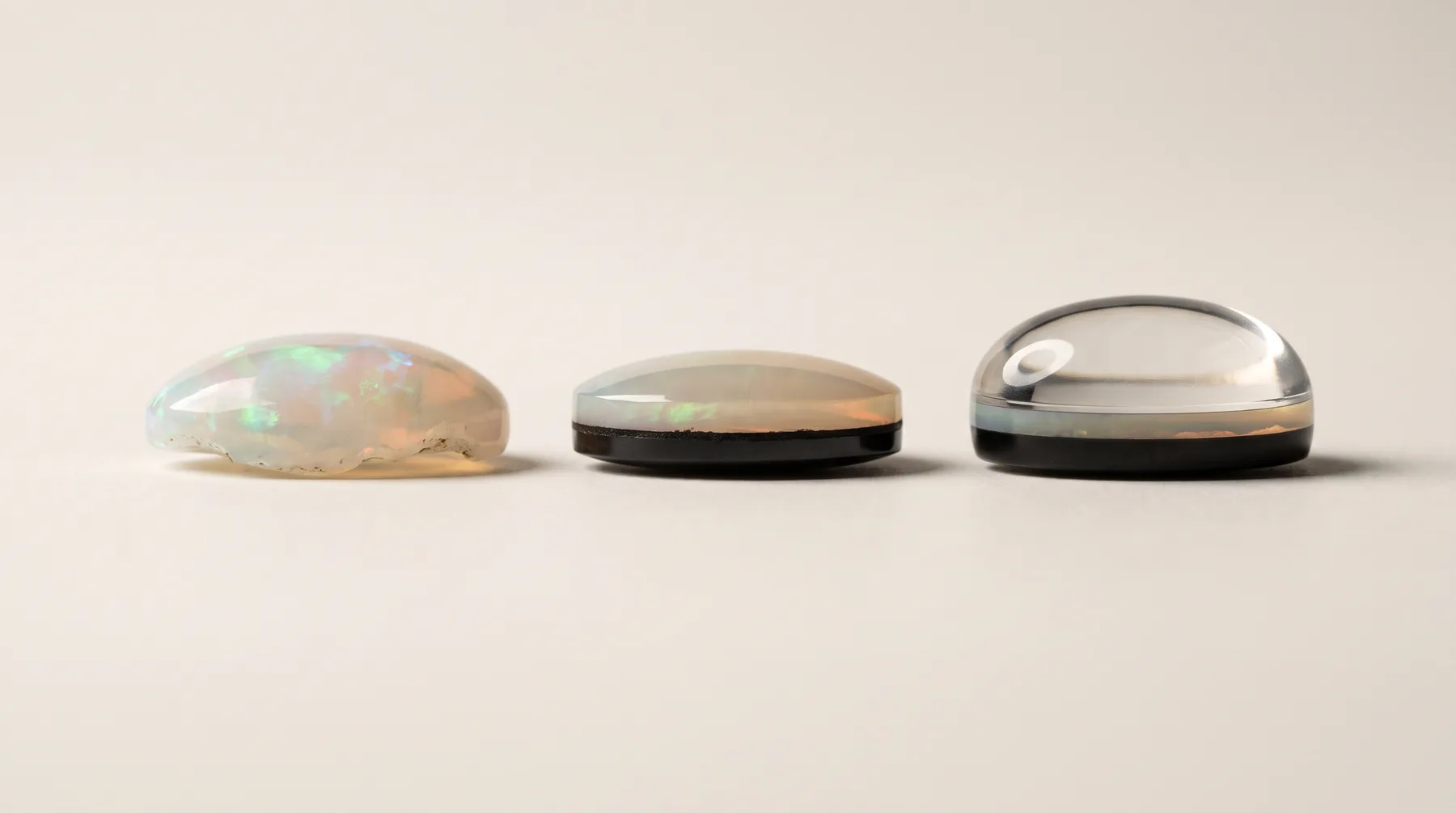
Three different products get sold under the word opal, and the price difference between them is large.
Solid opal is one piece of opal. It can be cut, re-polished, and repaired, and it is the only version that holds value.
A doublet is a thin slice of opal glued to a dark backing, usually potch or ironstone, to imitate the contrast of a black opal at a fraction of the cost.
A triplet adds a clear cap, usually quartz or glass, over the top, so what you are looking at is a very thin layer of opal between two other materials.
Assembled stones are legitimate products and they must be disclosed. Their weakness is glue: water can penetrate the joint and cloud or delaminate the stone, which is why a doublet or triplet must never be soaked, ultrasonically cleaned, or worn swimming. Once water gets in, the piece looks grey along the seam and there is no repair.
How to tell at a counter: look at the stone from the side. A solid opal shows opal all the way through, often with an irregular natural boundary. A doublet shows a dead straight dark line. A triplet shows two straight lines and a glassy dome on top. A seller who cannot answer which of the three you are holding has answered a different question.
How to judge play-of-color
1 min
Four things, in order of how much money they move.
- Color range and dominant hue. Red is rarest and dearest, then orange, then green, with blue and violet the most common. A stone that fires red and green across the whole face is a different animal from a blue-only stone of the same size.
- Body tone. Darker bodies make color sing. This is why black opal outprices white opal so decisively, and it is worth training your eye on before you compare anything else.
- Brightness. The single most underrated factor. A brilliant blue-green stone beats a dull red one in both beauty and price, and brightness survives poor lighting where subtle color does not.
- Pattern and coverage. Named patterns such as harlequin, broad flash and pinfire command different premiums, but coverage matters more: dead patches with no color at all pull the price down hard.
And one practical rule: look at the stone from several angles and in more than one light. Opal changes with viewing angle by definition, and a stone that only performs under one shop spotlight will disappoint you at breakfast.
How opal wears in real life
1 min
Cautiously, and the reasons are physical rather than fussy. At 5.5 to 6.5 on the Mohs scale opal is softer than quartz, which means ordinary household dust will scratch it over time. Its water content makes it sensitive to heat and to sudden humidity changes, and its porosity makes it sensitive to everything liquid.
Crazing is the failure mode to understand. Fine surface cracks appear when the stone dries or is thermally shocked, and they are permanent. Nobody can promise a given opal will never craze, since it depends on the material's own stability, but the things that trigger it are known: leaving a stone in a hot car or a sunny window, going from cold water to a hot dryer, storing it in a bank vault for decades where the air is very dry, or cleaning it with anything that strips moisture.
Practically, that makes opal an excellent pendant and earring stone, a good occasional ring, and a poor everyday ring unless it is bezel set, low, and worn by someone who takes it off for housework. This is the same conversation as emerald, one notch more demanding.
What our catalog says about opal at the counter
1 min
Opal is the birthstone where the counter and the mine have almost nothing to do with each other. Across our catalog, 96 styles declare natural opal and 373 declare laboratory-created opal. That is 80% synthetic, the most lopsided ratio of any gem we stock. Every style whose description names opal in any form totals 750, and only 107 were in stock as of 13 August 2026.
There is a reason beyond price. Laboratory-created opal, grown by processes commercialized in the 1970s, is far more uniform, far more predictable, and considerably less likely to craze in a mass-produced ring than a natural stone of the same size and cost. For a $90 October birthstone pendant, it is genuinely the more sensible material.
What matters is that the word appears on the tag. Created opal and natural opal are different products with different values, and the difference has to be stated rather than implied. If a listing simply says opal at a suspiciously round price, ask.
Tourmaline, October's other stone
1 min
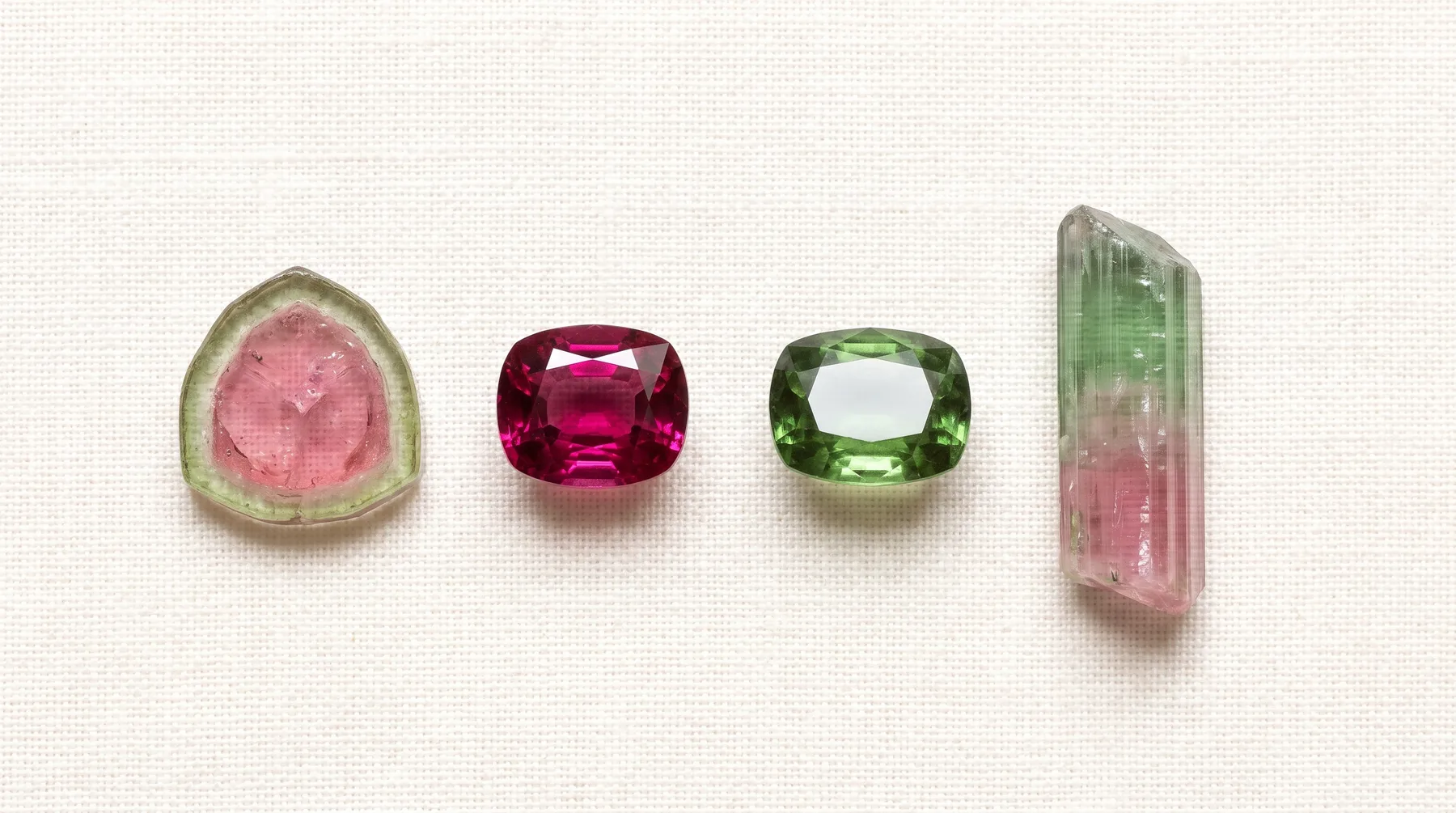
Tourmaline shares October and deserves better than a footnote, because it does something no other gem manages: it comes in every color there is, and often several at once in one crystal.
The gem tourmaline most jewelry uses is elbaite, and the trade names follow the colors: rubellite for pink and red, indicolite for blue, verdelite for green, and watermelon for the crystals that grow with a pink core inside a green rind, which get sliced across so you can see both. Paraiba tourmaline, a copper-bearing variety first found in Brazil in the 1980s and later in Africa, produces an electric neon blue-green that is among the most expensive colored stone material on earth per carat.
For a wearer, the important facts are cheerful. Tourmaline is 7 to 7.5 on the Mohs scale, meaningfully harder than opal and hard enough for ordinary ring wear. It is strongly pleochroic, showing different colors down different crystal directions, which is why cutters orient it carefully and why a well-cut tourmaline looks better than a badly cut one at any price. Our catalog carries 408 styles declaring pink tourmaline and 581 styles naming tourmaline overall, which makes it the more available of October's two stones in practice.
Choosing October birthstone jewelry by the piece
1 min
Pendants are opal's natural home. Nothing hits a pendant, the stone sits where light moves across it, and the fragility question mostly disappears. A bezel adds security and a dark backing effect for very little money.
Earrings are the second-safest option and they show play-of-color beautifully because they move constantly.
Rings need thought. Choose a solid opal rather than a doublet, a bezel or a low protective setting, and a cabochon that sits close to the finger. For someone who works with their hands, tourmaline is the honest recommendation instead.
Bracelets are the worst format for opal, since a wrist collides with everything. If the piece is a gift for daily wear, choose tourmaline or accept the risk knowingly.
How to buy an opal worth keeping
1 min
The questions that protect you are about construction and origin more than about beauty, because beauty is the part you can already see.
- Ask: solid, doublet, or triplet. Then look at the stone edge-on yourself and confirm the answer.
- Ask: natural or laboratory-created. Four out of five opal styles in our own catalog are created, so this is the default question rather than a suspicious one.
- Ask whether it is hydrophane. Most Ethiopian material is, which changes the care rules and matters if the stone will ever get wet.
- Look at it in at least two lights and from several angles, including from across the room. Opal is the one gem where the shop's lighting can flatter a mediocre stone into something else.
- Check the surface with a loupe for existing crazing, especially on older or estate pieces. Fine crack networks do not reverse.
- Buy the setting as carefully as the stone. A bezel is not a style choice on an opal ring; it is the difference between a decade and a season.
Caring for opal jewelry
1 min
Short list, strictly followed, and it is mostly about water and heat.
- Never use an ultrasonic or steam cleaner. Vibration and heat are the two fastest routes to crazing, and on a doublet or triplet water in the glue joint ruins the stone outright.
- Clean with a soft damp cloth and nothing else. No solvents, no ammonia, no jewelry dips, no oil. Our gold cleaning guide covers the metal, and the stone gets the cloth.
- Do not soak a solid opal, and never wet an assembled one. Hydrophane material will absorb whatever it is soaked in, including dyes and oils, and will look wrong until it dries, if it recovers at all.
- Avoid heat and dryness. No hot cars, no sunny windowsills, no long spells in a dry safe. If a piece is being stored for years, a cotton pouch in a normally humid room is kinder than a vault.
- Put it on last and take it off first, and keep it away from perfume, hairspray and cleaning products.
- Store it alone. Nearly everything else in a jewelry box is hard enough to scratch it.
Frequently Asked Questions
2 min
What is October's birthstone?
Opal and tourmaline. Opal is the traditional stone and tourmaline the modern addition, and both appear on current birthstone lists, so either is a correct choice for an October birthday.
Why do opals crack, and can it be fixed?
The fine crack network is called crazing, and it comes from drying or thermal shock in a stone that contains water. It is permanent. A badly crazed opal can sometimes be re-cut smaller if the damage is shallow, but there is no repair that restores the original stone.
Are lab-created opals real opals?
They are opal in the material sense, with the same silica-sphere structure that produces play-of-color, and they must be described as created or synthetic. They are more uniform and more stable than natural opal, and considerably cheaper. In our own catalog, 80% of the classifiable opal styles are laboratory-created.
What is the difference between a solid opal and a doublet?
A solid opal is one piece of opal throughout. A doublet is a thin slice of opal glued to a dark backing to imitate a black opal, and a triplet adds a clear cap on top. Assembled stones are worth far less, cannot be re-polished, and are ruined by water reaching the glue. Look at the stone from the side: a perfectly straight dark line means an assembled stone.
Can I wear an opal ring every day?
With care and the right setting. Choose a solid opal in a bezel or another protective mounting, take it off for cleaning, gardening, the gym and swimming, and accept that it will need more attention than a sapphire would. For hands that work hard, tourmaline is the better October stone.
Are opals really bad luck?
No, and the superstition has a traceable origin: Walter Scott's 1829 novel Anne of Geierstein, in which an opal's fire dies along with its owner. The book was a bestseller, the association stuck, and a fashion story has been mistaken for folklore ever since.