
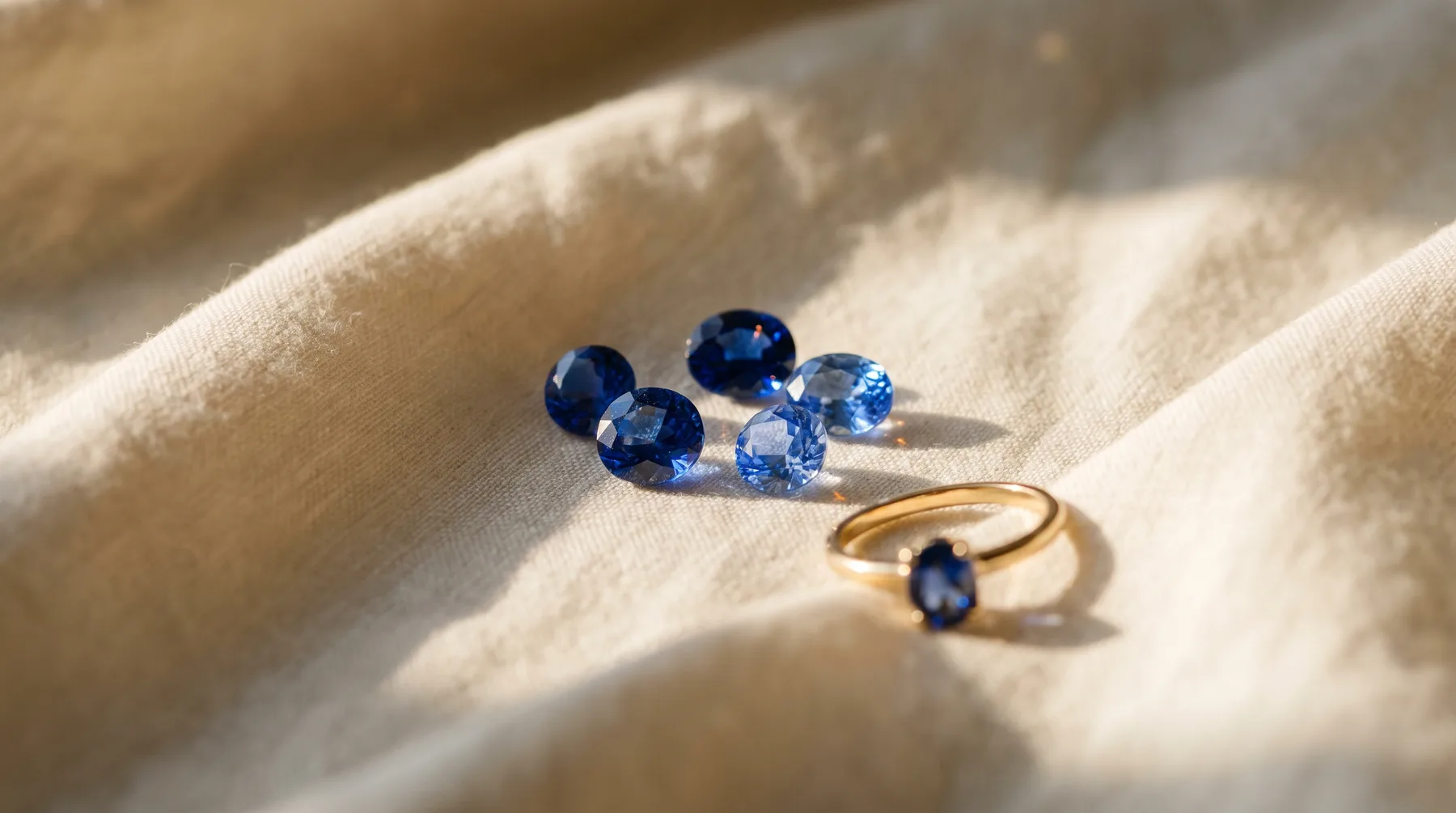
September's birthstone is sapphire, and the first thing to know about it is that blue is only one of its answers. Sapphire is gem corundum, and gem corundum comes in every color there is. Call it red and it becomes a ruby; everything else on the spectrum, including pink, yellow, green, violet, colorless and the pink-orange rarity called padparadscha, is sapphire.
The second thing to know is that it wears like almost nothing else. At 9 on the Mohs scale, with no cleavage plane waiting to split, sapphire is the gemstone a jeweler recommends without hesitation for a ring worn every day. That combination, endless color and genuine toughness, is why sapphire has been set into royal jewelry for eight centuries and why it keeps turning up in engagement rings that were never meant to be traditional.
A stone that has meant the sky for three thousand years
1 min
The name arrives through Latin sapphirus and Greek sappheiros, and the earliest uses almost certainly described lapis lazuli rather than corundum, which is a useful reminder that ancient gem names traveled by color, not chemistry. By the Middle Ages the confusion had settled, and sapphire had become the clergy's stone: medieval bishops wore sapphire rings, on the reasoning that a blue gem drew the wearer's mind toward heaven.
Ancient Persian tradition held that the earth rested on a giant sapphire, and the sky was blue because it reflected it. That is the kind of story a gem earns only when its color is genuinely striking, and it has followed the stone into the modern era largely unchanged. Sapphire also carries the fifth and forty-fifth wedding anniversaries, so it collects a second wave of buyers who arrive for a date rather than a birthday.
The meaning behind the stone
1 min
Sapphire's traditional associations are sincerity, faithfulness, wisdom and protection, which is a much more specific bundle than most birthstones carry. Star sapphires in particular were kept for centuries as talismans against ill will, on the belief that the three crossing rays of the star stood for faith, hope and destiny.
None of that is a claim we can verify with a spectrometer, and we are not going to pretend otherwise. What is true is that the meanings are old, consistent across cultures, and part of why the stone reads as serious. A sapphire given for a fifth anniversary is understood by nearly everyone who sees it.
Every color except one
1 min
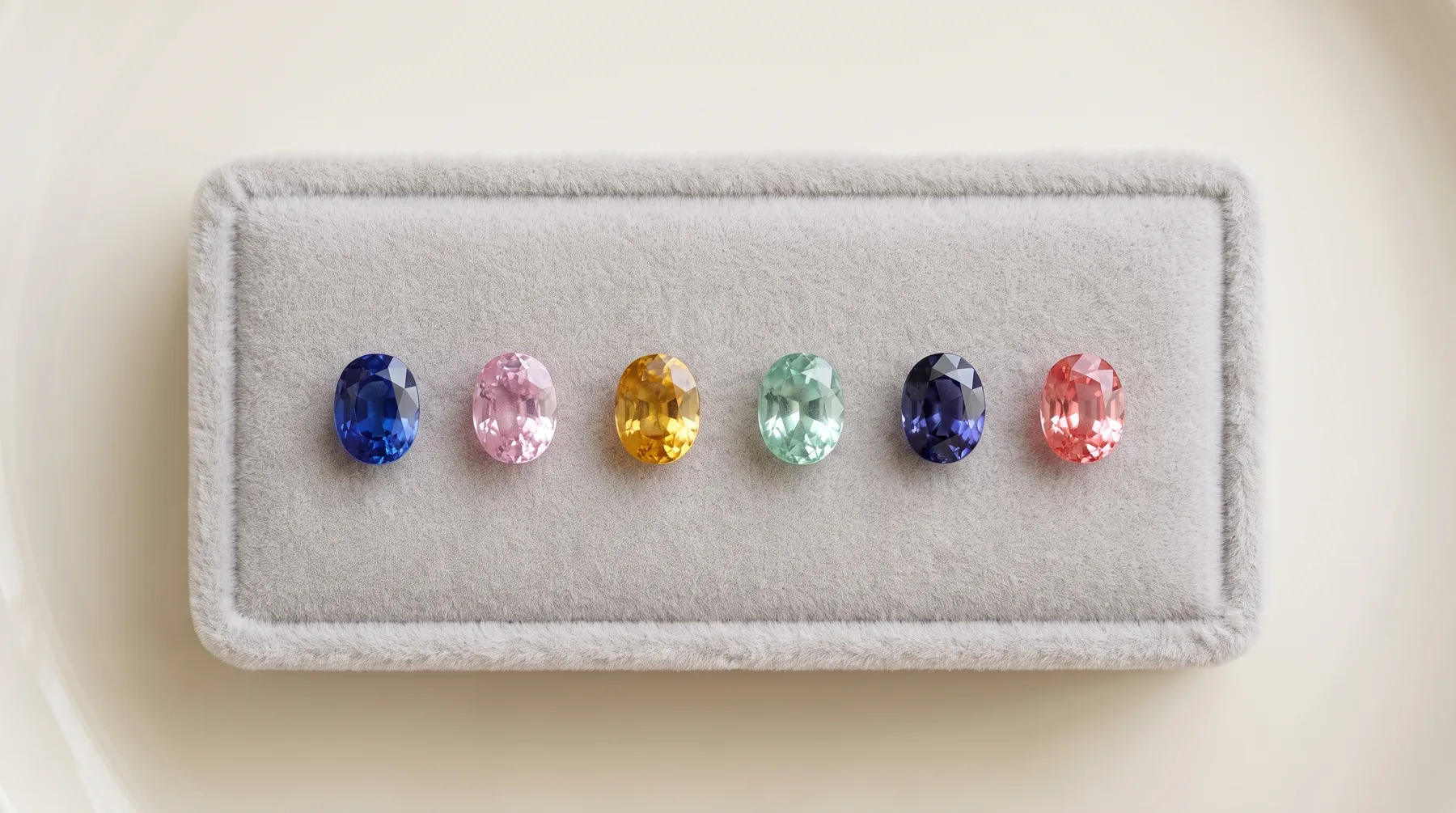
Sapphire and ruby are the same mineral: corundum, aluminium oxide, colorless when pure. Trace elements do all the work. Iron and titanium together produce blue. Chromium produces red, and when there is enough of it the stone is called a ruby rather than a sapphire, which makes ruby the only corundum with its own name. Iron alone tends toward yellow and green. Combinations of chromium and iron give the pinks and oranges.
Sapphires that are not blue are sold as "fancy sapphires" and are always named by color: pink sapphire, yellow sapphire, green sapphire. A stone described only as "sapphire" with no color word is understood in the trade to be blue.
Two phenomena are worth knowing by name. Silk is a haze of fine rutile needles inside the stone; in modest amounts it softens light beautifully, and in quantity it makes a stone sleepy. When those needles align in three directions and the stone is cut as a dome, the result is asterism, the six-rayed star of a star sapphire, which moves across the surface as the stone turns. A star sapphire is judged by how sharp, straight and centered that star is, not by clarity in the usual sense.
Padparadscha, the lotus sapphire
1 min
Padparadscha is a pinkish orange to orangey pink sapphire, and its name comes through Sinhalese from a Sanskrit phrase for lotus color. It is one of the very few gem varieties defined by a hue rather than a species, and one of the rarest things in the corundum world; laboratories are cautious about applying the name, and two respected labs can disagree about a borderline stone.
If you are shown a padparadscha at a price that seems reasonable, ask two questions: is it corundum, and has it been lattice diffused. Beryllium diffusion produces exactly this color range in ordinary sapphire, and a diffused stone is worth a fraction of a natural one. The answer belongs on a laboratory report, not in a conversation.
Where sapphire comes from today
1 min
Sri Lanka, historically Ceylon, has produced sapphire for more than two thousand years and still offers the widest range of colors, including most of the world's padparadscha. Madagascar has been the major modern source since deposits opened in the 1990s and supplies excellent material across the blue range, usually at prices below equivalent Ceylon stones. Myanmar produces some of the richest blues. Australia and Thailand contributed enormous quantities of darker, iron-rich material, and Thailand remains the trade's cutting and heat-treatment center regardless of where a stone was mined.
Two origins carry a premium out of proportion to what you can see. Kashmir sapphires, from a deposit high in the Himalayas that produced for barely a decade in the 1880s, have a velvety cornflower blue that the trade has never stopped chasing; the mine is exhausted and documented Kashmir stones sell at multiples of anything comparable. Montana is the only significant American source, with Yogo Gulch and the Rock Creek and Missouri River deposits producing small, clean, vividly colored stones. Yogo sapphires are famous for needing no heat treatment at all, which is genuinely unusual.
Origin premiums are real, but they are premiums on paper as much as on the stone. Two sapphires can look identical and differ in price by a factor of five because one has an origin report. Buy the stone you like first; treat origin as a collector's decision.
How sapphire wears in real life
1 min
This is where sapphire earns its place in daily jewelry. At Mohs 9, only diamond and moissanite outrank it, and it has no cleavage, the internal plane along which a crystal splits under a sharp knock. Diamond is harder but does have cleavage; sapphire trades a little hardness for the absence of that particular failure mode.
A caution on the Mohs scale, since it gets quoted as if it were linear. It is a ranking, not a ratio: the gap between corundum at 9 and diamond at 10 is far larger than the gap between 8 and 9. Sapphire will still be scratched by diamond, and a sapphire ring stored loose in a drawer alongside diamond rings will pick up marks.
In practical terms, a sapphire ring survives typing, dishes, gardening gloves and a decade of school runs. Compare that with the August birthstone, peridot, at 6.5, which wants to live in earrings and pendants. If someone wants a colored stone in an everyday engagement ring, sapphire is the first suggestion for a reason.
Heat, diffusion, and what has to be disclosed
1 min
Assume any sapphire you are shown has been heated unless a report says otherwise. Heat treatment has been used for centuries, it improves color and dissolves silk, it is stable and permanent, and the trade accepts it completely when disclosed. Industry estimates put the share of commercial sapphire that has been heated at 90 to 95 percent, which means an unheated stone is the exception you pay for.
The treatments that change what a stone is worth sit further along:
- Lattice diffusion drives an element into the surface layer of the stone at high temperature, most often beryllium for orange and pink-orange colors, or titanium for blue. The color lives in a skin, so a re-polish can reduce it. Diffused stones sell for a small fraction of untreated equivalents.
- Fracture filling with glass fills surface-reaching breaks to hide them. Filled stones are fragile in ways plain corundum is not: they can be damaged by ultrasonic cleaning, steam, and jewelers' torches during ordinary repairs.
- Dyeing and coating appear at the bottom of the market and are neither stable nor acceptable undisclosed.
United States sellers are required by the FTC Jewelry Guides to disclose treatments that are not permanent, that create special care requirements, or that significantly affect value. A seller who cannot tell you a stone's treatment status has told you which end of the market they buy from.
What our catalog says about "sapphire" at the counter
1 min
Here is something worth knowing before you shop the mass market. Of the 1,772 sapphire styles in our vendor catalog as of August 2026, 812, or about 46 percent, are laboratory-created sapphire rather than mined.
That is not a scandal. Laboratory-created corundum has been made since the early twentieth century, it is chemically and physically identical to mined sapphire, it is flawless and vividly blue, and it is inexpensive. It is the reason a "sapphire" pendant can cost thirty dollars. The rule is disclosure, and the required terms are the same as for diamonds: laboratory-created, laboratory-grown, or [manufacturer]-created, sitting right next to the word sapphire.
So when a sapphire piece is priced like costume jewelry, that price is telling you what the stone is. Read the description, and if it is silent on origin, ask.
Choosing September birthstone jewelry by the piece
1 min
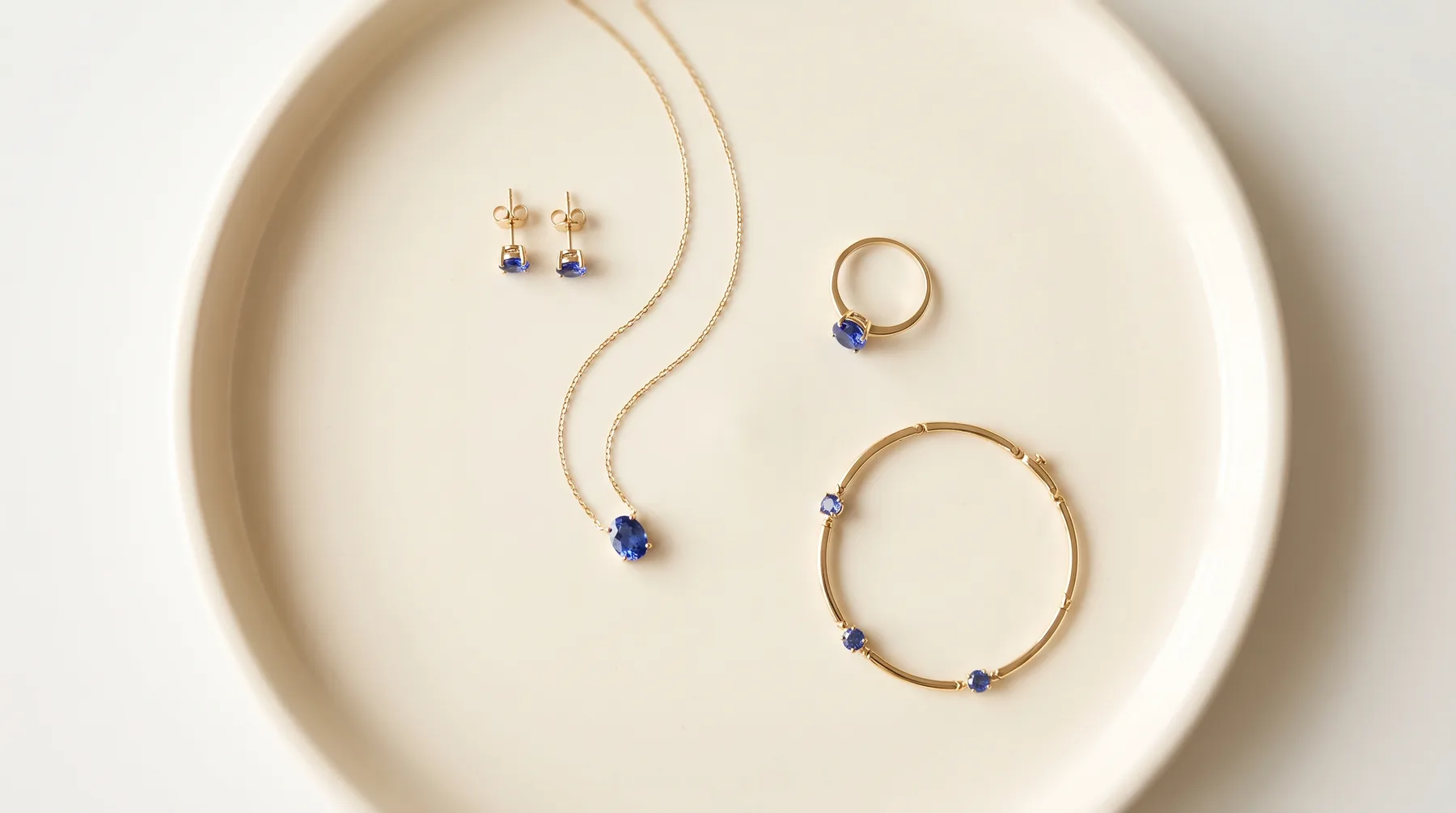
Different pieces ask different things of the same stone.
- Rings. Sapphire's best case. Pick a medium to slightly dark blue that keeps its color under warm indoor light, and set it in a design with some protection around the girdle. Our guide to engagement ring settings covers which styles do that, and it is worth measuring the finger properly before ordering a colored stone piece, because many are made to order.
- Earrings. Where a stone that is too dark for a ring can be perfect. Earrings are seen at a distance and in motion, and darker blues read as richer rather than sleepy.
- Pendants. The place for an unusual color. A yellow or a green sapphire that would look eccentric on a hand looks deliberate at the collarbone.
- Bracelets. The most abused position in a jewelry wardrobe, which sapphire tolerates. Check the clasp rather than the stones.
- Star sapphire cabochons. A stone with real presence in a men's ring, and a category where an old cut is often better than a new one.
How to buy a sapphire worth keeping
2 min
Color carries most of the value in any colored stone, and in sapphire it carries almost all of it. Work in this order.
- Color first, and judge it in two lights. The best blues are vivid and medium to medium-dark, saturated without going inky. Fluorescent shop lighting flatters blue; take the stone to a window and then look at it under a warm lamp. A stone that goes black at night is a stone you will stop wearing.
- Clarity second, by eye. Sapphire is a Type II gem, expected to have some inclusions. What matters is whether you see them without a loupe and whether silk is dulling the stone's brightness, not what a microscope finds.
- Cut third, and take it seriously. Colored stones are cut to save weight far more often than diamonds are, and a deep, lumpy sapphire looks smaller and duller than a well-proportioned one of the same weight. Look at the stone face-up: is the whole face alive, or is there a flat window through the center?
- Then treatment and origin. Ask directly. For any significant purchase, get a report from an independent laboratory, and if origin is part of why you are paying, insist the report states it. The habits in our guide to reading a laboratory report apply here too: verify the document, match it to the stone.
- Carat weight last. Sapphire is denser than diamond, so a one-carat sapphire is a smaller stone than a one-carat diamond. Buy by millimeter dimensions if the size on the finger is what you care about.
The engagement ring crossover
1 min
Sapphire's modern popularity in engagement rings traces to one ring. In 1981 Diana chose a 12-carat oval Ceylon sapphire surrounded by diamonds from Garrard's catalog, a piece anyone could have ordered, which was mildly scandalous at the time for exactly that reason. It passed to Catherine, Princess of Wales, in 2010, and jewelers have been making versions of it ever since.
The trade reason it works is more prosaic than the royal one. A sapphire center stone costs a fraction of a comparable diamond, wears nearly as well, and photographs as a color rather than a size. If the goal is a ring nobody else in the room is wearing, a fancy-color sapphire in an unusual cut does more for the money than any grade improvement on a colorless stone.
Caring for sapphire jewelry
1 min
Warm water, a drop of dish soap, a soft toothbrush behind the stone where the film collects, then rinse and dry. That is the whole routine for an untreated or heat-treated sapphire, and it is the same method as our guide to cleaning gold jewelry at home.
Ultrasonic and steam cleaners are generally safe for untreated and heat-treated sapphire, and genuinely unsafe for fracture-filled, dyed or heavily included stones. Since most people cannot tell which they own, the safe policy is soap and water at home and a jeweler's judgment for anything more aggressive.
Two more habits worth keeping. Store sapphire pieces separately, because a 9 will scratch nearly everything else in the box and diamond will scratch it back. And have prongs checked once a year: a sapphire is tough enough to survive being knocked out of a worn setting and rolling under a car seat, which is not the same as being findable.
Frequently Asked Questions
1 min
What is September's birthstone?
Sapphire, in any color except red. Red gem corundum is called ruby, which is July's birthstone. Sapphire also marks the fifth and forty-fifth wedding anniversaries.
Are all sapphires blue?
No. Sapphire occurs in pink, yellow, orange, green, purple, colorless and the pink-orange padparadscha, all sold as fancy sapphires. A stone called simply "sapphire" with no color named is understood to be blue.
Is a laboratory-created sapphire a real sapphire?
Chemically and physically, yes: it is corundum with the same hardness and optics. It is not mined, it is far cheaper, and United States sellers must disclose it with a term such as laboratory-created next to the word sapphire.
Are sapphires heated?
Most are. Industry estimates put the heated share of commercial sapphire above 90 percent, and heat is a stable, accepted treatment when disclosed. Unheated stones with laboratory documentation command a substantial premium.
Is sapphire durable enough for an everyday engagement ring?
Yes. At Mohs 9 with no cleavage, it is one of the few colored stones a jeweler will recommend for daily wear without qualifications about how careful you need to be.
How should I clean a sapphire ring?
Warm water, mild dish soap and a soft brush, then rinse and dry. Skip the ultrasonic unless you know the stone is untreated or heat-treated only.