
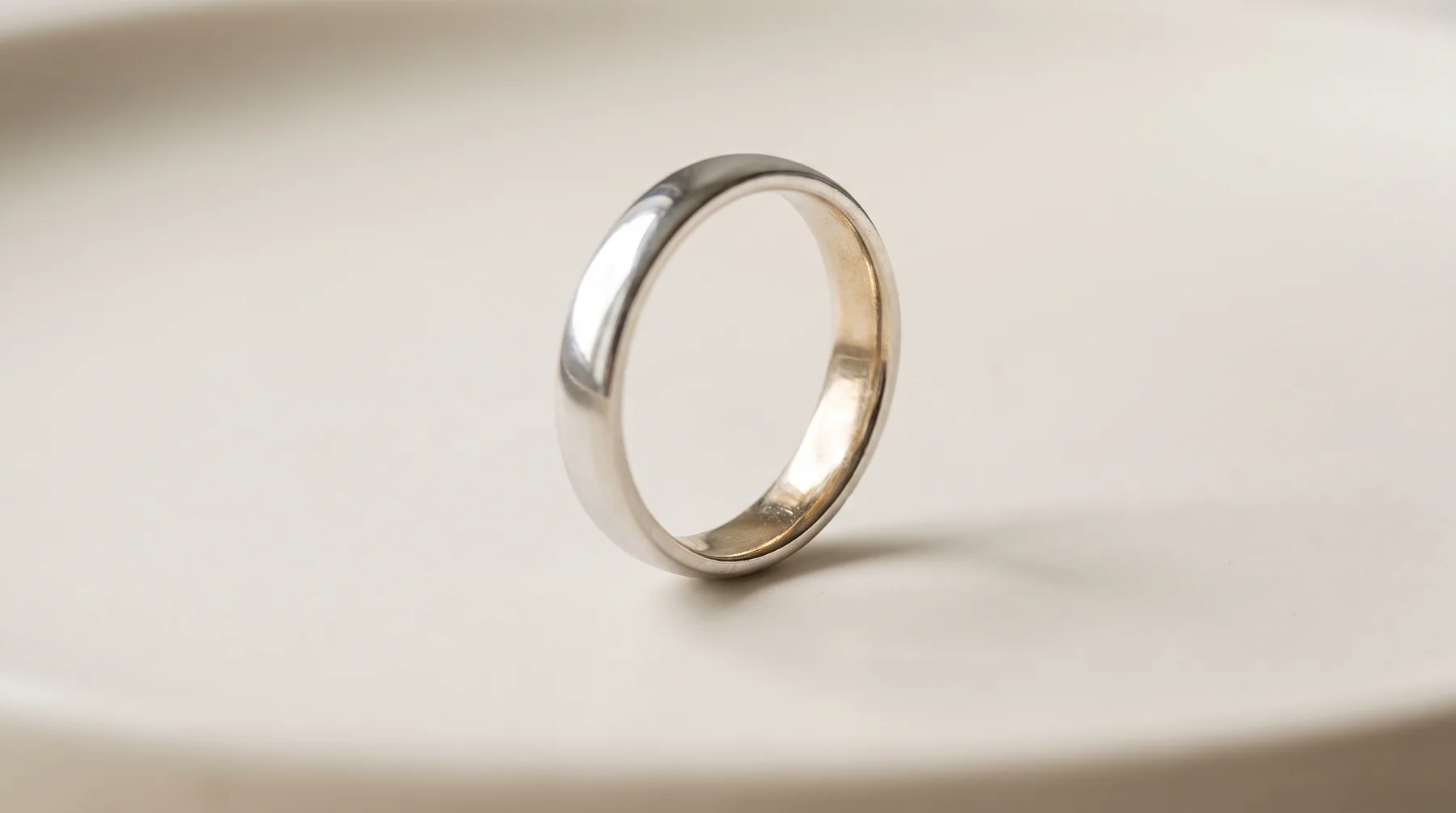
Rhodium plating is a microscopically thin layer of rhodium, a platinum-group metal, electroplated over white gold to make it bright, hard-surfaced and genuinely white. Almost every white gold ring sold in the United States leaves the factory wearing one. It wears off. That is not a defect and it is not a jeweler cutting a corner: it is how the product is designed, and knowing it before you buy changes which ring you choose.
The plating on a ring worn every day typically lasts one to three years. Re-plating is a routine bench job that US shops were publishing at roughly $60 to $120 per ring in August 2026. The part nobody tells you is that the job includes a polish, and polishing removes a little gold every time.
What is rhodium?
1 min
Rhodium is a silvery-white metallic element in the platinum group, alongside platinum, palladium, iridium, osmium and ruthenium. It does not tarnish or corrode in air at room temperature, it is extremely reflective, and at roughly 6 on the Mohs scale it is harder than the gold alloy underneath it. Those three properties are the entire reason it ended up on your ring.
It is also one of the rarest elements in the earth's crust, present at about 0.001 parts per million, and it is priced accordingly. The Umicore 10am quote on 13 August 2026 was $8,800 per troy ounce, in a range of $8,250 to $8,800 over the first two weeks of the month; Heraeus forecast a $6,000 to $9,000 band for 2026 as a whole. Rhodium has spent years trading well above gold, and that number is a favorite scare statistic in jewelry marketing. It should not scare you. A plating bath deposits a fraction of a gram, and the metal is close to the smallest line on the invoice.
Why does white gold need rhodium plating at all?
2 min
Because gold is yellow, and nothing changes that. White gold is yellow gold alloyed with whitening metals, historically nickel and now frequently palladium, and the honest result is not white. It is a pale, slightly warm grey with a yellow undertone, closer to the color of a well-worn nickel coin than to the color of platinum. Rhodium covers that undertone with a hard bright layer that reads as white to the eye.
The alloy question also has a health dimension worth knowing. Nickel is the most common contact allergen in the world, and the European Union restricts how much of it jewelry may release into skin. Under REACH regulation (EC) No 1907/2006, an article in prolonged contact with skin must not release more than 0.5 micrograms of nickel per square centimeter per week, tightening to 0.2 for post-piercing assemblies, measured by the BS EN 1811 and BS EN 12472 test methods that the Sheffield Assay Office applies. Nickel-whitened white gold has largely left the European market for skin-contact jewelry as a result, and palladium-whitened alloys took its place.
Here is the part that matters if you have reacted to jewelry before: rhodium plating is a barrier, and a barrier that is one micron thick is a barrier with an expiry date. It genuinely helps while it is intact. It is not a cure for a nickel allergy, because the day it wears through at the back of the shank is the day your skin meets the alloy.
How long does rhodium plating last?
1 min
One to three years on a ring worn daily is the honest range, and the number is set by two things: how thick the plating was applied, and what your hands do all day. Jewelry plating is normally deposited at 0.75 to 1.0 micron. For scale, a human hair is around 70 microns across, so the layer protecting your ring is roughly one seventieth of a hair. Plating much thicker than a micron is not the answer either, because rhodium deposits become brittle as they thicken and can craze rather than protect.
Position on the body does most of the rest. Ring shanks rub against everything: steering wheels, gym bars, keyboards, the inside of a pocket. Earrings and pendants barely touch anything and can hold their plating for many years. If a customer tells me the ring looks yellow at the bottom of the shank and perfect on top, nothing has gone wrong. That is exactly the wear pattern physics predicts.
What accelerates it: chlorinated pool water, hand sanitizer used a dozen times a day, cleaning products, salt water, and the abrasive habit of taking a ring on and off across a countertop. Perfume and lotion are less about chemistry than about the film they leave, which then holds grit against the surface.
What does re-plating cost, and what happens at the bench?
1 min
Published prices at US shops in August 2026 sit around $60 to $120 for a single ring, more for pieces with many stones, engraved surfaces, or a two-tone finish that has to be masked. The price is labor, not rhodium.
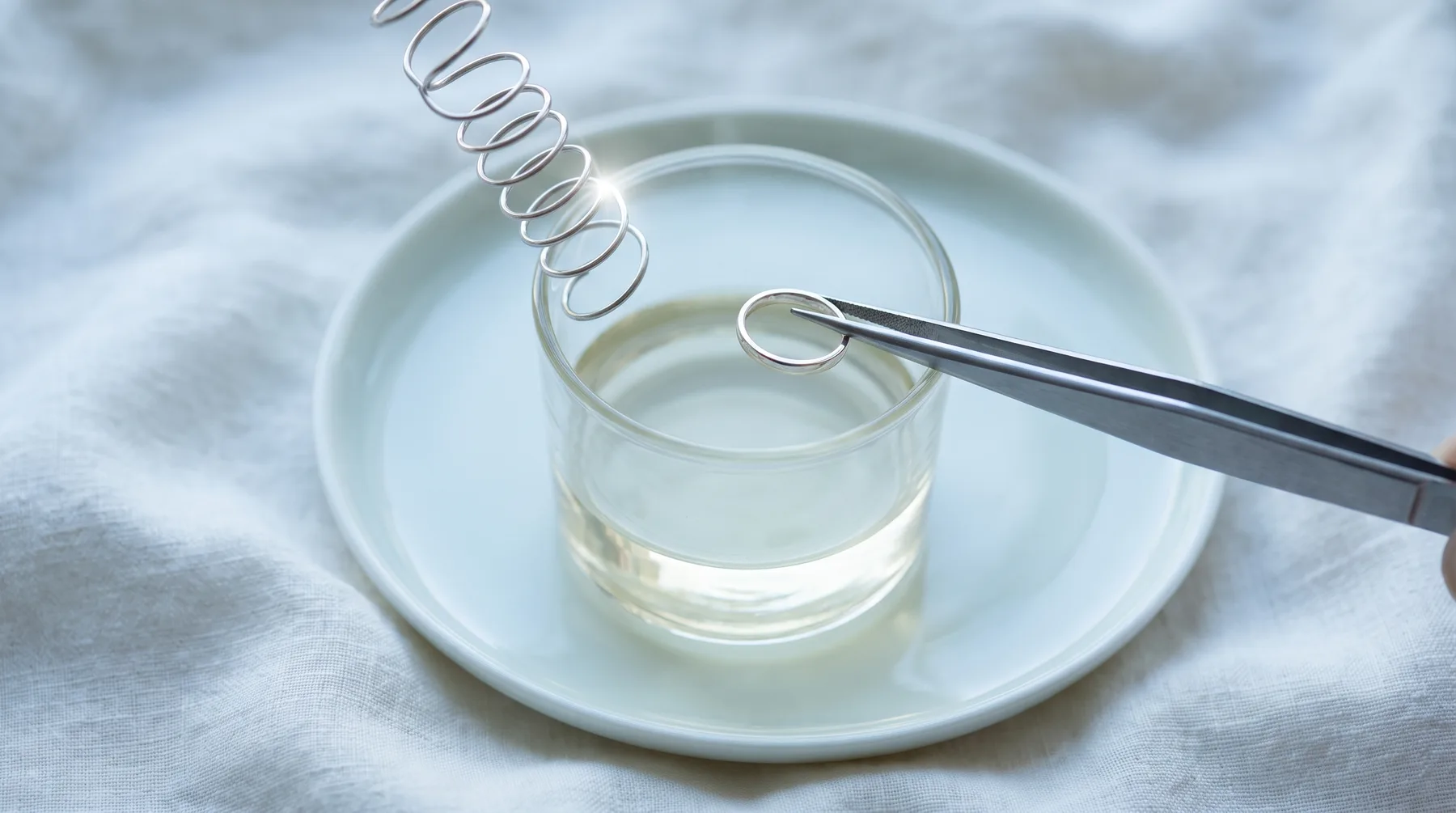
The bench sequence is unglamorous and mostly cleaning. The piece is polished back to a bright finish, run through an ultrasonic cleaner, rinsed in distilled water, steam cleaned, then electrocleaned in an alkaline bath before it ever reaches the rhodium. Plating itself takes two or three minutes at roughly 1.7 to 2.2 volts. Trade guidance from suppliers such as Stuller's bench library is consistent on the failure mode: almost every peeling, patchy or cloudy plating job traces back to incomplete cleaning or a fingerprint reintroduced after it, not to the plating step.
Ask two questions when you drop a ring off. First, will the prongs be checked while it is out of the tray, because the piece is already apart and inspected and that is when a worn prong costs nothing extra to find. Second, what happens to the engraving. Which brings up the thing most articles leave out.
The cost nobody mentions: every re-plate takes a little gold with it
1 min
Re-plating is not a coat of paint over the old one. The old plating and a thin skin of the gold beneath it are polished away first, because rhodium will not bond to a worn, contaminated surface. Do that every eighteen months for twenty years and the effect is cumulative: milgrain beading softens, hand engraving loses its crispness, hallmarks blur, and a light shank gets lighter.
So the rule I would give a friend is to re-plate on appearance, not on a calendar. If you cannot see the warmth coming through in daylight, leave it alone. There is no protective benefit being lost, only a cosmetic one, and a ring polished twice a year for the sake of a schedule will look tired in a decade in a way an unfussed ring will not.
Which stones should never go in the plating tank?
1 min
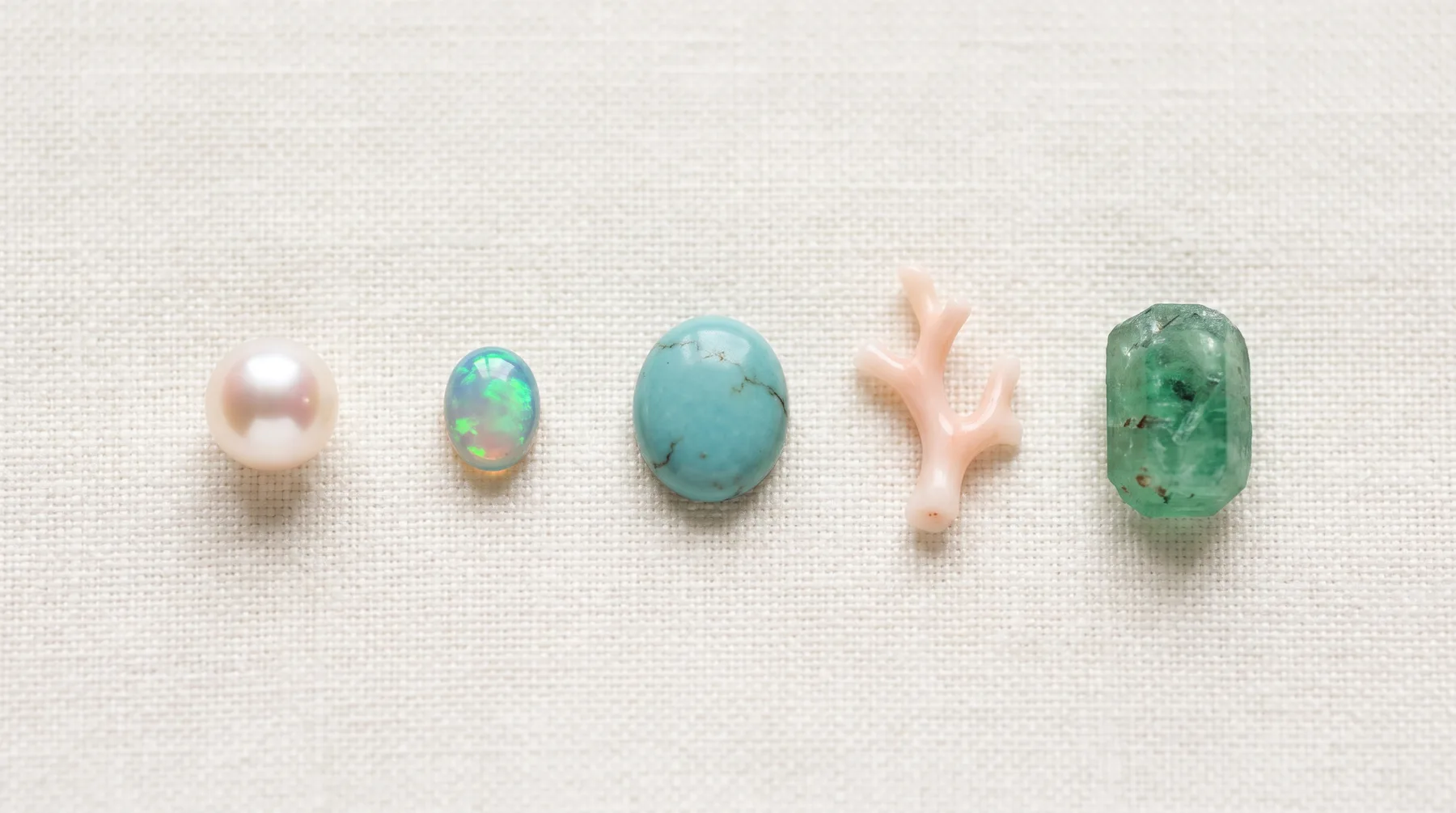
Pearls, opals, turquoise, coral, emerald, and anything porous, heavily fractured, dyed, or fracture-filled. The plating line involves acids, heat, ultrasonic energy and steam, and each of those is on the list of things that damage a porous or brittle gem. Pearls come out dull and pitted. Opals can craze. Oiled emeralds lose their filling and their inclusions suddenly show.
A good bench has answers: masking the setting with stop-off lacquer, plating with the stone out, or brush plating only the areas that need it. The answer you do not want is a shrug and a full dip. If your piece has any of those stones and a shop quotes you a flat dip price without asking about them, take it somewhere else.
What our catalog says about rhodium
1 min
Our catalog is a useful reality check here, because it covers a very large slice of what American jewelers actually stock. Of the 98,760 styles that declare a plating, 83,995 are rhodium. That is 85%, and no other plating comes close.
Break it down by metal and the picture gets clearer. Of the 40,520 14k white gold styles, 38,693 are rhodium plated: 95%. White gold without rhodium is close to a special order. Another 32,284 rhodium-plated styles are sterling silver, which is why a silver chain bought this decade may never have tarnished on you. And 1,901 styles are listed as 14k yellow and rhodium, with a further 435 in 10k, meaning that crisp two-tone contrast is often not two golds at all: it is one gold and a plated highlight, and it fades on the same clock as everything else here.
The counter-example is instructive. Our catalog carries 51,092 white gold styles across 10k, 14k and 18k, against 1,381 in platinum. Platinum never needs plating, and it is still outnumbered roughly 37 to 1, which tells you the trade decided decades ago that a maintenance step was an acceptable price for the cost difference.
How to make a plating job last longer
1 min
None of this is exotic, and all of it works:
- Take the ring off for the pool, the gym, cleaning, and gardening. Chlorine and grit do more damage in one afternoon than a month of ordinary wear.
- Put jewelry on last, after lotion, perfume and hairspray have dried.
- Wash it with warm water, a drop of dish soap and a soft brush, and dry it properly. Our guide to cleaning gold jewelry at home covers the method and what to keep away from it.
- Skip the drugstore polishing cloth on plated pieces. Those cloths are impregnated with a mild abrasive, which is exactly the wrong tool for a one-micron surface.
- Store rings separately. Diamonds scratch everything, including the rhodium on the ring next to them.
The alternatives, honestly ranked
1 min
If the maintenance is the part you hate, there are three real ways out and one fake one.
Platinum is the direct answer. It is white all the way through, so wear changes its texture rather than its color: it develops a soft grey patina that many people prefer, and a polish restores it whenever you like. It costs more up front and it is heavier on the hand, which you will either love or notice forever.
Palladium-whitened white gold, worn unplated, is the quiet option almost nobody offers. It is a warmer grey than platinum and it will never be as white as a fresh rhodium finish, but it never needs a tank again. Ask before you buy; some manufacturers will supply a piece unplated on request.
Yellow or rose gold is the answer for anyone whose real objection is maintenance rather than color. Both wear their own color permanently. If you are weighing that trade-off, our guide to 10k, 14k and 18k gold covers how alloy choice changes durability and color depth.
The fake option is a thicker rhodium layer sold as a permanent fix. Beyond about a micron the deposit turns brittle, and a brittle coating fails by cracking instead of thinning, which looks far worse than honest wear.
Frequently Asked Questions
2 min
Does rhodium plating wear off?
Yes, always, and it is designed to. Expect one to three years on a ring worn daily and considerably longer on earrings or a pendant. Wear shows first on the underside of a ring shank and along the edges that contact other surfaces.
Can yellow gold be rhodium plated?
Yes. Plating yellow gold white is common for two-tone effects and for anyone who wants a white look without buying a new piece. Our catalog lists 1,901 styles as 14k yellow and rhodium. It wears the same way, and on a yellow base the wear is more visible because the color contrast underneath is greater.
Does rhodium plating stop a nickel allergy?
Only while it is intact. Rhodium is a genuine barrier and it is why some people wear white gold comfortably for a year or two. Once the plating wears through, the alloy is against skin again. If you are reliably nickel-sensitive, buy a palladium-whitened white gold, platinum, or a high-karat yellow gold instead of relying on a coating.
Why is my sterling silver chain not tarnishing?
It is probably rhodium plated. Roughly 32,000 of the rhodium-plated styles in our catalog are sterling silver, and the layer is doing what silver cannot do for itself: refusing to react with the sulfur compounds in air. When such a chain finally does start to darken, the plating has worn, not the silver failed.
How do I know when my ring needs re-plating?
Look at it in daylight, not under a shop's warm bulbs, and compare the top of the ring to the underside of the shank. When the underside reads visibly warmer than the top, the plating is thinning there. That is a cosmetic threshold, not an urgent one, so book it when the look bothers you rather than on a schedule.