
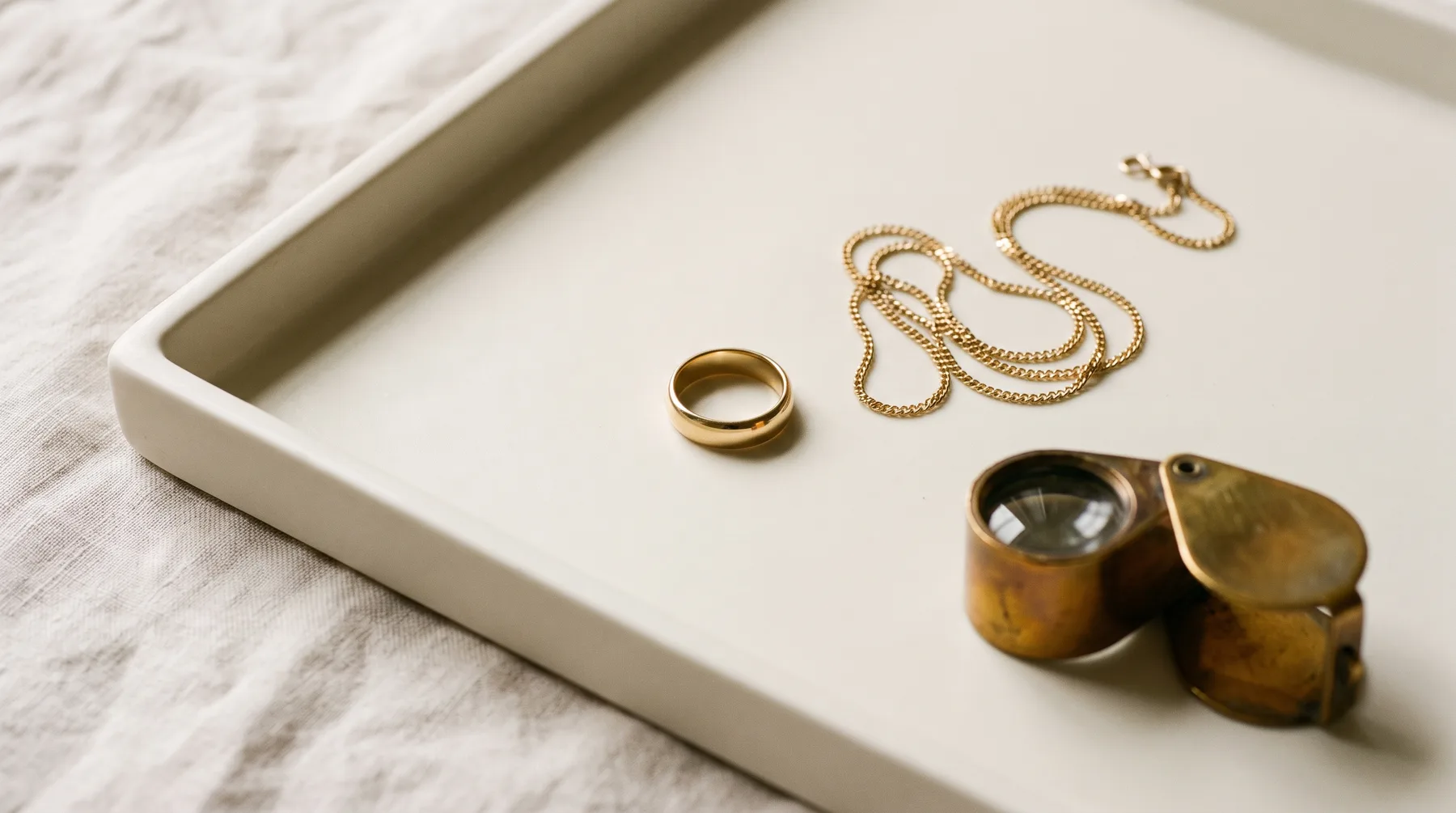
The short answer: real gold jewelry carries a karat stamp (10k, 14k, 18k) or a fineness number (417, 585, 750) with a maker's trademark next to it, and the only home test worth your time is a density check with a decent scale, because solid karat gold sits between about 11.6 and 15.6 g/cm³ and plated brass sits near 8.5. Magnets, bites, and vinegar prove almost nothing. For anything you paid real money for, or are about to, the answer is a jeweler with an XRF gun, who will test a spot below the surface if you ask.
Everything below is how a jeweler actually reads a piece: what the stamp means, what the law behind the stamp guarantees, why a listing can say "gold" and ship brass, the one home test that works (with the arithmetic), the tests that don't, and when to stop testing and pay for an answer.
What does the stamp on gold jewelry mean?
3 min
A gold stamp states the proportion of pure gold in the alloy, either as karats out of 24 (14k means 14 parts gold in 24, or 58.3%) or as a three-digit fineness in parts per thousand (585 means the same thing). The stamp is a claim, not a test result. In the United States nobody independently checks it before sale; in the United Kingdom, a hallmark means an assay office did.
The common marks, side by side:
| Stamp | Gold content | What it tells you |
|---|---|---|
| 10k / 417 | 41.7% | The lowest karat commonly sold as gold in the US. Hard, pale, real. |
| 14k / 585 | 58.3% | The default karat of American fine jewelry, and of most of our catalog. |
| 18k / 750 | 75% | Richer color, softer metal, roughly 28% more gold than 14k by weight. |
| 22k / 916 | 91.6% | Common in South Asian and Middle Eastern jewelry; rarely set with stones. |
| 24k / 999 | 99.9% | Essentially pure. Too soft for most jewelry; usually bullion or coin. |
| GP, GEP, HGE, RGP, GF, 1/20 12k GF | Surface layer only | Plated, electroplated, heavy electroplate, rolled gold plate, gold-filled. The base metal underneath is not gold. |
| 925 with a gold color | Sterling silver base | Gold vermeil or gold-plated silver. The 925 is honest; the gold is a coating. |
The second thing to look for is the mark next to the number. In the US a karat stamp is supposed to sit beside a trademark identifying the maker or importer. A piece that says "14K" and nothing else is not automatically fake, but it is unverifiable, and in a trade that stamps millions of pieces a year the ones that skip the trademark skip it for a reason more often than not.
The "ITALY" that follows "14K" on chains is a country-of-origin mark, not a quality guarantee, and a punch that says ITALY is as easy to buy as one that says 14K. Treat it as decoration.
How to read a UK hallmark
A British hallmark is the one marking system a shopper can actually trust on sight, because it is applied by an independent assay office after the metal has been tested. According to the Goldsmiths' Company Assay Office in London, a hallmark has three compulsory parts: the sponsor's mark (the registered maker or importer, usually initials in a shield), the millesimal fineness number, and the assay office mark, which shows which of the UK's assay offices tested the piece. The shape of the border around the fineness number tells you the metal, so a 750 in gold's cartouche and a 925 in silver's can never be confused. A date letter is optional. The Birmingham Assay Office notes that hallmarking is compulsory for gold items weighing one gram and over, and that every hallmarked gold item has been tested and certified by an authorised UK assay office.
That is the difference in one sentence: an American karat stamp is the maker's promise, and a British hallmark is a third party's measurement.
What does a karat stamp legally guarantee in the United States?
2 min
In the US, a karat mark is a regulated claim with a tight tolerance and a named party standing behind it, but no government office tests the piece before it is sold. The rules live in two places: the Federal Trade Commission's Jewelry Guides, 16 CFR Part 23, and the National Gold and Silver Stamping Act of 1906.
The Guides are blunt. Section 23.3(a) says it is "unfair or deceptive to misrepresent the presence of gold or gold alloy in an industry product, or the quantity or karat fineness of gold or gold alloy contained in the product." Section 23.3(b)(2) adds that using the word "Gold" for an alloy is misleading "unless a correct designation of the karat fineness of the alloy immediately precedes the word 'Gold' or its abbreviation, and such fineness designation is of at least equal conspicuousness." So "14 Karat Gold," "14K Gold," and plain "14K" are all acceptable markings; "Gold" by itself for a 14k piece is not.
The tolerance is small. Under the Stamping Act, codified at 15 U.S.C. 295, an article marked with a fineness may not test "less by more than three one-thousandth parts" than the mark where no solder is present, and seven parts per thousand where the tested part includes solder (three for watch cases and flatware). A 14k piece, nominally 583.3 parts per thousand, has to assay at 580 or better. Three parts in a thousand is the width of a rounding error; it is not permission to shave.
And the stamp has to be signed. 15 U.S.C. 297 requires any manufacturer or dealer who applies a quality mark to also "apply or cause to be applied to that article a trademark" that has been registered or applied for, by the same means as the quality mark, in lettering at least as large, and as close as possible to it. That trademark is the point of the whole system. A tolerance is only worth something if someone can be held to it.
Worth knowing: the Guides themselves are, in the FTC's words, its "current thinking," enforced through Section 5 of the FTC Act rather than as a standalone licensing scheme. In practice the honest part of the trade over-complies and the dishonest part ignores it, because a "14K" punch costs less than lunch and nobody inspects a marketplace listing. The law tells you what the stamp is supposed to mean. It cannot tell you whether this particular stamp is telling the truth.
Why can a listing say "gold" and still be plated?
3 min
Because the word "gold" is legal on a plated item as long as it is qualified, and the qualification only has to be somewhere nearby. A listing titled "18K Gold Chain" whose description says "18k gold plated over brass" is, read as a whole, arguably compliant. The FTC's rule, 23.3(b)(3), says "Gold" on a surface-plated product is misleading "unless the word 'Gold' or its abbreviation is adequately qualified to indicate that the product or part is only surface-plated." Sellers who want to mislead without technically lying put the qualifier where you will not read it.
The federal floor for calling something gold-plated is also thinner than most people assume. Section 23.3(c)(3) accepts "Gold Electroplate" on an electroplating of at least 10k gold with a minimum thickness equivalent to 0.175 microns of fine gold, roughly seven millionths of an inch. "Heavy Gold Electroplate" starts at 2.5 microns. A mechanically bonded layer can be called "Gold Plate" or "Rolled Gold Plate" at one-fortieth of the metal weight, and "Gold Filled" at one-twentieth. The construction behind each of those words, and how long each one lasts on a wrist, is the subject of our guide to gold vermeil vs gold-plated vs gold-filled vs solid gold.
One more change that catches buyers out. Until August 2018 the Guides said nothing under 10k could be called gold at all. The FTC's 2018 revision removed that threshold: an alloy of any karat may now be described as gold as long as the karat is disclosed with equal prominence. National Jeweler summarized the effect at the time: 8-karat, or even 5- or 6-karat material, can now be sold as gold in the US. The current text of 23.3(c)(1) lists "9 Karat Gold" among its acceptable markings. If a listing says "gold" and the karat is a number you have never seen in a jewelry store, it is real gold in the legal sense and very little of it in the physical one.
The word "solid" has its own rule. A hollow 14k chain is real 14k gold, and the Guides allow it to be sold as "14K Gold-Hollow" or "14K Gold Tubing," but the note to 23.3(c)(1) says such a product "should not be marked or described as 'solid.'" Hollow is not a scam. Hollow sold as solid is. Our guide to gold chain types covers which link styles are routinely made hollow and why.
Our own catalog is a useful yardstick for what honest listings look like. As of October 2026, every one of the 2,840 active gold products in the Karat & Kin catalog carries a vendor-declared karat in its attributes (2,804 at 14k, 103 at 10k, 3 at 18k), and 2,759 of them, 97%, state the karat in the product title itself. Of the gold styles that list a plating at all, 882 of 883 list rhodium, which is the standard white finish over white gold, not a disguise. A seller with nothing to hide puts the karat in the title, and a listing that makes you hunt for it has told you something.
Which home tests for real gold actually work?
3 min
One: the density test. Gold is extraordinarily dense, 19.3 g/cm³ for the pure metal according to the University of Sheffield's WebElements reference, and the alloys used in jewelry inherit most of that heft. Brass, the usual body of a fake, is a copper-zinc alloy, and copper is 8.92 g/cm³ and zinc 7.14. No plating can hide a difference that large, and a kitchen scale that reads to 0.01 g can measure it.
The reference numbers, from the specific-gravity table published by Stuller, the largest US jewelry-supply house, as of October 2026:
- 24k gold: 19.36 g/cm³
- 18k yellow gold: 15.58; 18k white gold: 14.64
- 14k yellow gold: 13.07; 14k white gold: 12.61
- 10k yellow gold: 11.57; 10k white gold: 11.07
- Sterling silver (so, gold vermeil): 10.40
- Platinum: 21.45
- Brass, for comparison: roughly 8.4 to 8.7, between its two ingredients
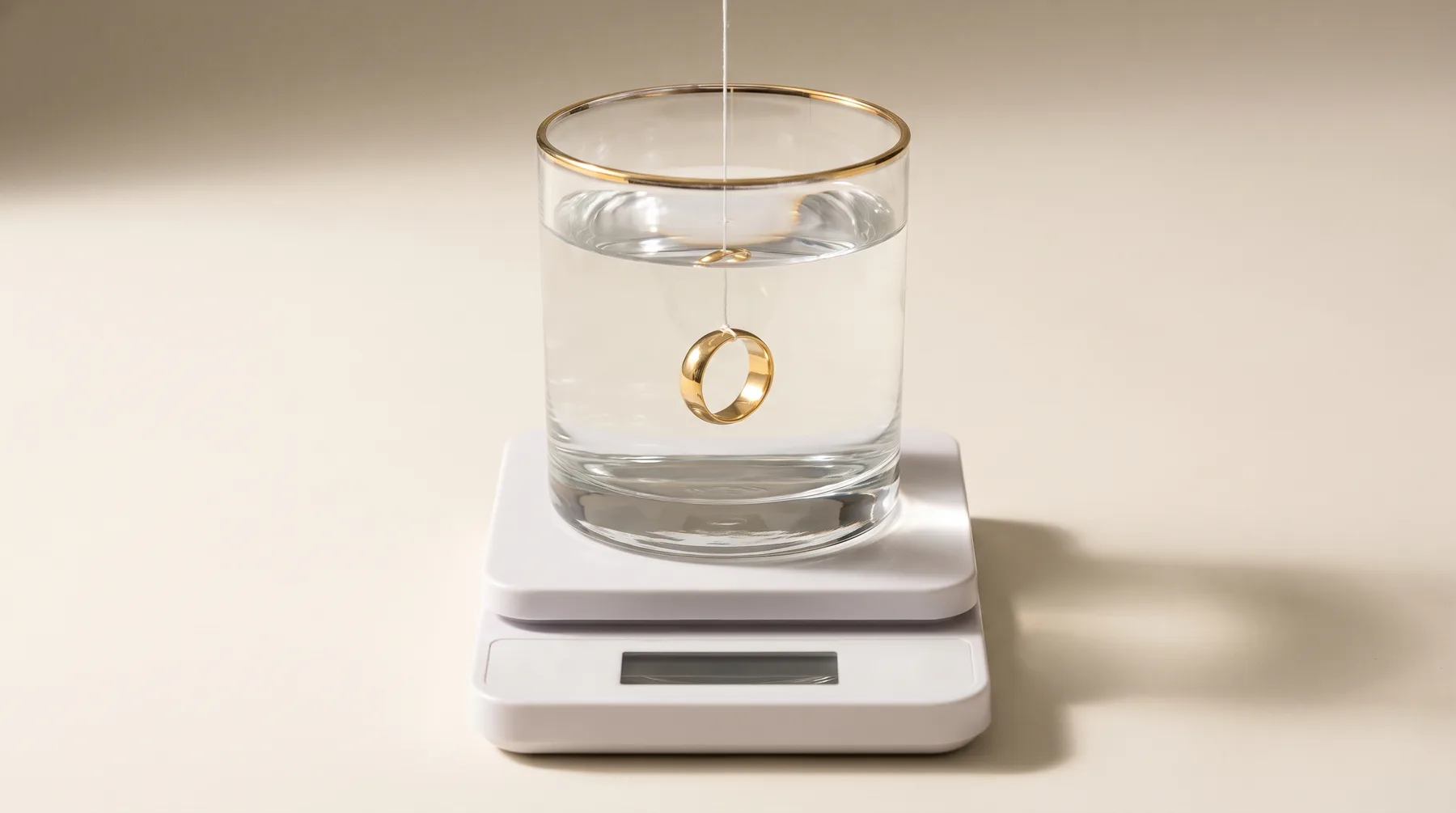
The procedure takes five minutes and uses Archimedes' principle: a submerged object pushes aside its own volume of water, and water weighs one gram per cubic centimeter.
- Clean and dry the piece. Weigh it on the scale. Write that down as the dry weight. Say a 14k ring reads 4.20 g.
- Put a glass of water on the scale, big enough to submerge the piece without it touching the sides or bottom. Press tare so the scale reads zero.
- Tie the piece to a thread (dental floss works) and lower it into the water until it is fully under, hanging from your fingers, not resting on the glass. Shake off any air bubbles clinging to it.
- Read the scale. The number is the weight of water the piece displaced, which in grams equals its volume in cubic centimeters. The ring reads 0.32 g, so its volume is 0.32 cm³.
- Divide dry weight by volume: 4.20 ÷ 0.32 = 13.1 g/cm³. That lands on 14k yellow gold's 13.07. A brass ring of the same dry weight would displace about 0.50 g and come out near 8.4. A vermeil ring would land near 10.4.
The test has real limits, and a jeweler would want you to know them before you trust it.
- Small pieces defeat cheap scales. A one-gram earring displaces about 0.08 g of water, and a scale that is honest to ±0.01 g gives you a ±12% answer. The method is for rings, bracelets, and chains over a few grams.
- Stones ruin the arithmetic. Diamonds and gemstones are a fraction of gold's density, so a stone-set piece reads low. Test plain metal pieces.
- Hollow pieces trap air. A hollow rope chain with a sealed air pocket reads far too light. Hollow chains with open ends read correctly once the bubbles are out.
- Alloys vary. Every maker's 14k white or rose mix is a little different, so treat the table as a guide to the neighborhood, not an exact target.
- Tungsten is the one common metal that matches gold. At 19.25 g/cm³ it is a near-twin of pure gold. For jewelry that matters less than it sounds: a piece stamped 14k that reads 19 is wrong in the other direction and just as worth a jeweler's look.
A good density reading tells you the body of the piece is a gold alloy and roughly which one. It cannot tell you whether a thin layer of 18k has been plated over a 10k body, which is a real trick we come to below.
Which gold tests are myths?
2 min
Most of them. The home tests passed around on video sites share a flaw: each one checks a property that fakes share with real gold, or checks only the surface, which on a plated piece is real gold by definition.
The magnet test
A magnet rules out one kind of fake and no others. Only iron, nickel, and cobalt are strongly magnetic; gold, silver, copper, and zinc are not, so a gold-plated brass chain sails through the magnet test as cleanly as a solid 18k one. A pass means "not steel." That is all it means. The reverse is also unreliable: a real chain can tug at a magnet because its clasp has a steel spring. The magnet is the first test every buyer runs and the last one any jeweler would rely on.
The bite test
Biting gold is a movie habit from the days of coin. Pure gold is soft enough to dent with teeth, but so are plenty of cheap base metals, and a dent says nothing about karat. Fourteen-karat jewelry alloy is hard enough that a bite mostly tests your dentist's patience. Skip it.
The vinegar test
The claim is that real gold is unchanged by vinegar while fakes discolor. Gold is indeed unreactive to household acids. So is a thin gold plating, which is what you are testing on a plated piece, and brass under a drop of vinegar does not do anything dramatic in the minutes you will watch it. The test has no failure mode a fake can actually trip.
"It turned my skin green, so it's fake"
Green or dark marks come from the copper and nickel in the alloy reacting with sweat, lotion, and whatever is on your hands. Real 10k and 14k gold does it to some people, and plated jewelry does it faster once the plating wears through, but the mark itself proves nothing about what is underneath. Our karat guide explains why lower karats are more prone to it.
The ceramic streak test
Dragging the piece across unglazed tile and reading the color of the streak is popular hobby lore. It scratches your jewelry, a plated piece leaves a gold streak because the plating is gold, and a dull brass alloy can leave a yellowish mark too. If you want a streak test, let a jeweler do it on a touchstone, with acids, in a spot that does not show.
"It feels heavy"
Heft without arithmetic is a feeling. Brass is heavy enough to feel substantial, and a real hollow chain feels suspiciously light. Weigh it, measure it, divide.
How does a jeweler test gold?
3 min
Three methods, in rising order of certainty and cost: the touchstone acid test, X-ray fluorescence (XRF), and fire assay. A good jeweler uses the first two together and knows exactly what each one cannot see.
Touchstone and acid
The piece is rubbed on a black stone, leaving a streak of metal, and graded acids (one for 10k, one for 14k, one for 18k, and so on) are applied to the streak. A streak that dissolves under the 14k acid contained less than 14k gold. The Assay Office London, which still uses the method alongside its instruments, describes it as giving "an initial indication of the fineness", and that is the right level of trust. It samples only what it rubs off. A careful tester files a small notch in a hidden spot, inside a shank or under a clasp, and tests the notch, because the surface of a plated piece is gold and will pass. If someone tests your piece with their own acid, on the surface, in front of you, and declares it solid, you have watched a demonstration, not a test.
XRF
An XRF gun fires X-rays at the metal and reads the element signatures that come back, giving a full alloy breakdown in seconds without touching the piece. The Assay Office London says XRF now does the vast majority of its assaying, nondestructively, in under 30 seconds; Bruker, which makes the instruments, rates handheld units within a few tenths of a percent of fire assay, with readings in two to five seconds. Many jewelers, refiners, and pawn shops will XRF a piece while you wait.
XRF reads the surface, which is both its virtue and its blind spot. It will usually catch plating when the coating is a different element from the base, because the base metal's signature leaks through. It is far less reliable when the coating and the base are the same element at different purities. The Gemological Institute of America (GIA) documented exactly that in its Summer 2025 Gems & Gemology lab notes: a rose gold piece whose 9k body sat under a 13.5k plating, and another whose 10k body sat under an 18k top layer. GIA's conclusion was that XRF "is unreliable when a piece of metal is coated with the same element" and that examination under a microscope, looking for wear-through and color breaks at edges, is essential. This is the trick that fools the gun, the acid, and the density test at once, since 10k under 18k still weighs like gold. It is also why the question to ask a tester is not "is it real" but "did you test below the surface."
Fire assay
Fire assay, or cupellation, melts a scraped sample and separates the pure gold from the base metals so it can be weighed. The Assay Office London still lists it among its methods. It is the definitive answer, and it destroys the sample. For jewelry it is reserved for refining lots and legal fights; you will never need it for a chain.
When should you have gold tested professionally?
1 min
Get a professional test whenever the gold value of the piece is more than the cost of asking, and always before paying a stranger for it. In practice that means four situations.
- Before buying from a private seller, a marketplace, or anyone met in a parking lot. Agree to meet at a jeweler or pawn shop with an XRF gun and let them test it. A seller who refuses has answered the question.
- Before selling or scrapping. Know your karat and weight before you walk in, so the buyer's reading has to agree with yours.
- For anything inherited, unmarked, or marked only with a karat and no trademark. Old pieces are often honest and under-marked; new pieces with a bare karat stamp are the ones to doubt.
- For insurance. An appraisal for a policy should state the tested karat and the metal weight, not repeat the stamp.
Ask three things at the counter: what method was used, whether the reading came from a filed spot or the surface, and whether the piece was checked for a hollow or filled construction. A jeweler who tests for a living will have answers to all three before you finish the question.
What do gold scams actually look like?
2 min
Seen from inside the trade, the scams are boringly consistent, because they all exploit the same gap: the stamp is free and the test costs effort.
- The stamped brass chain. Heavy rope or Cuban links, "18K" and "ITALY" on the clasp tag, sold below what the metal alone would cost at that day's gold price. The stamp is a punch anyone can buy. Weight is the tell: at 15.6 g/cm³ a real 18k chain of that size would cost more than the asking price in raw metal.
- The qualifier in the fine print. "Gold" in the title, "plated" in paragraph three, "brass" in the specifications. Legal on a technicality, dishonest by design.
- The seller's own acid. A surface scratch, a drop of something, "see, no reaction." You watched the plating pass.
- Same-metal plating. The GIA cases above: real gold over less real gold, built to beat the gun. Rare, deliberate, and the reason wear-through at an edge is worth a jeweler's loupe.
- Hollow sold as solid. Honest if disclosed, and the Guides forbid the word "solid" on it. A hollow chain also dents, and dents in a chain are a question worth asking before you pay.
The decision rule that sits under all of it: a stamp is a claim, a hallmark is a measurement, and a test is the only thing that settles the difference. Read the stamp, weigh the piece, and when the number of dollars is bigger than the number of minutes it takes to visit a jeweler, visit the jeweler.
Frequently Asked Questions
2 min
Does real gold stick to a magnet?
No. Gold, silver, copper, and zinc are not magnetic, so solid gold does not stick, but neither does gold-plated brass. A magnet only tells you a piece is not steel. A faint pull from a real chain usually means a steel spring inside the clasp.
What does 585 stamped on jewelry mean?
585 is the fineness of 14k gold in parts per thousand: 58.5% gold. European and many American pieces use the number instead of the karat; 417 is 10k, 750 is 18k, and 916 is 22k. On a British piece the number sits inside a hallmark, which means an assay office tested it.
Can gold-plated jewelry be stamped 14k?
Legally, only with a plating qualifier beside it, such as GP, GEP, HGE, or GF, and the karat then describes the gold layer, not the base metal. A plain "14K" on a plated piece is a false mark. In practice fakes carry plain karat stamps all the time, which is why the stamp alone proves nothing.
Is 10k gold real gold?
Yes. 10k gold is 41.7% gold by weight, carries a 417 fineness mark, and is the hardest of the common karats. It is lower in gold content than 14k or 18k, not less real, and a 10k stamp with a maker's trademark beside it is an honest mark under US law.
Does real gold turn your skin green?
It can. The green comes from copper in the alloy reacting with sweat and skin products, and 10k and 14k gold contain enough copper to do it on some people. Plated jewelry does it faster once the plating wears through. The mark says something about your chemistry and the alloy, not about whether the piece is gold.
Does "Italy 14k" on a chain mean it is real gold?
No. "Italy" is a country-of-origin mark, and a counterfeiter can stamp it as easily as the karat. What carries weight under US law is the karat mark with a registered trademark beside it, and what settles the question is a density check or a jeweler's test below the surface.