
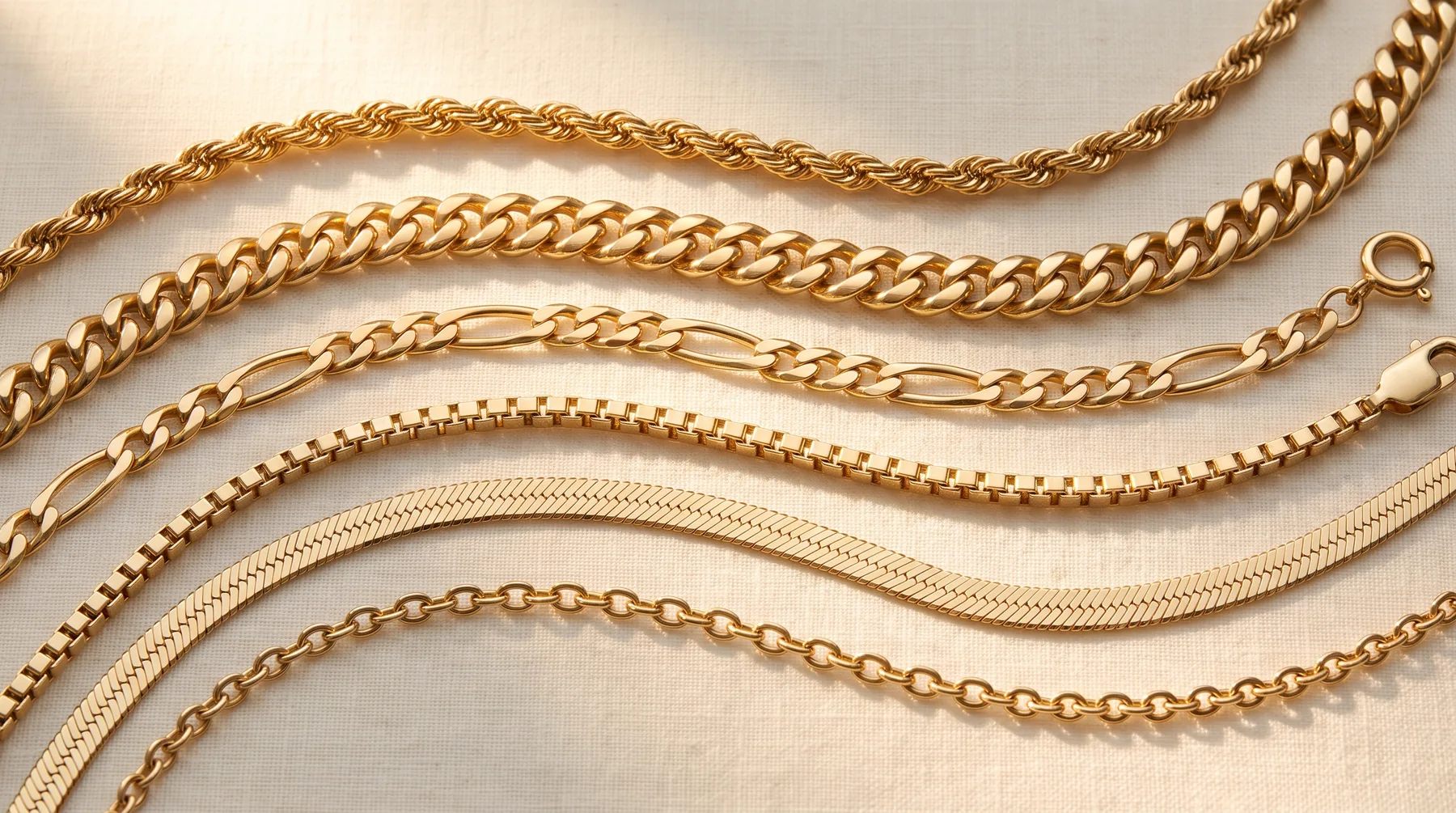
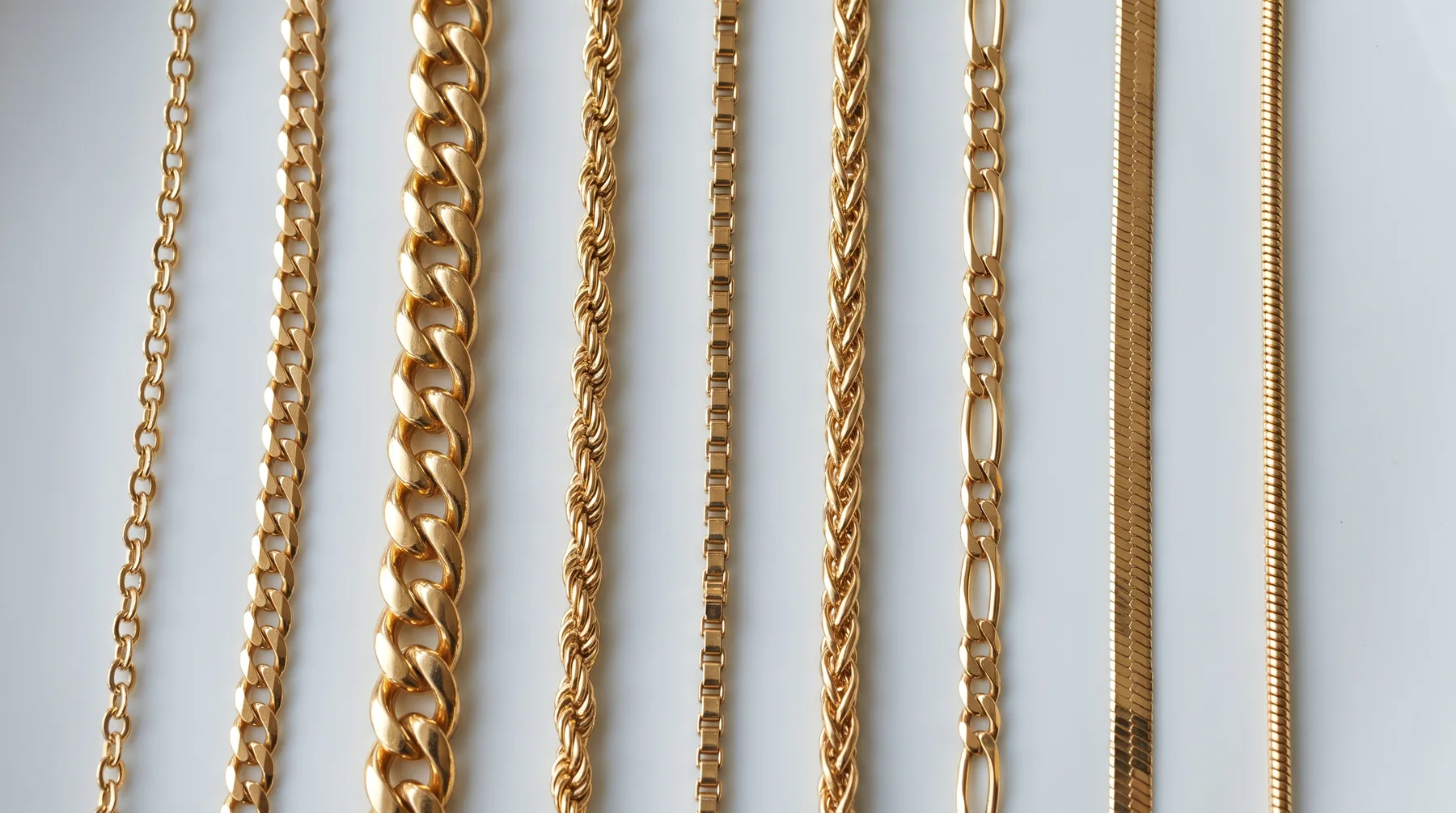
Nine link styles cover almost every gold chain sold in the United States: cable, curb, Cuban, rope, box, wheat, Figaro, herringbone and snake. Cable, curb, box and wheat are the safest everyday choices, because each link is a closed loop that a bench jeweler can re-solder if it opens; rope and Figaro sit close behind. Herringbone and snake are the two to buy with open eyes, since both fail by kinking rather than breaking, and a kink is usually permanent. Match the chain's width to the pendant it will carry, choose a lobster clasp over a spring ring once the chain weighs more than a few grams, and read the word "hollow" as a price-and-care trade rather than a defect.
That is the answer. The rest of this guide explains the why, chain by chain, because the reasons are what let you judge a chain that is not on this list. We lean on three things: how each link is actually made, what bench jewelers see when the chain comes back broken, and the supplier catalog behind our own store, which as of October 2026 carries 14,051 active gold chain styles tagged by link type, construction and clasp.
What are the main types of gold chains?
7 min
A chain type is the shape of one link plus the way that link is joined to its neighbors; together those two things decide how the chain drapes, how it catches light, and what gives out first. The table below is the short version. The sections after it go link by link.
| Chain | How it is built | What fails first | Carries a pendant? | Repair at the bench |
|---|---|---|---|---|
| Cable | Round or oval wire loops, each threaded through the last and soldered shut | One link pulls open, usually at the clasp or under the bail | Yes, at 1.2 mm and up | Easy |
| Curb | Cable links twisted and pressed flat so the chain lies flush | A link twists out of lie; wide curb almost never fails | Yes | Easy |
| Cuban | Curb links left thick and domed instead of flattened | Weight itself: clasp and end links take the strain | Rarely needed; it is the jewelry | Easy, but heavy to work |
| Rope | Several strands of small links twisted together in a spiral | One strand breaks and a section unravels | Yes, the classic pendant chain | Hard (re-weaving); hollow rope is the worst repair in the trade |
| Box | Flat wire folded into square links that meet face to face | A box crushed or stretched out of square stays bent | Yes | Moderate |
| Wheat (spiga) | Four strands of oval links twisted and braided into a dense, square-profile rope | Hard to kink; a cut strand is the only real failure | Yes, the strongest fine chain for its weight | Hard (re-weaving) |
| Figaro | Curb pattern of one long link alternating with two or three short ones | The long links, which are the thinnest metal in the chain | Yes | Easy |
| Herringbone | A multi-strand chain pressed flat so its links lie as slanted plates | Kinks; a kinked section never lies flat again | No | Not worth attempting |
| Snake | Tightly fitted curved plates forming a flexible tube | Kinks; the tube creases where it bends too far | Light pendants only | Hard |
Cable chain
A cable chain is the simplest chain there is: round or oval wire loops, each one passed through the one before and soldered closed. Because every link is a closed, soldered loop, a cable chain almost always fails at the one link that is not: the jump ring joining the clasp, or the link under a pendant bail that has been sawing at it for years. Both are five-minute repairs for any bench, which is why cable is the chain we recommend when someone asks for one chain to wear every day with a pendant. It is the second most common gold chain style in the supplier catalog behind our store, with 1,964 active styles as of October 2026, running from 0.8 mm up.
Curb chain
A curb chain is a cable chain whose links have been twisted and then pressed so they lie flat against the skin. The trade supplier Cookson Gold describes it as "uniform, twisted links that lie flat when worn", and that flattening is also why curb is the style most often diamond-cut: a flat face takes a bright cut well. Curb is the default men's chain in most of the world, and wide curb is close to indestructible. The thing to check on a thin curb is whether every link lies the same way; one that sits proud was under-soldered or twisted at the factory and will catch on clothing. 1,534 active gold styles in our supplier catalog.
Cuban link
A Cuban link is a curb link that was never flattened all the way. The New York wholesale supplier Ross Metals puts the distinction plainly: both start by twisting wire into a coil, and "depending on how flat the jeweler goes will be the final distinction". The rounder and thicker the link stays, the more Cuban it is; the flatter, the more curb. Thicker links mean more gold at the same width, so a Cuban is markedly heavier than a curb of the same millimeter; in our supplier catalog the 14k 5 mm Cuban chains at 22 inches average around 40 g as of October 2026, which is why a real Cuban is priced like a small bar of gold. "Miami Cuban" is trade shorthand for the heavy, tightly packed, domed version; no standards body defines it, so treat the label as a style word, not a specification. 691 active gold Cuban styles in the supplier catalog.
Rope chain
A rope chain is several strands of small links twisted together in a spiral so the whole thing reads as a length of cord. Cookson Gold's guide notes it "doesn't easily kink", and that matches what we see: a solid rope chain takes abuse well. Its one failure mode is a single strand breaking, after which a section unravels, and the repair is a re-weave rather than a solder joint. Bench jeweler Chuck Kohler, writing on the trade site Ganoksin, said he "struggled with rope chains for over a decade" before settling on a method for re-weaving hollow ones, which tells you how most jewelers feel when one comes across the counter. Rope is the single most common gold chain style in our supplier catalog, 2,502 active styles as of October 2026, and it is the style where "hollow" and "semi-solid" show up most.
Box chain
A box chain is flat wire folded into small square links that meet face to face, so the chain reads as a smooth string of cubes. The square faces give a sleek line and the links sit snugly enough that box carries pendants well. Its weak point is geometric: a box that gets crushed, or stretched into a rectangle by a pendant forced on and off, will not sit square again. On the Ganoksin Orchid bench forum, a jeweler whose 0.9 mm box chain had "crinkled" traced it to exactly that, and the consensus was that once the boxes are out of square the chain never lies straight. Box chains are also one of the styles routinely plated at the factory, because, as chain-industry writer Mark B. Mann observed at a large Italian chain plant, "polishing is nearly impossible in the recessed areas". 993 active gold styles in our supplier catalog.
Wheat chain (spiga)
A wheat chain, called spiga in Italian trade catalogs, is four strands of oval links twisted and braided together so the chain has a dense, almost square profile that looks like an ear of wheat. It is the strongest fine chain for its weight that we know of: the braid distributes load across many points, it resists kinking, and it barely stretches. The trade-off is the same as rope. If a strand is cut, the fix is a re-weave, not a solder joint. For a pendant you intend to wear daily on a chain under 2 mm, wheat is our first pick ahead of cable. 1,070 active gold styles in the supplier catalog.
Figaro chain
A Figaro chain is a curb pattern in which one long link alternates with two or three short ones. It is an Italian pattern, and the name is usually traced to Beaumarchais's barber Figaro, though nobody has documented who first attached the name to the link, so file that as trade lore. Figaro wears like curb, with one caveat: the long links are the thinnest metal in the chain, and a pendant bail will settle onto one of them and work there. On a 3 mm or wider Figaro that is no issue. On a 1.5 mm Figaro it is where the chain will eventually part. 1,259 active gold styles in the supplier catalog.
Herringbone chain
A herringbone chain is a multi-strand chain that has been pressed flat so its links lie as slanted plates in a V pattern, which is what gives it that liquid, mirror-like surface. The flattening is also why its reputation is earned. On the Ganoksin Orchid bench forum, jeweler Neil Pennell explained the kink: the links "jump past the little indentations formed when the chain is flattened, creating humps", and his verdict on repair was that even after a careful re-burnish, "the kink will come back." The other jewelers in that thread recommended scrapping a kinked herringbone rather than paying for the attempt. Buy herringbone as a chain worn alone, lying flat, taken off before sleep, and never with a pendant. Our supplier catalog carries 131 active gold herringbone styles and not one is flagged hollow, because the construction does not allow it.
Snake chain
A snake chain is a series of tightly fitted curved plates that form a flexible tube with a silky surface. Cookson Gold's guide says it directly: "snake chains can kink and are harder to repair than open-link chains." The tube drapes beautifully and will carry a light pendant, but if it is bent past its limit the plates crease, and the crease is visible forever. Snake is the right chain for a slider pendant and the wrong chain for anyone who sleeps in their jewelry. 206 active gold styles in the supplier catalog.
How are gold chains made?
2 min
Almost every gold chain you will ever handle was made by a machine that forms and links wire from a spool, after which the links were soldered in bulk and the chain was cut, finished and fitted with a clasp by hand. Mark B. Mann's account of a large Italian chain plant on Ganoksin gives the real picture: wire drawn to "slightly less than one millimeter" and annealed dead soft, then fed into automatic link-forming machines where "one experienced technician is capable of controlling up to 12 working machines." The links are not soldered one at a time. The chain is coated in a metallurgical powder that contains solder, run through a conveyor oven in a controlled atmosphere, and every joint closes at once. Newer equipment does "chain forming, linking and laser welding in the same process."
Diamond cutting, the faceting that makes a curb or rope flash, is done afterward with diamond tooling, and the chain is frozen into a cylinder of ice so it holds still for the cutter. Only at the end does a person pick up a torch: the jump rings and clasps are hand-soldered with micro torches, which is why the clasp end is the one place a factory chain can carry a bad joint.
Italy still sets the pace. JCK reported in May 2026 that Arezzo alone hosts about 1,200 companies producing gold jewelry at scale, and that the United States is one of the three largest markets for Italian-made jewelry according to the industry body Confindustria Federorafi. A "Made in Italy" stamp on a chain is a reasonable sign of good machine work; it says nothing about whether the chain is hollow, which is the next question.
Hollow vs solid gold chain: what is the difference?
3 min
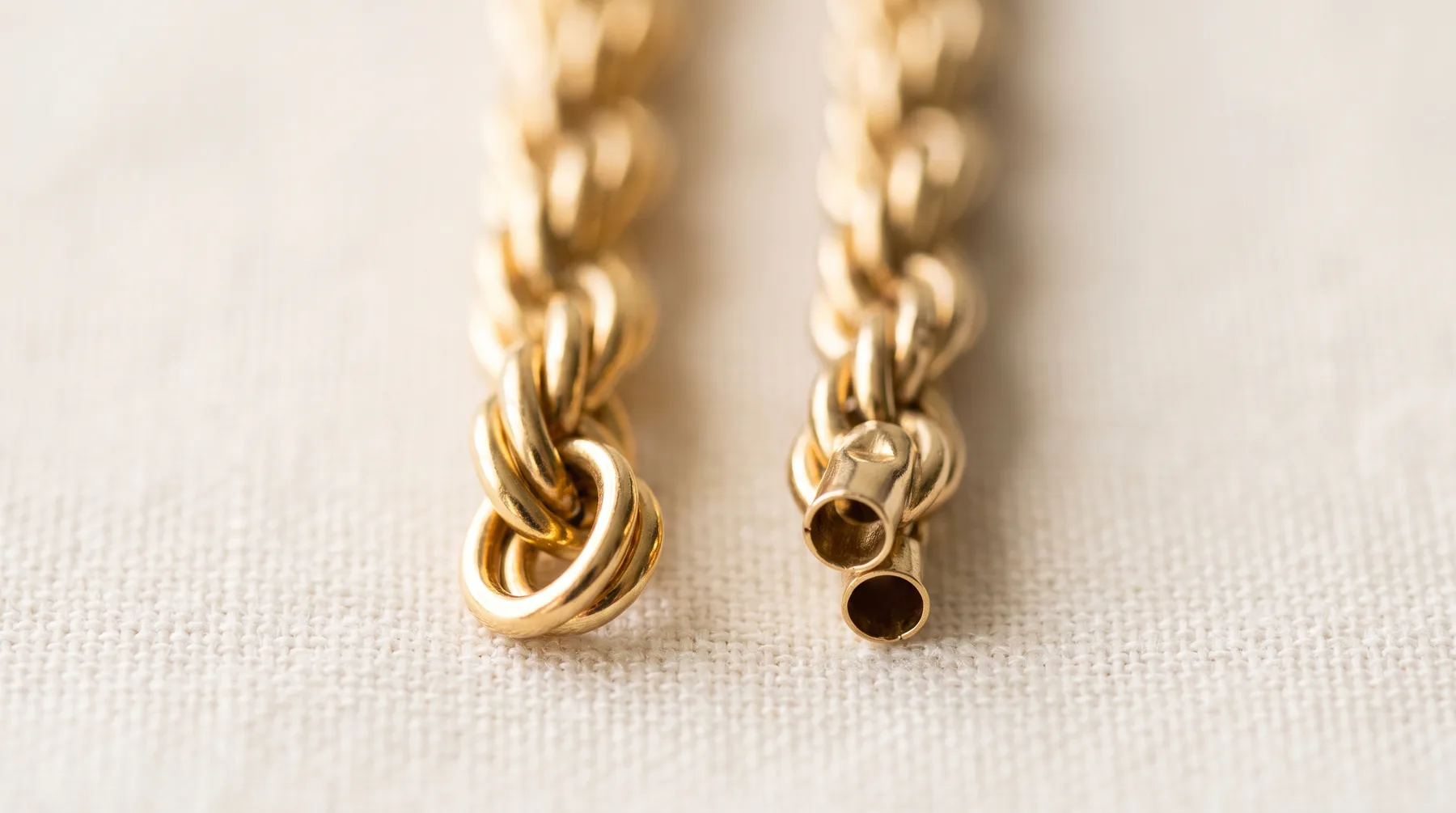
A hollow gold chain is made from gold tubing instead of solid wire, so every link is a shell with air inside; a solid chain is wire all the way through. Both are real gold of the stated karat, and the difference is weight, price and what happens when the chain is damaged. The United States Federal Trade Commission's Jewelry Guides are explicit: a product "composed throughout of gold alloy, but contains a hollow center or interior, may mislead consumers, unless the fact that the product contains a hollow center is disclosed in immediate proximity to the term 'Gold'", and such products "should not be marked or described as 'solid' or as being solidly of gold." If a listing says "14k gold rope chain" and the price seems impossible for the width, look for the word hollow; if it is missing, ask.
Our supplier data shows how the market is actually split. Of the 14,051 active gold chain styles in the catalog behind our store as of October 2026, 11,059 are flagged solid, 1,226 semi-solid and 316 hollow, with the rest unflagged. Hollow and semi-solid concentrate in rope, curb, Cuban, Figaro and paperclip styles, which are the ones people buy for a big look. Herringbone and snake have no hollow entries at all.
The weight gap is larger than most shoppers expect. In that same catalog, 14k 3 mm rope chains at 22 inches flagged solid have a median average weight of about 16.7 g; the semi-solid 3 mm rope chains at the same length average about 4.7 g. At 4 mm the split is roughly 28 g against 8 g. Since the price of a plain chain tracks its gold weight, a semi-solid or hollow rope costs about a third of its solid twin and looks identical in the box. That is the whole bargain.
What you give up is repairability and dent resistance. A hollow link that gets pinched stays pinched, because there is no metal behind the wall to push it back out. A broken hollow link cannot simply be re-soldered, because the wall is too thin to take the heat without collapsing, which is why Kohler needed a decade to work out a re-weave method for hollow rope and why many benches decline the job outright. "Semi-solid" is a supplier term, not an FTC one; it means thicker-walled tubing than hollow, and the care advice is the same.
Our rule: buy hollow when you want a wide chain, hate weight on your neck, will not hang a pendant from it, and treat it as a piece with a lifespan. Buy solid for anything you intend to repair, pass on or sell by the gram. For how karat affects the same decision, the karat guide covers 10k against 14k against 18k, and in the supplier catalog the split for gold chains is 9,537 styles in 14k, 3,253 in 10k and 1,182 in 18k.
Which gold chains kink or break, and why?
1 min
Chains fail in three ways, and the link style tells you which one you will get. Closed-loop chains (cable, curb, Cuban, Figaro, rolo) fail by one link opening, and any bench can close it again. Woven chains (rope, wheat, Byzantine) fail by one strand parting, and the fix is a re-weave that costs real money. Plate chains (herringbone, snake, omega) fail by kinking, and the kink is effectively permanent because the plates have left the plane they were pressed into.
Width multiplies all of it. A chain under 1 mm is a consumable in any style; the gold is simply too thin to survive a snag. Between 1 mm and 2 mm, link style matters most, which is where wheat and cable earn their keep. Above 3 mm, nearly everything is durable and the question becomes clasp and weight.
Two habits cause most of the chain repairs we have seen come across a counter. The first is sleeping in a fine chain, which twists it under the pillow, the exact motion herringbone and snake cannot tolerate. The second is forcing a pendant bail over a chain that is slightly too wide for it, which stretches the links at the bail and, on a box chain, pulls the boxes out of square. Both are free to avoid.
What chain is strongest for a pendant?
2 min
For a pendant worn daily, the strongest practical choices are wheat, cable, rope and curb, in roughly that order for fine widths, and the chain should be at least as heavy as the pendant it carries. That weight rule is ours, and the reason is physics: a pendant heavier than its chain pulls the clasp around to the front and turns the bail into a saw against one link. Bench jewelers on the Ganoksin Orchid forum, asked how to stop a pendant flipping, kept coming back to the same word, balance, and to symmetrical attachment points, which is the same problem in a different coat.
Three checks before you buy a chain for a pendant you already own:
- Bail clearance. The chain must pass through the bail with room to slide. A bail that only just fits will grind the link it rides on. If the pendant is precious, have a jeweler fit a larger bail rather than buying a thinner chain to suit it.
- Width to the pendant. As a working rule for solid gold: under 1 mm carries a small charm only; 1.2 mm to 2 mm handles an everyday pendant such as a solitaire, initial or small cross; 2.5 mm to 4 mm suits medallions, larger crosses and lockets; at 5 mm and above the chain is the jewelry and a pendant is optional.
- Length to the drop. A pendant sits where the chain's midpoint falls, so a heavier pendant on a longer chain swings more and works the links harder. The supplier catalog's most common gold chain lengths are 20, 24 and 18 inches, in that order, as of October 2026; 18 inches sits at the collarbone on most adults and is the length most pendants were designed around.
What clasp should a gold chain have?
2 min
A lobster clasp on any chain that weighs more than a couple of grams, a spring ring only on fine chains under about 2 mm, and a box catch with a safety on heavy Cuban links. The market agrees: of the active gold chains in our supplier catalog as of October 2026, 12,330 close with a lobster clasp (8,272 plain, 4,058 "fancy"), 791 with a spring ring and 657 with a box catch.
The reason is mechanical. A spring ring is a hollow ring with a tiny coil spring inside; the whole clasp is thin by design, the spring fatigues, and the ring itself is the weakest link in the chain. A lobster clasp is a solid body with a spring-loaded lever gate, so the load runs through solid metal and the spring only has to move the gate. A box catch is a folded tongue that snaps into a box, strong when new and the one clasp whose wear you can feel: when the tongue loses its spring, the click goes soft. A heavy Cuban should have a box catch with a figure-eight safety, and you should test that safety in the store.
One detail from the bench: on a factory chain, the jump ring joining the clasp is often the only link that was closed by hand, and sometimes the only one not soldered at all. Look at it with the chain held up to the light. A soldered jump ring shows a continuous ring; an unsoldered one shows a hairline seam, and that seam is where the chain will open under a tug. Asking a jeweler to solder it shut is a small job and the best money you will spend on a chain.
How to choose a gold chain
1 min
Buy the chain by its job, then by its link, then by its weight.
- To carry a pendant every day: wheat or cable in solid gold, 1.2 mm to 2 mm, lobster clasp, soldered jump ring.
- To wear alone, seen: curb, Cuban, rope or Figaro at 3 mm and up; solid if you want it to outlive you, semi-solid or hollow if you want the width without the weight and accept the care rules.
- For a flat, liquid look: herringbone or snake, worn alone, removed at night, bought knowing a kink is the end.
- For a budget: 10k over hollow 14k, every time. A thin solid chain in a lower karat can be repaired; a hollow chain cannot.
Then keep it clean and hung up. Chains trap moisture and skin oils between links and dull from the inside out; the cleaning guide has the soak-and-soft-brush method, and the one rule for chains is to hang them to dry rather than coil them.
Frequently Asked Questions
2 min
What is the strongest type of gold chain?
For its weight, a solid wheat chain; for sheer mass, a solid Cuban link. Wheat braids four strands so load is shared across many points and it resists kinking, while a wide Cuban has so much metal per link that nothing short of a vise harms it. Width matters more than style once you pass 3 mm.
Can a herringbone chain be repaired?
Technically yes, practically no. A kinked herringbone can be worked flat and re-burnished by a skilled bench, but jewelers on the Ganoksin Orchid forum report that the kink returns and that other sections kink next, so most recommend replacing the chain rather than paying for the attempt.
Is a hollow gold chain real gold?
Yes. A hollow 14k chain is 14k gold alloy throughout; it is simply made from tubing rather than solid wire. Under the FTC Jewelry Guides the seller must disclose the hollow center next to the word "gold" and must not describe the chain as "solid," so the honesty question is in the listing, not the metal.
What is the difference between a curb chain and a Cuban link?
Same link, different flattening. Both begin as a twisted coil of wire; a curb is pressed flat, a Cuban is left thick and domed. The Cuban therefore weighs markedly more at the same width, packs tighter and reads bolder, while the curb lies flatter, reflects more light and costs less.
What length gold chain should I buy?
18 inches sits at the collarbone on most adults and is the length most pendants were designed for; 20 inches gives a little drop and suits larger pendants; 22 to 24 inches is the usual men's length for a chain worn alone. As of October 2026 the most common gold chain lengths in our supplier catalog are 20, 24 and 18 inches, which mirrors what people actually wear.
Is a 10k chain stronger than a 14k chain?
Slightly, because 10k has more hardening alloy and less soft gold, which is why 10k is a reasonable pick for a chain that will be worn hard on a budget. The difference between karats is smaller than the difference between a thin chain and a thick one, or between hollow and solid, so settle those two questions first.