
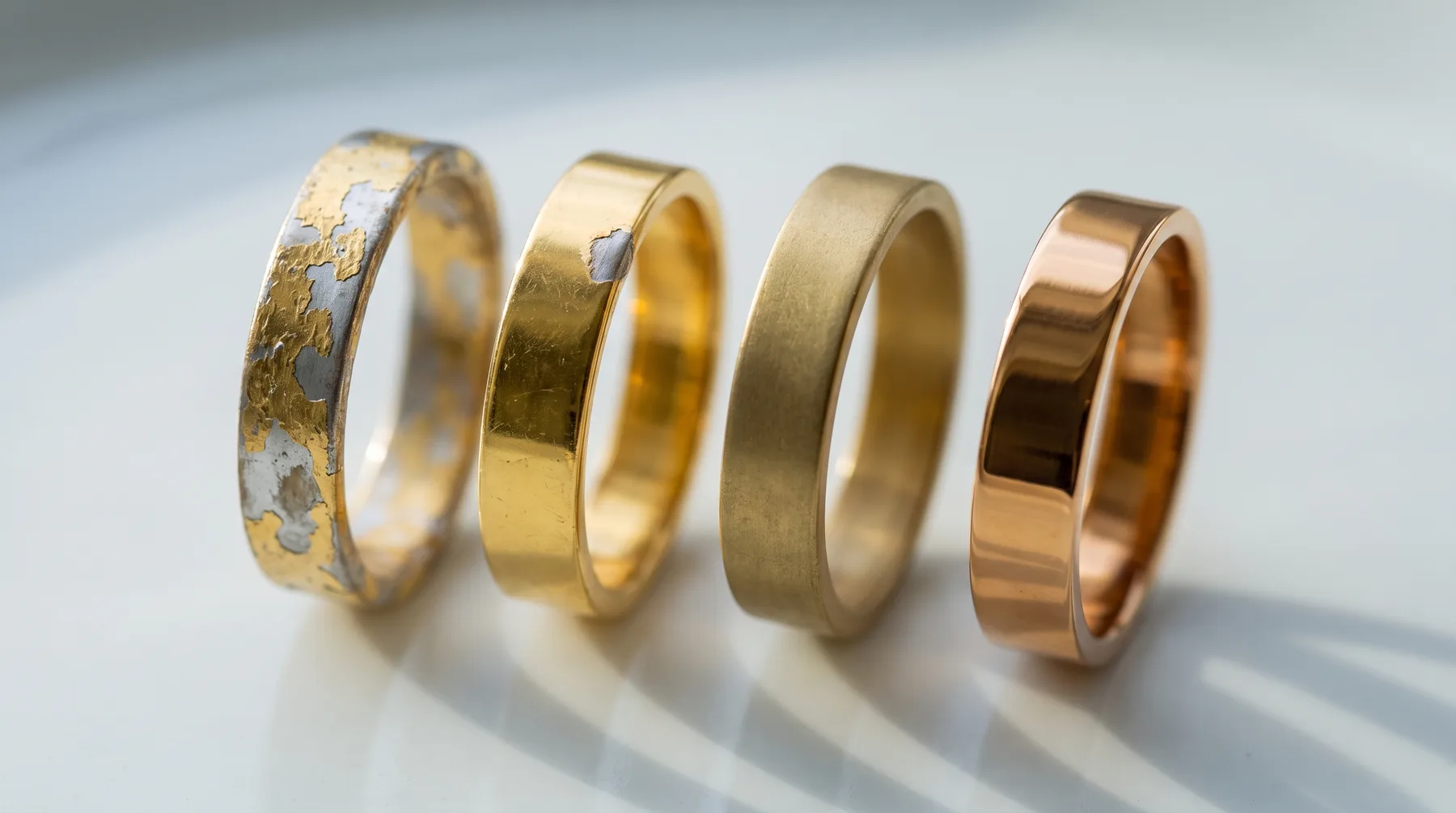
Four different things get sold as gold jewelry, and federal rules define all four. Gold-plated is a microscopically thin electroplated coating on a base metal. Gold vermeil is a thicker gold coating on a sterling silver base. Gold-filled is a substantial sheet of karat gold mechanically bonded to a core, at least 1/20th of the piece's weight. Solid karat gold is gold alloy all the way through.
Ranked by how long they last on a hand: solid gold, then gold-filled, then vermeil, then plated, and the gaps between them are large. A plated chain can show wear in months. A gold-filled one can outlive the person who bought it. The prices do not always reflect that order, which is the reason this article exists.
The four constructions, as federal rules define them
1 min
The Federal Trade Commission's Jewelry Guides, at 16 CFR Part 23, set out what each term is allowed to mean in the United States. These are the actual thresholds, quoted from the rule rather than from marketing copy.
| Term | Base | Federal requirement | Practical gold content |
|---|---|---|---|
| Gold electroplate | Any base metal | § 23.3(c)(3): at least 0.175 microns of at least 10k gold, roughly 7 millionths of an inch | A trace |
| Heavy gold electroplate | Any base metal | § 23.3(c)(3): at least 2.5 microns | Still a coating, 14 times thicker |
| Gold vermeil | Sterling silver only | § 23.4: at least 10k gold, at least 2.5 microns thick throughout | A coating over a precious metal |
| Gold-filled | Usually brass | § 23.3(c)(2): karat gold mechanically bonded, at least 1/20th of the article's total metal weight | 5% of the piece by weight |
| Solid karat gold | None, it is the material | Marked 10k, 14k, 18k and accurate within statutory tolerance | 41.7% to 75% pure gold |
One thing worth noticing immediately: gold-filled is defined by weight and everything else is defined by thickness. That is why gold-filled is in a different durability class, and why an honest gold-filled piece is marked with a fraction, such as 14/20 or 1/20 14k GF.
Gold-plated: what you are actually buying
1 min
Gold plating is electroplating, and the federal floor of 0.175 microns is astonishingly thin: about one four-hundredth the thickness of a human hair. A piece plated at the legal minimum has almost no gold on it at all, and the coating exists to survive the shop window rather than your life.
This does not make plating a scam. It makes it a category with a purpose: an inexpensive piece for a season, a trend you want to try, a costume necklace for one event. The problems start when plated jewelry is sold at prices that imply permanence, or when the listing is written to blur the line.
Two things to know as a buyer. First, the karat number in a plating claim describes the coating's purity, not its quantity, so 18k gold plated tells you nothing about how much gold is there. Second, thickness is the number that matters and good sellers publish it: a piece described as 1 micron, 2.5 micron or 3 micron plating is telling you something real, and 3 microns is roughly seventeen times the federal minimum.
The other plating fact nobody mentions is repair. Plated jewelry usually cannot be sized, soldered or refinished without destroying the finish, so a plated ring that no longer fits is generally a replaced ring rather than a repaired one.
Gold vermeil: sterling underneath, and why that matters
1 min
Vermeil, pronounced ver-may, is the only one of these terms that specifies what is underneath. Under federal rules the base must be sterling silver, the gold must be at least 10k, and the coating must be at least 2.5 microns thick throughout. Call the same coating thickness on brass vermeil and it is simply mislabeled.
The sterling base is the entire point, and it earns vermeil its place above plating for two reasons. When the gold eventually wears at the high points, what shows through is silver rather than brass, so you get a soft two-tone effect instead of a green mark on your skin. And because sterling holds value and takes a bench cleanly, a vermeil piece can be re-plated later, which is a normal service.
Vermeil is the right answer for someone who wants the look of gold on a real precious metal at a fraction of gold's price, and who accepts that the surface is a wear item. It is not the right answer for a piece worn on a hand daily, because hands abrade coatings faster than any other part of the body.
Gold-filled: the one most people have never heard of
1 min
Gold-filled is the sleeper of this list. A sheet of karat gold, typically 14k, is bonded to a brass core under heat and pressure until it is metallurgically joined, and the gold has to make up at least 1/20th of the article's weight to earn the name. That is roughly a hundred times the gold in an ordinary plated piece.
The practical result is jewelry that behaves like gold. It does not flake, it survives daily wear for decades with reasonable care, it tolerates water and sweat, and it can often be worked at a bench. Gold-filled chain has been the backbone of American costume and mid-market jewelry since the nineteenth century for exactly these reasons, and the mark to look for is that fraction: 14/20, 1/20 14k GF, or GF alongside a karat number.
Its weakness is the same as its strength. Because the gold is a layer rather than the whole material, a deep scratch or a heavy polish can eventually cut through, most often on a ring shank or a bracelet's high points. Buy gold-filled for chains, earrings, and pieces you want to wear constantly on a modest budget; buy solid gold for rings you never take off.
Solid gold: what solid does and does not mean
1 min
Solid gold means the metal is karat gold alloy throughout rather than a coating over something else. It does not mean the piece has no hollow spaces, and this catches people out constantly.
A hollow rope chain marked 14k is solid gold in the legal and material sense: every part of the metal is 14k alloy. It is also a tube, and a dented or split hollow chain is close to unrepairable because there is not enough wall thickness to solder to. This is the single most common misunderstanding in gold buying, and it is why the honest question at a counter is about gram weight rather than about the word solid. Our guide to why two similar rings differ in price works that arithmetic through with real numbers.
The karat number sets purity: 10k is 41.7% gold, 14k is 58.3%, 18k is 75%. Which one to choose is a separate decision about durability, color and price, and our 10k, 14k and 18k comparison covers it. In the United States, a quality mark such as 14k must be accompanied on the piece by the registered trademark of whoever is responsible for its accuracy, under 15 U.S.C. § 297. A karat stamp with no maker's mark anywhere on the piece is a genuine warning sign.
How long each actually lasts
1 min
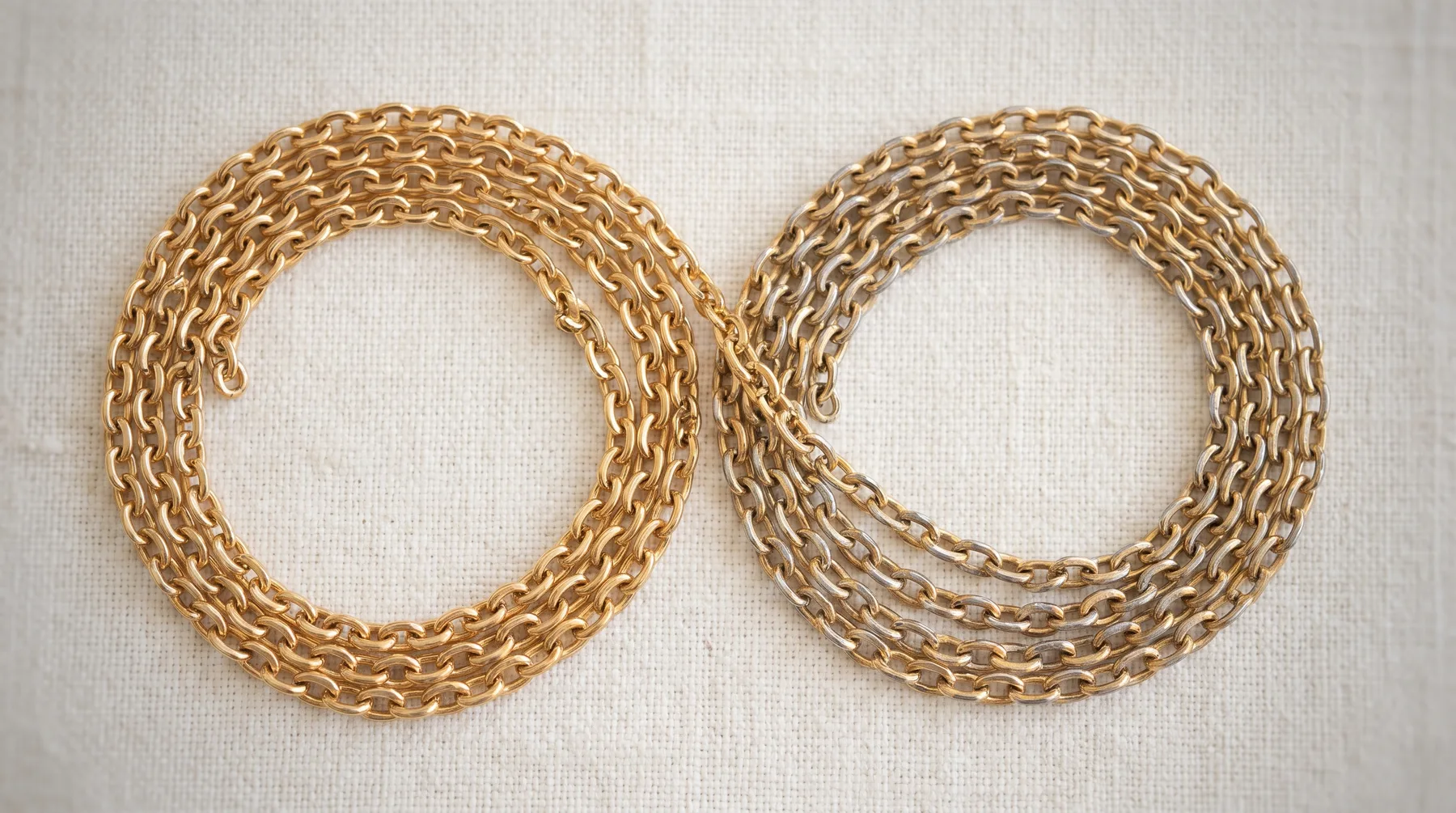
Nobody publishes a controlled study of this, and any specific number you read is a shop's experience rather than a measurement. Here is the honest version of the trade's experience, with the reason attached to each.
- Gold plated: months to a couple of years of regular wear. Sub-micron coatings simply do not survive friction. Rings and bracelets fail first, earrings last longest.
- Gold vermeil: a few years on pieces that are not constantly rubbed, and it is re-platable when it goes. A vermeil ring worn every day is a one-to-two-year proposition.
- Gold-filled: decades of normal wear. It is a legitimate everyday material and the reason vintage gold-filled chains still turn up looking fine.
- Solid gold: generations, with the caveat that gold is soft and everything wears. A 14k shank thins over thirty years of wear, and that is a repair rather than a loss.
The variable inside every one of those ranges is chemistry, not time. Chlorine, salt water, hand sanitizer, cleaning products and perspiration all accelerate wear on coatings dramatically, and none of them care what the piece cost.
How to read a listing honestly
1 min
Sellers rarely lie outright. They omit. These are the phrases and the gaps to watch, in the order I would check them.
- "18k gold" with a low price and no weight. Ask for the gram weight. Solid gold has an arithmetic floor set by the spot price, and no seller escapes it.
- "Gold vermeil" with no mention of sterling. Vermeil requires a sterling base by rule. If the listing will not confirm the base metal, it is probably plated brass.
- "Gold filled" with no fraction. Real gold-filled carries 14/20, 1/20 12k GF or similar. The fraction is the definition.
- "Gold" alone, or "gold tone", "gold finish", "gold overlay", "gold bonded". These are decorative descriptions and, apart from specific defined terms, they signal a coating whose thickness nobody wants to state.
- A karat mark with no maker's trademark. Required by US law on the piece itself.
- "Hypoallergenic" on a plated piece. The coating may be, briefly. What is under it is the question, and it is often nickel-bearing brass.
What our catalog says about how the trade actually stocks gold
1 min
Our catalog is a useful cross-section of what American jewelers buy at wholesale, and the distribution is stark. Across 248,335 styles, 141,462 declare a solid karat gold or platinum metal, 11,306 are plated, and just 760 are gold-filled.
Inside the plated group, the two largest categories are gold plating over sterling silver, at 9,057 styles, and rose plating over sterling at 1,256. That is the vermeil construction described in plainer trade language: gold over sterling, exactly what § 23.4 covers when the coating meets the thickness rule. Another 871 styles are described as flash plated, a term the trade uses for the thinnest decorative coatings, and only 25 styles anywhere in the catalog publish an actual plating thickness in microns.
The gold-filled figure is the interesting one. At 760 styles it is a rounding error in a quarter-million-style catalog, and all of them carry the classic 14/20 mark. A material that genuinely lasts decades sits at 0.3% of what the trade stocks, largely because it is harder to manufacture and harder to explain than plating.
Caring for each of the four
1 min
The rule of thumb is that the thinner the gold, the gentler the care, and the shorter the list of things you can do about it later.
- Plated: keep it dry, keep it away from perfume and lotion, wipe with a soft dry cloth only. No polishing cloths, ever, since the abrasive in them removes the plating you are trying to save. Take it off before washing your hands.
- Vermeil: the same rules, plus one advantage: when it wears, a jeweler can re-plate it. Do not use a silver polish or a tarnish-removing dip, both of which strip gold.
- Gold-filled: warm water, mild dish soap, soft brush, dry properly. It tolerates ordinary life. Avoid heavy machine polishing.
- Solid gold: the same wash, and it can take everything else a bench does. Our gold cleaning guide covers the method and the products to keep away from it.
Which one should you buy?
1 min
Match the construction to the piece and to the number of hours it will spend against your skin.
- Everyday rings: solid gold, or accept replacing the piece. A ring is the harshest environment in jewelry.
- Everyday chains and earrings on a budget: gold-filled is the best value in jewelry that nobody talks about.
- Fashion pieces you want in gold's color at silver's price: vermeil, on the understanding that the surface is consumable and re-platable.
- A trend, a costume, one occasion: plated, at a price that matches its lifespan.
- Sensitive skin: solid gold, vermeil, or platinum, and ask what alloy. A worn plating puts brass against skin, which is where most complaints about cheap jewelry come from.
Frequently Asked Questions
2 min
Is gold vermeil real gold?
The coating is real gold of at least 10k, and it must be at least 2.5 microns thick over a sterling silver base to be called vermeil in the United States. The piece as a whole is a silver piece with a gold surface, so the gold is real and the quantity is small.
What is the difference between gold-filled and gold-plated?
Quantity, by roughly a factor of a hundred. Gold-filled must be at least 1/20th of the item's weight in karat gold, bonded mechanically. Plating can legally be as little as 0.175 microns thick. Gold-filled lasts decades in normal wear; plating is measured in months to a couple of years.
Does gold vermeil tarnish or turn skin green?
The gold layer does not tarnish, but it wears, and what shows through is sterling silver, which can tarnish darker rather than green. Green marks on skin come from copper in brass, which is why the sterling base requirement matters and why worn plated brass causes most of those complaints.
Can gold-plated jewelry be re-plated?
Sometimes. A jeweler can re-plate a piece whose base metal takes plating and whose construction survives cleaning, and the cost frequently approaches the value of an inexpensive piece. Vermeil re-plates well because the base is sterling. Ask before assuming.
Does solid gold mean the piece is not hollow?
No. Solid gold describes the material, not the geometry: a hollow 14k rope chain is entirely 14k alloy and is still a tube. Ask for the gram weight, which is the number that separates a substantial piece from a light one.
How can I tell what I already own?
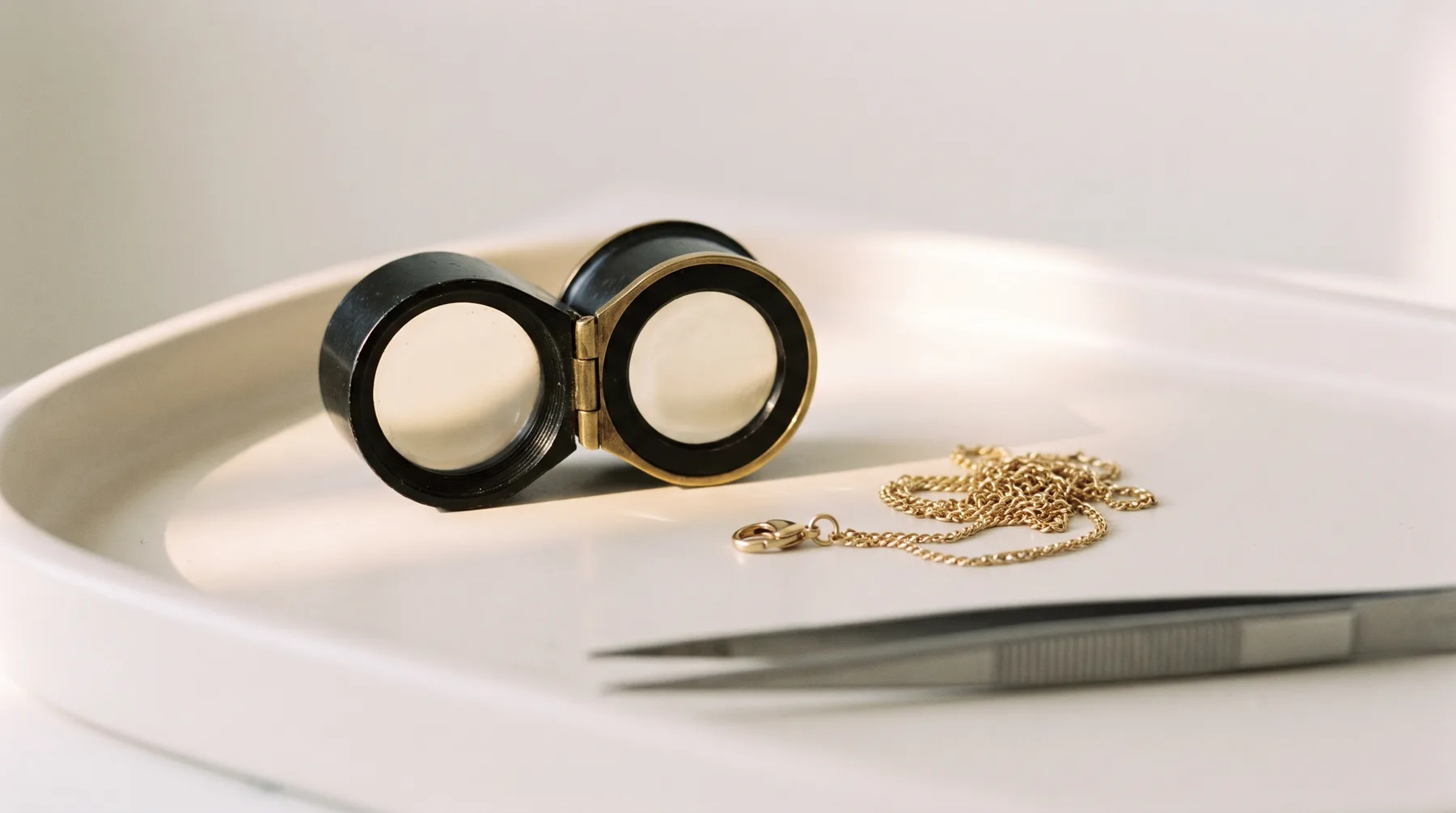
Look for marks with a loupe, usually on a clasp, a shank, or a tag. 14k, 585, 750 and 18k indicate solid karat gold; 14/20 or 1/20 14k GF indicates gold-filled; 925 with a gold color usually indicates vermeil or gold-plated sterling; GEP or HGE indicates electroplate. Any quality mark should be accompanied by a maker's trademark. If there is no mark at all, assume plated.