
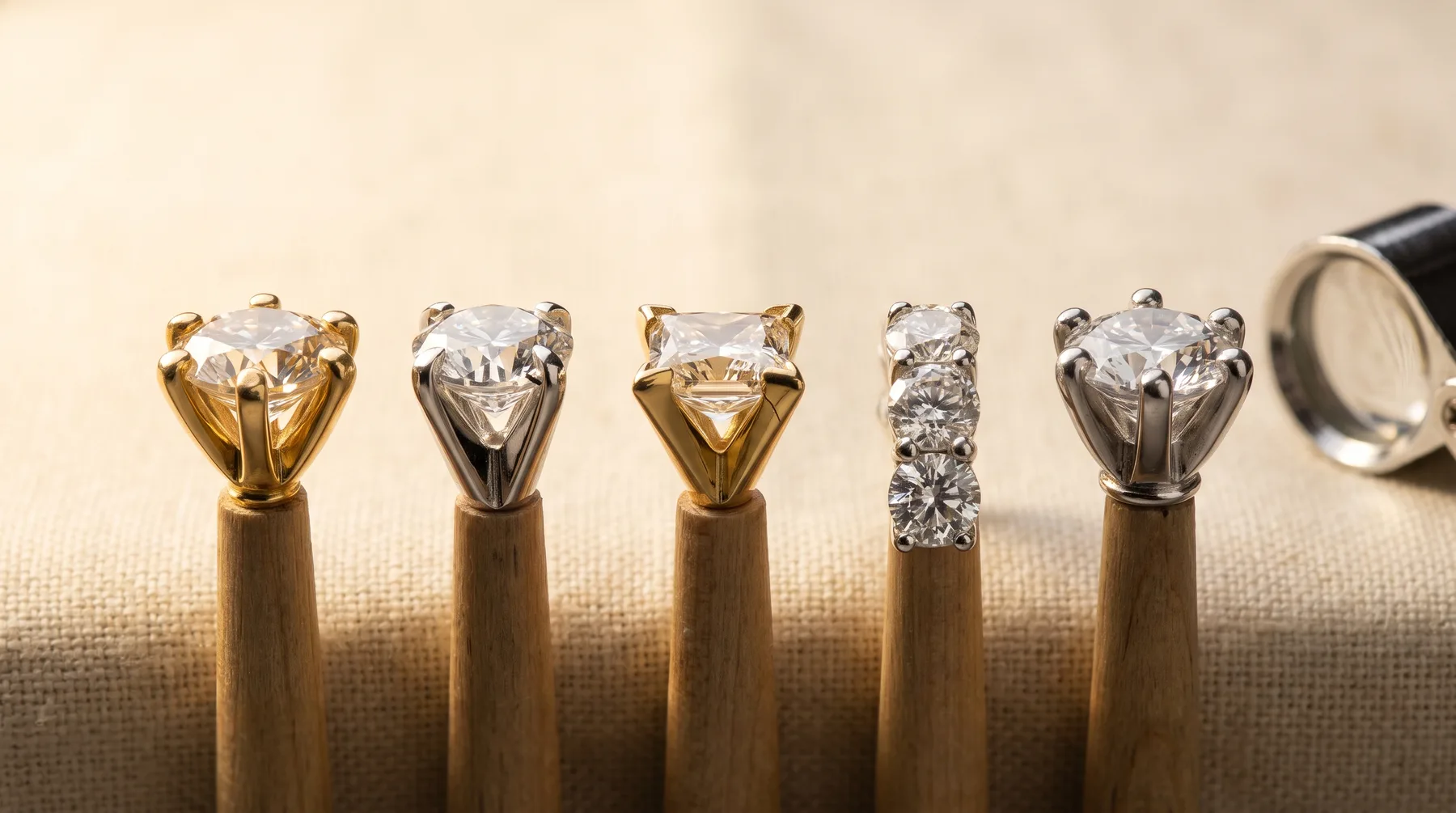
Prong retipping is the bench repair that rebuilds the worn tips of the little metal claws holding your stone, by soldering or laser-welding fresh metal onto each prong and reshaping it over the stone. Gold prongs on a daily-worn ring typically need it about once a decade; platinum prongs far less often. As of October 2026, published price lists put a gold retip at roughly $25 to $60 per prong, with platinum about double, and the job is worth doing only while the base of each prong is still sound. Once most of a head is worn, or it has been retipped before, a new head is the better repair.
We have stood on a few sides of this one: years inside a jewelry manufacturer's operations, where heads and prong wire are stocked by the thousand, and a lighter stretch at a repair bench with a torch and a boric acid jar. What follows is what a bench jeweler would tell you across the counter if the shop were quiet.
What is prong retipping?
2 min
Retipping is adding new metal to a prong whose tip has worn thin, then filing and polishing it back into a tip that grips the stone. The Gemological Institute of America (GIA) defines it in its engagement ring settings guide as "the process of rebuilding worn prong tips by adding metal," and that is exactly what it is: a patch, not a rebuild. The prong keeps its base and most of its body; only the top gets replaced.
The good version of the repair adds real metal. The bench cuts the worn tip off at an angle, fits a piece of matching wire or a pre-formed tip to the cut, and either torch-solders it with hard solder or welds it on with a laser. Then the new metal is shaped so it blends into the old prong and looks original. Tom Weishaar, a certified master bench jeweler writing for Jewellery Business, is blunt about the shortcut: "Re-tipping a prong with solder only rather than also adding new metal, is a huge mistake. Doing so creates a weak, and often pitted, prong." A solder-ball tip is only as hard as the solder, and easy-flow solder is soft. If a quote seems too quick and too cheap, ask whether new metal is going on or only solder.
Torch or laser: does it matter which your jeweler uses?
Done well, the result should be the same; what changes is speed and what the stone has to survive. Weishaar reports five to six torch-retipped prongs an hour at full quality and roughly twice that with a laser, and he charges the same either way. A torch heats the whole head, which is why the stone gets painted with boric acid first: in an oxygen-rich flame a diamond begins to burn, or "frost," at about 700 C, and the boric acid coat is, in his words, "the only thing protecting stones during re-tipping." Its protection is gone after a minute or two of heat, so a careful bench re-coats between prongs.
A laser welder puts its heat into a spot a fraction of a millimeter wide. A Ganoksin survey of laser-shop owners describes working "as close as half a millimeter away from heat-sensitive stones," which is what makes retipping around an emerald or opal possible at all without pulling the stone. The laser has its own risk, though: a beam that glances off a facet can mark the stone. Weishaar chose the torch over the laser on one large diamond in heavy chevron prongs for exactly that reason. Ask which tool, by all means, but ask more about who is holding it.
How many prongs should a ring have: 4 or 6?
2 min
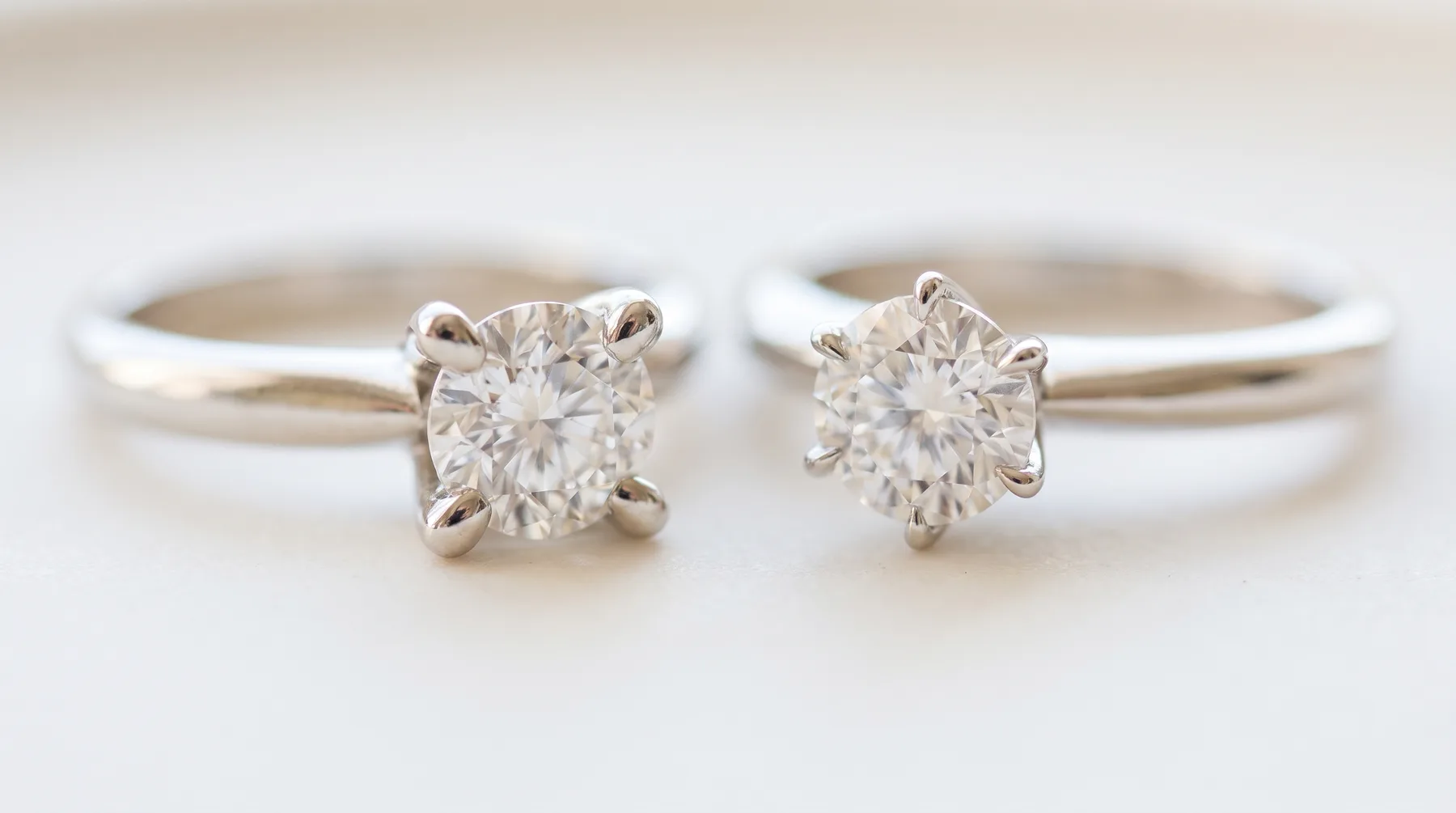
Four prongs show more diamond; six give you a spare. GIA's guidance is that most round brilliant rings use four or six, chosen by stone size, and that "four prongs may make the stone appear slightly squarer, while six prongs tend to emphasize and enhance the stone's round shape." From the bench side, the argument for six is simpler: if one prong of four wears or snags open, the stone can walk out. With six, one bad prong is an inconvenience and a repair ticket, not a lost diamond.
The shape of the tip matters as much as the count:
- Round (button) prongs are the default: a rounded bead of metal folded over the girdle. Easy to retip, least likely to snag.
- Claw prongs taper to a point. They show more of the stone, GIA notes they are often used for larger gemstones, and they catch on knitwear more. A claw also has less metal at the tip to begin with, so it reaches "worn" sooner than a round prong of the same wire.
- V-prongs (V-end) wrap a pointed corner. GIA lists them for heart, princess, pear and marquise cuts because a bare point chips; the V takes the knock instead of the stone. Retipping a V-prong is fiddly work, and a V that has worn open is the one case where we would rather see a new head than a patched tip, because the corner it guards is the most breakable part of the stone.
- Shared prongs let two neighboring stones share one prong, the way eternity bands and diamond-set shanks are built. Less metal, more light, and a prong that is doing two jobs. From the bench, the geometry is the thing to understand: a shared prong has stone on both sides, so it carries two stones' worth of grip on one sliver of metal, and a worn one loosens two stones at once.
- Double claws (two small claws per corner) and eight- or ten-prong vintage heads spread the grip, at the cost of more tips to wear and more small parts to inspect.
Our own catalog is a decent census of what jewelers can actually order. As of October 2026, of the 13,021 heads and mountings in the vendor catalog behind our store that record a head type, 7,564 are four-prong, 986 are six-prong, 830 are three-prong (pears, trillions, hearts) and 1,030 are bezels; V-end heads of every prong count total 849. Of the pieces that record a stone setting, 12,898 are prong-set and 1,203 list shared prongs. The trade builds four-prong heads at roughly seven to one over six, so if you want the spare prong, you will usually be choosing it on purpose. The settings guide covers how each head style fits into a whole ring.
How do prongs wear down?
2 min
Prongs wear from the tip inward, by abrasion, and the first sign is a tip that has gone flat and thin where it used to be a rounded bead. A prong is the highest point on the ring, so it takes every brush against a desk edge, car door, sink and steering wheel, and each contact removes a few atoms of metal. Years of that and the bead that folded over the girdle has become a thin shelf, then a sharp edge, then nothing. Jewelers Mutual's warning-sign list reads the same way from the owner's side: a prong that "appears slightly shorter than the others, or its rounded top seems to have narrowed."
The second way prongs fail is faster: a snag. A sweater loop or a glove seam catches under the tip and levers it up, opening a gap between prong and stone. The prong is not worn, it is bent, and now the stone can rotate. A tilted or rotated stone is the clearest sign of all that the grip is gone, and the fix for that one is often a tightening rather than a retip, if it is caught early.
How fast all this happens depends on the metal more than anything else. Platinum wears by displacement: a knock pushes the metal sideways rather than shearing it off, so a scuffed platinum prong is mostly still there. Gold alloys shed. Platinum Guild International's wear study, run from 2016 to 2020 at the fem Research Institute and reported by Centurion, measured volume loss in platinum prong alloys up to three times lower than 18k palladium white gold and roughly half the loss of 14k palladium white gold and 14k or 18k nickel white gold; the study's own conclusion is that platinum prongs need re-tipping far less often than gold. Weishaar's bench rule of thumb is that a gold prong wants retipping about every ten years of daily wear, and he describes a ten-year-old 18k ring that arrived "right on schedule." Within gold, 14k is harder than 18k and holds a tip's shape longer, which is one of the quiet reasons the trade sets so many diamonds in 14k white heads regardless of the shank. The white gold versus platinum comparison goes deeper on the metallurgy; the karat guide covers hardness.
One more thing owners rarely connect to prong wear: a rhodium-plated white gold head wears exactly like the gold underneath once the plating goes, which it does first on the prong tips, because they are the high points. Our rhodium plating guide explains why the tips are where white gold shows its true color first.
How do you check ring prongs at home?
2 min
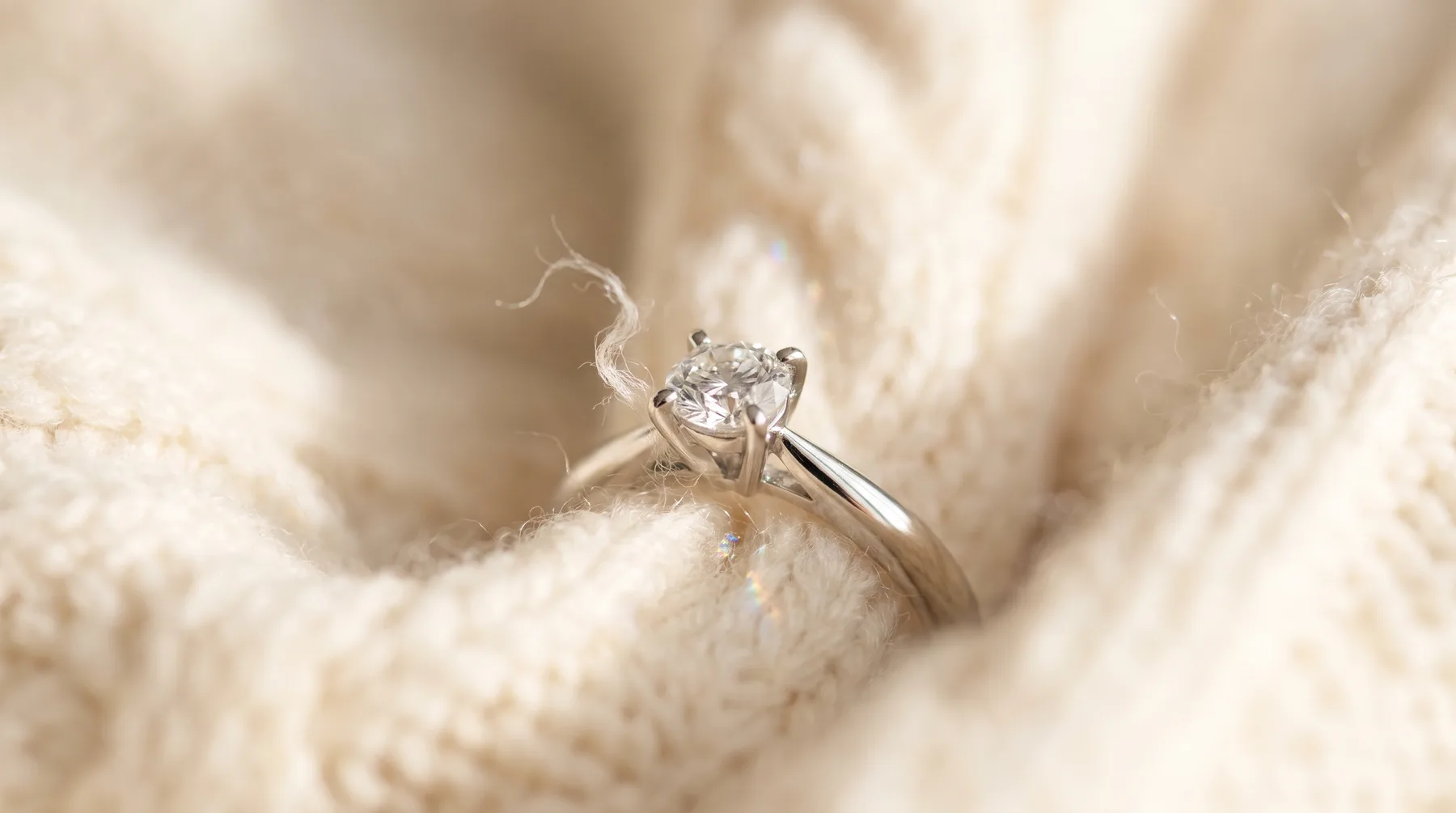
Drag the ring, gently, through something that snags. An old nylon stocking, a cotton ball or a loosely knitted sleeve works; healthy prong tips sit flush on the stone and slide through, and a lifted or worn tip hooks a fiber. If one prong keeps grabbing, or you find fibers packed under one tip and not the others, that prong has left the stone. This is the catch test, and it is the single most useful thing an owner can do between appointments, because it finds the problem at the lifted-tip stage rather than the empty-head stage.
Then, three more checks:
- Tap it. Hold the ring near your ear and tap the shank with a fingernail. A tight stone is silent. A loose one ticks. If it ticks, stop wearing the ring until a jeweler has seen it.
- Look at the tips side by side. Under a loupe or your phone camera zoomed in, every prong should be the same height and the same rounded shape. One shorter, flatter, narrower or bent prong is the one that will fail. Jewelers Mutual's list is short and right: short, bent or missing prongs, and a stone that has shifted or tilted.
- Run a fingertip across the top. A worn tip feels sharp where its neighbors feel smooth. A prong you can feel is a prong that will catch.
None of this replaces a professional look. Jewelers of America's standing rule is to see your jeweler at least once a year to have jewelry checked "for loose prongs, worn mountings, and general wear and tear"; Jewelers Mutual recommends twice a year and notes that some insurance policies require an annual inspection to keep a stone covered. A jeweler's inspection costs little or nothing and takes two minutes under a microscope, and it is the moment a worn prong is cheapest to find.
How much does prong retipping cost?
2 min
As of October 2026, the published price lists we checked at independent repair shops put a gold prong retip at $25 to about $60 per prong, with the first prong priced highest and each additional one cheaper; platinum runs roughly double, and rebuilding a prong from its base costs about twice a retip in either metal. Mail-in services advertise flat rates (one lists $49 for up to twelve prongs) that are cheaper per prong and come with a shipping round trip and no conversation with the bench. Most shops add a polishing or refinishing charge on top, and many price rhodium re-plating of a white gold head as a separate line.
| Job | Gold (14k or 18k) | Platinum | What it means |
|---|---|---|---|
| Retip one prong | $25 to about $60 | About $50 to $120 | New metal added to a worn tip; base and body kept |
| Rebuild or replace one prong | About $48 to $120 | About $120 and up | Prong cut to the base and a new wire fitted |
| Mail-in flat retip | From about $49 for up to 12 prongs | Quoted case by case | Bulk pricing, no in-person inspection |
| Laser surcharge | Up to 50% more | Up to 50% more | Only when the laser is required by the stone, per bench pricing guidance |
| Refinishing | Usually extra | Usually extra | Polish, and rhodium on white gold |
Those figures come from price lists published by a regional jewelry chain ($27 per gold prong to retip, $59 platinum; $48 and $120 to replace), a St. Louis repair chain ($25 to $45 per prong, $50 to $120 to rebuild), an independent custom shop that quotes $60 to $150 per prong, and a national mail-in service ($49 for up to twelve prongs, $24 to rebuild a prong). The structure behind them is what matters more than any one number. David Geller's repair-pricing guidance, widely used by independent shops, is published by Stuller: the first tip carries the setup (intake, cleaning, inspection), additional tips are cheaper because the bench is already set up, and the laser earns a 50% premium only when the stone requires it. If a shop charges extra for the laser on a plain diamond solitaire, that is a choice, not a necessity.
Platinum costs double for a reason that has nothing to do with greed. Platinum prongs cannot be retipped with platinum solder in place, because, as Jurgen Maerz of Platinum Guild International put it in his bench guide, "no stone would be able to take the temperature it takes to melt the solder." The torch method uses a lower-temperature white gold solder to attach a platinum wire tip, which is a compromise; a laser can fuse platinum to platinum without solder. Either way the metal costs more and the work is slower.
Retip or new head: which is the better repair?
3 min
Retip when one or a few tips are worn and the rest of the head is sound; replace the head when most of the prongs are worn, when the ring has been retipped before, or when the base of any prong has gone thin. That is the rule Stuller's bench guidance gives its jewelers almost word for word: retipping suits a head where "the majority of the head remains structurally sound," and reheading is "ideal for settings that have already had multiple repairs." A prong is a lever, and the force on it concentrates at the base. New metal on the tip does nothing for a base that has thinned.
The decision is partly arithmetic. A four-prong platinum head at $59 to $120 per retipped prong is $240 to $480 before refinishing, and a six-prong head is half again more. A new head is the part plus the labor to cut off the old head, solder or weld on the new one, and reset the stone. We have left head-replacement dollar figures out of this piece on purpose, because the quotes vary too widely by metal and shop to put a range on honestly; get both numbers from your jeweler on the same ticket and compare them against the age of the head. If the retip quote is within shouting distance of the new head, take the new head: you are buying fresh metal at every prong instead of patched metal at the tips.
Four situations tip the decision toward a new head regardless of the quote:
- Earlier bad work. Prongs that have run together with pitted solder were retipped with easy solder and no wire. Weishaar's advice is not to retip over it; strip and rebuild.
- Gold solder on platinum. It happens, and it contaminates the platinum, which "can forever alter the method with which future repair work can be done." A platinum head that has been patched with gold solder is usually a head to replace.
- Eternity bands and shared-prong rows. A long-time PriceScope contributor's view, which matches ours, is that a retip across a full eternity band rarely looks right afterward and often costs more than resetting the stones in a new band. Many small prongs that all need to flow together is restoration work, not a patch.
- A V-prong that has opened. The corner behind it is the most chip-prone point on the stone. Rebuild the V or replace the head; do not rely on a thin tip.
Stones that have to come out first
With a torch, some stones leave the ring before any heat does. GIA's care guides are plain on the two most common cases: for emerald, "heat can damage emeralds, especially by extending existing fractures," and GIA notes most emeralds are fracture-filled; for opal, "high heat or sudden temperature changes can also cause opal to fracture." GIA flags tanzanite and several other gems as heat-sensitive too, and any treated or glued stone deserves the same caution. A laser shrinks the no-go list considerably, since the heat never reaches the stone, but a good jeweler still pulls an opal before welding next to it. Expect the quote to include unsetting and resetting when the stone is one of these, and treat a jeweler who offers to torch-retip around an emerald without mentioning it as a jeweler to walk away from. Our emerald and opal guides cover the care side of both stones.
Why should prong metal match the mounting?
2 min
The new metal on a prong should be the same alloy as the prong it joins, because the repair has to wear, flex and color-match as one piece, and because the karat stamp on the ring is a promise about the whole ring. Platinum should be repaired with platinum; a 14k head with 14k wire and 14k hard solder; an 18k head with 18k. Bench jewelers on the Ganoksin forum make the practical case for hard solder and matching-karat wire: the closer the repair metal is to the prong, the better it wears. A softer tip on a harder prong wears away first and leaves a step; a harder tip on a softer prong makes the base the weak point.
Color is the next reason. A 14k white tip on an 18k white prong, or a palladium-white tip on a nickel-white prong, looks identical under rhodium and quite different a year later when the plating wears off the high points. On yellow gold the mismatch is visible the day the ring comes back. Then there is the stamp: under the FTC's Jewelry Guides (16 CFR 23.3) a karat mark describes an article "composed throughout" of that fineness, with a small allowance for solder. Retipping a 14k head with 10k wire because it was handy makes the stamp a little less true each time.
Matching the prong to its own head is different from matching the head to the shank. A platinum or white gold head on a yellow gold shank is a deliberate, century-old combination, and Stuller's advice to its jewelers is that "whatever metal your customers are trying to choose between for a shank, suggesting a platinum head to secure their stone can be the best recommendation." The join between a platinum head and a gold shank just has to be designed for it (a mechanical seat, not solder alone), which is the jeweler's problem, not yours. What you want is that every prong on the head is the same metal as its neighbors and as the tip someone later adds to it. Ask the bench what alloy they will retip with.
What to do this week
1 min
Pull the ring through a stocking tonight. If it slides clean and the stone is silent when tapped, book the once-a-year look and forget about it. If a prong catches, stop wearing the ring and take it in; a lifted tip is a tightening, a worn tip is a retip, and a head full of thin tips is a new head, in rising order of cost and falling order of urgency.
Frequently Asked Questions
2 min
How often do ring prongs need to be retipped?
There is no calendar; it is wear-based. A bench rule of thumb is that gold prongs on a ring worn every day want retipping about every ten years, and sooner for claw tips, chlorine exposure or a wearer who is hard on jewelry. Platinum prongs commonly go decades. A professional check once a year is how you find out where yours are.
Can prongs be retipped without removing the diamond?
Usually, yes. Diamonds tolerate a torch when the bench coats them in boric acid and works quickly, as do most sapphires and rubies that are not glass- or fracture-filled, and a laser puts almost no heat into the stone at all. Emerald, opal, tanzanite and treated or glued stones generally come out first for torch work, and the quote should say so.
How long does prong retipping take?
The work itself is minutes per prong: a skilled bench torch-retips five or six prongs an hour, a laser roughly twice that. Turnaround depends on the shop's queue, so ask when you drop it off; mail-in services add shipping both ways.
Will a retipped prong look different?
It should not. A properly retipped prong is filed and polished to the same height and shape as its neighbors and reads as original. Tips that look lumpy, pitted or taller than the others were built up with solder alone, and that work will not last.
Does a loose prong mean the diamond is about to fall out?
Not immediately, but it is the stage before. A stone held by three good prongs out of four is still held; a stone that ticks when the ring is tapped is held by friction and luck. Stop wearing it and have it tightened or retipped before the weekend, not after.