
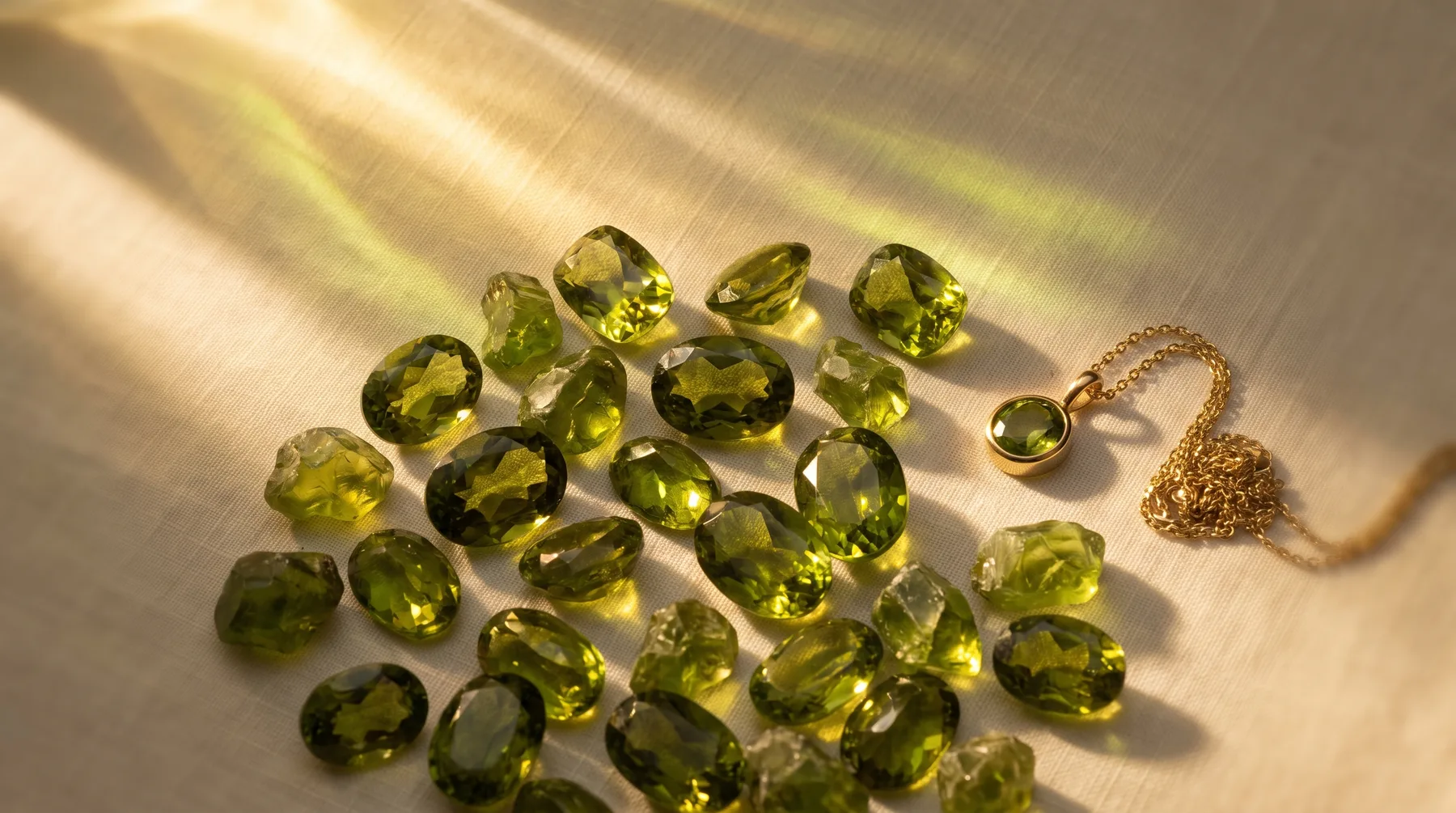
Some gems are found. Peridot arrives — carried up from the deep earth in volcanoes, washed ashore at the feet of a goddess, and, every so often, delivered by meteorite. The August birthstone is the only gem in the case with a courier service from outer space, and that is somehow only the third most interesting thing about it.
August birthstone jewelry is built around a color no other gem does quite the same way: a sunlit, olive-to-grass green that the ancient Egyptians named for their favorite thing in the sky. Peridot doesn't flash like a diamond or brood like a sapphire. It glows — evenly, warmly, in almost any light — which is exactly why the Romans wore it after dark.
August actually has three birthstones — peridot, sardonyx, and spinel — and we will give the other two their due below. But the month belongs to peridot, so that is where we will start.
A Gem Mined by Lamplight for 3,500 Years
2 min
The oldest peridot story is a real place: a small, forbidding island in the Red Sea that the ancients called Topazios and charts now call Zabargad, or St. John's Island. Egyptian papyri record mining there as early as 1500 BC, according to the Gemological Institute of America (GIA), and the American Gem Society notes the Egyptians called what came out of it the "gem of the sun." Legend holds that some of the mining happened at night, when the stone's glow gave it away — a story that says less about geology than about how this gem behaves in low light.
Peridot has spent most of history being mistaken for something else. The Romans called it the "evening emerald" for the way its green held up by lamplight. For centuries, the faithful admired the great 200-carat gems on the Shrine of the Three Holy Kings in Germany's Cologne Cathedral as emeralds; per GIA, they are peridots. And some historians believe Cleopatra's famous emerald collection may have been peridot rather than emerald all along — a claim worth repeating exactly that carefully, because the sources say "may." What the AGS folklore record does say plainly: Cleopatra loved this stone, and believed it kept dark spirits at bay.
Half a world away, Hawaiians found small peridots washed up on volcanic shores and understood them as the tears of Pele, the volcano goddess. Two civilizations with no contact, one conclusion: this stone came from somewhere hotter and deeper than the beach it landed on. They were right — peridot forms in the earth's mantle and rides magma to the surface.
The Meaning Beneath the Color
1 min
Across its cultures, peridot's symbolism keeps circling the same ideas: sunlight, protection, and calm after dark. The Egyptians wore the gem of the sun; medieval wearers valued it against night terrors and evil spirits; Hawaiians read it as a goddess's grief turned beautiful. If garnet in January is the gem of the kept promise, peridot in August is the gem of carried light — summer you can wear into the fall.
It has a quieter, married meaning too: peridot is the official gemstone of the sixteenth wedding anniversary, per the International Gem Society. Sixteen years in, the flashy gifts are done and the honest ones begin — a green that glows in the evening is not a bad emblem for that stretch of a marriage.
The Only Gem Born Green
1 min
Here is the fact that reframes the whole stone: most colored gems get their color from trace impurities — a little chromium sneaks into a colorless mineral and you have ruby or emerald. Peridot's green comes from iron, and iron is part of the mineral's own recipe. Gemologists call this being idiochromatic, self-colored: as the American Gem Society puts it, peridot is one of the few gems that exists in only one color family. There is no blue peridot, no pink peridot, anywhere, ever. The stone cannot be anything but green.
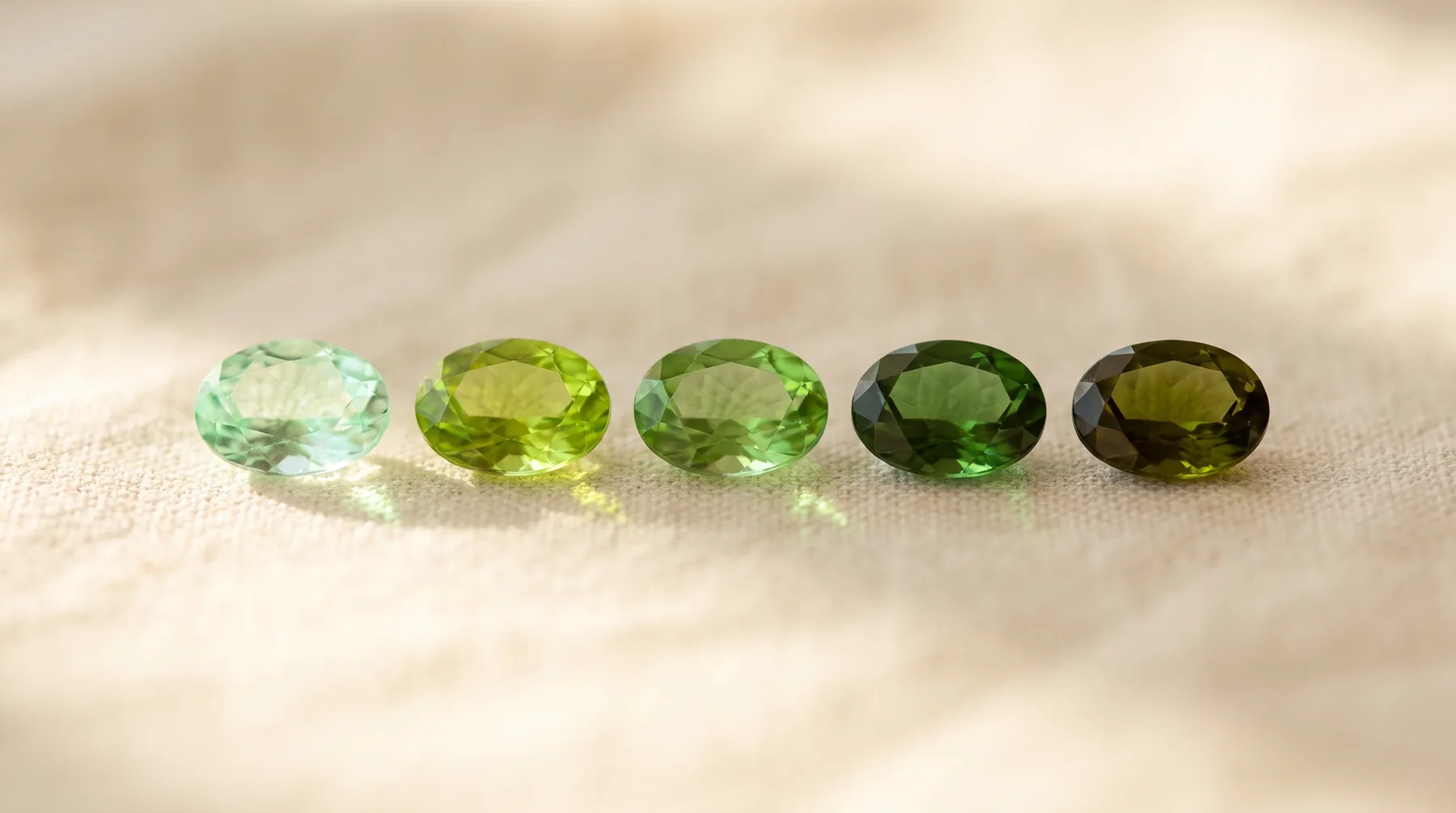
Within that green there is a real range — spring yellow-greens, pure grass greens, deeper olive tones — steered by exactly how much iron the crystal carries; push far enough toward iron-rich and the green browns out. Peridot is the gem variety of the mineral olivine, and per the International Gem Society, it is also strongly doubly refractive: light splits in two inside the stone, doubling the back facets when you look closely, and lending the gem the soft, velvety glow the AGS describes — closer to candlelight than to a diamond's white sparkle. Hold one up and you can see it: peridot looks lit from within, not lit from above.
The Gem That Falls From Space
1 min
Peridot is the only gem regularly faceted from material that did not start on this planet. A rare class of meteorites called pallasites carries crystals of olivine locked in iron-nickel, and per the International Gem Society, pallasites have yielded facetable peridots — gem-quality stones cut from meteorite. The AGS notes some of these crystals date back 4.5 billion years, to the birth of the solar system. Earthly peridot is already the deep earth made wearable; a pallasitic peridot is older than the planet it landed on.
You will likely never buy one — they are collector rarities — but it is a fine thing to know while wearing the terrestrial kind. No other birthstone's origin story includes the sky falling.
Where Peridot Comes From Today
1 min
Most of the world's peridot now comes out of the San Carlos Apache Reservation in Arizona, which the American Gem Society identifies as a major source of the world's supply — modest-sized stones in cheerful yellow-greens, mined by hand on Apache land, and the reason peridot stays refreshingly affordable.
The connoisseur material comes from elsewhere. Pakistan's high-mountain deposits produce the stones dealers reach for first — deep pure greens with exceptional clarity; the Smithsonian added a 100-carat Pakistani peridot to the National Gem Collection in 2011. Myanmar produces richly saturated, often large stones. And the largest known cut peridot of all — 310 carats, in the Smithsonian — came from Zabargad itself, the same Red Sea island the pharaohs mined. The old source still holds the record.
How Peridot Wears in Real Life
1 min
Peridot sits at 6.5 to 7 on the Mohs hardness scale. That is respectable — harder than opal or pearl, about the hardness of quartz — but it is meaningfully softer than sapphire, and softer than the everyday dust that settles on jewelry, which is full of quartz. In practice: a peridot pendant or pair of earrings will stay beautiful for generations, while a peridot ring worn hard, every day, will slowly collect the fine abrasions that dull its polish.
The AGS's advice is ours too: peridot is best worn in earrings and necklaces, or in a ring with a protective mounting. A bezel — a full metal wall around the stone — turns a peridot ring from "be careful" into an honest everyday piece; so does a low profile and a habit of taking it off for the gym and the garden.
Two quirks are specific to this gem, and most owners learn them the hard way. Peridot is sensitive to acids — including, per the International Gem Society, the mild acids in perspiration — so a quick wipe after a sweaty day genuinely matters. And it dislikes rapid temperature change, which can stress a stone that almost always carries some internal character. Neither quirk is a reason to pass; both are reasons to read the care section below.
Choosing August Birthstone Jewelry by the Piece
1 min
Match the piece to how peridot actually behaves, and every option gets easier.
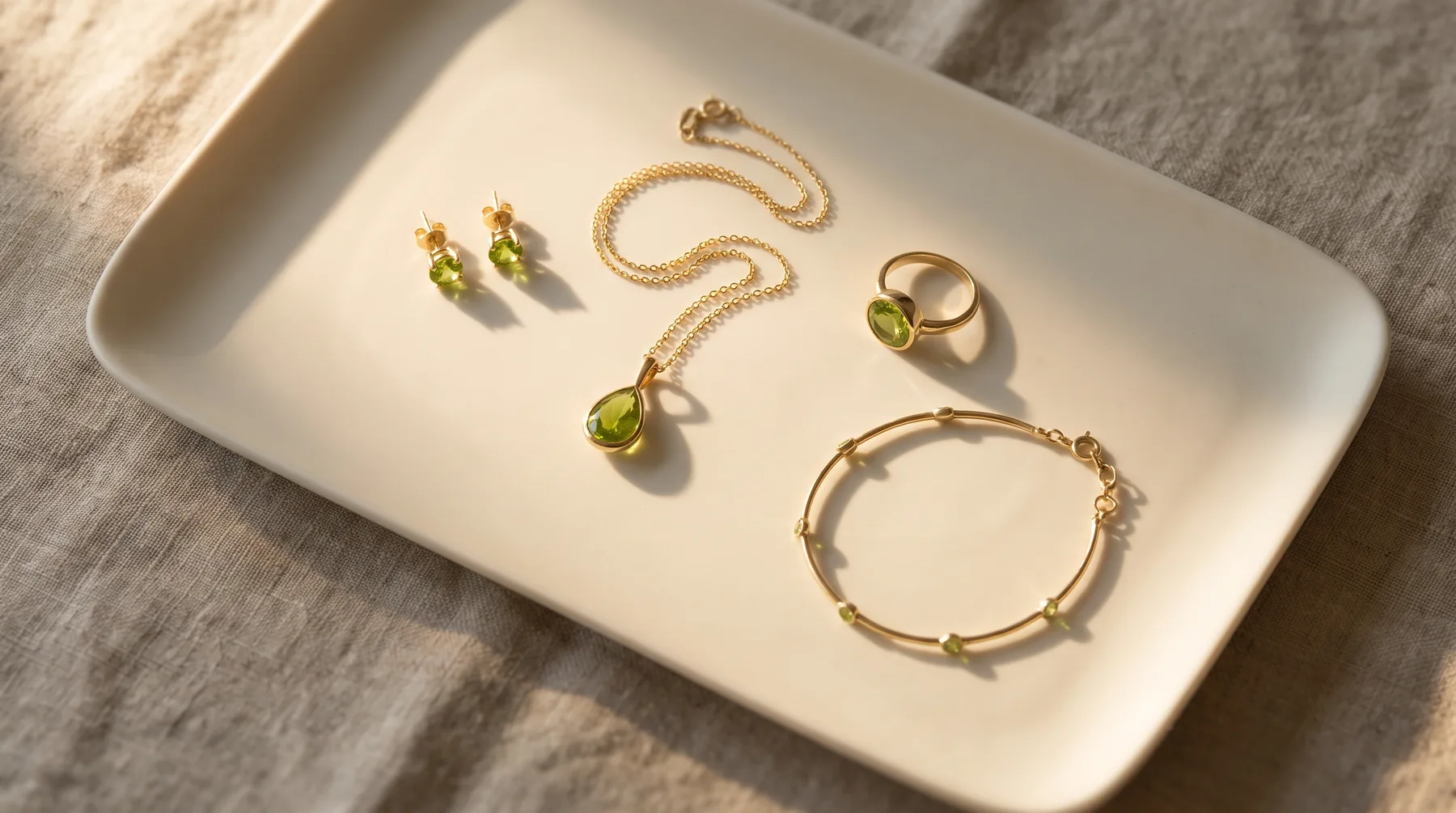
Peridot necklaces and pendants
The safest gift and arguably the best showcase. At the collarbone the stone meets nothing harder than fabric, and its glow reads across a dinner table. A 7mm to 9mm round or cushion in yellow gold is the classic move — yellow metal amplifies the sun in the stone rather than fighting it.
Peridot earrings
Earrings are where softer gems live their best lives, and peridot is no exception. Studs in a simple basket setting handle daily wear indefinitely; drops catch the light with every turn of the head, which suits a gem whose whole personality is glow. This is our default recommendation for an August birthday when you don't know the recipient's ring size or taste.
Peridot rings
Entirely wearable — chosen with open eyes. Favor bezels, halos, and lower-set designs over high solitaires; think of the polish as renewable (a jeweler can restore it) rather than permanent. An occasional-wear cocktail ring with a big, sleepy green stone is one of the most charming things peridot does. For the engineering of protective settings, our honest guide to ring settings goes deep.
Peridot bracelets
The honest caveat: wrists take hits. A peridot line bracelet is a beautiful occasional piece, but for daily wear choose a design where the stones sit protected, or accept gentle aging as part of the bargain.
How to Buy a Peridot Worth Keeping
2 min
With peridot, color is nearly the whole ballgame — and you should know going in that colored stones have no equivalent of the diamond's universal grading system. The International Gem Society notes there is still no international grading standard for colored gems as rigorous as GIA's diamond scale, so a "AAA peridot" label means whatever the seller decides it means. Train your eye instead:
- Color first, always. The prize is a richly saturated green with minimal brown or excess yellow — the AGS buying guidance says exactly this. Between two stones, take the smaller one with the purer, livelier green every time.
- Expect eye-clean. Good peridot in jewelry sizes should show no inclusions to the naked eye. Visible black spots or veils are a reason to keep looking, not a discount to accept.
- Size is your friend here. Unlike emerald or fine tsavorite, peridot stays affordable as it grows — larger stones are more available than in almost any other green gem, so a genuinely bold piece is within reach.
- Treatments are refreshingly rare. Per the International Gem Society, most peridots receive no treatment at all. Like garnet, this is a gem where what you see is almost always what nature made.
- The double image is the signature. Look into the stone with a loupe: real peridot's strong double refraction visibly doubles the back facet edges. A "peridot" with the flat, single-image look of bottle glass deserves your suspicion, especially at a price too good to be true.
Sardonyx and Spinel: August's Other Two Birthstones
1 min
August is one of the few months with three official birthstones, per the American Gem Society, and both alternates are worth knowing.
Sardonyx is the ancient one — banded layers of reddish sard and white onyx that Roman soldiers carved with Mars, god of war, and wore into battle. It is the traditional August stone, a carver's gem more than a faceter's, and an estate-case treasure for anyone who loves cameos and intaglios.
Spinel is the newcomer with the oldest résumé. In June 2016, Jewelers of America and the American Gem Trade Association added spinel as an official August birthstone — only the third change to the modern list since it was drawn up in 1912. Spinel spent centuries being mistaken for ruby; the "Black Prince's Ruby" in the British Imperial State Crown is, famously, a red spinel. For an August-born wearer who wants a hard, brilliant stone in red, pink, lavender, or steel blue — and a ring that shrugs off daily wear better than peridot — spinel is the insider's answer.
Caring for Peridot Jewelry
1 min
The rules are short, and two of them are non-negotiable.
- Warm water, mild soap, soft brush — only. The bowl-and-brush routine from our gold cleaning guide is the complete peridot method too.
- Never use an ultrasonic or steam cleaner. Both the AGS and IGS care guidance rule them out for peridot; vibration and heat are this stone's two enemies.
- Wipe after sweaty wear. Peridot's acid sensitivity extends to perspiration. Thirty seconds with a soft cloth is the whole defense.
- Avoid temperature shocks. No hot car dashboard to cold rinse. Let the stone change temperature at its own pace.
- Store it separately. At 6.5–7, peridot loses every argument with sapphire, ruby, and diamond. A soft pouch — not the communal jewelry-box pileup — keeps its polish where it belongs.
Frequently Asked Questions
2 min
What is the August birthstone?
Peridot is the primary August birthstone, joined officially by sardonyx (the traditional stone) and spinel (added in 2016 by Jewelers of America and the American Gem Trade Association). Peridot is the yellow-green gem variety of the mineral olivine.
Why does August have three birthstones?
The modern birthstone list, created in 1912, has been amended only a handful of times. Sardonyx was August's traditional stone, peridot became its modern standard-bearer, and spinel was added in 2016 — partly to give August-born buyers a harder, more ring-friendly option.
What color peridot is most valuable?
A richly saturated, pure grass green with minimal brown or yellow modification. Color drives peridot value more than any other factor; fine Pakistani and Burmese stones command the premiums, while lighter yellow-green stones stay very affordable.
Can you wear a peridot ring every day?
Yes, with the right mounting. At 6.5–7 on the Mohs scale, peridot in a protective bezel or low-set design handles daily life well; a high-set solitaire worn through workouts and gardening will dull faster. Earrings and pendants carry no such caveats.
Were Cleopatra's emeralds really peridot?
Possibly — some historians believe her famed emerald collection may have included peridot from Egypt's Zabargad Island, and gem institutions phrase it exactly that cautiously. What is documented is that Cleopatra prized peridot and that Egypt mined it from around 1500 BC.
Is peridot really found in meteorites?
Yes. Pallasite meteorites carry gem-quality olivine crystals — some dating back 4.5 billion years — and a small number have been faceted into wearable peridots. It is the only gemstone regularly cut from extraterrestrial material.
How do you clean peridot jewelry?
Warm water, a drop of mild soap, and a soft brush — nothing else. Never use an ultrasonic or steam cleaner on peridot, wipe the stone after sweaty wear, and store it away from harder gems that can scratch it.
Peridot never needed to be rare to be loved. It survives on charm: a green that no other stone owns, a glow that works by candlelight, a history that runs from a pharaoh's island to the Hawaiian shore to the asteroid belt. Choose one for the color your eye keeps returning to, set it where its life will be gentle, and August's little piece of the sun will outlast every summer it commemorates.