
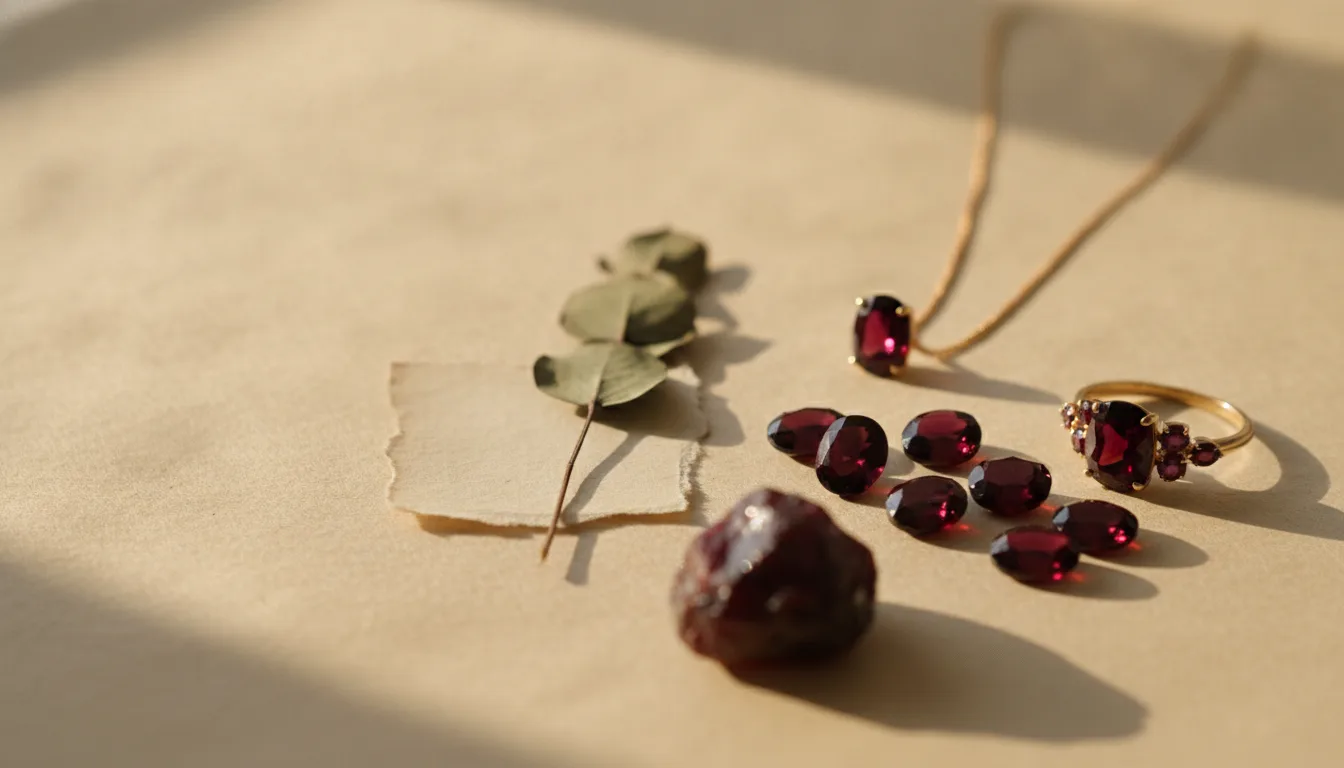
A gem worn for five thousand years, glowing quietly through every century — and still the most honest piece of January birthstone jewelry you can give.
Split a pomegranate in winter and look at what spills out: a cluster of small, glassy seeds, each one holding its own private fire under a translucent skin. That is the image a Roman wordsmith reached for when he named this gemstone granatus — pomegranate — and it is still, two thousand years later, the most honest way to describe a garnet held up to a January window.
January birthstone jewelry is built around that quiet, internal fire. Not the icy flash of a diamond, not the showy blue of a sapphire, not the headline-grabbing green of an emerald. Garnet glows from inside, the way a fireplace glows after the flames have settled — warm, steady, lived-in. It is the gemstone of midwinter for a reason.
And it has been worn for longer than almost anything else in a jewelry box.
A Stone That Has Been Loved for Five Thousand Years
1 min
The first garnets we know about were strung around the necks of Egyptian pharaohs around 3100 BC, according to the American Gem Society. Bronze Age warriors carried them as protection on long journeys, believing the red glow could ward off the dangers of the road and the dark. Roman senators wore garnet signet rings carved with intaglios — tiny reverse-cut images pressed into hot wax to seal a letter, a treaty, a promise. Every time one of those rings closed a document, a small piece of garnet touched a piece of someone's word.
The Victorians inherited that lineage and made it intimate. Bohemian pyrope, mined in what is now the Czech Republic, fed an entire era of mourning brooches, rose-cut earrings, and parures handed down mother to daughter. Walk into any estate jeweler today and you will find pieces from that century still in wearable condition, the gold a little softer, the stones still throwing their pomegranate light.
A garnet pendant given today belongs to a chain of givers and receivers that runs back through Vienna and Prague, through Pompeii, through the Nile delta. That is not marketing. That is what the archaeology says.
The Meaning Beneath the Color
1 min
Across the cultures that have worn it, garnet has settled around the same small handful of ideas. Loyalty. Friendship. Safe travels. The kind of love that does not announce itself but is reliably there in the morning. The Gemological Institute of America calls garnet the gemstone of the second wedding anniversary, a marker for the moment a marriage stops being new and starts being real.
There is something fitting about that. A diamond is the gem of the spectacular promise. Garnet is the gem of the kept promise — quieter, deeper, and arguably harder.
For a January birthday, the symbolism lands a little differently. January is a beginning month, and garnet's meaning has always carried a forward-facing protectiveness — a stone for the journey ahead rather than the year just finished. Giving someone a garnet in their birth month is, traditionally, a way of saying I want you safe and steady through whatever this year hands you. Few gifts say that without saying it.
Garnet Is a Family, Not a Single Stone
2 min
Here is the thing almost every birthstone guide skips, and the thing that turns shopping for January birthstone jewelry from guesswork into a real choice. Garnet is not one mineral. It is six.
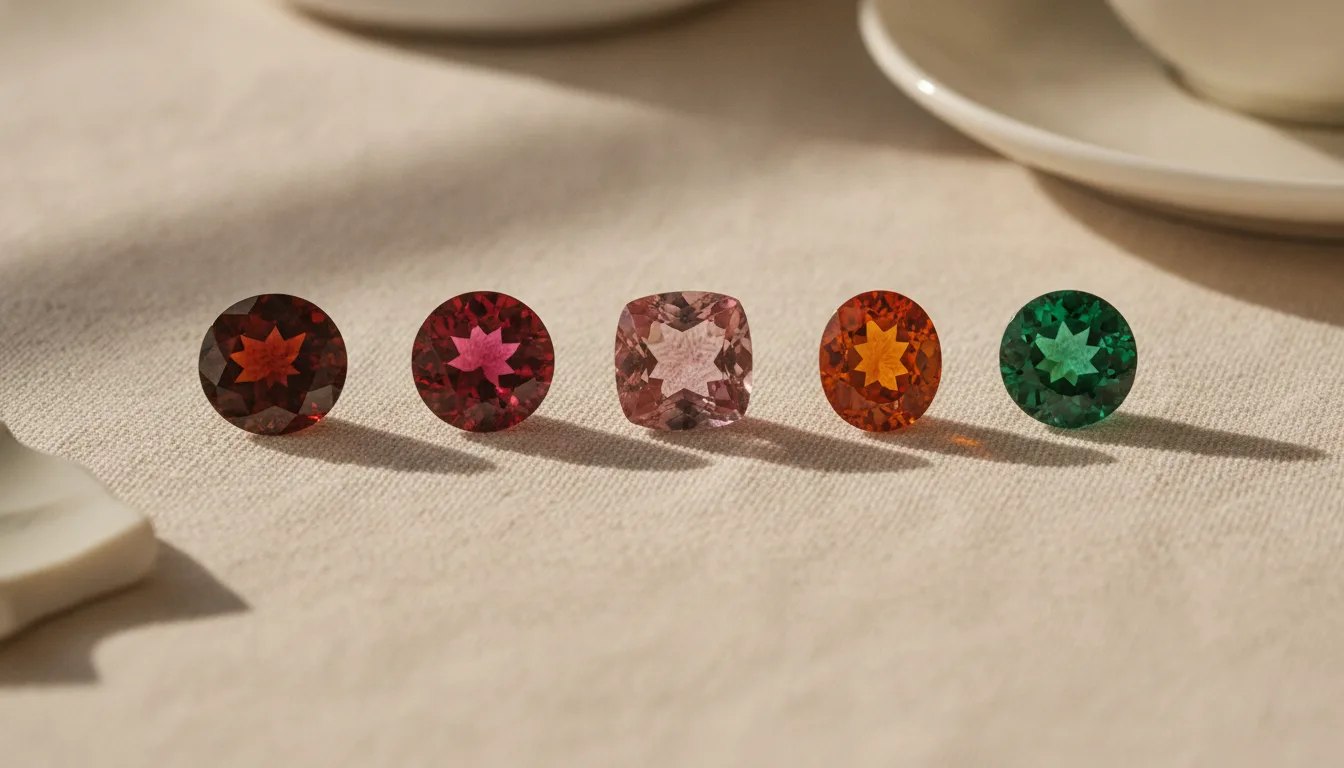
The garnet group splits into six recognized species — almandine, pyrope, spessartine, grossular, andradite, and uvarovite — and a longer list of named varieties produced when those species blend or when trace elements shift the color. The result is a family of gems that runs across nearly the entire color wheel.
Almandine and pyrope: the classic reds
Almandine and pyrope are the stones most people picture when they hear the word garnet. Almandine leans deep and slightly brown, like wine in a heavy glass. Pyrope leans pure and luminous, and the chrome-rich pyropes can hold their own next to a ruby in good light, per the International Gem Society.
Rhodolite: the raspberry one
Rhodolite is what happens when those two blend toward purple — a raspberry-pink-red garnet, brighter and more alive than either parent stone, often eye-clean in a way red garnets aren't always. It is the variety to choose if the wearer reaches for color rather than gravity.
Spessartine: the orange one
Spessartine produces vivid orange to reddish-orange stones. The most saturated examples are sold as "mandarin garnet," and a fine mandarin pendant in yellow gold is one of those pieces that stops a room without trying.
Tsavorite: the secret
Tsavorite was discovered in 1967 near Kenya's Tsavo National Park — a chromium-bearing grossular garnet with a green so vivid it competes directly with emerald, except that it is harder, cleaner, and untreated. A tsavorite ring is a quiet flex among people who actually know gems.
Demantoid: the rare collector's piece
Demantoid is a dispersive bright green andradite with more fire than diamond. The Russian Urals demantoids carry "horsetail" inclusions: golden filaments of byssolite that fan inside the stone like a still photograph of light. GIA calls it "the most valuable garnet and one of the rarest gems in the world."
A reader buying their first piece of January birthstone jewelry will probably reach for almandine, pyrope, or rhodolite — and that is the right call. A reader buying their fifth piece, or shopping for someone who already has the obvious red, has a much wider conversation to have.
How Garnet Wears in Real Life
1 min
Most people learn about gem durability the wrong way: by chipping something they love. A few minutes of context prevents that.
Garnet sits between 6.5 and 7.5 on the Mohs hardness scale, depending on variety. Almandine, pyrope, spessartine, and tsavorite live at the harder end. Demantoid sits a hair lower. That puts garnet roughly on par with quartz and tanzanite — softer than sapphire or ruby, but harder than opal, pearl, or turquoise.
The crucial detail is what GIA calls out specifically: garnet has no cleavage planes. Diamonds, topaz, and emerald all have built-in lines of weakness that can split a stone if it gets struck the wrong way. Garnet does not. In practical, drop-it-on-the-tile terms, that makes garnet more resistant to breaking than diamond, even though it scratches more easily.
What that means for actual wear: a garnet pendant or pair of earrings will outlast its owner with no special handling at all. A garnet ring is fine for daily wear if it is treated like jewelry rather than a tool — and a low-profile bezel setting on a daily-wear ring is the small engineering choice that turns "be careful" into "wear it and forget about it."
Choosing January Birthstone Jewelry by the Piece
2 min
The best piece of garnet jewelry for someone is not a price tier. It is a match between how the gem behaves and how the wearer lives.
Garnet necklaces and pendants
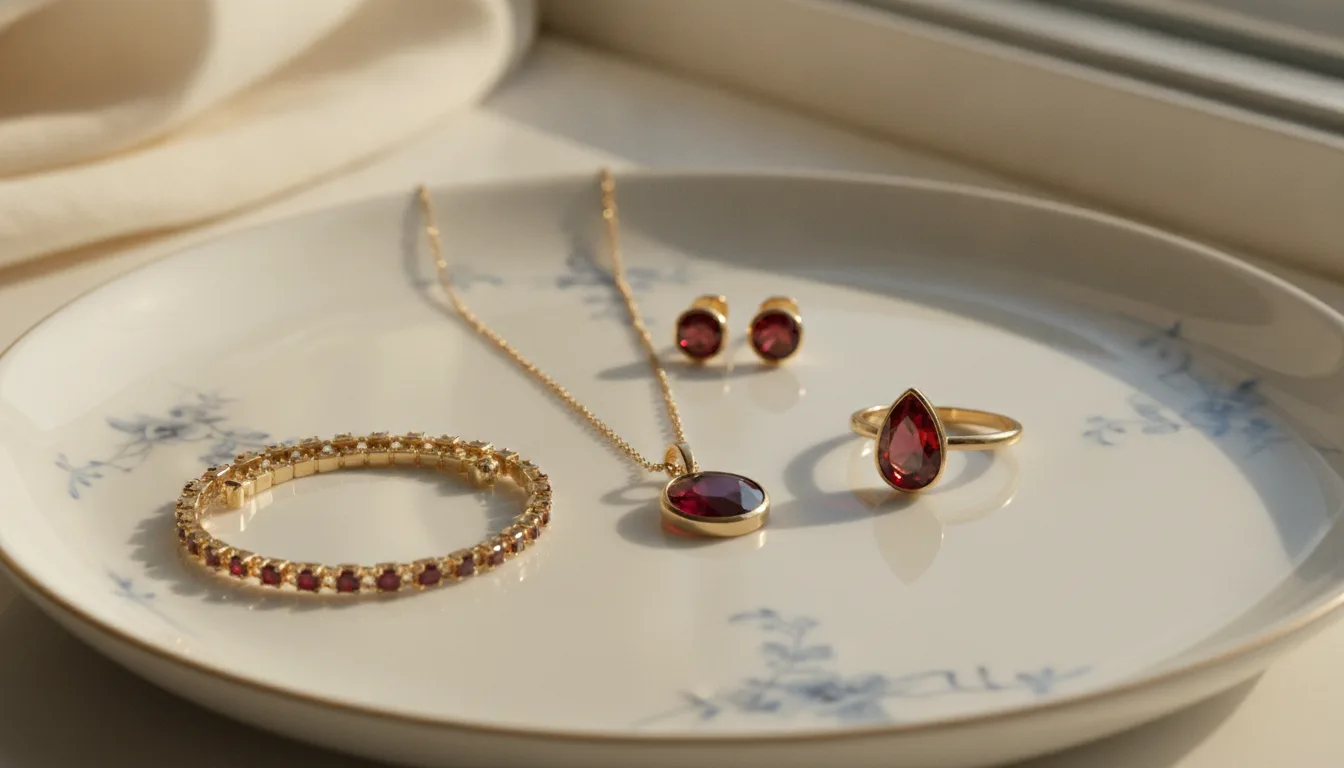
A garnet necklace is the most forgiving way to give January birthstone jewelry as a gift. Pendants don't need a ring size, don't catch on doorknobs, and let the stone sit at the heart, which is exactly the right register for a gem that means loyalty. Look for a clean rhodolite or pyrope between 6mm and 8mm — large enough to read across a room, small enough to layer with a daily chain.
Garnet rings
Garnet rings come into their own in clusters, halos, and three-stone designs, where risk is shared across multiple stones rather than concentrated on a solitaire. Rose gold flatters red garnet by deepening the pink undertones. Yellow gold pulls the warmth forward and reads classic. White gold and platinum let the gem do the color work alone and lean modern.
Garnet earrings
Earrings are the easiest entry into garnet jewelry. Round 5mm to 6mm studs in a basket or martini setting suit nearly every face shape and outfit. Pear or oval drops add length and movement and are flattering on a long neck. Because earrings sit far from any rough surface, the softer varieties become genuinely viable in a way they aren't in a ring.
Garnet bracelets
A line bracelet of small rhodolites in 14k yellow gold is the most underrated second-anniversary gift in jewelry. It does not announce itself the way a tennis bracelet of diamonds does. It simply glows on the wrist whenever the wearer's sleeve rides up, year after year, the way a long marriage does the same.
How to Buy a Garnet Worth Keeping
2 min
Garnets are graded on the same four C's as any colored stone, with the weight skewed toward color above all.
- Color is the heart of it. Hold the stone in daylight. A well-cut red garnet should throw bright, clear reflections from its table — the flat top facet — and not read as a uniform dark mass. Saturation matters; darkness for its own sake is not value.
- Clarity is more forgiving than people expect. Most red garnets reach the market eye-clean, and any visible inclusion in a pyrope or rhodolite is a reason to keep looking. The deliberate exception is demantoid, where horsetail inclusions raise the price rather than lower it.
- Cut rewards garnet's high refractive index. A precision-cut stone outperforms a larger but sloppily cut one in any setting. Watch the table reflection; if the center looks dark or vacant, the cut is too shallow.
- Carat. Pyrope, almandine, and rhodolite are reasonable buys at larger sizes. Tsavorite, demantoid, and pure mandarin spessartine become scarce above two carats and price accordingly.
One more thing every buyer should know. Under the FTC Jewelry Guides, sellers must disclose any treatments performed on a colored stone. Garnet is one of the few gems where the answer is almost always "none." Most red garnets reach the market untreated, which is a quiet part of why they offer such honest value. If a seller cannot tell you whether a stone has been treated, that is itself the answer — keep shopping.
A Word on the "Modern" January Birthstone
1 min
Some lifestyle guides include rose quartz as a January alternative. The major gemological institutions — GIA, AGS, Jewelers of America — anchor January firmly to garnet. Rose quartz is a lovely pink quartz with its own following in the crystal-healing world, but it is not on any official birthstone list. For a recipient who already owns a deep-red piece, the more tradition-aligned alternative is simply a different garnet variety: a green tsavorite, an orange spessartine, a raspberry rhodolite. Any of these still counts, fully, as January birthstone jewelry — and any of them avoids the visual repetition of the obvious red.
Caring for Garnet Jewelry
1 min
The official GIA care guidance is short and worth following.
- Warm soapy water is always safe. A small bowl, a drop of dish soap, a soft toothbrush. Rinse, pat dry with a lint-free cloth. The full bench routine is in our guide to cleaning gold jewelry at home.
- Ultrasonic cleaners are usually fine for untreated garnets but should be skipped for any stone with fractures or fracture-filling.
- Avoid steam cleaning. GIA does not recommend it for garnet.
- Store garnet separately. It can scratch pearl, opal, and turquoise, and be scratched by sapphire, ruby, or diamond.
- Take rings off for hand-intensive work. Gardening, weights, and heavy household cleaning are the three culprits behind nearly every chipped stone.
A garnet given proper care will hand itself down. That is not a sales line; it is what the estate market shows, every Saturday, in cases full of Bohemian pyrope brooches still glowing the way they did in 1880.
Frequently Asked Questions
2 min
What is the January birthstone?
Garnet — recognized by the GIA, the American Gem Society, and the traditional birthstone calendar. It comes in red, orange, green, purplish-red, cinnamon, and rare color-changing varieties.
What does garnet symbolize?
Loyalty, friendship, safe travels, and enduring love. Garnet is also the traditional gemstone for the second wedding anniversary, which gives a garnet piece a double meaning for couples whose anniversary lands in January.
What color is the January birthstone?
Most often a deep, glowing red — but garnet is a family, not a single stone, so vivid green tsavorite, orange mandarin spessartine, and raspberry rhodolite all qualify as January birthstone jewelry.
Can garnet be worn every day?
Yes for almandine, pyrope, rhodolite, spessartine, and tsavorite, particularly in protective settings like bezels or as pendants and earrings. Demantoid and hessonite are softer and better suited to occasional wear.
How can you tell a garnet from a ruby?
A ruby's red leans slightly pink or stoplight-bright. Garnet leans pomegranate — slightly browner, deeper, more glowing than flashing. Ruby is significantly harder (9 on Mohs vs. garnet's 6.5–7.5) and substantially more expensive. A jeweler can confirm in seconds with a refractometer.
Are garnets treated?
Almost never. Garnet is one of the few gems that consistently reaches the market untreated, which is a quiet part of why it offers such honest value compared to gems where heat treatment or fracture-filling is the norm.
What's the best metal for a garnet ring?
Rose gold deepens the pink-red undertones. Yellow gold pulls the warmth forward and reads classic. White gold and platinum let the stone carry the color alone and feel more modern. Tsavorite and demantoid pair particularly well with yellow gold.
A garnet is not a flashy stone. It is a steady one. It does not demand attention across a room; it rewards the person who looks twice. That is exactly why it has been worn for five thousand years, and why a piece of January birthstone jewelry chosen with a little care turns into the kind of gift that stops being a gift and starts being a thing the wearer just has — for years, for decades, for the next person down the line.