
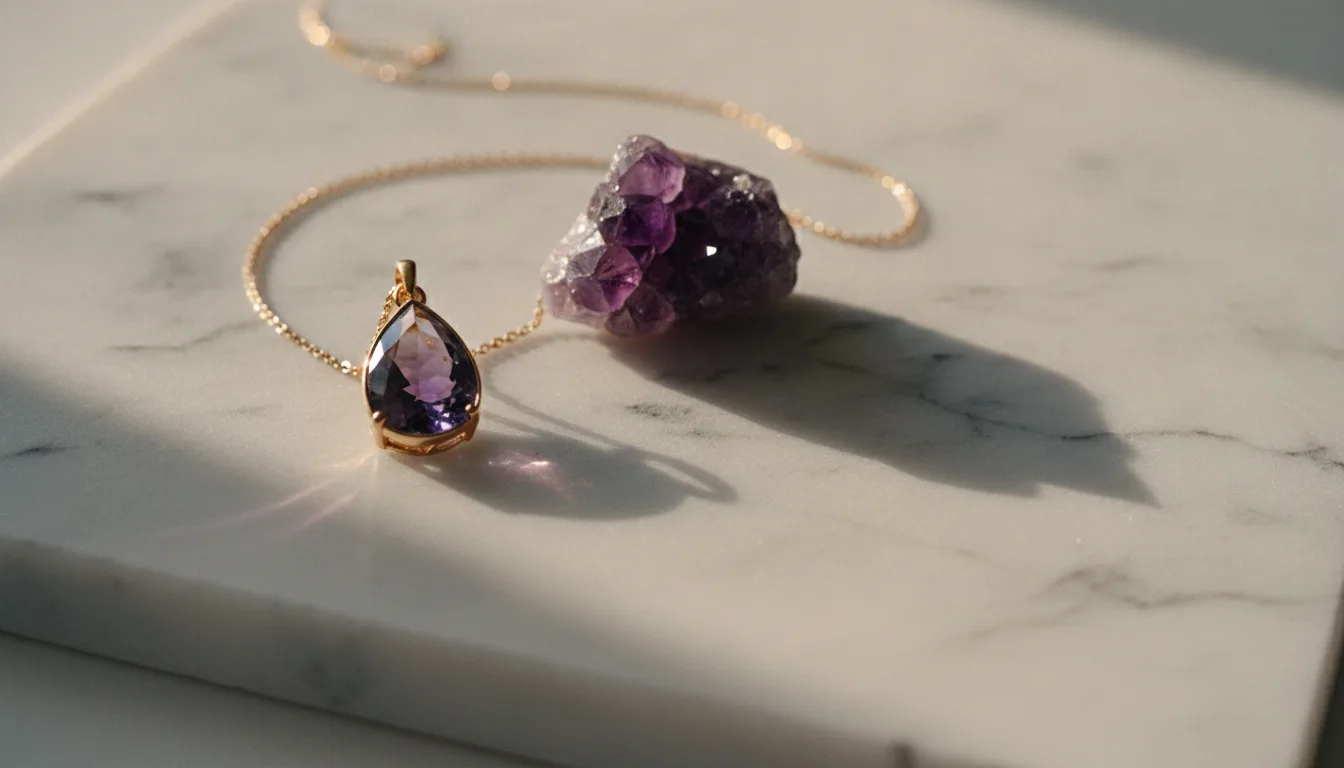
A purple stone once valued alongside diamond and ruby, worn by emperors, bishops, and empresses — and still the most quietly dignified piece of February birthstone jewelry you can give.
For most of recorded history, amethyst was not the affordable gemstone it is today. It was one of the five "cardinal" gems — diamond, ruby, sapphire, emerald, and amethyst — and a fine purple stone could be priced alongside any of them. That ranking held until vast Brazilian deposits were discovered in the early nineteenth century and the supply curve finally caught up with the demand. Amethyst did not become less beautiful that day. It became more accessible. The two things are not the same.
February birthstone jewelry rests on that long, complicated lineage. The purple is not loud. It does not flash like a ruby or refract like a diamond. It glows — a deep, contemplative violet that has carried meaning through Greek symposiums, Roman intaglios, medieval episcopal rings, and Russian imperial parures. Wearing amethyst has, for most of history, been an act of quiet authority.
And the people who knew gems best were the first to wear it.
A Stone Worn by Kings, Bishops, and Empresses
2 min
The name itself is a Greek joke about restraint. Amethystos means "not intoxicated," and ancient Greeks carved drinking vessels from amethyst in the genuine belief that the wine-colored stone could ward off drunkenness, according to the Gemological Institute of America. Bacchus, the Roman god of wine, is woven into early myths about how the stone got its color. Whether or not anyone truly stayed sober, the symbolism stuck for two thousand years.
The stone moved seamlessly from pagan symposiums into the Christian church. Anglican and Roman Catholic bishops have, for centuries, worn an episcopal ring set with an amethyst — a tradition the American Gem Society traces to the same idea of clarity, sobriety, and spiritual discipline. The reference scholars often cite is Acts 2:15, where the Apostles at Pentecost are described as "not drunk" — the same word the Greeks reached for when they named the stone.
Royal taste followed. Catherine the Great loaded her court with amethyst necklaces and ear pieces from the Russian Urals, where the finest "Deep Siberian" material was mined — a quality grade the trade still uses today, even though the original mines have long since faded. In 1953, the Duchess of Windsor wore a Cartier-designed amethyst bib necklace to a gala in Versailles, the kind of piece estate auction houses still circulate decades later. That necklace did not need to be a diamond rivière. The purple did the work.
For most of two thousand years, amethyst was the gem that signaled a particular kind of taste — older, quieter, more confident than whatever the room was wearing. The Brazilian discoveries changed the price. They never changed the meaning.
The Meaning Beneath the Purple
1 min
Amethyst's symbolism has been remarkably stable across cultures. Sobriety. Clarity. Self-possession. The kind of calm that does not need to announce itself to be felt. The Greeks and Romans tied it to mental discipline; the medieval church tied it to spiritual restraint; modern lifestyle traditions tie it to focus, intuition, and a quiet kind of resilience. Different vocabularies, same underlying picture.
For a February birthday, that meaning lands well. February sits at the hinge of winter — the month of resolutions still being kept or quietly let go, of long evenings and early reflection. Amethyst suits that register the way garnet suits January's beginnings: a stone for the wearer who keeps their head, holds their pace, and doesn't reach for the loudest piece in the case.
Amethyst is also the traditional gemstone for the sixth wedding anniversary, which turns a piece of February birthstone jewelry into a layered gift for couples whose anniversary lands in the right window. Six years is the moment a marriage stops being a young experiment and starts being an actual life. Amethyst — quiet, durable, anciently associated with constancy — is well-cast for the role.
One Mineral, Many Purples
2 min
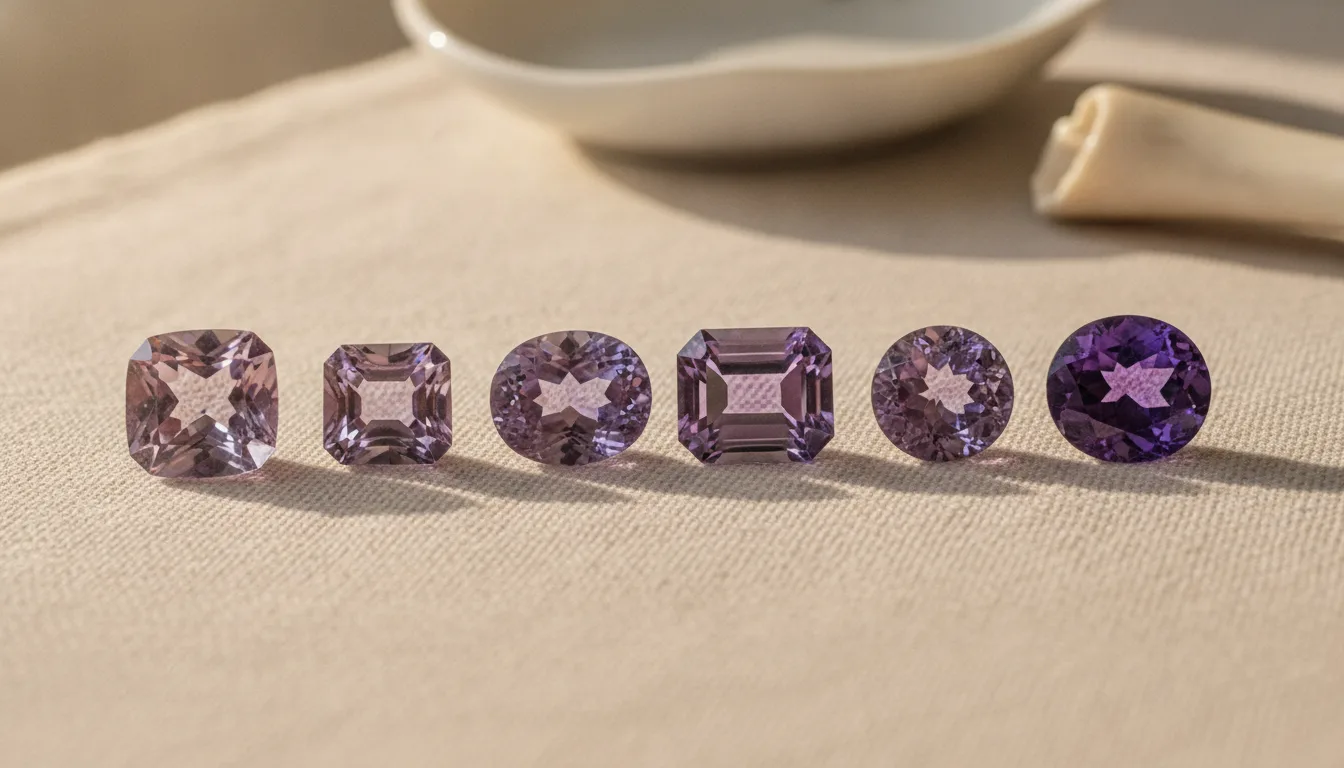
Amethyst is the purple variety of quartz, colored by trace iron and natural irradiation deep inside the crystal. That is one mineral. But the visual range it produces — from soft lavender to nearly black-purple — is wide enough that experienced buyers shop by origin and by color grade, not by carat alone. Knowing where a stone came from is the difference between paying for the name and paying for what is actually in your hand.
Brazilian amethyst: the everyday workhorse
Brazil is the largest historical source. Brazilian geodes produce amethyst in significant size, but the color tends toward the lighter end — pale lilac, soft violet, sometimes uneven within a single stone. Most commercial amethyst jewelry sold worldwide is Brazilian. There is nothing wrong with that, and a well-cut Brazilian amethyst can be genuinely beautiful. It is simply not where the highest grades come from.
Uruguayan amethyst: the deep one
Across the border, the Artigas region of Uruguay produces what most of the trade considers the world's finest amethyst color: a saturated, almost gel-like deep purple with subtle blue and red secondary flashes, per the International Gem Society. Uruguayan stones tend to be smaller than Brazilian ones — the geology produces tighter geodes — but the color premium is real. A Uruguayan amethyst at the same carat weight as a Brazilian one looks, to the eye, like a different gem.
Zambian amethyst: the raspberry one
Zambia is the largest producer in Africa, with annual output measured in the thousand-ton range. Unlike South American geodes, Zambian amethyst forms in veins inside metamorphic rock, which yields smaller stones with an unusually rich raspberry-purple character — slightly warmer than Uruguayan, with a velvet rather than glassy quality. For a wearer who likes purple but finds Uruguayan material too cold, Zambia is often the right answer.
"Siberian" amethyst: a grade, not a place
The original Siberian deposits in the Russian Urals are essentially exhausted. But "Deep Siberian" lives on as a grade name in the trade, describing a primary purple of roughly 75 to 80 percent saturation with 15 to 20 percent blue and red secondary flashes depending on the light. It is the highest quality grade you will see used in serious amethyst jewelry — and it can describe a stone from any locality that hits those parameters. When a jeweler uses the word, they are talking about color, not geography.
How Amethyst Wears in Real Life
2 min
Most people learn about gem durability the wrong way: by chipping something they love. Amethyst rewards a few minutes of context.
Amethyst sits at 7 on the Mohs scale of hardness — the same as quartz, since amethyst is quartz. That puts it in the same durability tier as citrine, tourmaline (lower end), and tanzanite — softer than sapphire, ruby, and diamond, but harder than opal, pearl, and turquoise. It has no cleavage, which means it does not split along internal grain the way diamond, topaz, or emerald can.
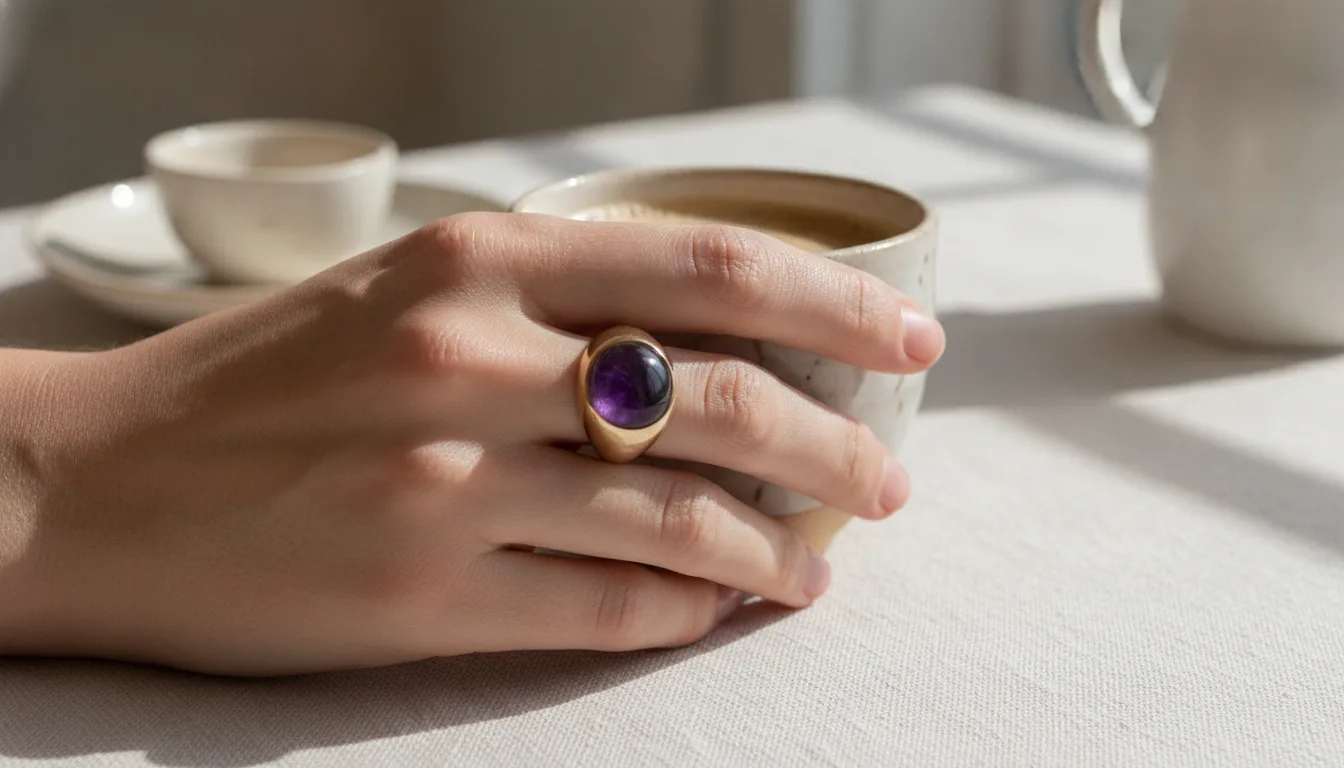
What that means for daily wear: amethyst earrings, pendants, and bracelets will last with no special handling at all. Amethyst rings are a slightly different conversation. The 7-on-Mohs surface will pick up scratches over years of constant wear, and any stone that has been heat-treated (most have been) is more sensitive than a fully natural one to sudden temperature swings. A daily-wear amethyst ring is fine in a low-profile bezel; in a high-prong solitaire, expect to repolish or replace the stone after a long life of wear.
One quirk worth knowing: amethyst's color can fade with prolonged exposure to direct sunlight or high heat, per the GIA care guide. The fading is slow and rarely catastrophic, but it is real — which is part of the reason Victorian amethyst pieces sometimes look paler today than the day they were set. Treat amethyst like a watercolor, not a photograph: protect it from direct sun when it isn't being worn.
Choosing February Birthstone Jewelry by the Piece
2 min
The right piece is not a price tier. It is a match between how the wearer lives and where the stone behaves best.
Amethyst necklaces and pendants
An amethyst pendant is the most forgiving way to give February birthstone jewelry as a gift. Pendants don't need a ring size, sit protected against the chest, and let amethyst's purple read against skin and fabric in the way that flatters it most. For a single solitaire pendant, look for a saturated Uruguayan or Zambian stone in the 6mm to 9mm range — purple gains presence at slightly larger sizes than red gems do. Cushion and oval cuts read warmer; emerald and pear cuts read more contemporary.
Amethyst rings
Cocktail rings are where amethyst has historically done its most confident work — large oval or cushion stones in yellow gold, often surrounded by small accent diamonds or seed pearls. For everyday wear, a low bezel in 14k or 18k gold is the protective choice; the bezel also frames the purple in a way that emphasizes saturation rather than spread. Yellow gold deepens the warm secondary flashes; white gold and platinum read cooler and more modern; rose gold pulls out a pink undertone you might not see otherwise.
Amethyst earrings
Studs in the 5mm to 7mm range are the easiest entry point into amethyst jewelry and arguably the most flattering — purple near the face does something subtly warming that no other gemstone color quite replicates. Drops and chandeliers benefit from amethyst's affordability at larger sizes: a substantial pair of pear-cut amethyst drops costs a fraction of the equivalent in sapphire or tourmaline.
Amethyst bracelets
A line bracelet of small, evenly cut amethysts in 14k yellow gold is the kind of piece that goes unnoticed at first and then becomes the thing the wearer reaches for every day. Tennis-style amethyst bracelets are surprisingly flattering on most skin tones because purple sits beautifully against both warm and cool undertones — a quirk of the color that doesn't apply to most other gems.
How to Buy an Amethyst Worth Keeping
2 min
Amethyst is graded on color above everything else. The other three C's matter, but color is doing 80% of the work.
- Color is the heart of an amethyst purchase. Look for a saturated, even purple with red and blue secondary flashes when the stone is rocked in light. Avoid pieces with visible color zoning — pale bands or windows where the purple breaks up. The finest amethysts read as a continuous, deep purple with no obvious lighter areas.
- Clarity is forgiving in amethyst. The vast majority of fine amethyst on the market is eye-clean to the unaided eye, and any visible inclusion is a reason to keep looking. Unlike emerald, where inclusions are accepted as part of the stone's character, amethyst should look clean.
- Cut matters more than people expect. Quartz has a relatively low refractive index, so amethyst depends on precision faceting to throw light back at the viewer rather than swallow it. A well-cut stone shows even brilliance across the table; a poorly cut one looks dark or "windowed" in the center.
- Carat. Amethyst is one of the few fine gems where you can buy at large sizes without paying an exponential per-carat premium. A 10-carat amethyst is not a meaningfully more expensive proposition than a 5-carat one of the same quality. Take advantage of that. A statement-sized amethyst pendant or cocktail ring delivers visual impact that the same dollar in another colored stone simply cannot.
One regulatory note. Under the FTC Jewelry Guides, sellers must disclose any treatment performed on a colored stone. The vast majority of commercial amethyst has been heat-treated — a stable, permanent process that lightens overly dark material into the more marketable medium-deep purple most buyers want. Heat treatment is the industry norm and is not something to avoid. What you should avoid is a seller who cannot or will not tell you whether a stone has been treated.
A Note on Lab-Created Amethyst
1 min
Lab-grown amethyst has been commercially available since the 1970s and is chemically and physically identical to mined material — same hardness, same refractive index, same iron-and-irradiation color chemistry. A trained gemologist can usually distinguish lab from natural by examining inclusion patterns, but the visual difference to a casual wearer is essentially zero. Lab amethyst is sold at a substantial discount and is a defensible choice for buyers who want size and saturation at a lower price.
The honest framing: a natural Uruguayan amethyst carries the geological and historical weight discussed earlier. A lab amethyst is the same purple, in a different format. Neither is wrong; they answer different questions. Reputable sellers should clearly label one versus the other, and the FTC Jewelry Guides require they do.
Caring for Amethyst Jewelry
1 min
The official GIA care guidance is short.
- Warm soapy water is always safe. A small bowl, a drop of dish soap, a soft toothbrush. Rinse, pat dry with a lint-free cloth. This handles nearly every cleaning need amethyst will ever have. The full bench routine is in our guide to cleaning gold jewelry at home.
- Ultrasonic cleaners are usually fine for untreated amethyst, but should be skipped for any stone that has been dyed or fracture-filled. When in doubt, skip.
- Avoid steam cleaning. Sudden temperature changes can crack amethyst or develop internal fractures.
- Keep amethyst out of direct sunlight when stored. Prolonged sun and heat can fade the color. A drawer, a fabric pouch, or a closed jewelry box solves the problem.
- Store separately from harder gems. Sapphire, ruby, and diamond will scratch amethyst's surface. A divided box or individual pouches is the simplest fix.
- Take rings off for hand-intensive work. Gardening, weight training, and heavy household cleaning are the three usual suspects behind chipped or scratched stones.
Amethyst given proper care will hand itself down. Estate cases are full of Edwardian and Art Deco amethyst pieces still in wearable condition more than a century after they were set, the gold a little softer, the purple still doing the same quiet work.
Frequently Asked Questions
2 min
What is the February birthstone?
Amethyst — the purple variety of quartz, recognized by the GIA, the American Gem Society, and the traditional birthstone calendar. Its color ranges from soft lilac to deep, near-black violet depending on origin and grade.
What does amethyst symbolize?
Sobriety, clarity, self-possession, and spiritual discipline. The Greeks tied it to mental restraint; the medieval church tied it to piety and bishop rings. Amethyst is also the traditional gemstone for the sixth wedding anniversary.
What color is the February birthstone?
Purple, in a range from pale lavender to deep violet. The finest grade — known as "Deep Siberian" — shows roughly 75 to 80 percent purple with 15 to 20 percent blue and red secondary flashes in different lighting.
Can amethyst be worn every day?
Yes, particularly in pendants, earrings, and bracelets. Amethyst's 7-on-Mohs hardness makes it durable, but rings will pick up surface scratches over decades of constant wear, and a low-bezel setting protects the stone better than a high-prong solitaire.
Why was amethyst once as valuable as diamond?
Until the early nineteenth century, amethyst was one of the five "cardinal" gems — diamond, ruby, sapphire, emerald, and amethyst — and was priced accordingly. Vast Brazilian deposits discovered in the 1800s expanded supply and brought prices down. The beauty did not change; the rarity did.
Are amethysts treated?
Most commercial amethyst has been heat-treated to lighten overly dark material into a more marketable medium-deep purple. The treatment is stable and permanent. Under the FTC Jewelry Guides, sellers must disclose it.
Is lab-grown amethyst real?
Yes. Lab-created amethyst, available since the 1970s, has the same chemical composition, hardness, and color chemistry as mined amethyst. It is sold at a substantial discount and must be labeled as lab-grown under FTC rules.
What metal looks best with amethyst?
Yellow gold deepens amethyst's warm secondary flashes and reads classic. White gold and platinum let the purple stand alone and read modern. Rose gold pulls out a pink undertone in lighter Brazilian or Zambian material.
Amethyst is not a stone that shouts. It glows. It carries two thousand years of association with restraint, clarity, and a kind of quiet self-possession that has nothing to prove and nothing to lose. That is exactly why emperors wore it, why bishops still do, and why a piece of February birthstone jewelry chosen with a little care turns into the kind of gift that gets quieter and more meaningful the longer it is worn.