
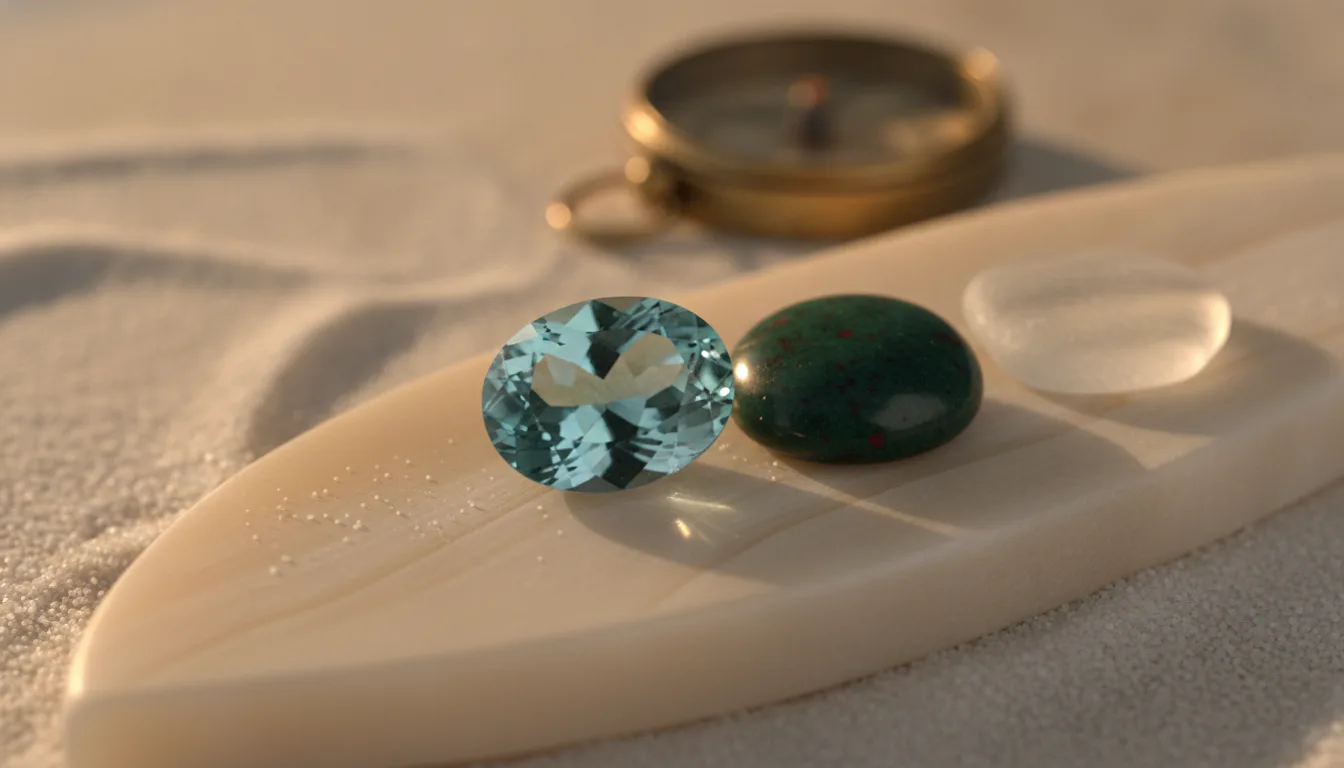
A gem named for seawater, worn by sailors as protection across two thousand years of voyages — and still the most quietly luminous piece of March birthstone jewelry you can give.
Hold a fine aquamarine up to a window in the right light and there is a moment of recognition that has very little to do with gemology. The color is not just blue. It is shallow Mediterranean water on a calm afternoon — that pale, almost translucent blue that holds light rather than reflects it. Roman sailors thought aquamarine had been carried up from the treasure chests of mermaids, and they wore the stone as a charm against shipwreck. Looking at one in your hand, you can see how the legend started.
March birthstone jewelry is built around two stones, not one. Aquamarine is the modern primary — clear, sea-blue, recognized by every major gemological body — and bloodstone, a deep green chalcedony streaked with red, is the traditional historical alternate. Most modern shoppers reach for aquamarine. The reasons that bloodstone keeps its place on the list are worth knowing too.
This guide handles both, with most of the weight on aquamarine — the stone that does the most actual work in March jewelry today.
A Stone Named for the Sea
2 min
The name is straight Latin: aqua marina, "seawater." Ancient Roman and Greek sailors carried polished aquamarine amulets on long voyages in the genuine belief that the stone, sharing a color with the ocean, could calm rough water and bring them safely home. According to the Gemological Institute of America, the gem has been mined and worn for at least four thousand years, with the same sea-protection symbolism repeating across cultures that had no contact with each other.
Aquamarine is part of the beryl family, which also includes emerald (the green one), morganite (pink), heliodor (yellow), and goshenite (colorless). One mineral species, six color personalities — and aquamarine is the blue-to-green-blue member, colored by trace iron deep inside the crystal. Beryl runs hard. Aquamarine sits at 7.5 to 8 on the Mohs scale, putting it in the same durability tier as topaz and well above quartz. That hardness, combined with the color, is part of why it has endured as a jewelry stone for so long.
Royal taste followed the symbolism. The British Crown Jewels include a parure of aquamarines given to Queen Elizabeth II by the President of Brazil at her 1953 coronation — a tiara, necklace, and earrings carved from some of the finest pale-blue Brazilian material ever mined. Edwardian and Art Deco jewelers built entire collections around aquamarine because its even, light-holding blue paired beautifully with the period's geometric platinum settings. Walk through any major auction house's estate cases and the aquamarines are usually among the most photographed stones.
A fine aquamarine does not sparkle so much as glow — the way calm seawater glows from inside on a bright day. It is a color you do not have to chase. It chases you.
The Meaning Beneath the Blue
1 min
Aquamarine's symbolism has been remarkably consistent across cultures: protection at sea, calm under pressure, clarity of communication, and a steady mind in turbulent circumstances. The Romans gave engraved aquamarine intaglios as wedding gifts to symbolize a marriage that would weather rough water. Medieval Europe associated it with reconciled disputes and renewed vows. Modern lifestyle traditions tie it to courage, focus, and emotional steadiness — different vocabulary, same underlying picture of calm strength.
For a March birthday, that meaning lands at a useful moment. March is the hinge from winter to spring, the month when light returns and things start moving. Aquamarine, with its associations of clarity and renewal, suits the wearer who is starting something or finishing something — the gem of clear-headed transitions rather than dramatic reinventions.
Aquamarine is also the traditional gemstone for the nineteenth wedding anniversary, which makes a piece of March birthstone jewelry a quietly purposeful gift for couples reaching that mark. Nineteen years is the kind of milestone that does not show up on a card aisle. Aquamarine — durable, calming, and historically linked to enduring partnerships — is well-suited to it.
Where the Best Aquamarines Come From
2 min
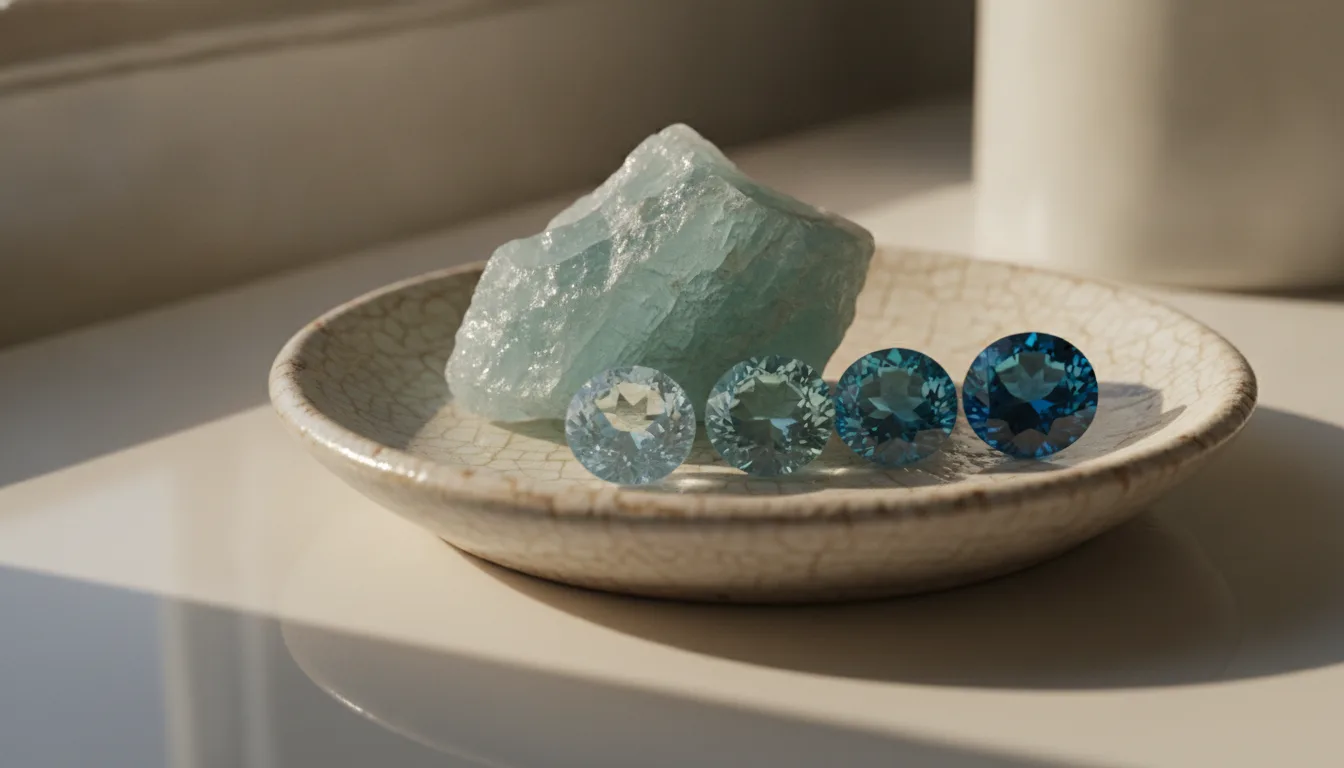
Aquamarine is mined on multiple continents, but four origins shape almost every important piece of March birthstone jewelry on the market. Knowing them is the difference between paying for an aquamarine and paying for a particular kind of aquamarine.
Brazilian aquamarine: the historical benchmark
Brazil's Minas Gerais state has been the world's most important aquamarine source for more than a century. The legendary Santa Maria de Itabira mine produced an exceptionally saturated, slightly violet-blue color that became the trade benchmark — so much so that "Santa Maria" survives today as a color grade name applied to any aquamarine that hits the same parameters. The original mine is now nearly depleted, but Brazilian deposits across Minas Gerais continue to produce excellent material in commercial volume.
Mozambican aquamarine: the natural blue
Mozambique has emerged in recent decades as the most important new source of fine aquamarine. The trade calls the deepest Mozambican stones "Santa Maria Africana" — and the unusual fact is that this material often comes out of the ground already in a saturated blue, with no heat treatment required. For buyers who specifically want untreated stones, Mozambique is the answer the market has been looking for.
Pakistani aquamarine: the crystal collector's gem
The Shigar Valley and the Hunza Valley in northern Pakistan produce some of the world's most exceptional aquamarine crystals — large, gem-clear, and often untreated. Pakistani aquamarine tends to be slightly cooler and more glassy than Mozambican material, and the rough crystals themselves are highly prized by collectors. Faceted Pakistani stones reach the highest end of the market.
"Santa Maria" as a grade, not a place
One trade-vocabulary note: "Santa Maria" is now a color grade, not an origin claim. The AIGS gemological lab issues Santa Maria grading reports for aquamarines that hit specific blue saturation, tone, and clarity criteria — regardless of where the stone was mined. When a jeweler describes an aquamarine as "Santa Maria," they are talking about color, not geography. Ask, politely, whether the lab grade is supported by a report.
How Aquamarine Wears in Real Life
2 min
Most people learn about gem durability the wrong way: by chipping something they love. A few minutes of context prevents that.
Aquamarine sits at 7.5 to 8 on the Mohs scale of hardness, which puts it well above amethyst (7), in the same tier as topaz, and just below sapphire and ruby (9). The International Gem Society rates aquamarine's overall durability as good for everyday wear — better than most colored stones in the same price tier. That is part of why aquamarine engagement rings have become a quiet trend among buyers who want a colored alternative to diamond without sacrificing daily-wear practicality.
One quirk: aquamarine is sensitive to high heat. Per the GIA care guide, sustained temperatures in the 700–850°F range can shift the color. That is well above anything a jewelry piece would encounter in normal life, but it is a reason to remove an aquamarine ring before doing certain hands-on work — soldering, glassblowing, oven cleaning with the door open — that exposes the stone to abnormal heat. Routine sun exposure does not affect the color; in fact, aquamarine is more colorfast than amethyst in that respect.
The practical guidance: aquamarine pendants and earrings will last with no special handling at all. Aquamarine rings work well in low-bezel or four-prong settings for daily wear. The 7.5–8 hardness means the stone resists scratches better than most colored gems in the same price range, and the bigger durability concern is the standard one — taking off the ring for gardening, weight training, and heavy household work, the three activities that damage almost every gem regardless of hardness.
Choosing March Birthstone Jewelry by the Piece
2 min
The best piece of aquamarine jewelry for someone is a match between how the wearer lives and how aquamarine reads. Pale, light-holding blues sit beautifully against most skin tones and pair effortlessly with both casual and formal wardrobes. The piece type is where the decisions get specific.
Aquamarine necklaces and pendants
An aquamarine pendant is the most flattering way to give March birthstone jewelry as a gift. The stone's pale blue picks up light from the wearer's skin in a way deeper colored gems do not, and a pendant sits in the spot where that subtle glow is most visible. Look for an emerald or oval cut between 8mm and 12mm — aquamarine is one of the few fine gems where you can shop large without the price climbing exponentially, and the color reads better at slightly larger sizes. A pale Brazilian or saturated Mozambican stone in 14k yellow or white gold works for nearly every wardrobe.
Aquamarine rings
Aquamarine has become a serious alternative-engagement-ring stone in recent years, and for good reason — the durability is genuinely up to daily wear, and the color signals taste rather than convention. Cushion and emerald cuts sit flat in low-profile settings and resist catching on fabric. Halo and three-stone designs flatter aquamarine especially well because small accent diamonds emphasize the central stone's clarity rather than competing with its color. White metals (platinum, white gold) make the blue read cooler and more crystalline; yellow gold pulls warmth out of the stone and reads more vintage.
Aquamarine earrings
Studs in the 6mm to 8mm range are the easiest entry into aquamarine jewelry. Pale blue near the face does something subtly flattering — it brightens the eyes and complements a wider range of complexions than warmer-colored stones do. Drop and chandelier designs benefit from aquamarine's affordability at larger sizes: a substantial pair of pear-cut aquamarine drops costs a fraction of the equivalent in sapphire or tanzanite.
Aquamarine bracelets
A line bracelet of evenly cut aquamarines in 14k white gold or platinum reads timeless rather than trend-driven, and aquamarine's hardness makes it well-suited to the wear and movement a bracelet receives. For a quieter alternative, station bracelets — five or seven small aquamarines spaced along a fine chain — work beautifully as everyday wear and layer well with other bracelets.
How to Buy an Aquamarine Worth Keeping
2 min
Aquamarine is graded on the same four C's as any colored stone, with weight skewed toward color and clarity in roughly equal measure.
- Color is the dominant value driver. Look for a saturated, even blue with no visible green or gray cast. The finest aquamarines — Santa Maria grade — show a medium-deep, slightly violet-tinged blue that holds its character in both daylight and incandescent light. Pale stones are not less authentic; they are simply a different point on the price curve. What you want to avoid is a stone with low saturation and visible color zoning, which reads as washed-out rather than delicate.
- Clarity matters more in aquamarine than in many other colored stones. Because the body color is light, inclusions show. Look for eye-clean stones — no visible inclusions to the unaided eye — and be especially cautious of "feathers" (small internal cracks) and liquid inclusions, which can affect both durability and ultrasonic safety.
- Cut rewards aquamarine's relatively low refractive index. A precision-cut stone — symmetric, properly proportioned — outperforms a larger but sloppily cut one in any setting. Watch the table; if the center reads "windowed" (transparent and lifeless rather than bright), the cut is too shallow.
- Carat. Aquamarine is one of the few fine gems where you can buy large without paying an exponential per-carat premium. A 5-carat aquamarine pendant is a reasonable proposition; a 5-carat sapphire of comparable quality is not. Take advantage of that. Statement-sized pieces are part of what aquamarine does best.
One regulatory note. Under the FTC Jewelry Guides, sellers must disclose any treatment performed on a colored stone. Most commercial aquamarine has been heat-treated at moderate temperatures to remove a slight green or yellow cast and produce a purer blue. The treatment is stable and permanent, and it is the industry norm — not something to avoid. What to avoid is a seller who cannot or will not tell you the treatment status. Untreated stones (most often from Mozambique or Pakistan) carry a modest premium for buyers who specifically want them.
Bloodstone: The "Other" March Birthstone
2 min
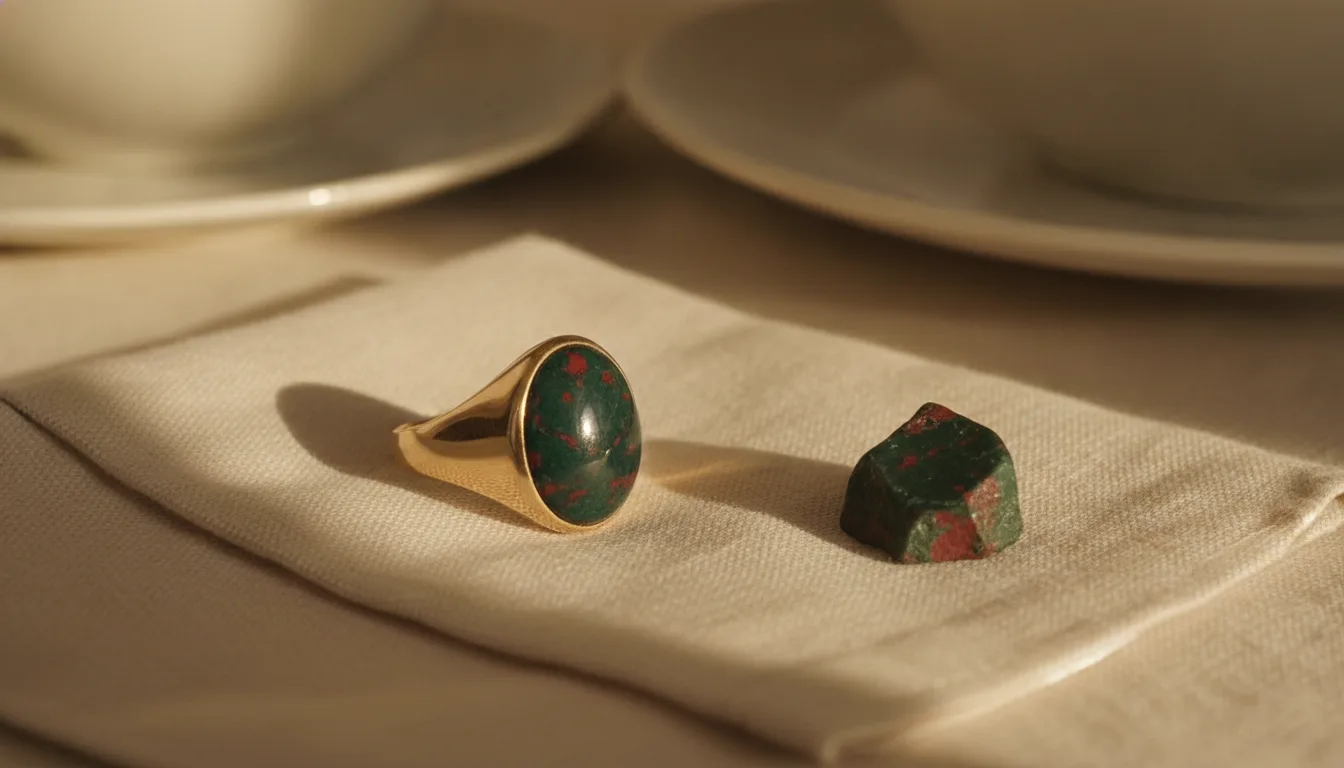
March is one of the few months on the modern birthstone calendar with two officially recognized stones, and bloodstone — the historical primary — keeps its place for reasons worth knowing. Per the American Gem Society, bloodstone is a variety of chalcedony (cryptocrystalline quartz), traditionally a deep, opaque green jasper streaked with red flecks of iron oxide — the "blood" the name describes.
The historical weight is substantial. Romans declared bloodstone the "March stone" because of its association with Mars, the god of war, and Roman soldiers carried polished bloodstone amulets into battle in the genuine belief that the red flecks could staunch wounds. Medieval Christians read the same red flecks as the blood of Christ at the Crucifixion, which gave bloodstone a place in religious carving and signet rings throughout the Middle Ages. The Greek name heliotrope — "to turn the sun" — refers to an old belief that a bloodstone placed in water under sunlight cast red reflections back at the surface.
Bloodstone sits around 6.5 to 7 on the Mohs scale and works best as cabochons, signet ring intaglios, and carved beads rather than faceted stones. It is an unusual gift — quieter, more masculine in its traditional associations, and visually distinctive in a way few other birthstones are. For a March wearer who already owns aquamarine, or for someone whose taste runs toward earth tones rather than pastels, a bloodstone signet ring or pendant is a meaningful and tradition-aligned alternative.
Caring for Aquamarine and Bloodstone Jewelry
2 min
The official GIA care guidance covers both stones with a few key distinctions.
- Warm soapy water is always safe for both aquamarine and bloodstone. A small bowl, a drop of dish soap, a soft toothbrush. Rinse, pat dry with a lint-free cloth. The full bench routine is in our guide to cleaning gold jewelry at home.
- Ultrasonic and steam cleaners are usually safe for aquamarine — but only if the stone has no visible feathers (small internal fractures) or liquid inclusions. When in doubt, skip both and stick with soapy water. Bloodstone is generally safe in ultrasonic but should not be steam cleaned.
- Avoid sustained high heat for aquamarine. Routine wear is fine, but remove the piece before any work involving heat sources (soldering, oven cleaning, glassblowing).
- Store aquamarine separately from harder stones — sapphire, ruby, and diamond can scratch its surface over time. Bloodstone is similarly vulnerable.
- Avoid hydrofluoric acid (found in some heavy-duty rust removers and industrial cleaners), which can damage aquamarine and most colored stones.
- Take rings off for hand-intensive work. Gardening, weights, and heavy household cleaning are the three usual suspects behind chipped or scratched stones, regardless of gem.
Aquamarine given proper care will hand itself down. Edwardian and Art Deco aquamarine pieces are still in wearable condition more than a century after they were set, the platinum a little softer at the edges, the pale blue still doing exactly the same quiet work.
Frequently Asked Questions
2 min
What is the March birthstone?
March has two officially recognized birthstones: aquamarine (the modern primary, a blue-to-green-blue beryl) and bloodstone (the traditional alternate, a deep green chalcedony with red flecks). Both are recognized by the GIA and the American Gem Society.
What does aquamarine symbolize?
Calm, courage, clarity of communication, and protection at sea. Ancient Greek and Roman sailors carried aquamarine amulets as a charm against shipwreck. Aquamarine is also the traditional gemstone for the nineteenth wedding anniversary.
What color is aquamarine?
A pale-to-medium blue, sometimes with a slight green tint. The finest grade — known as Santa Maria — is a saturated, slightly violet-tinged blue that holds its character in both daylight and incandescent light.
Can aquamarine be worn every day?
Yes. Aquamarine sits at 7.5 to 8 on the Mohs scale, well above amethyst and most other colored stones in its price tier. Pendants and earrings need no special handling; rings work well in low-bezel or four-prong settings for daily wear.
What is "Santa Maria" aquamarine?
Originally an origin name from the Santa Maria de Itabira mine in Minas Gerais, Brazil. Today, "Santa Maria" is used as a color grade — applied to any aquamarine that hits the same saturated, slightly violet-blue color, regardless of where it was mined. The AIGS gemological lab issues Santa Maria grading reports.
Is aquamarine treated?
Most commercial aquamarine is heat-treated at moderate temperatures to remove a slight green or yellow cast and produce a purer blue. The treatment is stable and permanent. Some Mozambican and Pakistani stones come out of the ground already blue and are sold as untreated, often at a modest premium.
What is bloodstone, and is it really a March birthstone?
Yes. Bloodstone is a deep green chalcedony streaked with red iron-oxide flecks, recognized as a traditional March birthstone alongside aquamarine. Romans called it the "March stone" for its association with Mars; medieval Christians associated the red flecks with the blood of Christ.
What metal looks best with aquamarine?
White gold and platinum make the pale blue read cooler and more crystalline, which is the modern default and an excellent match for Edwardian or Art Deco styles. Yellow gold pulls warmth out of the stone and gives it a more vintage, romantic character. Rose gold is unusual but flattering on lighter Brazilian material.
Aquamarine does not announce itself. It glows the way clear water glows on a still afternoon — quiet, lit from inside, completely sure of what it is. That is exactly why Roman sailors trusted it, why Edwardian jewelers built collections around it, and why a piece of March birthstone jewelry chosen with a little care turns into the kind of gift that gets quieter and more meaningful the longer it is worn.