
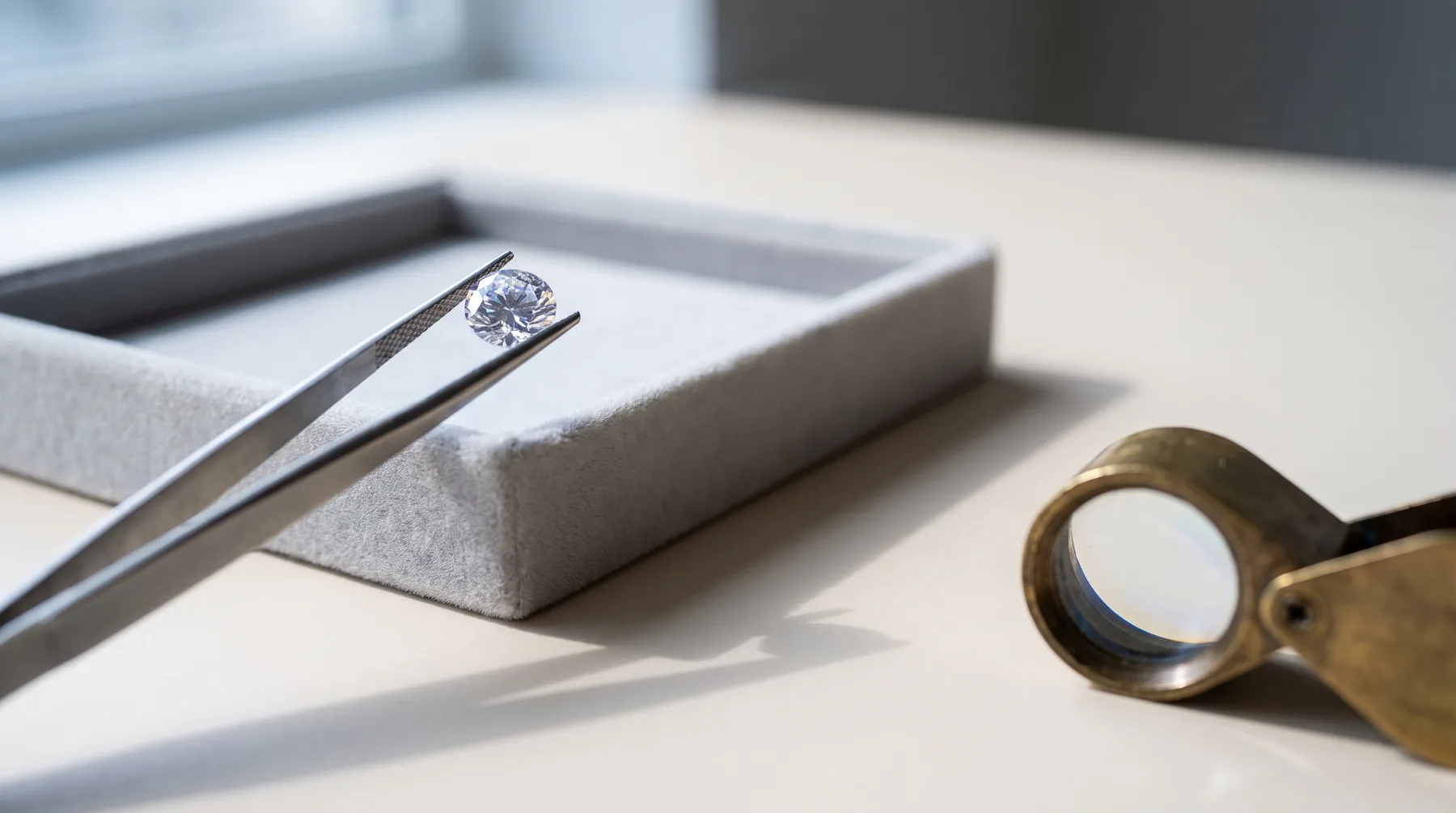
A GIA report is a description of one diamond, written by people who have no stake in selling it. It is not an appraisal, it carries no value, and it is not a promise that the stone is beautiful. Read it in four passes: identity (report number, date, shape, measurements), quality (the 4Cs block), geometry (the proportions diagram), and integrity (the plot, the comments, the inscription). If all four agree with the stone in your hand, the paper has done its job.
The Gemological Institute of America (GIA) grades loose natural diamonds in the D-to-Z color range from 0.15 carats up. It does not grade a stone that is still in its mounting, and since 1 October 2025 it no longer grades laboratory-grown diamonds on the 4Cs scale at all. Both of those facts change how you should read the paperwork in front of you, and we will get to them.
What a GIA report is, and what it is not
1 min
It is a quality description of one specific stone at one specific moment. It is not a certificate of authenticity, not an insurance document, and not a statement of worth. GIA is explicit that a grading report does not indicate monetary value, which is why an insurer will still ask for a separate appraisal.
The practical consequence is the part people miss: two diamonds with identical grades can differ by thousands of dollars and, more to the point, can look nothing alike. The report tells you what the stone is. Whether it performs is still decided by your own eyes under a few different lights.
One more limit worth knowing before you ask a jeweler for one. GIA grades unmounted stones. A diamond already set in a ring can be examined and described, but it cannot receive the same full grading report, because color and clarity cannot be judged reliably through metal. If a seller hands you a "GIA report" for a mounted stone, the paper is describing something else, or it is describing a stone that was graded before it was set.
The header: report number, date, and shape
1 min
Start at the top left. The report number is the stone's identity, the date is the day GIA examined it, and the shape and cutting style line tells you exactly what was graded ("Round Brilliant", "Rectangular Modified Brilliant" for most radiants and cushions, and so on).
The date matters more than it looks. A report is a snapshot. If a stone has been recut, chipped and repolished, or damaged since that date, the paper is out of date and the grades no longer describe the diamond. A report from 2011 on a stone sold in 2026 is not a red flag by itself, but it is a reason to have the diamond checked against the document rather than assumed.
Below the date sit the measurements, in millimeters. For a round they are printed as minimum diameter, maximum diameter, then depth, for example 6.50 - 6.53 x 4.02 mm. Fancy shapes get length x width x depth. On a round, a spread of more than about a tenth of a millimeter between the two diameters means the stone is measurably out of round, which is the kind of thing you notice in a bezel long before you notice it in a photo.
The 4Cs block: carat, color, clarity
2 min
These three lines are what most buyers think the report is. They are graded under controlled lighting by multiple graders who do not know what the stone is worth or who sent it.
- Carat weight is given to the hundredth of a carat. GIA weighs to the thousandth and then rounds down, with one exception: the weight rounds up only when the third decimal is a nine. A stone weighing 1.768 ct is reported as 1.76 ct; 1.769 ct becomes 1.77 ct. So the weight on the paper is never generous.
- Color runs D through Z and is judged face-down against master stones, which is why a J can look perfectly white face-up in a yellow gold ring and slightly warm in platinum.
- Clarity runs FL, IF, VVS1, VVS2, VS1, VS2, SI1, SI2, I1, I2, I3, all assessed at 10x magnification, and our guide to which clarity grades are worth paying for walks that scale in buying terms. The scale is about what a trained grader sees at 10x, not what you see across a dinner table.
A note on weight that saves real money. The trade prices in steps at 0.50, 0.70, 0.90, 1.00, 1.50 and 2.00 carats, and the jump at those thresholds is far bigger than the size difference your eye can register. Industry pricing data puts the premium at roughly 15 to 25 percent between a 0.99 ct and a 1.01 ct of the same quality. Nobody has ever spotted that difference on a hand. Buy just under the line and put the savings into cut.
Why cut grade only appears on round diamonds
1 min
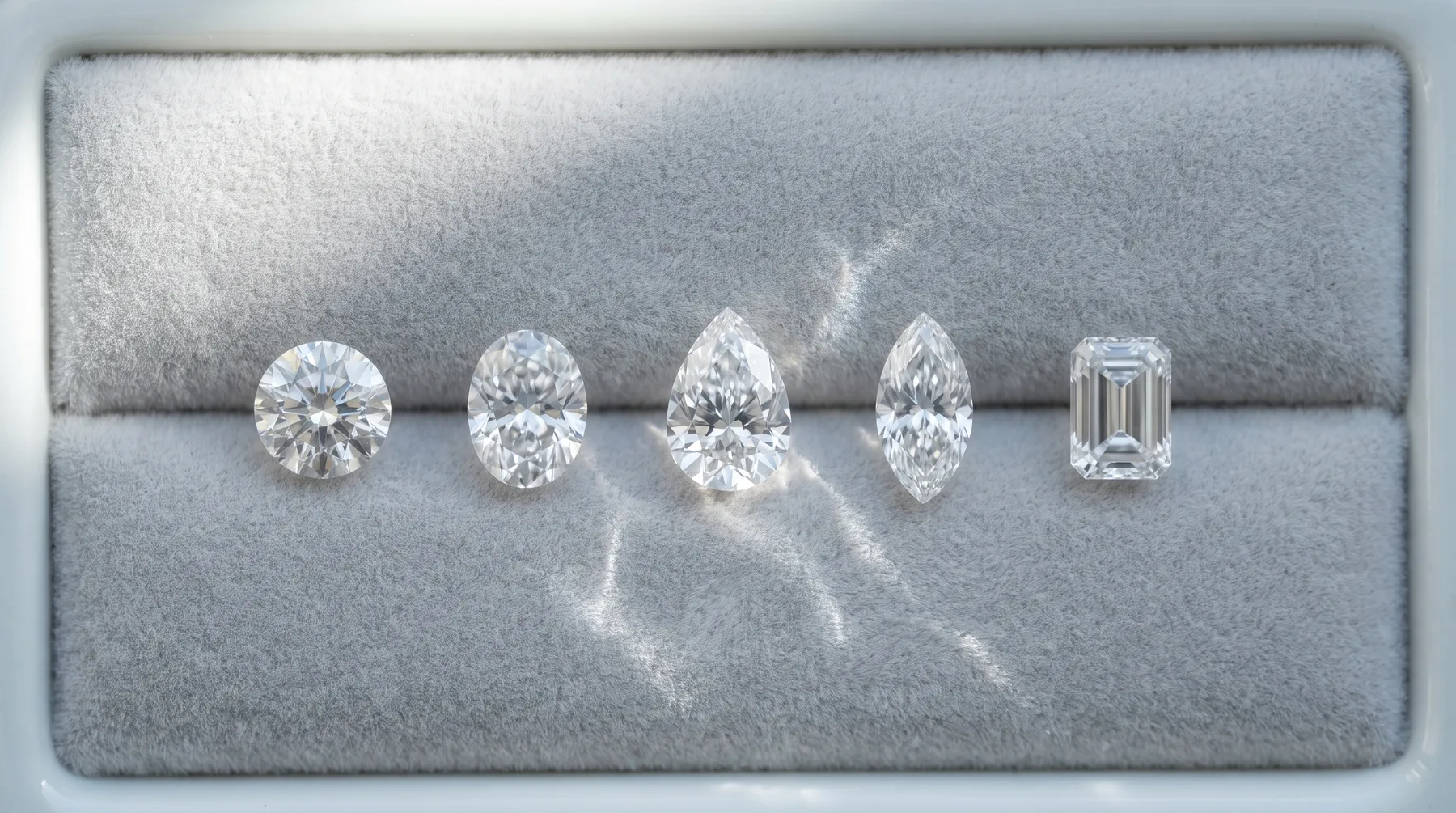
GIA assigns an overall cut grade, Excellent through Poor, only to standard round brilliants in the D-to-Z range. Every other shape receives polish and symmetry grades but no cut grade, because there is no single agreed geometry for a "good" oval or pear the way there is for a round.
That is changing. GIA announced in June 2026 that it will introduce cut grades for marquise, oval and pear shapes starting in 2027, with more detail promised in early 2027. Until then, judging a fancy shape means reading the proportions yourself and, honestly, looking at the stone.
For rounds, cut is the grade we would protect first. Color and clarity can be traded down a step or two with no visible loss. Cut cannot: a poorly proportioned stone leaks light out of the bottom and no setting, metal, or lighting fixes it.
The proportions diagram: reading the geometry
1 min
The diagram on the right side of the report is a cross-section with the numbers that produce the cut grade. Table percentage is the flat top facet as a share of the stone's width. Depth percentage is total height over average diameter. Crown angle, pavilion angle, star length, and lower-half length describe the facet architecture, and the girdle and culet lines describe the edges.
Two entries deserve your attention beyond the summary grade:
- Girdle thickness, printed as a range such as "Medium to Slightly Thick". An extremely thin girdle is a chipping risk on the bench and in life, particularly in a claw setting where the edge is exposed. An extremely thick girdle hides weight in a rim you cannot see, so the stone measures small for its carat weight.
- Culet, the tiny facet at the point. "None" is normal on modern cuts. A large culet on an older stone shows as a small window when you look straight down through the table.
Most rounds graded Excellent land near a table of 53 to 58 percent and a total depth of 59 to 62.5 percent, with a crown angle around 34 to 35 degrees. Treat those as landmarks, not a scorecard. Plenty of gorgeous stones sit outside them and plenty of dull ones sit inside.
The clarity plot: red, green, and what is missing
1 min
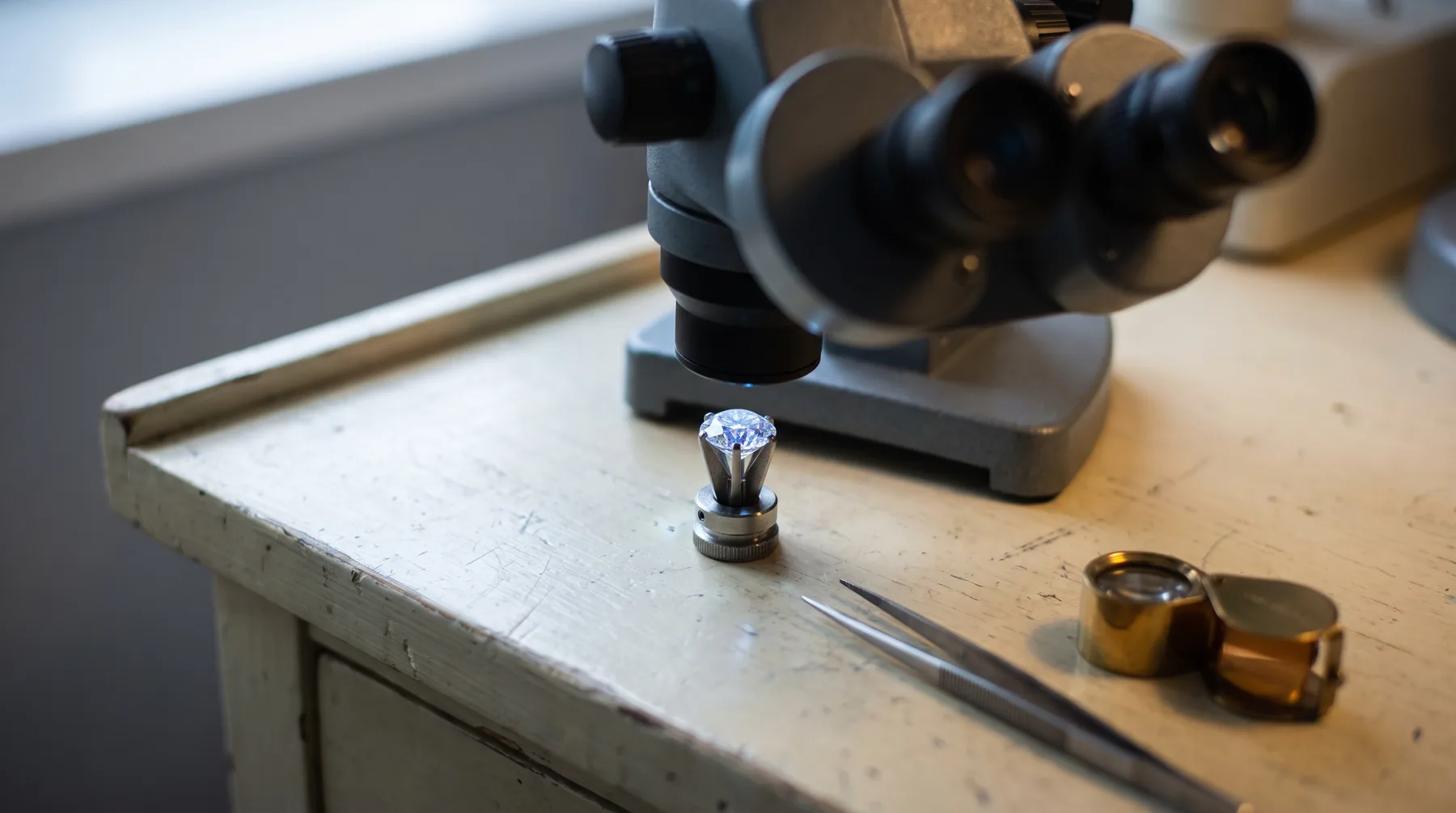
The plot is the stone's fingerprint. Internal characteristics (inclusions) are drawn in red; external ones (blemishes, including polish lines and naturals on the girdle) are drawn in green. Symbols are placed to scale and position, so a plot can be matched against the actual stone under a microscope, which is exactly how a jeweler confirms that a report belongs to the diamond in front of them.
The Diamond Dossier, GIA's compact report for stones from 0.15 to 1.99 carats, carries the same grading results but no plot. In its place the stone gets its report number laser-inscribed on the girdle. Neither format is "better" grading; they are the same lab work presented differently.
Now the part that most buying guides skip. Read the key to symbols and then read the comments box, because the comments tell you what the plot deliberately leaves out. Lines like "Pinpoints are not shown", "Internal graining is not shown", and above all "Clouds are not shown" appear routinely. On a VS stone that is housekeeping. On an SI1 or SI2 whose plot looks suspiciously clean, "clouds are not shown" can mean the grade is being driven by a diffuse cloud that never got drawn, and a cloud-driven SI2 is the classic hazy stone that photographs fine and looks lifeless in person. Ask to see that stone before you buy it, every time.
Fluorescence, polish, symmetry
1 min
Fluorescence describes how the diamond glows under ultraviolet light, from None to Very Strong, and it is a description rather than a grade. GIA's own research on blue fluorescence, published in Gems & Gemology, found no general appearance penalty for most stones, and the trade's long-standing discount on strongly fluorescent diamonds is more habit than optics.
GIA is formalizing that. Beginning in the fourth quarter of 2026, natural D-to-Z reports will carry new fluorescence comments: one noting that fluorescence may improve appearance in daylight and other UV-rich light, and a second, applying to fewer than 0.2 percent of diamonds, noting that it can make haziness or reduced transparency more noticeable. GIA expects around 10 percent of the D-to-Z diamonds it receives to qualify for one of the comments.
Polish and symmetry are graded Excellent through Poor. Very Good polish and symmetry on a stone with an Excellent cut grade is not a compromise worth paying to avoid.
The inscription, and how to verify the report yourself
1 min
Most GIA-graded diamonds carry their report number laser-inscribed on the girdle, in letters far too small to see unaided. Under a 10x loupe, with the stone rotated to catch the light along the girdle edge, the number should be legible and should match the report exactly.
Then verify the report against GIA's own database. Type gia.edu into your browser yourself and use GIA Report Check; do not use the seller's link and do not scan the seller's QR code. Enter the report number and the tool returns the grading data GIA holds on file. Every line should match your document: shape, weight, color, clarity, cut, polish, symmetry, fluorescence, and measurements.
This takes ninety seconds and it closes the two frauds that actually happen: an altered PDF, and a genuine report from a different stone traveling with a lesser one.
Laboratory-grown reports: what changed on 1 October 2025
2 min
GIA stopped grading laboratory-grown diamonds on the 4Cs color and clarity scales on 1 October 2025. In their place, qualifying lab-grown stones from 0.15 carats up receive a descriptive quality assessment with two categories:
| Category | Color | Clarity | Polish and symmetry | Cut (round brilliant) |
|---|---|---|---|---|
| Premium | D | VVS or better | Excellent | Excellent |
| Standard | E to J | VS | Very Good | Very Good |
A stone that meets neither minimum receives no designation. The girdle is inscribed "Laboratory-Grown" plus the assessment number, and the fee is $15 per carat with a $15 minimum, roughly half of GIA's smallest natural-diamond dossier.
GIA's stated reason is concentration: since 2022, about 95 percent of the lab-grown diamonds submitted to GIA graded colorless (D, E or F) and about 98 percent came in at VS1 clarity or better. A scale built to separate natural rarity has little left to separate when nearly everything lands in the top two rungs.
What this means in a shop, in August 2026: most lab-grown diamonds you are shown will carry an IGI report rather than a GIA one, and IGI still issues full D-to-Z and FL-to-I3 grades for lab-grown stones. That is not a scandal, but it does mean a GIA "premium" and an IGI "D VVS1" are not the same kind of statement, and you cannot compare them grade for grade. If you are choosing between lab-grown and mined, our guide to what actually differs between lab-grown and natural diamonds covers the ground the report no longer does.
Red flags: when the stone and the paper disagree
1 min
Most bad paperwork is not forged. It is mismatched, stale, or from a lab whose grades are simply softer. Watch for these:
- The report will not come out until you commit. A seller who is evasive about handing over the report number before purchase has told you something.
- The inscription is absent on a report that says the stone is inscribed, or the number under the loupe does not match the document.
- Report Check disagrees with the printed report on any line, including a single measurement.
- The plot does not match the stone. Inclusions are positional. If the report plots a crystal at the 3 o'clock crown and the microscope shows nothing there, stop.
- The lab is one you have never heard of. Grades are not standardized across laboratories, and the gap between a strict lab and a generous one runs to multiple grades on the same stone, which is most of the reason two "G VS2" diamonds can be priced worlds apart.
- The report is old and the stone has clearly been worked on. Repolishing changes weight and measurements. New work needs new paper.
Frequently Asked Questions
2 min
Does a GIA report mean the diamond is a good one?
No. It means the diamond was described accurately by a lab with no interest in the sale. A GIA report on a poorly cut stone will faithfully record a poorly cut stone. Use the report to compare, then use your eyes to choose.
Is a Diamond Dossier worse than a full grading report?
No. The grading work is the same. The Dossier, offered for stones from 0.15 to 1.99 carats, omits the plotted clarity diagram and instead inscribes the report number on the girdle. If you want the plot as a matching tool, ask for the full report.
Can GIA grade a diamond that is already set in a ring?
Not with a standard grading report. GIA grades loose stones. Jewelry services can describe a mounted stone, but color and clarity judged through a setting are estimates, not grades.
Why does my report not have a cut grade?
Because the diamond is not a standard round brilliant. Fancy shapes currently receive polish and symmetry only. GIA has said cut grades for marquise, oval and pear shapes arrive in 2027.
Is fluorescence bad?
Usually not. GIA's research found no general appearance penalty for most fluorescent diamonds, and from the fourth quarter of 2026 GIA reports will comment on fluorescence that may help appearance in daylight. A minority of very strongly fluorescent stones do look hazy, so the rule is simple: look at the stone in daylight before deciding.
How do I check a GIA report number?
Go to gia.edu yourself, open GIA Report Check, and enter the report number. Compare every line to your printed report. Do not use a link or QR code supplied by the seller.