
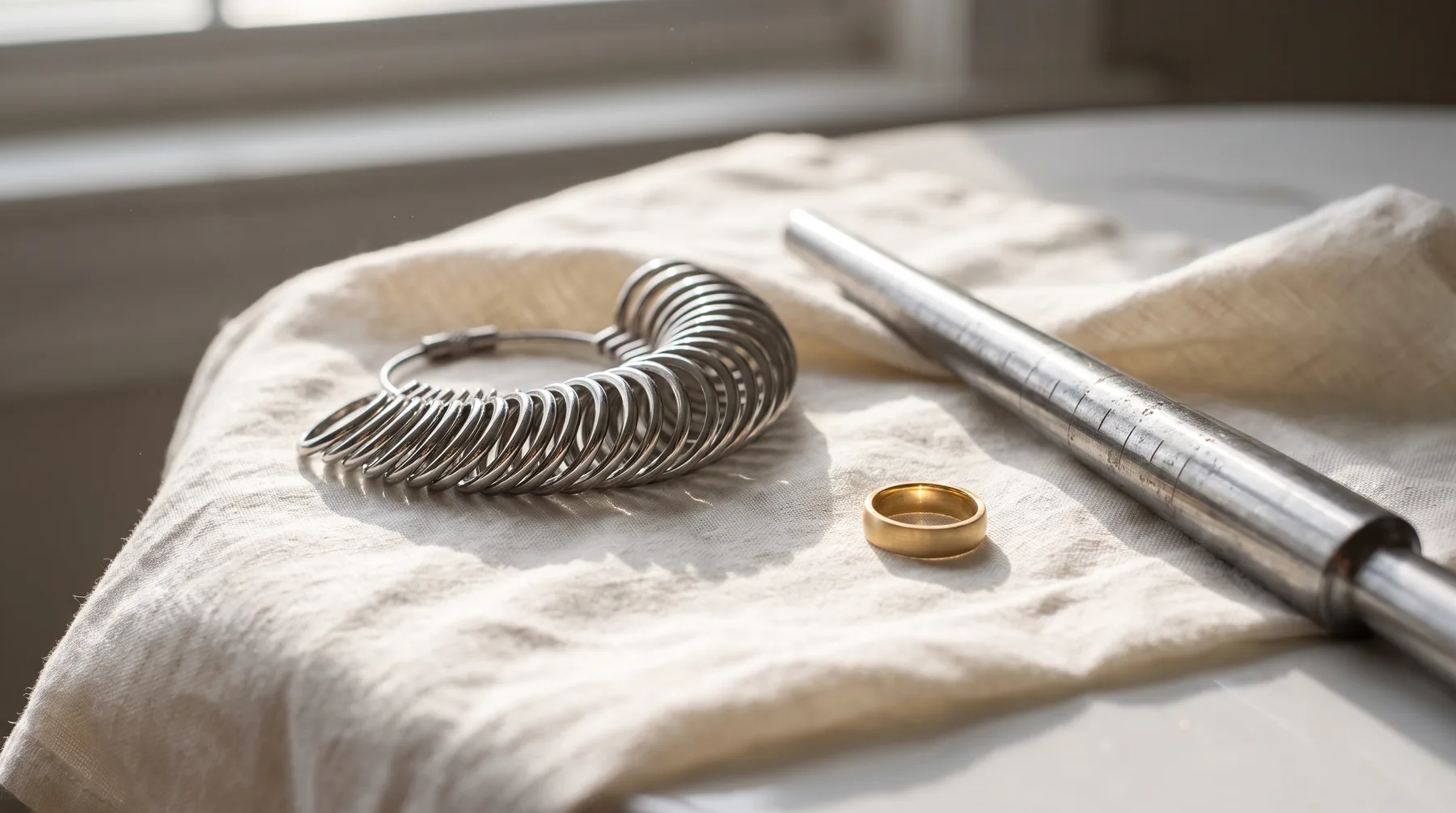
The most accurate way to find your ring size is to have a jeweler slide a set of steel sizers onto your finger, in the width of band you actually intend to wear. Everything you can do at home is a ranked set of approximations, and they are not equally good: a plastic or paper multi-sizer you wrap around the finger beats measuring a ring you already own, which beats a paper strip, which beats string. String is last for a reason.
The stakes are small in millimeters and large in practice. One full US ring size is about 2.55 mm of inside circumference, which works out to roughly 0.81 mm of inside diameter. A quarter size is two tenths of a millimeter. That is why a measurement that feels close can still produce a ring that spins, and why a two-millimeter error in a paper strip lands you nearly a full size off.
The methods, ranked by how much you should trust them
1 min
Trust them in this order, and use the highest one available to you.
- A jeweler's steel sizer set, worn for a minute in the band width you plan to buy. This is the reference standard, and it is free at any counter.
- A wrap-style plastic or paper multi-sizer (the belt-shaped kind that threads through itself). Free from most jewelers, a few dollars online, accurate to about a quarter size in most hands.
- Measuring the inside diameter of a ring that already fits that finger, ideally with digital calipers.
- A paper strip wrapped around the finger and measured against a millimeter ruler.
- String. Only if you have nothing else, and expect to be wrong.
Whichever you use, measure at the end of the day when your hands are warm, and measure three times on three different days. Fingers change size with temperature, salt, exercise, altitude, hormones and the weather. Cold hands can read a full size small. If two of your three measurements agree, that is your size.
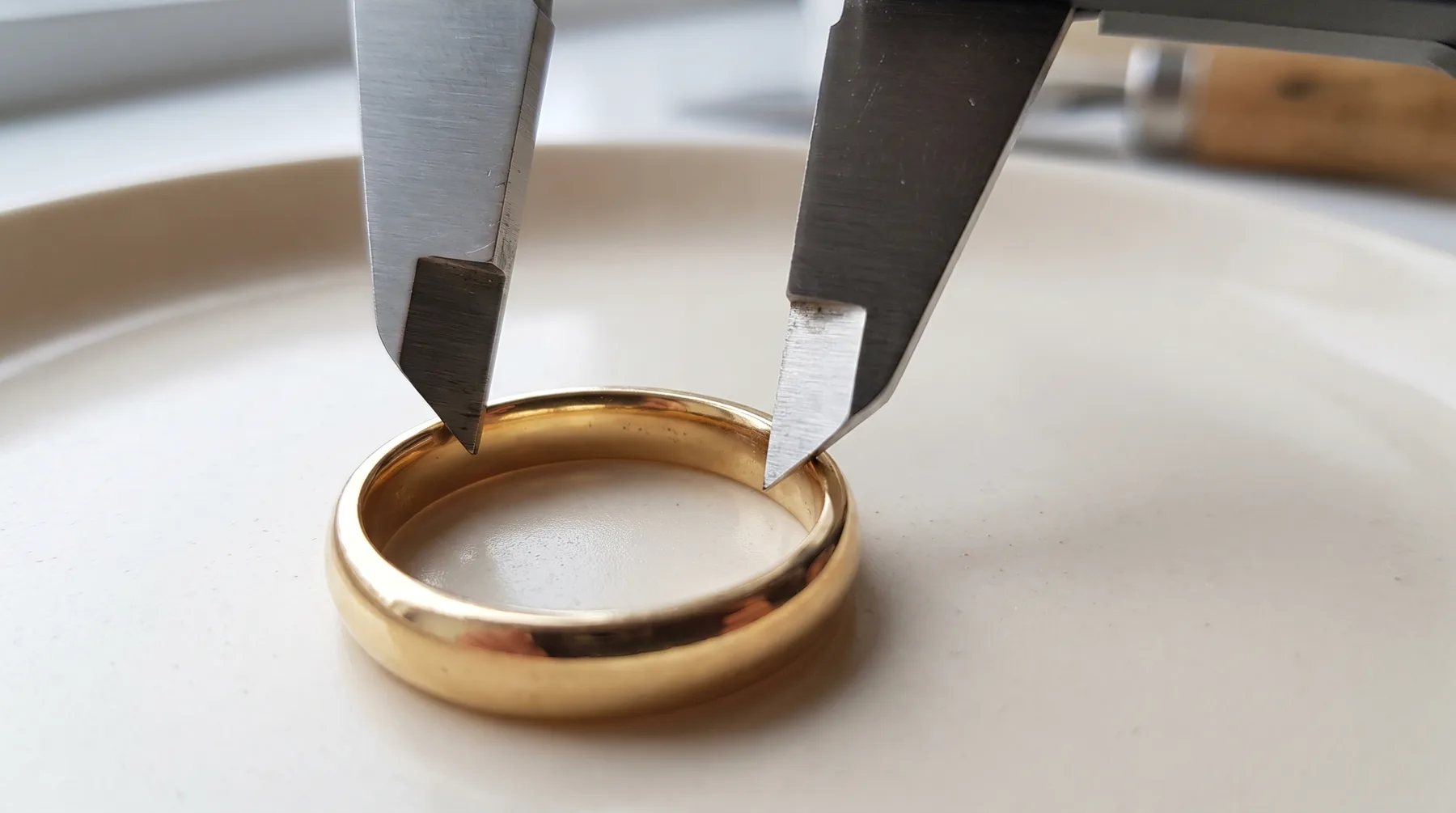
How to measure a ring that already fits
1 min
Measure the inside diameter across the widest point of the circle, in millimeters, and convert with the chart below. Calipers are ideal; a millimeter ruler laid across the opening is workable if you are careful to find the true center.
Two cautions from the bench. First, measure the ring on the finger it is worn on, because most people's hands differ by a quarter to a half size, and the dominant hand is usually larger. Second, do not trace the ring on paper and measure the drawing. The line you draw sits outside the metal, and a pen line is a third of a millimeter of error before you start.
If you are buying a wide band and measuring a narrow one, read the band-width section further down before you order. The number you just took is correct for a narrow ring and slightly small for a wide one.
The paper-strip method, and why string lies
1 min
Cut a strip of paper about 5 mm wide. Wrap it around the base of the finger, snug but not compressing the skin, mark where the end overlaps, and measure the marked length in millimeters. That length is your inside circumference; match it in the chart.
Paper beats string because string stretches under tension and paper does not. Pull a piece of string half a millimeter tighter and you have just measured a different finger. The same logic explains the most common home-measuring failure: wrapping tight enough to indent the skin, which reads a quarter to a half size small and produces a ring that will not clear the knuckle on a hot day.
Do the wrap three times, mark it three times, and take the largest of the three. People consistently pull tighter as they get impatient.
US ring size chart in millimeters
1 min
US sizes are a linear scale: each full size adds about 0.81 mm of inside diameter and about 2.55 mm of inside circumference. Find your measurement, then take the nearest row.
| US size | Inside diameter (mm) | Inside circumference (mm) |
|---|---|---|
| 4 | 14.9 | 46.8 |
| 4.5 | 15.3 | 48.1 |
| 5 | 15.7 | 49.3 |
| 5.5 | 16.1 | 50.6 |
| 6 | 16.5 | 51.9 |
| 6.5 | 16.9 | 53.1 |
| 7 | 17.3 | 54.4 |
| 7.5 | 17.7 | 55.7 |
| 8 | 18.1 | 56.9 |
| 8.5 | 18.5 | 58.2 |
| 9 | 19.0 | 59.5 |
| 9.5 | 19.4 | 60.8 |
| 10 | 19.8 | 62.1 |
| 10.5 | 20.2 | 63.4 |
| 11 | 20.6 | 64.6 |
| 11.5 | 21.0 | 65.9 |
| 12 | 21.4 | 67.2 |
| 12.5 | 21.8 | 68.5 |
| 13 | 22.2 | 69.7 |
If your measurement falls between two rows, note both. Which one to order depends on your knuckle and the width of the band, and those are the next two sections.
Why printable ring sizers so often print wrong
1 min
Because printers resize. Any PDF or image sizer is only correct if the page prints at exactly 100 percent, and the default in most print dialogs is "fit to page" or "shrink oversized pages", which quietly scales the whole sheet by a few percent. A three percent error on a size 7 is about a third of a size.
Every reputable printable sizer includes a reference line or a scale bar for this reason. Print the sheet, lay a millimeter ruler on the reference line, and confirm the length before you measure anything. If the line is short, set scaling to none or 100 percent and print it again.
The on-screen version of the same trick, where you lay a ring over circles on your monitor, has the identical problem plus a browser zoom level. Use it to sanity-check a number you already have, never to produce one.
When the knuckle is bigger than the finger
1 min
Measure both the knuckle and the base of the finger, then choose a size between the two: large enough to pass the knuckle without a fight, small enough that the ring does not swim at the base. When the two measurements differ by more than a full size, take the knuckle measurement and plan on a fix rather than trying to split the difference.
Those fixes are ordinary bench work. Sizing beads are two small balls of metal, usually around 2 mm, soldered inside the bottom of the shank; they take up perhaps a quarter to a half size at the base while leaving the opening big enough for the knuckle, and they also stop a heavy stone from rolling to the palm side. A spring insert or a hinged shank does more for a badly arthritic knuckle. None of these is a compromise you should feel bad about; jewelers fit rings this way every week.
A ring that fits properly takes a little effort to come off. If it slides off with no resistance at all, it is too big, and a ring that is too big is the one that gets lost.
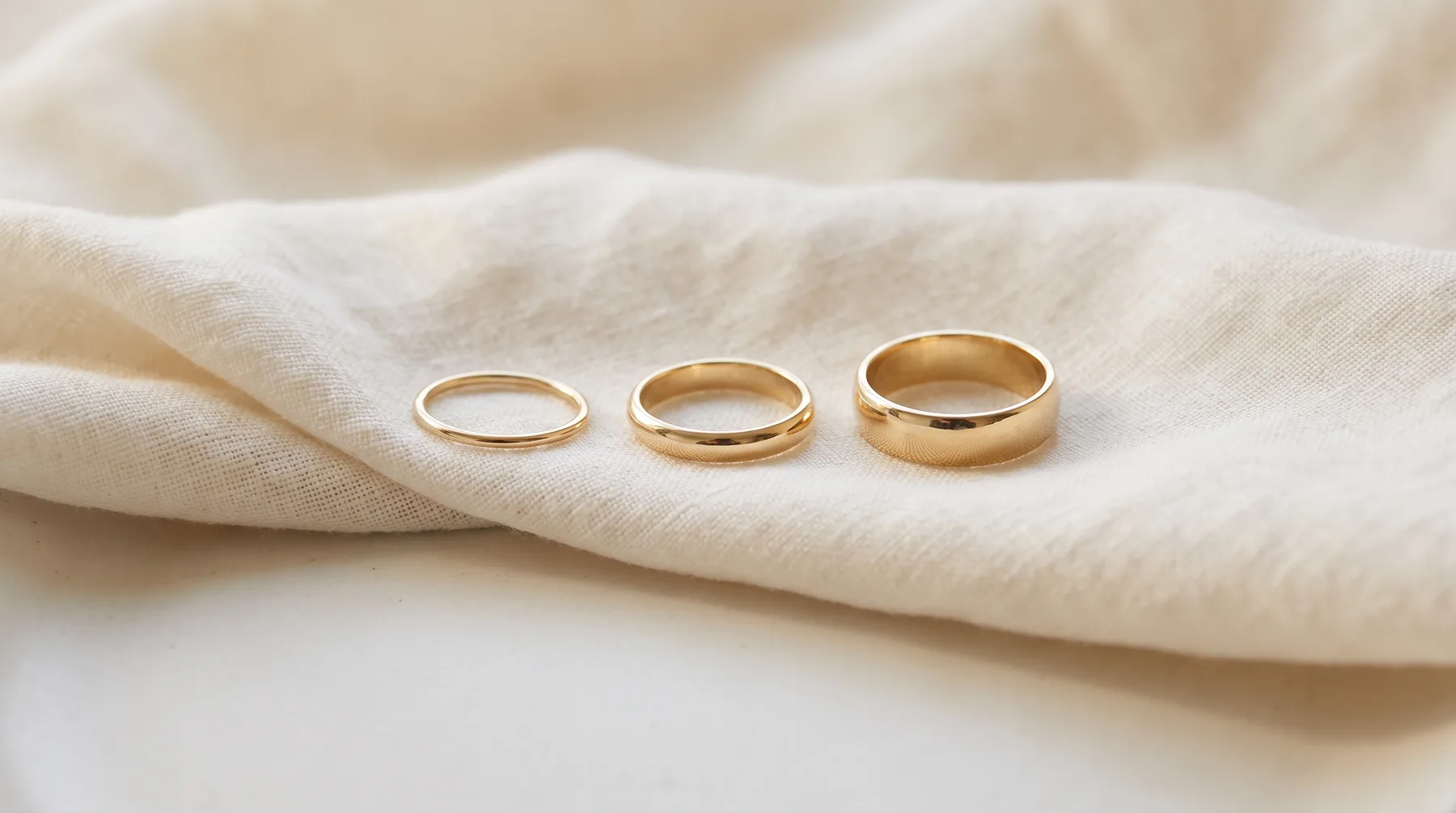
How band width changes the fit
1 min
A wide band sits on more of your finger and feels tighter at the same measured size. The trade rule is to add a quarter to a half size once a band passes about 6 mm, and a half size at 8 mm and up.
Comfort-fit bands run the other way. Their inside surface is domed, so less metal touches the finger and the ring slides more easily; a comfort-fit band typically fits a half size larger than a standard band of the same marked size, which is why jewelers often size comfort-fit down by a half. When a band is both wide and comfort-fit, the two effects cancel more than they add, so do not stack the adjustments. Size on an actual sizer in that width if you possibly can.
This is also the reason a stacking set can feel wrong even when each ring is "your size". Three 2 mm bands worn together behave like one 6 mm band.
Round up or round down?
1 min
Round up when the ring is wide, when the wearer's hands swell in heat or after exercise, when the knuckle is prominent, or when the design cannot easily be sized later. Round down when the ring is narrow, when the wearer runs cold, or when the piece is a plain gold or platinum band that a jeweler can adjust in an afternoon.
Ask what the ring is made of before you decide, because some of them cannot be adjusted at all. A solid gold or platinum shank can usually move about two sizes in either direction; beyond that it wants a new shank. Stretching on a mandrel, the fast way to gain a fraction of a size, is off the table once stones are involved, because the stress goes straight into the settings. A full eternity band cannot be resized in any meaningful way, since there is no plain metal to cut, and a tension setting cannot be touched, because the spring of the shank is what holds the stone. Tungsten, ceramic and inlaid rings are replaced rather than sized.
What the catalog says about which sizes actually exist
1 min
Here is a piece of the trade most buying guides never mention: the shelf is not a bell curve. Across the ring styles in our vendor catalog carrying a stocked finger size, as of August 2026, size 10 accounts for about 62 percent of in-stock styles and size 7 for about 17 percent, with sizes 5 and 6 making up most of the rest. Almost nothing is stocked above 11 or below 4.
That is not a statement about human fingers. It is how manufacturing works: men's bands are made at 10 and women's rings at 7, those two sizes sit on shelves, and everything else is either sized from a stock ring or made to order. The practical consequences for you are worth knowing before you fall in love with a design.
- If your size is 7 or 10, you can often have a piece quickly.
- If your size is unusual, expect a lead time rather than a shipment, and expect made-to-order terms, which frequently means the piece is not returnable.
- If you are choosing between a stock size that is slightly off and a made-to-order size that is right, the right size usually wins. Resizing a stone-set shank costs money and, on some designs, changes how the stones sit.
Measuring for a surprise proposal
1 min
Borrow a ring she already wears on that hand and take it to a jeweler. That is the whole method, and it beats every clever alternative. A jeweler reads an existing ring in thirty seconds on a mandrel and can also tell you whether it is a narrow or wide band, which changes the answer.
If you cannot borrow one, the least bad options are asking a close friend or her mother to find out, or having her try on rings in a shop with someone who is in on it. The methods that circulate online, tracing a ring on paper or pressing it into soap, are the two we see produce the largest errors, and they fail in the direction that ruins the moment.
If you have to guess, guess a little large and plan on sizing. A ring that is slightly loose can be worn on the day and adjusted next week; a ring that will not go past the knuckle cannot go on at all. Ask about the sizing policy before you buy, not after, and if you are still choosing the ring itself, our guide to engagement ring settings covers which designs are easy to size and which are not.
Frequently Asked Questions
2 min
What is the average ring size?
The trade's working assumption in the United States is roughly size 6 to 7 for women and 9 to 10 for men, which is why those are the sizes manufacturers stock. Averages are close to useless for one specific hand. Measure the finger you are buying for.
Should I measure the left hand or the right?
The one that will wear the ring. Hands are rarely identical, and the dominant hand is usually a quarter to a half size larger.
Can any ring be resized?
No. Plain gold, platinum and silver shanks usually move about two sizes either way. Full eternity bands, tension settings, and tungsten, ceramic or inlaid rings generally cannot be sized and have to be remade or exchanged.
Why does my ring spin around my finger?
Either the ring is too large at the base, or the setting is top-heavy for the shank. Sizing beads or a small internal bar usually solve both, and both are quick bench jobs.
My finger measures between two sizes. Which do I order?
Take the larger one if the band is wide, if your knuckle is prominent, or if your hands swell in heat. Take the smaller one for a narrow band on a stable hand. When you genuinely cannot tell, order the size that can be adjusted.
Does the time of day really matter?
Yes. Fingers are at their smallest first thing in the morning and in cold weather, and at their largest late in the day, after exercise, and in heat. Measure warm, late, and more than once.