
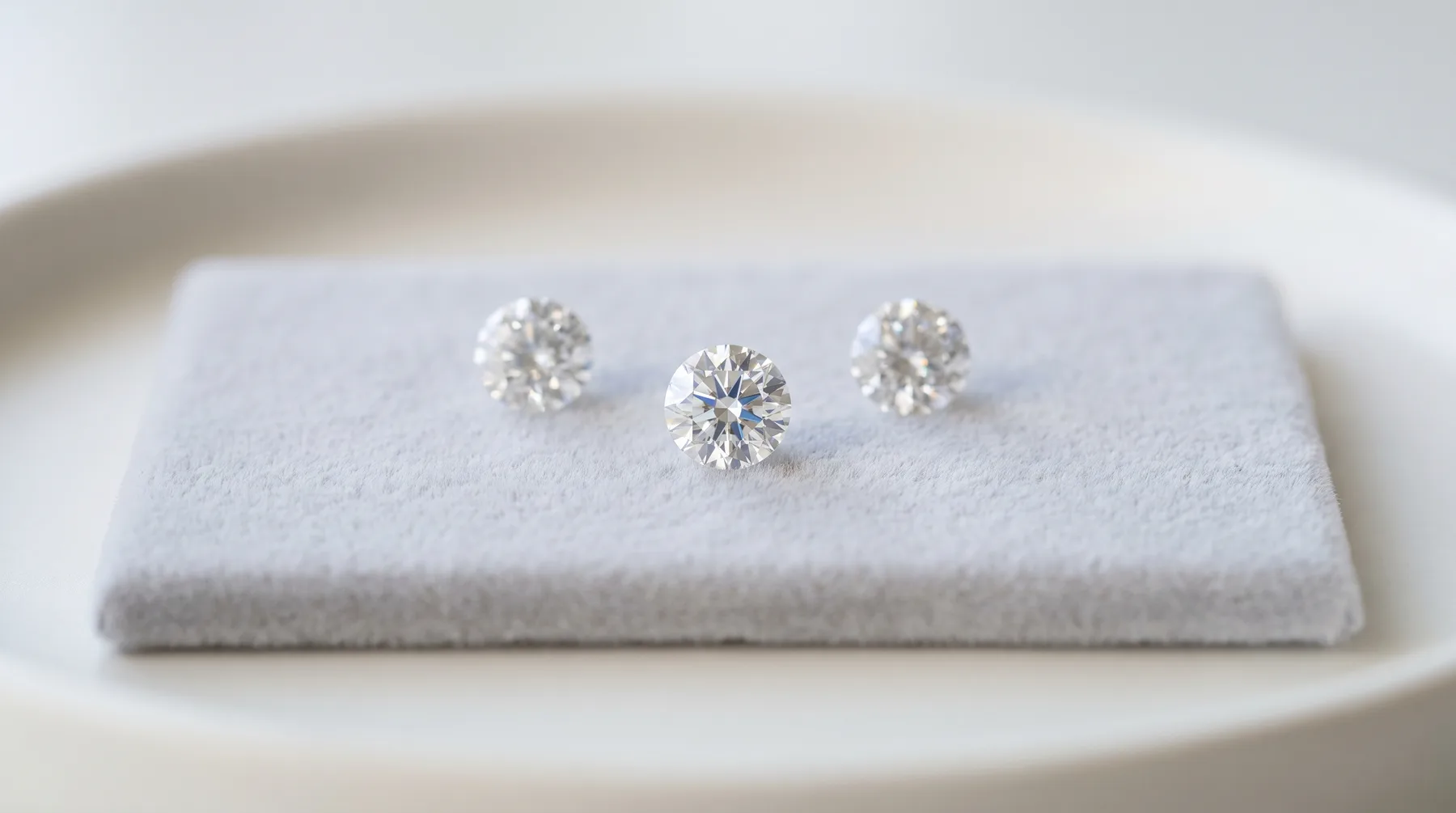
Three stones, three different purchases. A natural diamond is carbon crystallised in the earth and priced on scarcity. A laboratory-grown diamond is the same carbon crystal made in a reactor over a few weeks, physically and optically a diamond, priced like a manufactured good. Moissanite is not a diamond at all: it is silicon carbide, a different material with more fire, slightly less hardness, and a price that reflects being neither rare nor pretending to be.
Choosing between them is not really a gemology question. It is a question about what you want your money to buy: rarity, size, sparkle, or resale. This guide gives you the physical differences that actually show up on a hand, the August 2026 price picture, and the disclosure a seller legally owes you. If you have already ruled out moissanite, our companion piece on lab-grown versus natural diamonds goes deeper on those two.
What moissanite actually is
2 min
Moissanite is silicon carbide (SiC). The natural mineral was identified by Henri Moissan in 1893 in fragments of the Canyon Diablo meteorite in Arizona, and natural crystals are so rare that every moissanite sold as jewelry is laboratory-made. It has been on the market as a gem since the late 1990s.
The properties that matter to you:
- Hardness 9.25 on the Mohs scale, against diamond's 10. Both are far above the roughly 7.5 threshold where daily wear starts scratching stones.
- Refractive index of about 2.65 to 2.69, higher than diamond's 2.42, so it returns light efficiently.
- Dispersion of about 0.104, against diamond's 0.044. Dispersion is the rainbow fire, and moissanite has about two and a half times as much.
- Doubly refractive, where diamond is singly refractive. Light entering moissanite splits into two rays, which is both an identification tool and the reason large moissanites can look faintly soft at the facet edges.
- Less dense than diamond, around 3.21 against 3.52. A moissanite the same weight as a diamond is visibly bigger.
That last point explains a sales practice that confuses people. Moissanite is usually sold by millimeter diameter with a "diamond equivalent weight" attached, so a 6.5 mm round is advertised as a 1 carat equivalent even though it weighs closer to 0.88 carats. That is not a trick; it is the honest way to compare a lighter material. But it does mean carat-to-carat comparisons between moissanite and diamond are meaningless. Compare millimeters.
What a lab-grown diamond is
1 min
A laboratory-grown diamond is diamond. Same carbon lattice, same hardness of 10, same refractive index and dispersion, grown either by high pressure high temperature (HPHT) or chemical vapor deposition (CVD) over a matter of weeks. The US Federal Trade Commission removed the word "natural" from its definition of a diamond in its 2018 revision of the Jewelry Guides for exactly this reason: the material is not in question, only its origin.
No handheld tester on a shop counter can separate a lab-grown diamond from a mined one, because there is nothing chemically to separate. Distinguishing them takes laboratory instruments that read growth features and trace fluorescence, which is why nearly every lab-grown stone of any size is laser-inscribed and sold with a report.
The three-way comparison
1 min
Everything in this table is a property of the material, not an opinion about it.
| Natural diamond | Lab-grown diamond | Moissanite | |
|---|---|---|---|
| Material | Carbon | Carbon (identical) | Silicon carbide |
| Origin | Earth, over geological time | Reactor, weeks | Reactor, weeks |
| Mohs hardness | 10 | 10 | 9.25 |
| Refractive index | 2.42 | 2.42 | 2.65 to 2.69 |
| Dispersion (fire) | 0.044 | 0.044 | 0.104 |
| Optical character | Singly refractive | Singly refractive | Doubly refractive |
| Density | 3.52 | 3.52 | 3.21 |
| Cleavage | Perfect, four directions | Perfect, four directions | None |
| Sold by | Carat weight | Carat weight | Millimeter size, with equivalent weight |
| Resale, August 2026 | Well below retail, but real | Very little | Effectively none |
How they actually look on a hand
2 min
A lab-grown diamond and a natural diamond of the same cut, color and clarity look identical, because they are. Any visible difference between two diamonds is a difference of cut quality, not origin. Moissanite is the one you can learn to spot.
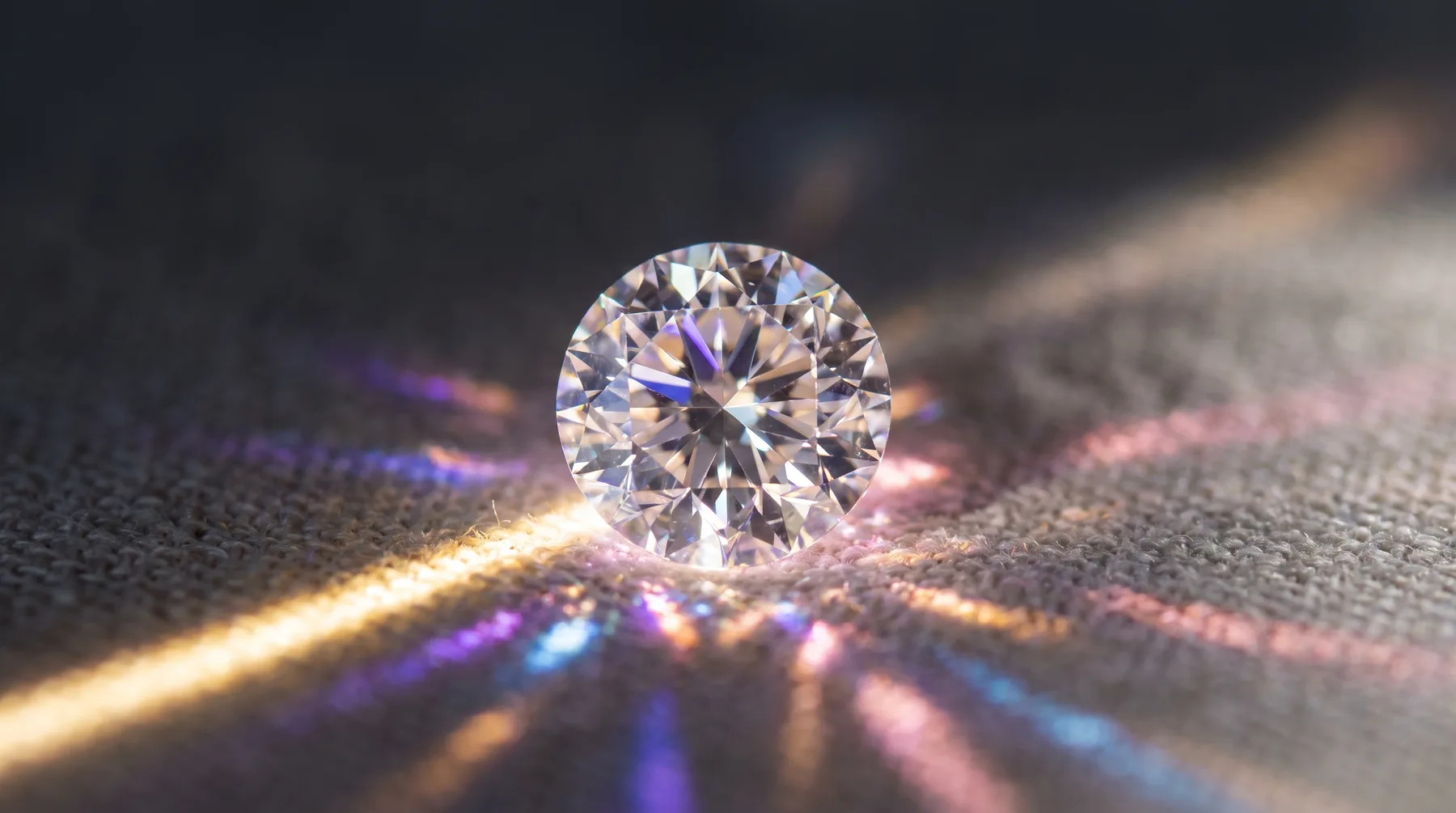
The tell is fire. Two and a half times diamond's dispersion means moissanite throws distinctly more colored flashes, and in direct sun or under LED spotlights a large one can read as rainbow rather than white. Under about half a carat equivalent, most people never notice. Above a carat and a half, plenty of jewelers can call it across a counter, and some buyers love exactly that look. It is worth seeing a big one in daylight before deciding which camp you are in.
The second difference is doubling. Tilt a moissanite under a 10x loupe and look through a crown facet toward the far side: the facet junctions appear doubled, like a slightly out-of-register print. Diamond, being singly refractive, never does this.
Durability plays out less predictably than the hardness numbers suggest. Diamond is harder, so it stays sharper at the girdle and facet edges over decades. But diamond also has perfect cleavage in four directions, meaning a hard knock at the wrong angle can split a facet clean off, and moissanite has no cleavage at all. In practice both survive normal life; the difference shows up as scratches on the moissanite after many years, and as the occasional chip on a diamond.
Price in August 2026
1 min
The lab-grown market is the story of this decade. According to analyst Edahn Golan's LGD Wholesale Price Index, published 7 July 2026, wholesale lab-grown prices are down 96 percent since tracking began in July 2018, and fell about 13 percent year over year in the second quarter of 2026. The decline is decelerating rather than accelerating: 1 carat rounds actually rose 1 percent year over year, while 2 carat rounds fell 20 percent.
Two consequences follow for a buyer standing at a counter in August 2026:
- A lab-grown diamond costs a small fraction of a comparable mined stone, commonly quoted at 80 to 90 percent less. The gap is no longer a discount; it is a different price category.
- The bigger the stone, the faster its price is falling. A 2 carat lab-grown bought today is a depreciating asset in a way a 1 carat is not, at least at wholesale.
Moissanite sits below both, and its own price collapsed years earlier when the original patents expired and generic producers entered. It is now priced like a well-made manufactured gem, which is what it is.
Natural diamond prices move slowly and behave like a commodity with a marketing budget. If your purchase is emotional rather than financial, that is fine. If someone tells you a diamond of any kind is an investment, ask what they would pay you for it today.
Resale, honestly
1 min
Every one of these stones is worth less the moment it leaves the shop, and the differences between them are differences of degree.
A natural diamond has a real secondary market. You will not recover retail, and typical offers land well below what you paid, but there are dealers, auction houses and buyers who want the stone itself. A lab-grown diamond has a thin secondary market and falling replacement cost, so a buyer's offer is anchored to what a new one costs this month, which is less than it was last month. Moissanite has essentially no secondary market; ask a pawnbroker or estate buyer and the honest answer is usually the scrap value of the gold, because they can order a new stone for less than the trouble of taking yours.
None of that is a reason not to buy any of them. It is a reason to buy the one whose price you are happy to have spent, rather than the one you expect to get back.
How a jeweler tells them apart
1 min
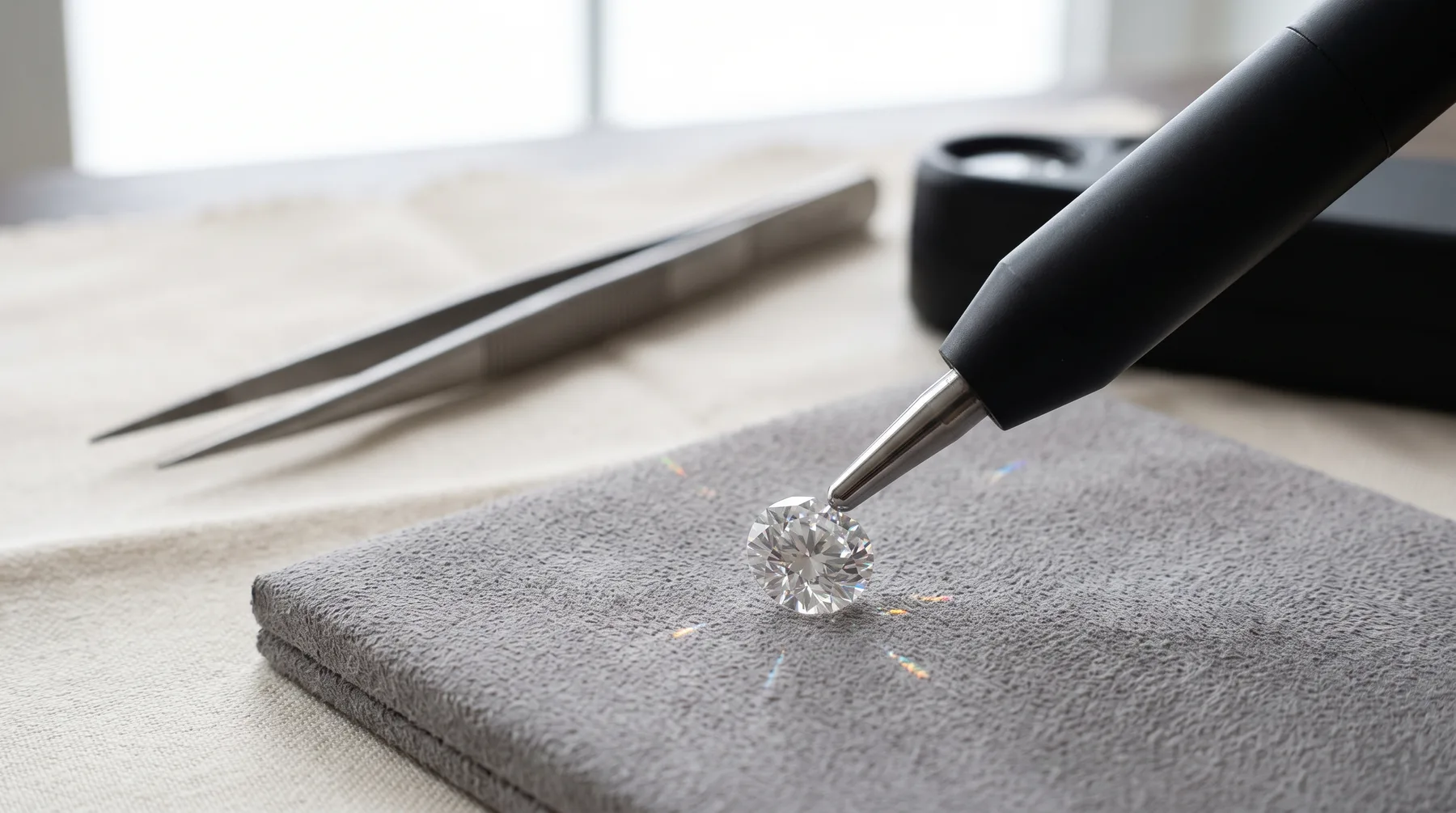
This is where a piece of trade history matters. When moissanite reached the market in the late 1990s, the standard diamond tester was a thermal probe, and moissanite conducts heat closely enough to diamond that it reads as diamond. The problem was documented as the material launched, in Nassau and colleagues' Winter 1997 Gems & Gemology paper, and in a test from the same period dozens of jewelers and pawnbrokers using thermal probes called moissanite diamond. The industry's fix was to add a second measurement: moissanite testers read electrical conductivity, which is much higher in moissanite than in natural diamond.
So the modern counter procedure is a combination tester, plus the loupe check for doubling, plus specific gravity or measurement against weight if there is any doubt. If you are shown a stone and told "it tested as diamond", ask which tester. A thermal-only pass is not an answer.
Telling lab-grown from natural is a different problem and cannot be done at the counter at all. It takes laboratory screening, so the practical protection for a buyer is documentation and inscription, not equipment. Our walkthrough of how to read a GIA report covers what those documents do and do not tell you, including what changed for lab-grown reports on 1 October 2025.
What a seller is legally required to tell you
1 min
In the United States the FTC Jewelry Guides (16 CFR Part 23) set the disclosure rules, and they are clearer than most shop copy suggests.
- A laboratory-grown diamond must be described with a qualifier such as laboratory-grown, laboratory-created, or [manufacturer]-created, placed immediately next to the word diamond, in a way that is clear and conspicuous rather than buried in a footnote.
- The word cultured is permitted only when it carries one of those qualifiers alongside it.
- A simulant, which is what moissanite is relative to diamond, must have its true identity disclosed clearly. Moissanite sold as "moissanite" is properly disclosed. Moissanite sold as a "diamond" of any adjective is not.
The practical version: if you have to work out what you are being sold, you are being sold badly. Any seller worth buying from will tell you the material in the first sentence, without being asked twice.
Which one to buy
1 min
Decide by what you are optimising for, and be honest about which it is.
- Maximum size for the budget. Moissanite, without much argument. Nothing else puts that many millimeters on a hand for that money.
- A diamond, at a price you are comfortable with. Lab-grown, and buy the size you want rather than the largest you can reach. Prices for big stones are still falling.
- Rarity, tradition, or a piece meant to be handed down. Natural, and put the money into cut before carat weight.
- The least maintenance over thirty years. Either diamond, for the edge retention.
- Anything you want to be able to sell. Natural, with the understanding that resale still means a real loss.
One last piece of advice that applies to all three: the setting will decide how the stone looks far more than the material will. A well-cut stone in a well-built mounting reads as expensive; a poorly cut stone does not, whatever it is made of.
Frequently Asked Questions
2 min
Is moissanite a fake diamond?
It is a different gemstone, not an imitation of one. Silicon carbide has its own properties, and it is only "fake" if someone sells it as diamond, which the FTC Jewelry Guides prohibit.
Will moissanite pass a diamond tester?
On a thermal tester, yes, and it has since it entered the market. Modern combination testers add an electrical conductivity reading, which separates the two immediately.
Does moissanite get cloudy over time?
No. At 9.25 on the Mohs scale it does accumulate fine surface scratches over years of daily wear, which can dull the polish, and it collects the same skin oils and soap film every stone does. Cleaning restores it; our guide to cleaning gold jewelry at home covers the method.
Can a jeweler tell a lab-grown diamond from a natural one?
Not at the counter. It requires laboratory screening instruments, which is why lab-grown stones are inscribed and reported. Anyone claiming to identify origin by eye or with a handheld probe is guessing.
Which is more sparkly, moissanite or diamond?
Moissanite produces more colored fire, roughly two and a half times diamond's dispersion. Whether that reads as more beautiful is a matter of taste, and the difference grows with size.
Do lab-grown diamonds still come with 4Cs grades?
From most laboratories, yes. GIA stopped applying the 4Cs color and clarity scales to lab-grown diamonds on 1 October 2025 and now issues a two-tier descriptive assessment instead, while other laboratories continue to grade them on the familiar scales.