
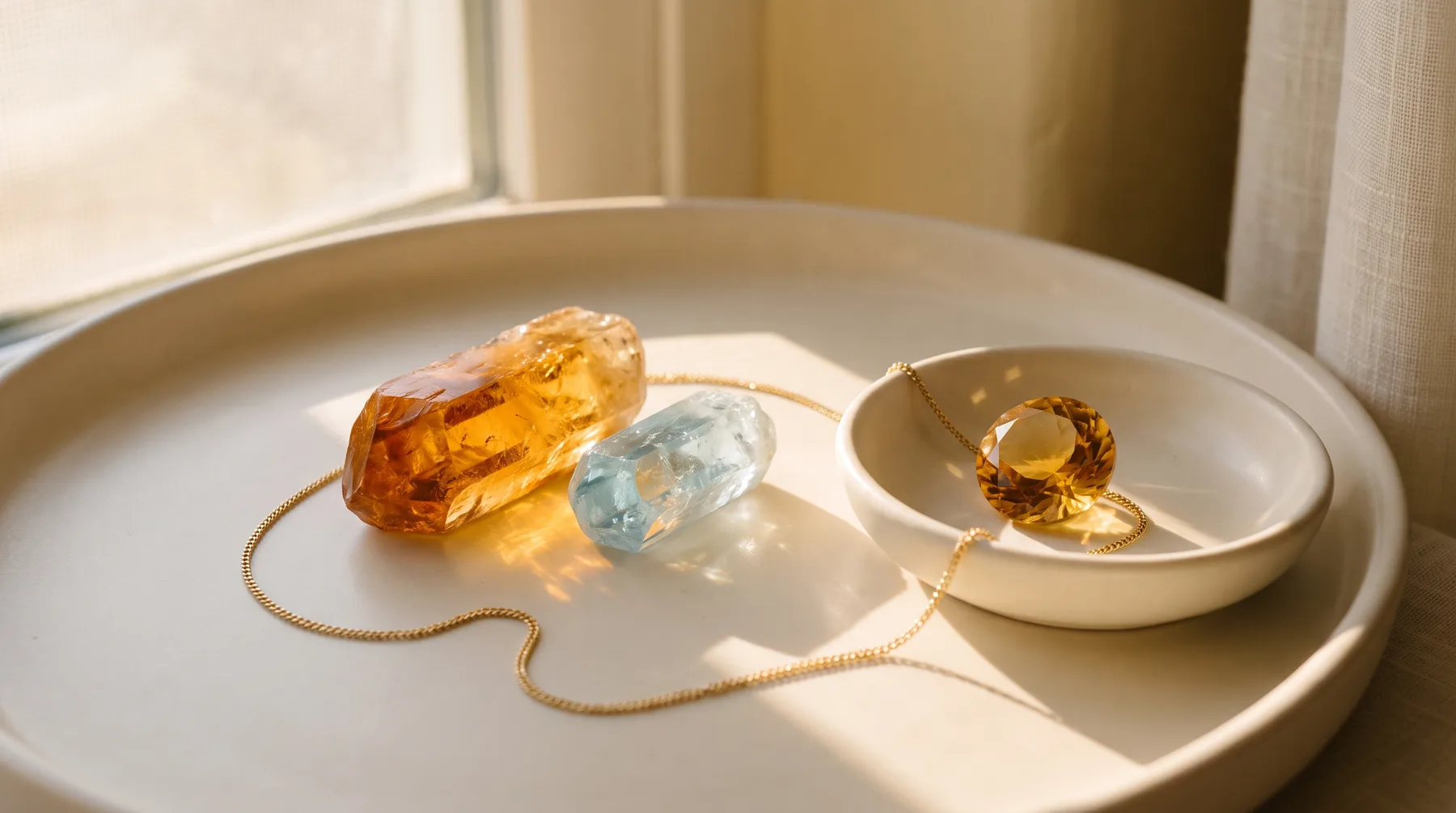
November has two birthstones: topaz, the traditional stone, and citrine, added to the American list in 1952. Topaz is the harder and more varied of the two, an 8 on the Mohs scale that comes in orange, pink, brown, colorless and the blue nearly everyone pictures. Citrine is yellow-to-orange quartz, a 7 on the same scale, cheaper, tougher in daily wear, and usually the product of heating amethyst.
Both stones carry a disclosure story the tag rarely tells. The blue topaz in nearly every birthstone pendant started colorless and was irradiated, then heated, to turn blue. The citrine beside it was, in all likelihood, purple when it came out of the ground. Neither fact makes the stone a fake; both are permanent treatments the trade has used for decades. But a buyer who knows them pays the right price, cleans the right way, and does not mistake a Swiss blue for the collector's topaz, which is a different color altogether and comes from one mining district in Brazil.
What topaz actually is
1 min
Topaz is an aluminum silicate mineral containing fluorine and hydroxyl, Al2(F,OH)2SiO4, rated 8 on the Mohs hardness scale. According to the Gemological Institute of America (GIA), it is allochromatic: its color comes from trace elements and crystal defects rather than its basic chemistry. Chromium gives pink, red and purple; structural imperfections give yellow, brown and blue. Pure topaz is colorless, and colorless topaz is plentiful, which is the economic basis of the entire blue topaz business.
Two physical facts shape how it behaves in jewelry. It is pleochroic, showing slightly different colors down different crystal directions, so cutters orient it with care. And it has one direction of perfect cleavage, so for all its hardness a sharp blow in the wrong direction can split it cleanly. Hardness is resistance to scratching; toughness is resistance to breaking. Topaz has plenty of the first and, in GIA's words, is "not very tough."
Why blue topaz is almost never natural
2 min
Nearly all blue topaz sold today is colorless topaz that has been irradiated and then heated, and the resulting color is permanent and stable to light. GIA says it flatly: the vast majority of blue topaz seen today is the result of that treatment. Natural blue topaz exists, famously in Mason County, Texas, where blue topaz became the state gem in 1969, but it is pale, scarce and plays no part in mass-market jewelry.
The mechanism was laid out in Kurt Nassau's 1985 Gems & Gemology paper, Altering the Color of Topaz. Gamma rays, high-energy electrons and reactor neutrons each turn a colorless stone yellow to brown; in most cases a heat treatment afterward turns it blue. The trade names describe how far the recipe was pushed. Sky blue, Swiss blue and London blue are not grades or origins, and GIA does not use them; they are market shorthand for pale, vivid and deep inky blue, with London blue generally associated with reactor treatment.
Reactor treatment is where the regulation comes in. Neutrons leave a small induced radioactivity in the stone that decays over time, and the US Nuclear Regulatory Commission (NRC) set the rules in Generic Letter 88-04 of 23 February 1988: the first US distributor of neutron-irradiated gems needs a specific NRC license (later sellers and consumers do not), stones must test below the release limits of 10 CFR 30.70 first, and only cut, finished gems may be distributed. The trade press describes the hold before release as a matter of months, after which a retail stone reads as nothing on an ordinary Geiger counter. When the NRC tightened enforcement in 2007, it told JCK on 1 October 2007 that its initial field data showed no indication of a public health and safety issue with gems on the market.
The takeaway is not fear. Blue topaz is a manufactured color with a paper trail, and a seller who calls it natural blue has it wrong.
What has to be disclosed, and how the trade says it
2 min
Under the Federal Trade Commission's Jewelry Guides, a seller must disclose a gemstone treatment when it is not permanent, when it creates special care requirements, or when it significantly affects the stone's value. That is 16 CFR 23.24 in the current rule; the next section, 23.25, names topaz in its title and bars using the word for anything that is not the natural stone without a clear qualifier.
- Irradiated and heated blue topaz is permanent and needs no special care, but the treatment is the whole reason a plentiful colorless stone became a blue one, so the value trigger applies.
- Coated topaz, sold as mystic topaz and under other trade names, is colorless topaz with a microscopic layer of metallic oxide on it. GIA notes the coating is not very durable and that abrasive cleaners or a buffing wheel will remove it: both the not-permanent and the special-care triggers.
- Diffusion-colored topaz is coating's cousin. A 2008 study by Gabasch and colleagues found that both processes color only the near-surface of the stone, unlike irradiation, which changes the whole crystal.
- Heated citrine is permanent, needs no special care, and is so common that heating is close to the normal condition of the stone. Good suppliers state it anyway.
The wholesale trade writes this in the American Gem Trade Association (AGTA) enhancement codes, printed on invoices rather than consumer tags: N natural, H heating, R irradiation, C coating, U diffusion. AGTA released the 17th edition of its Gemstone Information Manual on 24 August 2026. Any retailer can find out which letter a topaz arrived with, and it is a fair question to ask.
The meaning behind the stone, and why it is called imperial
1 min
Topaz has stood for strength for most of its recorded history. Some trace the name to the Sanskrit tapas, meaning fire; others to Topazios, the Greek name for the Red Sea island now called Zabargad. The ancient Greeks believed topaz gave them strength, Europeans from the 1300s to the 1600s thought it could thwart magic spells and dispel anger, and in India a topaz worn above the heart was said to assure long life, beauty and intelligence.
The word imperial has two origin stories, and GIA gives both. In nineteenth-century Russia, the pink topaz of the Ural Mountains was named in honor of the czar. In Brazil, the name is tied to Emperor Pedro II's 1881 visit to Ouro Preto. The place is not in dispute: the Portuguese court celebrated the discovery of imperial topaz there in 1768, and a 1983 Gems & Gemology study called the small district around Ouro Preto the only known source of imperial topaz for over 200 years.
Citrine's name comes from the French citron, lemon, and Scottish Victorian jewelry used it generously. The first official American birthstone list of 1912, drawn up by the trade body now called Jewelers of America, gave November to topaz alone; the 1952 revision added citrine.
The families of topaz
1 min
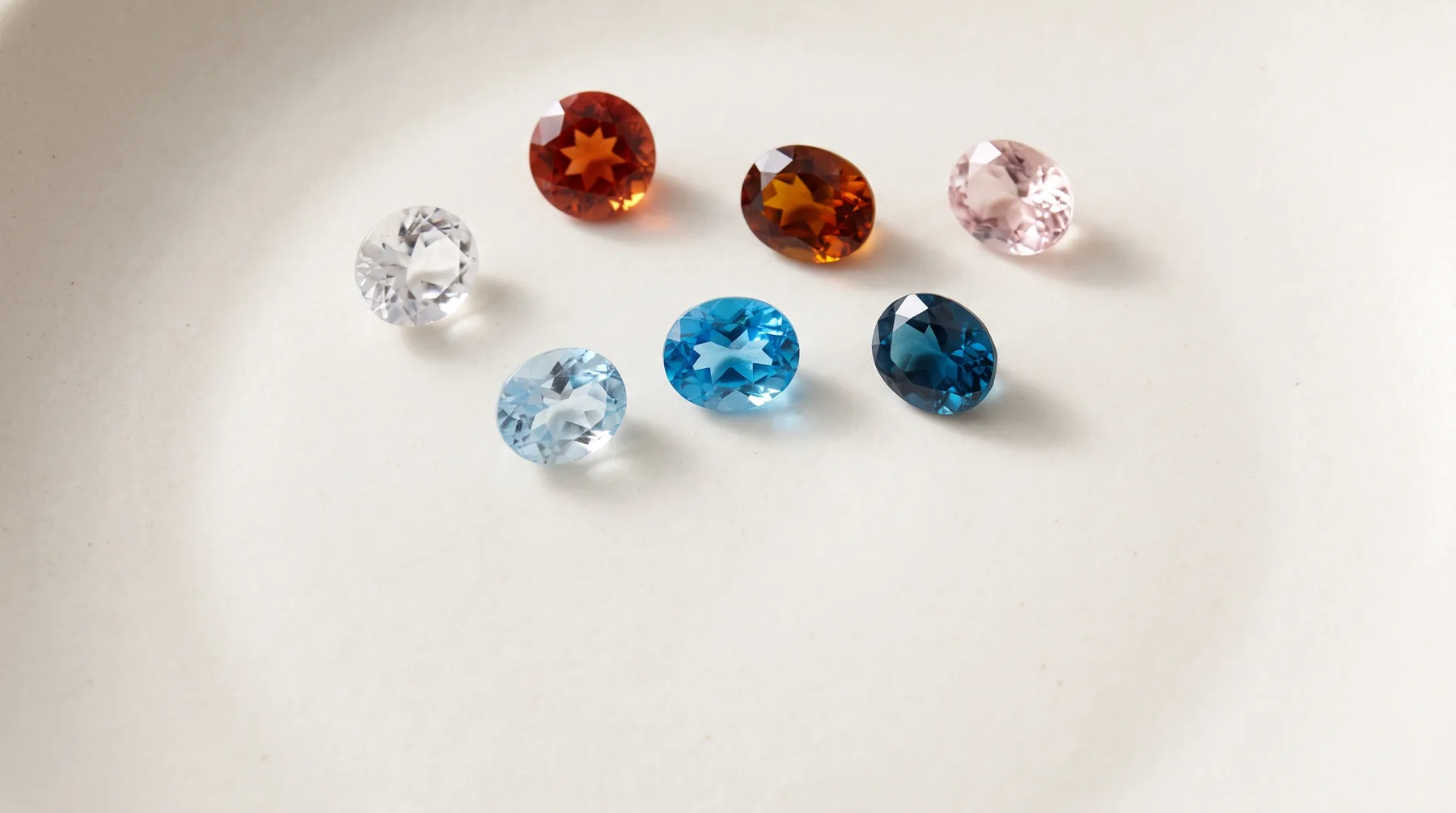
Topaz is sold by color, and the color is what separates a commodity from a collector's stone. Imperial topaz is the trade's name for a medium reddish orange to orange-red, the color GIA calls highly prized and very rare.
| Type | Color | Usual treatment | Notes |
|---|---|---|---|
| Imperial | Medium reddish orange to orange-red | Usually none | Ouro Preto, Brazil, is the only commercial source. The collector's topaz |
| Sherry | Yellowish brown to brownish yellow to orange | Usually none | Trade term; can fade with prolonged heat or sun |
| Pink | Pink to purplish pink | Natural (chromium), or heated from orange | The two look alike; ask which |
| White | Colorless | None | Plentiful; a budget diamond stand-in and the raw material for every blue |
| Sky, Swiss, London blue | Pale, vivid, deep inky blue | Irradiation, then heat | Treatment depths, not grades or origins |
| Mystic and other coated | Rainbow, teal, green, purple | Coating or diffusion | The color is a surface film. Must be disclosed |
| Natural blue | Pale blue | None | Texas and a few other localities; rare and seldom seen in commercial jewelry |
The pink row deserves its extra sentence. A 1996 Gems & Gemology update on the Capão mine near Ouro Preto by Sauer, Keller and McClure recorded that heating turns some brownish yellow or orange imperial topaz peach or pink, and that the deposit's rarest color is pinkish purple to purple. At imperial prices, natural versus heated pink is a question to ask in writing.
Hardness 8 with a catch: how topaz wears in real life
2 min
Topaz wears well against scratches and badly against knocks, and every care decision follows from that. At 8 it is harder than quartz, garnet and most other colored stones, so its polish stays bright for years. But GIA's care guidance is blunt: a hard blow might split it, and high heat or sudden temperature changes can cause breaks.
The bench knows this better than the sales floor. Setters avoid very hard alloys and overly thick prongs on topaz, because pushing a stiff prong over can cleave the stone, and routine prong tightening on an old topaz ring is a known way to turn one stone into two. Channel settings are worse. Jewelers who have repaired chipped topaz describe the cleavage plane as hard to locate on a cut stone, so a careful setter treats every direction as the dangerous one. The stone cannot take a torch either: a prong on a topaz ring is retipped with the stone out, or with a laser welder.
For a wearer, the translation is simple. A topaz pendant or pair of earrings will last indefinitely. A topaz ring in a bezel or a low, snug setting is a reasonable everyday ring for someone who takes it off for the gym and the garden. A large emerald-cut topaz on four thin prongs, on a hand that types, lifts and opens doors, is a chip waiting for its day. The same logic answers the cleaning question: GIA says no ultrasonic and no steam for topaz, and our guide to which jewelry survives an ultrasonic cleaner puts it in the never column for exactly this reason.
What our catalog says about topaz at the counter
2 min
Topaz at the counter is blue, and the counter sells it as a December stone. As of 10 October 2026, 2,203 styles in the vendor catalog behind our store name topaz as a set stone, and 1,303 of them, 59%, name a blue one: Swiss blue 1,064, sky blue 165, London blue 66, with white topaz at 602. Fine colors are a rounding error, with 26 styles pink, 10 yellow and 6 red, and no style's recorded stone type names imperial topaz. Of the 2,203, 462 were in stock that day.
The treatment data is worth reading twice. Where the vendor records a treatment on a topaz style, 855 say irradiation, 150 heating, 64 coating and 61 diffusion, against 295 marked not enhanced, and 285 of those 295 are white topaz. That is the AGTA system working as designed, upstream of the shopper, and it means a store that wants to can state the treatment on every tag.
Then there is the month. Where the vendor assigns a birthstone month to a topaz style, 874 say December and 13 say November. The trade lists disagree: GIA, the American Gem Society and Jewelers of America all give December to turquoise, tanzanite and zircon, not topaz. Blue topaz as a December stone is a retail convention, and the data shows how completely it has won. Citrine, meanwhile, is tagged November on 726 of its 1,114 styles, so in practice the industry has moved November's traditional stone to another month and handed November to the newcomer.
Citrine, November's other stone
2 min
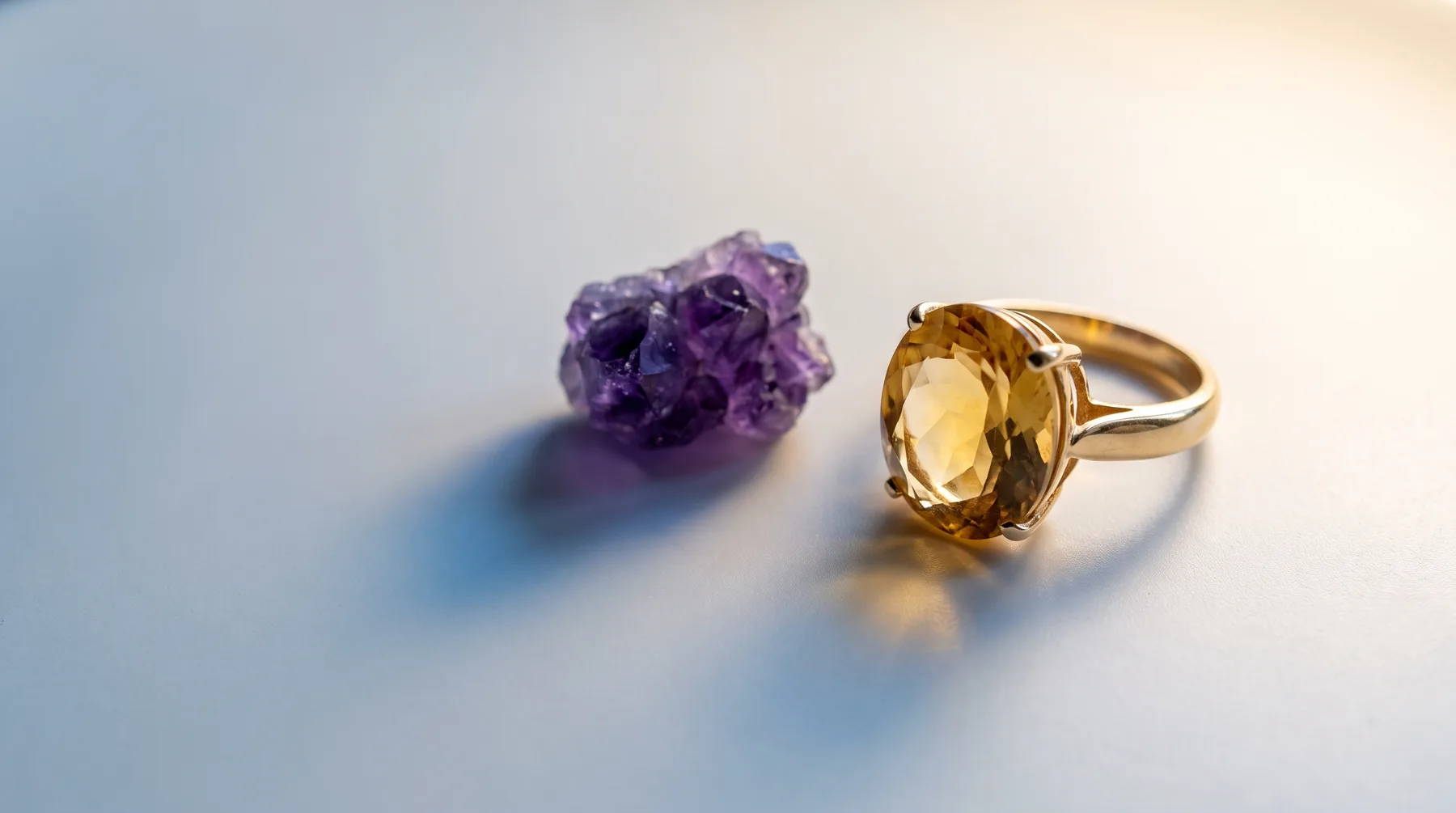
Citrine is the transparent yellow to orange variety of quartz, rated 7 on the Mohs scale with good toughness, and GIA calls it suitable for all jewelry types. Natural citrine is rare; most citrine on the market, in GIA's words, is the result of heat treatment of amethyst. If you have read our February amethyst guide, you have met most citrine before it was heated.
That is not a scandal. The heated stone is still quartz and the color is permanent. GIA lists Bolivia, Spain, Madagascar, Mexico and Uruguay as citrine sources, with the amethyst typically heated to citrine mined mostly in Brazil; Bolivia also produces ametrine, amethyst and citrine zones in one crystal. What the heating should change is your expectation of price. GIA calls citrine the top-selling yellow-to-orange gem, readily available in sizes up to 20 carats, and a dealer asking a premium for unheated citrine should be able to show a laboratory report that says so.
In wear, citrine is the easier November stone. It has no cleavage problem, so a citrine ring survives knocks that would split a topaz, and GIA says ultrasonic cleaners are usually safe for it, except for dyed or fracture-filled material. Its weaknesses are heat and light: abrupt temperature change can fracture it, steam is not recommended, and some citrine fades in prolonged intense light. In our vendor catalog, all 1,114 citrine styles declare their stone natural and all 1,114 declare heating, which is exactly the honest combination.
Choosing November birthstone jewelry by the piece
1 min
Choose topaz when color matters most and citrine when the piece will be worn hard. Someone who has always been told their stone is blue will be disappointed by an orange one, however correct the gemology, and Swiss blue topaz is an honest, lively stone nobody should apologize for. Someone who collects wants an imperial from Ouro Preto and should expect to pay for it.
Pendants suit both stones and are the safest place for topaz, since nothing hits a pendant. A blue topaz in a simple bezel is the classic November gift for good reason.
Earrings favor topaz, whose polish and brightness show best when the stone moves, and four-prong studs are fine because earrings rarely get knocked.
Rings are where the two stones part. For daily wear, choose citrine in any setting, or topaz in a bezel, half-bezel or low prong setting with the stone close to the finger. Our settings guide covers the trade-offs; for topaz, the setting supplies the toughness the stone lacks.
Bracelets go to citrine. A wrist meets desks, doors and car handles all day, and a line of prong-set topaz takes exactly the kind of sharp knock its cleavage cannot forgive.
How to buy a topaz worth keeping
1 min
The questions that protect you are about treatment and origin, because the color is the part you can already see.
- Ask how the stone was treated. Blue topaz is irradiated and heated; a listing that calls it natural blue has answered the question for you.
- Ask whether it is coated. Rainbow, teal or green topaz at a low price is coated or diffused. Fine for fashion wear, not for a ring that will ever be polished.
- For imperial topaz, get origin and heating in writing, ideally on a report from a recognized laboratory.
- Loupe the girdle. Chips along the edge are the first sign of a stone that has already met its cleavage, especially on estate pieces.
- Mind the size step. GIA notes topaz is inexpensive in smaller sizes, that prices rise above about 10 by 8 mm, and that it is often cut as long ovals and pears to follow the crystal. A good long stone is bright right to its ends.
- Buy the setting for the stone's weakness, not its strength. Bezel, half-bezel or low prongs for any ring.
Caring for topaz and citrine jewelry
1 min
Clean topaz by hand, keep citrine out of steam and strong sun, and protect both from heat shock.
- No ultrasonic and no steam for topaz. Warm water, a drop of mild soap and a soft brush, then a rinse at the same temperature. Our gold cleaning guide covers the metal around it.
- Citrine can usually go in an ultrasonic, but never a steamer, and never from cold water straight into hot.
- Keep coated topaz away from anything abrasive, including polishing compound and the buffing wheel.
- Keep sherry and brown topaz, and citrine, out of long sun and heat. Blue topaz is stable to light.
- Take topaz rings off for anything with impact, and ask whoever tightens an old topaz ring's prongs to do it with the cleavage in mind.
- Store topaz in its own pouch. It scratches most of what it touches, and diamonds and sapphires scratch it.
The rest of the year
1 min
This is the eleventh guide in our birthstone series. The others: January garnet, February amethyst, March aquamarine, the natural blue that blue topaz most often stands in for, April diamond, May emerald, June pearl, July ruby, August peridot, September sapphire and October opal.
Frequently Asked Questions
2 min
What is November's birthstone?
Topaz and citrine. Topaz is the traditional November stone and appeared on the original 1912 American list; citrine was added in the 1952 revision. Both are correct for a November birthday, though retail now often sells citrine as the November stone and blue topaz as a December one.
Is blue topaz natural?
Almost never. Nearly all blue topaz is colorless topaz that was irradiated and then heated, a permanent treatment that is stable to light. Natural blue topaz exists, in Texas for example, but it is pale and rare. Sky, Swiss and London blue describe the depth of the treated color, not a grade or an origin.
Is irradiated blue topaz safe to wear?
Yes. Reactor-treated stones are held until their induced radioactivity decays below US Nuclear Regulatory Commission release limits, and only licensed distributors may release them. In 2007 the NRC said its field data showed no indication of a public health and safety issue with gems on the market.
Is citrine just heated amethyst?
Usually, yes. GIA states that natural citrine is rare and that most citrine on the market is heat-treated amethyst. The heated stone is still quartz, the color is permanent, and it needs no special care. A claim of unheated natural citrine should come with a laboratory report.
Can I wear a topaz ring every day?
With the right setting. Topaz is an 8 on the Mohs scale and resists scratches well, but its perfect cleavage means a hard knock can split it. Choose a bezel or low protective setting, take it off for the gym and housework, and never clean it in an ultrasonic or steamer. For a ring that will be worn carelessly, citrine is the tougher choice.
Which is more valuable, topaz or citrine?
It depends on the topaz. GIA describes topaz as inexpensive in smaller sizes, and blue and colorless stones sit at that end. Imperial topaz from Ouro Preto in Brazil, in reddish orange, pink or purple, is highly prized and very rare, and is priced far above either.