
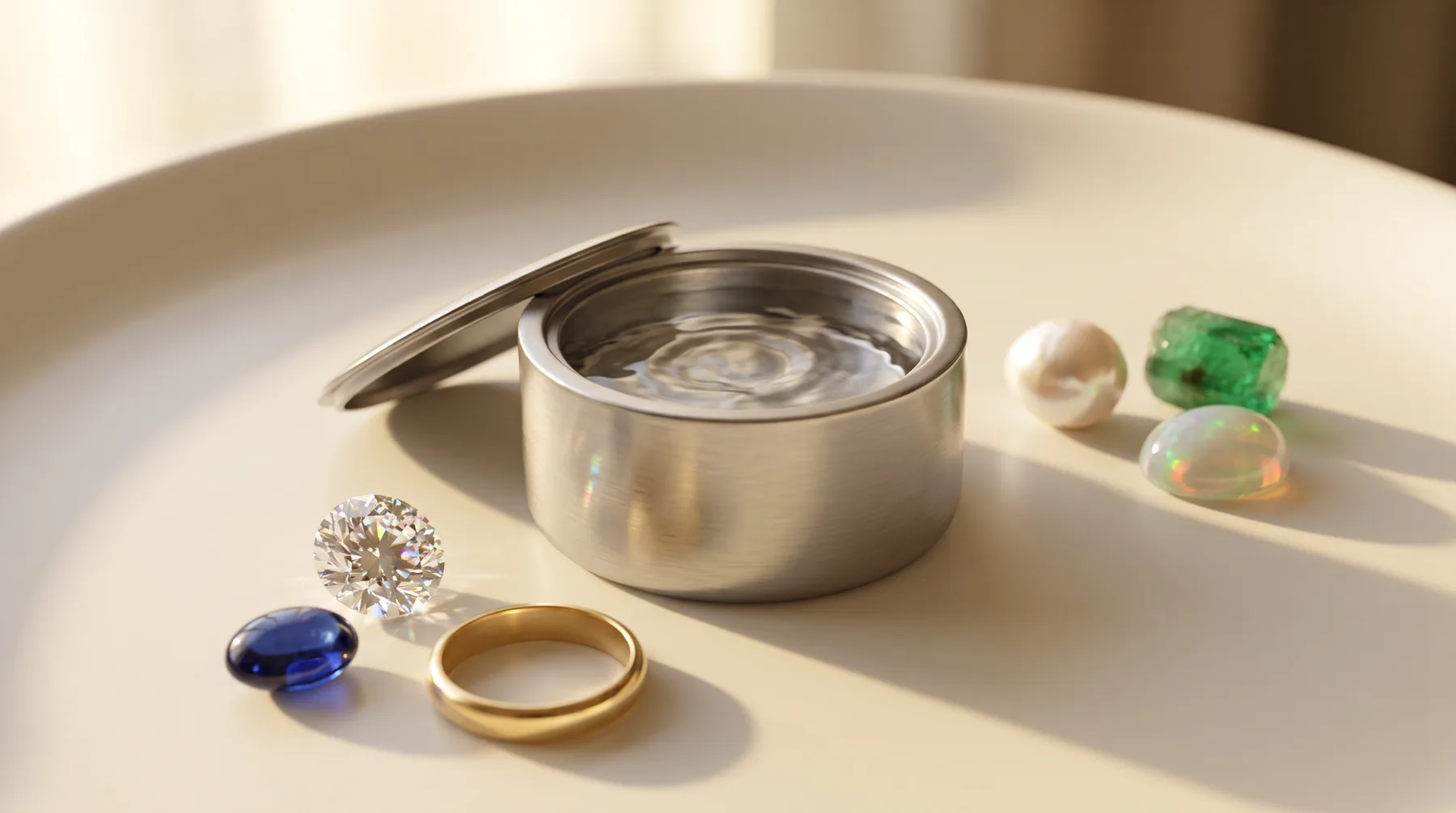
An ultrasonic jewelry cleaner is safe for diamonds, sapphires, rubies and solid gold or platinum, provided every stone is tight in its setting and nothing in the piece has been oiled, filled, glued or plated. It is not safe for opal, emerald, pearl, turquoise, tanzanite, topaz or anything assembled with adhesive, and the Gemological Institute of America (GIA) tells owners to keep even sturdy stones out of it when a treatment is involved. The machine itself is not the hazard. What breaks jewelry in an ultrasonic is the combination of vibration and heat meeting a stone, a filler or a prong that was already marginal.
This is the follow-up to our bowl-and-brush cleaning guide, which told you to leave the ultrasonic to the jeweler. If you own one anyway, here is how to use it without a trip to the repair bench.
How does an ultrasonic jewelry cleaner work?
2 min
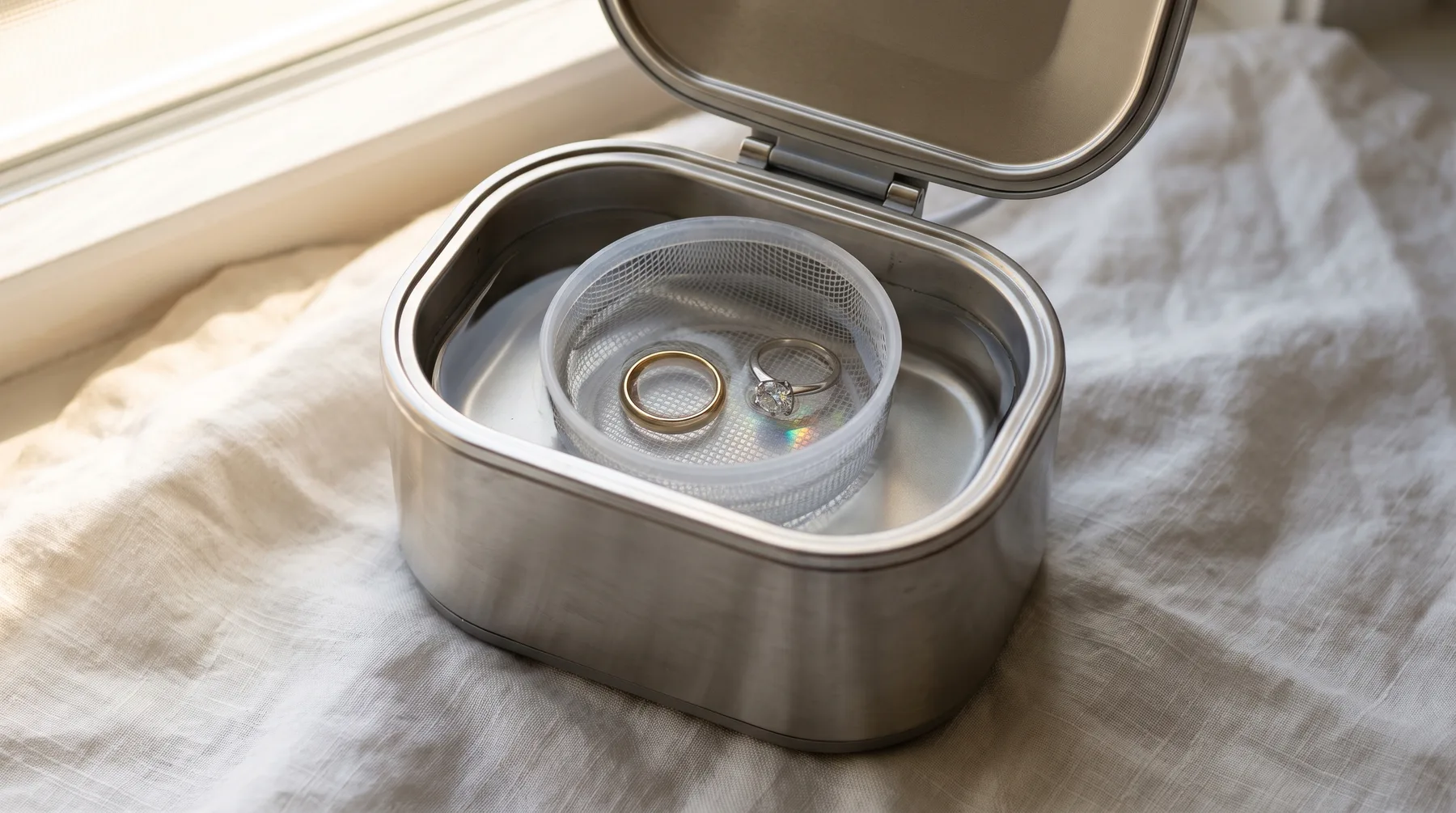
An ultrasonic cleaner is a tank of liquid driven by a transducer that vibrates at a frequency above human hearing, and it cleans by cavitation: the formation and violent collapse of microscopic bubbles against every surface of whatever is submerged. Branson's ultrasonic cleaning primer, an industrial manufacturer's reference, puts it plainly: cleaning "depends upon cavitation, the rapid formation and violent collapse of minute bubbles or cavities in a cleaning liquid." Each collapsing bubble is tiny, but millions collapse every second, and Branson's theoretical estimate for the inside of a single imploding bubble is a pressure above 10,000 psi and a temperature above 20,000 °F. That is the scrubbing action. It reaches under prongs, inside gallery work and down the links of a chain, which is why nothing cleans a pavé band as thoroughly.
Frequency sets how rough the scrub is. Lower frequencies make bigger, more energetic bubbles; higher frequencies make smaller, gentler ones. Branson notes that as frequency rises "the energy released by each cavity decreases making higher frequencies ideal for small particle removal without substrate damage," and Crest Ultrasonics recommends 40 to 100 kHz for jewelry. The consumer machines sold for jewelry typically run at 40 to 42 kHz, which is the right band. A cheap 20 or 28 kHz "parts washer" from a hardware aisle is the wrong tool; it is tuned for engine components.
Two more things happen in the tank that the box never mentions. The liquid warms, both from the transducer and from any built-in heater, and the whole piece is shaken at thousands of cycles a second. GIA's own description of the machine is that it generates sound waves "creating heat and pressure." Keep heat and vibration in mind; every entry on the never list fails on one or the other.
Which gemstones are safe in an ultrasonic cleaner?
4 min
Diamond, sapphire, ruby, spinel, amethyst, citrine, garnet, aquamarine and morganite are usually safe in an ultrasonic cleaner, in GIA's words, as long as the specific stone is untreated or only heat-treated and has no fractures. Pearl, opal, emerald, turquoise, tanzanite, topaz, peridot and tourmaline are not. The table below is GIA's per-gem care verdict for every stone that shows up in our catalog in any number, plus the metals and the glued pieces people forget to think about.
Read the right-hand column before you trust the left. "Usually safe" is GIA's exact phrase, and the exceptions it carves out are the whole reason this article exists.
| Material | Ultrasonic | Steam | Why (GIA care guidance unless noted) |
|---|---|---|---|
| Diamond, natural or lab-grown, untreated | Yes | Yes | Hardest gem there is; the only risk is the setting. GIA still lists both machines as "not recommended for home use" because they "can loosen gemstones in their settings." |
| Fracture-filled (clarity-enhanced) diamond | No | No | Lead-glass filler "may degrade or become discolored" with heat, ultrasonic cleaning or chemicals (GIA, Gems & Gemology, Winter 2025). |
| Moissanite | Usually | Usually | 9.25 on the Mohs scale. Rio Grande's jeweler's bench guide to Charles & Colvard moissanite: "single pieces will cause no problems in ultrasonic cleaners." Charles & Colvard's own care page is stricter and says ultrasonic cleaners "may damage the gemstone." |
| Cubic zirconia (CZ) | Usually | Usually | 8.5 on the Mohs scale per GIA and untreated. The weak point is the plated setting CZ usually sits in, not the stone. |
| Sapphire and ruby, untreated, heated or lattice-diffused | Usually | Usually | "Usually safe for untreated, heat-treated, and lattice diffusion treated stones." 9 on the Mohs scale, no cleavage, excellent toughness. |
| Sapphire or ruby that is fracture-filled, cavity-filled or dyed | No | No | "Should only be cleaned with a damp cloth." The lead-glass filler is damaged even by lemon juice. |
| Spinel | Usually | Usually | 8 on the Mohs scale, good toughness; "certain inclusions like fractures could pose a potential problem." |
| Amethyst and citrine | Usually | No | Ultrasonic "usually safe except in the rare instances where a stone is dyed or treated by fracture filling." Steam is not recommended; abrupt temperature change can fracture quartz. |
| Garnet | Usually | No | Ultrasonic fine "except for stones that have fractures." Steam is not recommended. |
| Aquamarine and morganite | Usually | Usually | Both "usually safe unless the stone has liquid inclusions or fractures." |
| Jade, untreated | Yes | Yes | "Safe for untreated jade." Dyed, bleached or polymer-impregnated jade: soapy water only. |
| Tourmaline | No | No | "Not recommended." Thermal shock can fracture it; toughness only fair. |
| Peridot | No | No | "Not recommended." Rapid or uneven heat can fracture it. |
| Topaz (blue, white, imperial) | No | No | "Avoid steam or ultrasound." Perfect basal cleavage; a vibration or a thermal shock can split it along that plane. |
| Tanzanite | No | No | "Never recommended." Cleavage, fair to poor toughness, heat sensitive. |
| Emerald | No | No | GIA cites estimates that 90 percent or more are fracture-filled with oil, resin or polymer. "Ultrasonic vibrations can weaken already-fractured stones, and hot steam can cause oil or unhardened resin to sweat out." |
| Opal, including doublets, triplets and lab-created | No | No | "The only safe way to clean opal is with warm, soapy water." Heat and dryness cause crazing; doublets and triplets are cemented layers. |
| Pearl and mother-of-pearl | Never | Never | "Pearls should never be cleaned in an ultrasonic or steam cleaner." 2.5 on the Mohs scale, and most are glued to a peg. |
| Turquoise | Never | Never | "Should never be cleaned with steam or ultrasonic cleaners." Heat and solvents damage the stabilizing treatment most turquoise carries. |
| Solid gold (10k, 14k, 18k) and platinum | Yes | Yes | The metal is indifferent to both. Check every stone before and after. |
| Gold-plated and vermeil | No | No | Cavitation scrubs; a plating layer measured in microns is finite. Our vermeil vs plated guide covers the layer thicknesses. |
| Anything glued: pearl pegs, inlay, assembled stones, costume jewelry | No | No | Vibration and warm solution work on adhesive the way they work on dirt. |
| Watches | No | No | Bracelet only, head held above the water, per the Sharper Image manual. |
Two things the table cannot tell you. First, "usually safe" assumes you know the stone's treatment history, and most owners do not. If you have a GIA or other lab report, read the treatment line; if you have nothing, treat a colored stone as if it were treated. Second, a safe stone in a worn setting is still an unsafe piece. That is the subject of its own section below.
Which gemstones should never go in an ultrasonic cleaner?
3 min
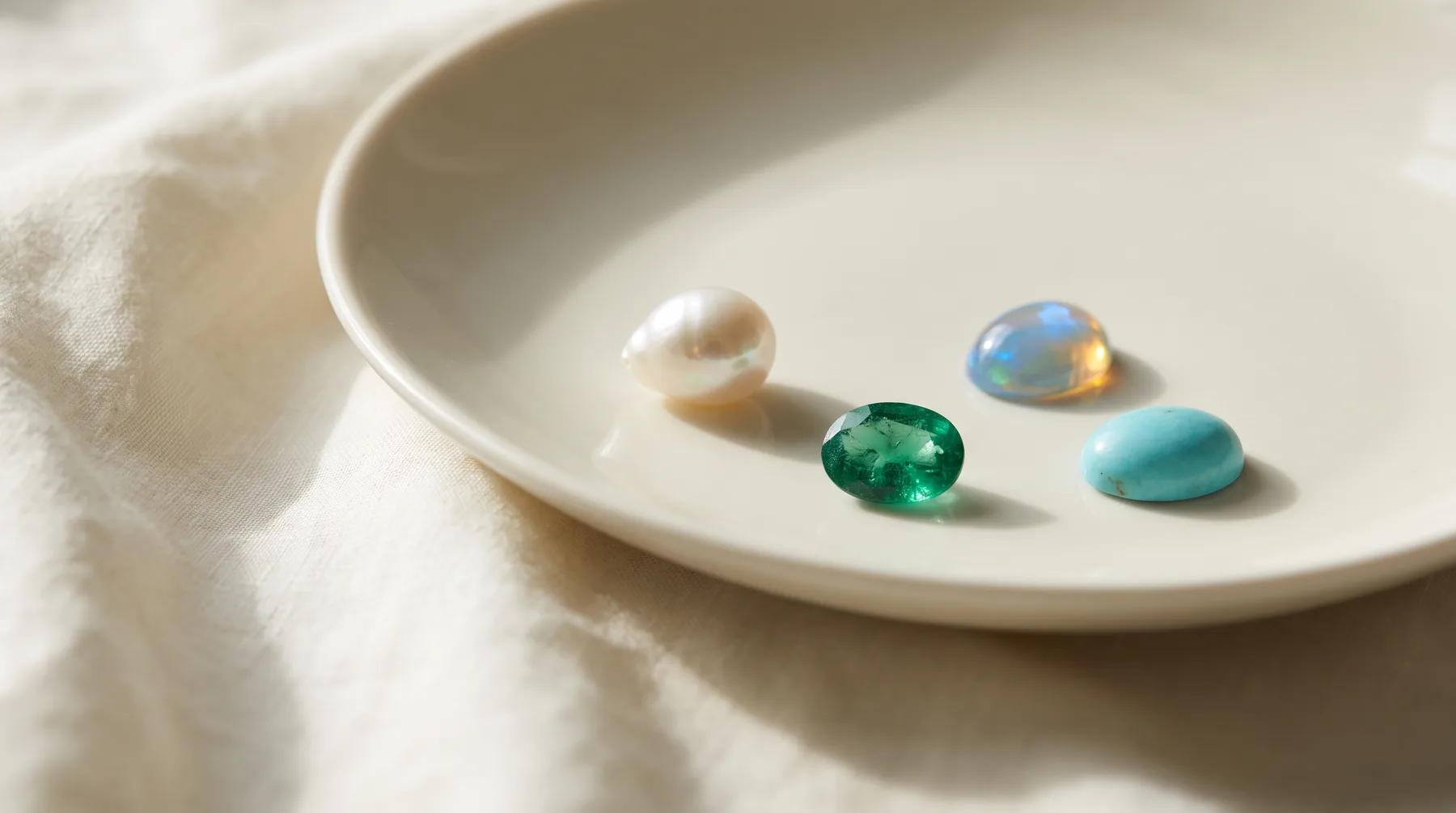
Opal, emerald, pearl, turquoise and tanzanite should never go in an ultrasonic cleaner, and topaz, peridot and tourmaline join them on GIA's not-recommended list. Each fails for a specific physical reason, and knowing the reason is what lets you judge a stone the table does not name.
Opal fails on heat and water. GIA says plainly that "the only safe way to clean opal is with warm, soapy water," and that heat or dryness causes crazing, "a fine network of cracks that resembles a spider's web." A warm, vibrating tank is the opposite of what an opal wants. Doublets and triplets are worse: GIA describes them as a thin layer of opal "cemented" to a backing or between a cap and a backing, and a cemented seam is an adhesive seam. Our October birthstone guide covers how to tell a solid opal from an assembled one. Lab-created opal gets the same treatment from us: much of it is polymer-impregnated, which puts resin inside the stone, and the safe method costs nothing.
Emerald fails on fractures and filler. GIA estimates that "90 percent or more of emeralds are fracture-filled" with oils, resins or polymers, and the care page is explicit: "Ultrasonic vibrations can weaken already-fractured stones, and hot steam can cause oil or unhardened resin to sweat out of fractures." The stone comes out of the tank with the oil gone, every fracture suddenly visible, looking like a different and much cheaper gem. A stone that lost its oil can be re-oiled by a gem dealer or cutter, but a fracture that the vibration extended cannot. More in the May birthstone guide.
Pearl fails on everything. It is 2.5 on the Mohs scale, nacre is organic, and GIA's sentence has no hedge in it: "Pearls should never be cleaned in an ultrasonic or steam cleaner." There is also the detail nobody outside a bench knows: a pearl on a ring, a pendant or a stud is almost always half-drilled and glued onto a metal peg with two-part epoxy. Stuller's pearl-setting instructions specify a five-minute epoxy and a 24-hour cure. Vibration plus warm detergent solution is the recipe for softening exactly that bond. The June birthstone guide has the full pearl care routine, which is a soft cloth and nothing else.
Turquoise fails on porosity. GIA: "it should never be cleaned with steam or ultrasonic cleaners," and "heat or solvents can damage the treated surfaces" of the stabilized material that is common in the trade.
Tanzanite fails on cleavage and heat; GIA calls ultrasonic and steam "never recommended." Topaz is the surprise on this list because it is hard, 8 on the Mohs scale, and people assume hard means tough. It is not. Topaz has perfect basal cleavage, GIA rates its toughness poor, and the care page says to "avoid steam or ultrasound." Every blue topaz in a holiday gift box has that plane running through it. Peridot and tourmaline are both "not recommended" on thermal-shock grounds; the peridot guide has the rest.
The pattern: soft, porous, organic, cleaved, filled or glued. If a stone you cannot find in the table is any of those, it stays out.
Why do treatments change whether a stone is ultrasonic-safe?
3 min
Treatments change the answer because most of them put a foreign material into the stone, and the ultrasonic attacks that material rather than the gem. GIA's standing advice on jewelry care is that treated gems "can be negatively affected by heat, solvents, steam and ultrasonic cleaners," and that knowing whether a gem is treated is the first step to knowing how to clean it. The same species can be a yes or a no depending on what was done to it.
The clearest case is diamond. An untreated diamond shrugs off any cleaning method ever devised. A fracture-filled diamond, sold as "clarity enhanced," has had surface-reaching fractures filled with a lead-containing glass whose refractive index is close to diamond's, so the fractures disappear. GIA's Winter 2025 Gems & Gemology lab note on these stones is blunt: "Fracture filling is not permanent; the filler may degrade or become discolored over time, particularly when exposed to ultraviolet light, heat, ultrasonic cleaning, or certain chemicals." GIA will not even grade one, "because of the unstable nature of the filler." If a diamond was cheap for its apparent clarity, ask whether it is enhanced before it goes anywhere near a tank. Our clarity grades article covers what an honest clarity price looks like.
Corundum works the same way. GIA rates ruby and sapphire as "usually safe" in both machines when untreated, heat-treated or lattice-diffused, because none of those treatments leaves anything in the stone. Fracture-filled, cavity-filled or dyed corundum is a different object: "should only be cleaned with a damp cloth," and the high-lead glass in a filled ruby is damaged "even by mild acids like lemon juice." The trade calls the heavily filled ones composite rubies, and the name is honest. The ruby guide and sapphire guide both explain how to read a treatment disclosure.
Coatings are the third category. "Mystic" topaz and other coated topaz carry a microscopic metallic-oxide film that GIA says "is not very durable" and that abrasives or buffing will remove. Cavitation is an abrasive by another name. Dyed quartz, polymer-impregnated jade and stabilized turquoise are all the same story: the treatment is the weak link.
One honest note on the source. GIA's general jewelry-care tips are more conservative than its per-gem pages and list "some heat-treated gemstones" among the cautions, and its guide to gems and ultrasonic cleaners says star ruby and star sapphire "should not be cleaned in an ultrasonic machine." The per-gem pages for ruby and sapphire say heat-treated stones are "usually safe." Where the two differ, this article follows the per-gem page, because it is the more specific guidance, and it hedges exactly where GIA hedges.
The practical rule is this. A treatment that changes the crystal (heat, irradiation, diffusion) usually leaves the stone cleanable. A treatment that adds something to the crystal (oil, resin, glass, dye, wax, coating) usually does not.
Why do stones fall out in an ultrasonic cleaner?
2 min
Stones fall out in an ultrasonic cleaner because they were already loose, and the vibration finishes the job. GIA's reason, on its diamond care page, for calling the machines "not recommended for home use" has nothing to do with diamonds and everything to do with mountings: "ultrasonic cleaners and steam cleaners can loosen gemstones in their settings." The machine does not wear a prong down. It finds the prong that is worn, and it does so faster than a year of hand-washing would.
The vulnerable settings are predictable. Pavé and bead-set melee, where each stone is held by a few tiny beads of metal, loses stones most often; the beads are small and the stones are small. Prongs that have been retipped before, prongs that catch on sweaters, and any prong on a ring worn daily for a decade come next. GIA adds one more that surprises people: the vibration "can sometimes shake gems loose or chip gems that are set with their girdles touching," which describes a lot of channel-set bands and shared-prong eternity rings. Our settings guide shows which styles share metal between stones, and the prong wear and retipping article explains what a thin prong looks like under a loupe.
Here is how a repair bench handles the same risk, because it is the procedure you should copy. Every piece gets looked at under 10x magnification before it goes in, and a loose stone gets a gentle prod with a fine point; if it moves, the piece is tightened first or it does not go in. After the cycle the stones get checked again. The jewelers' consensus on the trade forums is blunter than any care page: you check them before you dip them, and if a stone comes out, it is on you. When a store offers a free cleaning, ask whether the stones get checked. The check is the part worth having.
At home: hold the ring to your ear and tap it with a fingernail. A loose stone rattles, faintly. Run a cotton swab around each stone; if the fibers snag on a prong, that prong is lifted. Either sign means the piece goes to a bench before it goes in the tank. And run the machine with the basket in place, never with the piece on the tank floor: the Sharper Image manual notes that dents on the tank bottom are the signature of jewelry dropped straight onto the transducer, which is bad for the machine and worse for a stone.
Steam cleaning vs ultrasonic: which is safer?
2 min
Neither is safer across the board. An ultrasonic risks vibration and gradual warmth; a steam cleaner risks sudden heat. A bench steamer like the Reliable 6000CJ pushes steam at up to 60 psi and 221 °F out of a nozzle, which blasts loosened grime off a piece in seconds and is the reason a jeweler's clean looks the way it does. It is also a thermal shock delivered to one spot of a stone.
GIA's care pages treat the two differently for several stones, and the differences are instructive. Amethyst, citrine and garnet are "usually safe" in an ultrasonic but steam is "not recommended" for all three, because "abrupt temperature changes can cause" quartz to fracture. Emerald loses its oil to "hot steam" specifically. Opal crazes from heat. Topaz splits from "high heat or sudden temperature changes." Steam is the harsher of the two for anything with inclusions, cleavage or a filler, which is most colored stones.
For diamonds and corundum in tight settings the two are complementary, and that is how a bench uses them: ultrasonic first to lift the grime from under the stone, steam second to blast it away and leave the metal dry and bright. At home, a steam cleaner is the one we would skip. The stones that tolerate steam are the same ones that tolerate the ultrasonic, and a hot rinse followed by a lint-free cloth gets most of the effect with none of the risk. One caution GIA adds that applies to any rinse: do it in a glass of water, not over an open drain, because that is how a loosened stone or an entire ring disappears.
What should you look for in an at-home ultrasonic cleaner?
3 min
A home ultrasonic cleaner needs four things: a 40 to 42 kHz frequency, a stainless tank big enough to submerge a ring in a basket without touching the bottom, a timer with a short cycle, and a basket. Everything else on the box is marketing. GIA's own jewelry-care tips put a professional ultrasonic cleaner at "$150 or less," and as of October 2026 the typical 20 to 25 ounce consumer unit lists for well under that.
What to check on the spec sheet, and why:
- Frequency: 40 to 42 kHz. This is the band Crest and Branson both describe as gentle enough for small, delicate parts. A unit that advertises 28 kHz is built for parts, and one that does not state a frequency is not worth the gamble.
- A basket, and use it. Items on the tank floor dent the transducer and take the full force of cavitation. Small studs go in a stainless tea strainer inside the basket, which is the manufacturer's suggestion and also what a bench does.
- Timer cycles of 90 seconds to a few minutes. The Sharper Image unit, typical of the category, runs 90 to 480 seconds. Start at the shortest. A ring that is not clean after two short cycles has something on it that cavitation will not lift, usually hand lotion baked under the stone, and a soft brush does that part.
- A heater is optional and we would leave it off for anything but plain metal. Warmth speeds cleaning and also speeds every heat failure in the table.
- Solution: warm tap water and a drop of dish soap. The manuals say the same. The Sharper Image manual is typical: never ammonia, never anything flammable, never an acid mix.
- Never run it dry, and keep fingers out while it runs. Cavitation does not distinguish between a ring and a fingertip.
Space the pieces. The jeweler's bench guide to Charles & Colvard moissanite makes the point for moissanite that applies to everything: pieces that bounce against each other in the tank scratch each other, "metal and all kinds of jewels." One ring at a time, or hung on the basket so nothing touches.
Rinse in a glass, dry with a lint-free cloth, and look at every stone again with the piece held up to a window. If the ultrasonic took a month of grime off and a stone now sits a hair lower than its neighbors, the machine did not loosen it. It told you.
For the catalog-minded: across the roughly 5,300 pieces listed in the Karat & Kin catalog as of 15 October 2026, cubic zirconia and diamond are the two most common stones and pearl is the third, with 190 pearl pieces listed. In other words, the third most common stone in our catalog, after two that usually tolerate the tank, is the one that must never go in it. If you own a single pearl piece, that is the line to remember.
Frequently Asked Questions
2 min
Can I put my diamond engagement ring in an ultrasonic cleaner?
Yes, if the diamond is untreated and every prong is tight. The diamond is not the risk; the mounting is. GIA calls ultrasonic and steam cleaners "not recommended for home use" specifically because they "can loosen gemstones in their settings." Check the prongs under magnification first, run a short cycle in the basket, and check again after. A fracture-filled (clarity-enhanced) diamond stays out entirely.
Is a lab-grown diamond safe in an ultrasonic cleaner?
Yes. A lab-grown diamond is diamond, with the same hardness and the same indifference to vibration and heat as a mined one; our lab-grown vs natural article covers what does and does not differ. The same setting rules apply: tight prongs, short cycle, basket.
Can I put a ring with a sapphire or ruby in an ultrasonic cleaner?
Usually. GIA rates ultrasonic and steam cleaners "usually safe" for untreated, heat-treated and lattice-diffused sapphire and ruby. A fracture-filled, glass-filled or dyed stone should only ever see a damp cloth. If the ring was inexpensive for the size of the stone and you have no treatment disclosure, assume it is filled. Star ruby and star sapphire stay out of the tank entirely, per GIA.
How long should jewelry stay in an ultrasonic cleaner?
Start with the shortest cycle your machine offers, typically 90 seconds to three minutes, and repeat once if needed. Consumer units run 90 to 480 seconds per cycle. Longer soaks add heat and vibration without adding cleaning; what cavitation has not lifted in two cycles needs a soft brush.
Does an ultrasonic cleaner damage gold?
Not solid gold. 10k, 14k and 18k gold and platinum are unaffected by cavitation at jewelry frequencies. Gold-plated and vermeil pieces are different: the plating is a thin layer, and scrubbing it is the one thing that layer cannot survive repeatedly. For those, the lukewarm dip and soft cloth method is the whole routine.
Can I use an ultrasonic cleaner on pearls if I run it for only a few seconds?
No. GIA's guidance is that pearls "should never be cleaned in an ultrasonic or steam cleaner," with no exception for short cycles. Nacre is 2.5 on the Mohs scale, and most set pearls are glued to a peg. Wipe them with a soft cloth after each wearing and wash occasionally in warm soapy water with a makeup brush.