
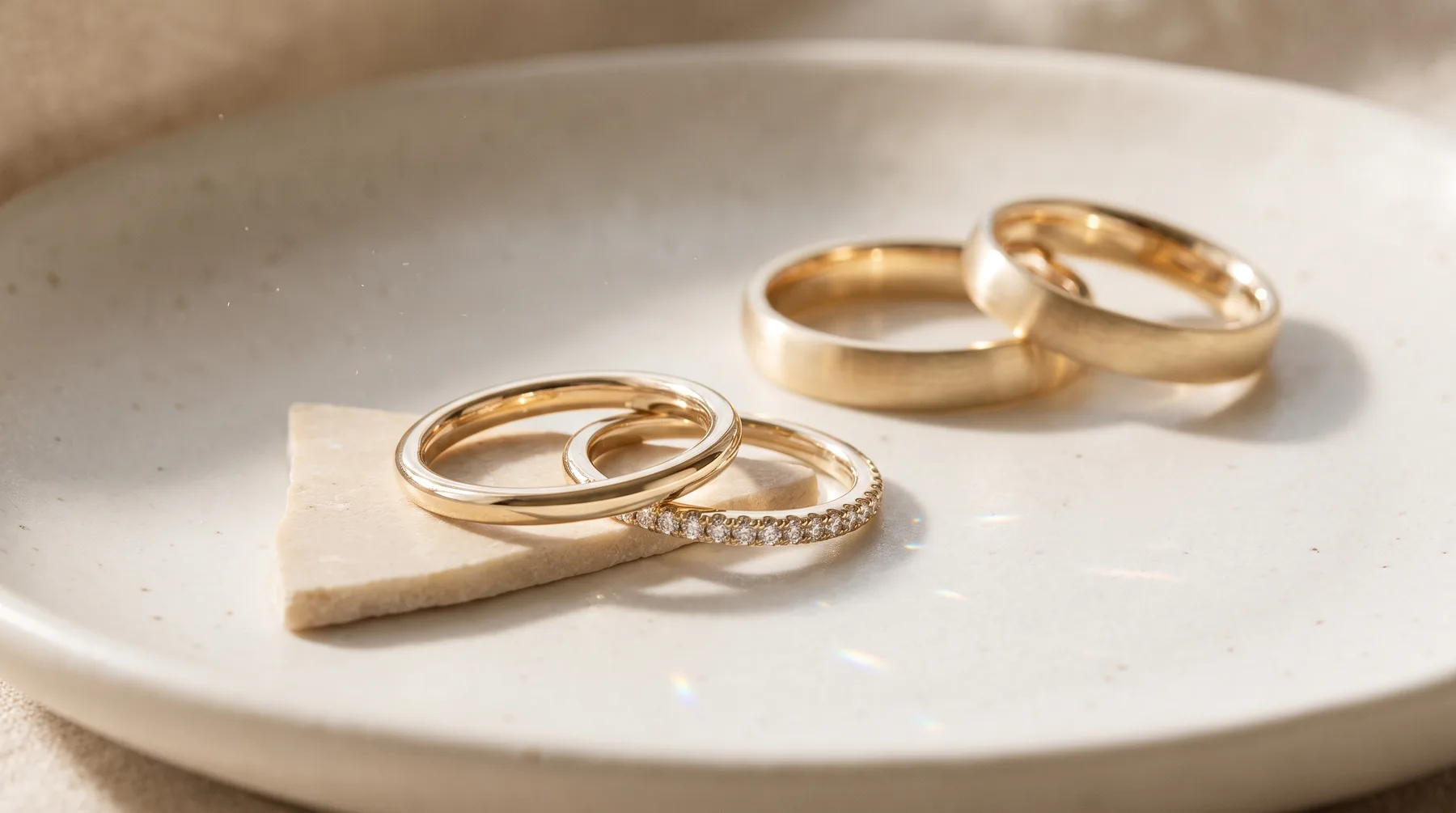
A wedding band works with an engagement ring when three things line up: the band's profile fits the ring's head so the two sit flush, the metal and karat match closely enough that both rings wear at the same rate, and the width suits the engagement ring's shank. Get those three right and the band can be plain or set with diamonds, matched or deliberately contrasting. Get one of them wrong and the pair will show it within a year: a wedge of daylight next to the setting, a softer ring worn thin by a harder one, or a band so wide it shoves the engagement ring up the finger.
This guide is written with the wholesale catalog in view, where bands and engagement rings are sold as separate products and nobody assumes they will meet. It walks the decisions in the order a jeweler at the counter would: fit first, then metal, then width and comfort fit, then whether to solder the pair, then what the stacking trend does to all of the above.
Does a wedding band have to match the engagement ring?
1 min
No. A wedding band has to fit the engagement ring; whether it matches is a style choice. Matching means the same metal color, the same finish, often the same diamond style. Fitting means the band sits flat against the engagement ring with no gap, neither ring grinds the other down, and the finger is comfortable with both on. Plenty of sets match and fit badly, and plenty of contrasting pairs fit beautifully.
The useful distinction is where the two rings touch. A straight band touches a straight-shanked engagement ring along its whole edge, so finish and color show side by side and mismatches are obvious. A contoured band touches the engagement ring only at the shoulders and the base, so a different metal or finish reads as intentional. Matched sets sold together are built to the first logic; most of the interesting stacks you see are built to the second.
One honest trade note before the detail: wedding bands and engagement rings are, at wholesale, different product lines, often from different factories, and the engagement ring's head height is set without any particular band in mind. That is why "will a band sit flush?" is a real question and not a given, even within one brand. The settings that cause the most trouble are covered in our engagement ring settings guide; the next section explains why.
Why doesn't my wedding band sit flush against my engagement ring?
3 min
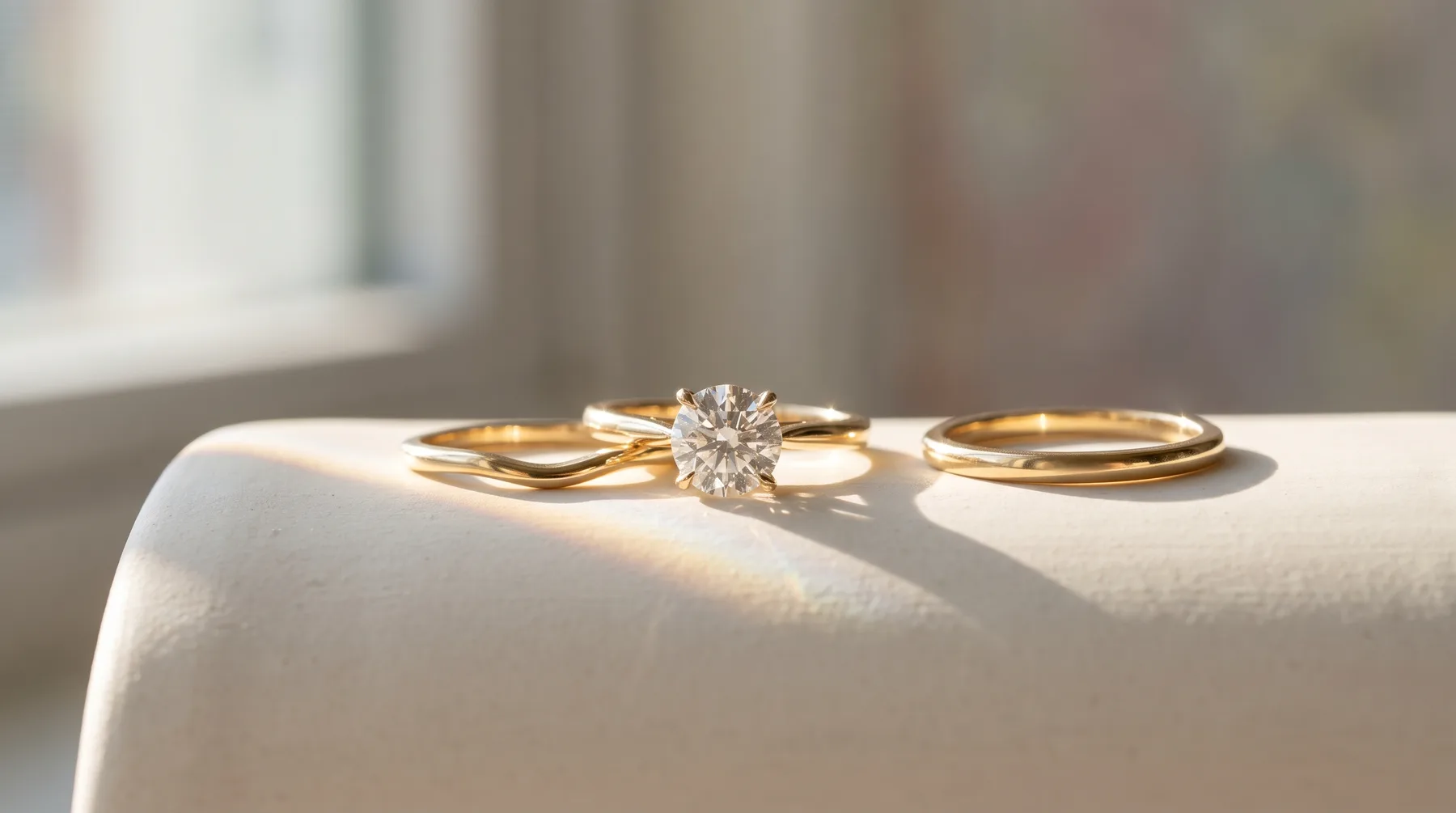
A band leaves a gap when the engagement ring's head, or the arches holding it, reach lower than the band's top edge. The band hits the setting before it reaches the shank, and the space between them is the gap. Cathedral settings, halos and low-set bezels are the usual offenders; a high-set solitaire on a plain shank rarely is.
A cathedral setting sweeps the shank up in two arches alongside the center stone. Those arches start low on the shoulders, so a straight band of any real width runs into them. A halo spreads a ring of small diamonds around the center, which makes the head wider than the shank beneath it; unless the halo has been lifted on a gallery, the band cannot tuck under the overhang. Both problems are geometry, not quality. A very well-made cathedral ring will still leave a gap next to a 3 mm straight band if the arches were designed low.
Low profiles behave differently. A bezel wraps the stone in a collar that sits almost on the shank, so a straight band slides up to it. A solitaire with the head set high, with a gap of air under the stone, usually leaves room for a band to pass underneath. The question to ask any seller, in person or by email, is simply "what band width does this head clear?" A decent answer is a number in millimeters. "It fits most bands" is not an answer.
Contoured, notched, or straight: which band closes the gap?
A contoured band (the trade also says curved or shadow band) bends in a continuous arc that follows the engagement ring's outline; a notched band stays straight and has a small cut-out at the front where the head sits; a straight band is straight. The choice follows the shape of the problem.
- Cathedral with low arches: a contoured band whose curve matches the arch angle. The curve has to be the right radius for that ring, which is why contoured bands sold "to fit any solitaire" fit few of them well.
- Halo or wide head on a straight shank: a notched band. The notch only has to clear the head, and the rest of the band stays flat, so it looks normal worn alone.
- Pear or marquise center, point toward the finger: a chevron, which is a contoured band with a V in it. The point of the stone sits in the V.
- Bezel, low solitaire, or a head that clears the band: a straight band. Buy the plainest one the budget allows and spend the difference on the engagement ring.
A caution on contoured bands that comes up constantly in buyer forums and is fair: worn without the engagement ring, a strongly curved band looks like half of something. If you expect to wear the band alone (for work, for the gym, on trips), a notched band or a gently curved one is the better compromise; a deep curve belongs to a pair that will always be worn together. One more trade trick: a notched band worn with the notch rotated to the palm side looks straight from above.
And the fix that costs nothing: try the band on the other side of the engagement ring. Some heads are asymmetric enough that a band sits flush against one shoulder and gaps against the other.
Should the wedding band be the same metal and karat as the engagement ring?
3 min
Match the metal family and the karat if the rings will be worn together every day. Two rings rubbing against each other wear at the rate of the softer one, and karat and alloy decide the hardness. A mismatch is not fatal, but a decade of daily wear will leave the softer ring visibly thinner on the side facing its harder neighbor.
The numbers come from the alloy sheets manufacturers publish rather than from folk wisdom. Vickers hardness (written HV) measures the size of the dent a diamond pyramid leaves in a metal under a set load; higher is harder. The figures below are for annealed metal, the soft state metal is in after it has been heated and cooled at the bench, before wear hardens it.
| Alloy | Hardness, annealed | Source |
|---|---|---|
| 18k yellow gold (Hoover & Strong Royal D) | 125 HV | Manufacturer spec sheet, January 2015 |
| 14k yellow gold (Hoover & Strong Yellow D) | 140 HV | Manufacturer spec sheet, January 2015 |
| 18k nickel white gold (Hoover & Strong Brilliant White) | 265 HV | Manufacturer spec sheet, January 2015 |
| 14k nickel white gold (Hoover & Strong Brilliant White) | 230 HV | Manufacturer spec sheet, January 2015 |
| 950 platinum, 5% ruthenium | 120–130 HV | Platinum Guild International; Stuller |
| 950 platinum, cobalt | about 135 HV | Platinum Guild International; Stuller |
| 900 platinum, 10% iridium | 110 HV | Platinum Guild International; Stuller |
| 950 "hard" platinum (Hoover & Strong PTH) | 180 HV | Manufacturer spec sheet, January 2015 |
Sources: Hoover & Strong material specification sheets (revised January 2015), Jurgen J. Maerz's Platinum Alloy Applications for Jewelry written with Platinum Guild International, and Stuller's platinum alloy data. Hoover & Strong's own sheet puts its hard platinum at "33% harder than 950 platinum-ruthenium and 64% harder than 900 platinum-iridium," which puts platinum-iridium at about 110 HV and platinum-ruthenium at about 135, close to the published figures above.
Three things in that table decide the matching rule:
- In yellow gold, higher karat is softer. 18k yellow at 125 HV against 14k yellow at 140 HV is a modest gap, but it is the 18k ring that loses metal. If the engagement ring is 18k YG and the band is 14k YG, the engagement ring's shank wears faster on the band side. Our karat guide covers why more gold means softer metal.
- White gold is a different animal. Nickel white alloys are far harder than yellow of the same karat, and 18k nickel white is harder than 14k. A 14k nickel-white band against an 18k yellow engagement ring is the mismatch that does real damage: 230 HV grinding on 125 HV, every day, at exactly the spot where the rhodium plating on the white band will also wear through first. Palladium white golds are softer than nickel whites, so "white gold" on a tag tells you less than you would hope; ask which white alloy it is.
- Platinum sits close to 14k yellow when annealed and then work-hardens in wear. That is why the trade still steers a platinum engagement ring toward a platinum band. The two metals also need different solders and different torches if the pair is ever joined or sized; our white gold vs platinum article has the melting points and the finishing differences.
Now the awkward fact from our own shelves. In the wholesale catalog behind our store, as of October 2026, roughly 18,000 gold and platinum wedding-band styles carry a purity attribute: 10,565 are 14k, 7,168 are 10k, 277 are 950 platinum, and three are 18k. Three. That catalog is built around 14k and 10k, and if your engagement ring is 18k or platinum, a band in matching metal is usually a made-to-order item rather than a stock one. Budget a few weeks for it, and when a seller offers a 14k band "that looks the same," understand that you are being offered a harder ring to live next to a softer one. (The same logic runs one step down: a 10k band next to a 14k engagement ring is the harder of the two, so the engagement ring is the one that wears. If you ever need to confirm what a band actually is, our guide to telling real gold from plated covers the stamps and the tests.)
How wide should a wedding band be next to an engagement ring?
3 min
A band should be the same width as the engagement ring's shank or a touch narrower. Equal widths read as a set; a slightly narrower band keeps the engagement ring the headline. A band noticeably wider than the shank looks top-heavy and, more practically, pushes the engagement ring up the finger toward the knuckle, where it spins.
Engagement ring shanks are narrow: of the engagement mountings in our wholesale catalog that state a width (as of October 2026), the median shank is 2.25 mm and three quarters are 2.5 mm or narrower, which is why 2 mm bands sit next to them so naturally. A halo tolerates a wider band, 3 mm or so, because the head is wide enough to balance it. A very thin band, under 1.5 mm, looks delicate and bends; it is the first ring on the hand to go out of round, and once it is oval it stops sitting flush no matter how carefully the profile was chosen.
Wedding bands run much wider. In the same catalog, the median gold or platinum wedding band is 5 mm wide; 19 percent of styles are under 3 mm and 39 percent are 6 mm or wider. The wide end is the men's market and the narrow end is where bands meant to sit against an engagement ring live. If a seller's "ladies' bands" start at 4 mm, they are selling you a men's product line in a smaller size run.
What does comfort fit mean on a wedding band?
A comfort-fit band has a domed inside surface instead of a flat one, so less metal touches the finger and the ring slides over the knuckle more easily. The outside can be any shape. The inside doming is the whole definition, and it makes a band feel roughly a half size larger than a flat band of the same marked size, which is why jewelers usually size comfort fit down by a half (our ring sizing guide goes through it).
Two bench facts a listing will not tell you. First, how much the inside is domed is not standardized; a 2.25 mm-thick comfort band from one factory and a 2.5 mm one from another fit differently at the same size, so try the actual band, not "a comfort fit in a 6." Second, a comfort-fit band is thicker through its cross-section than a flat band of the same width, because the dome has to be carved out of something. Next to a thin-shanked engagement ring that extra thickness shows as a step between the two rings when you look at the hand from the side. It is a small thing, and it is the kind of small thing that bothers people for twenty years.
As of October 2026, 46 percent of the gold and platinum wedding bands in our catalog that state a fit are comfort fit. For a narrow band next to an engagement ring, standard fit is usually the better-looking choice and the extra ease matters less, because a 2 mm band is easy to get over a knuckle anyway. For anything 4 mm and up, comfort fit earns its keep.
Should you solder your wedding band to your engagement ring?
3 min
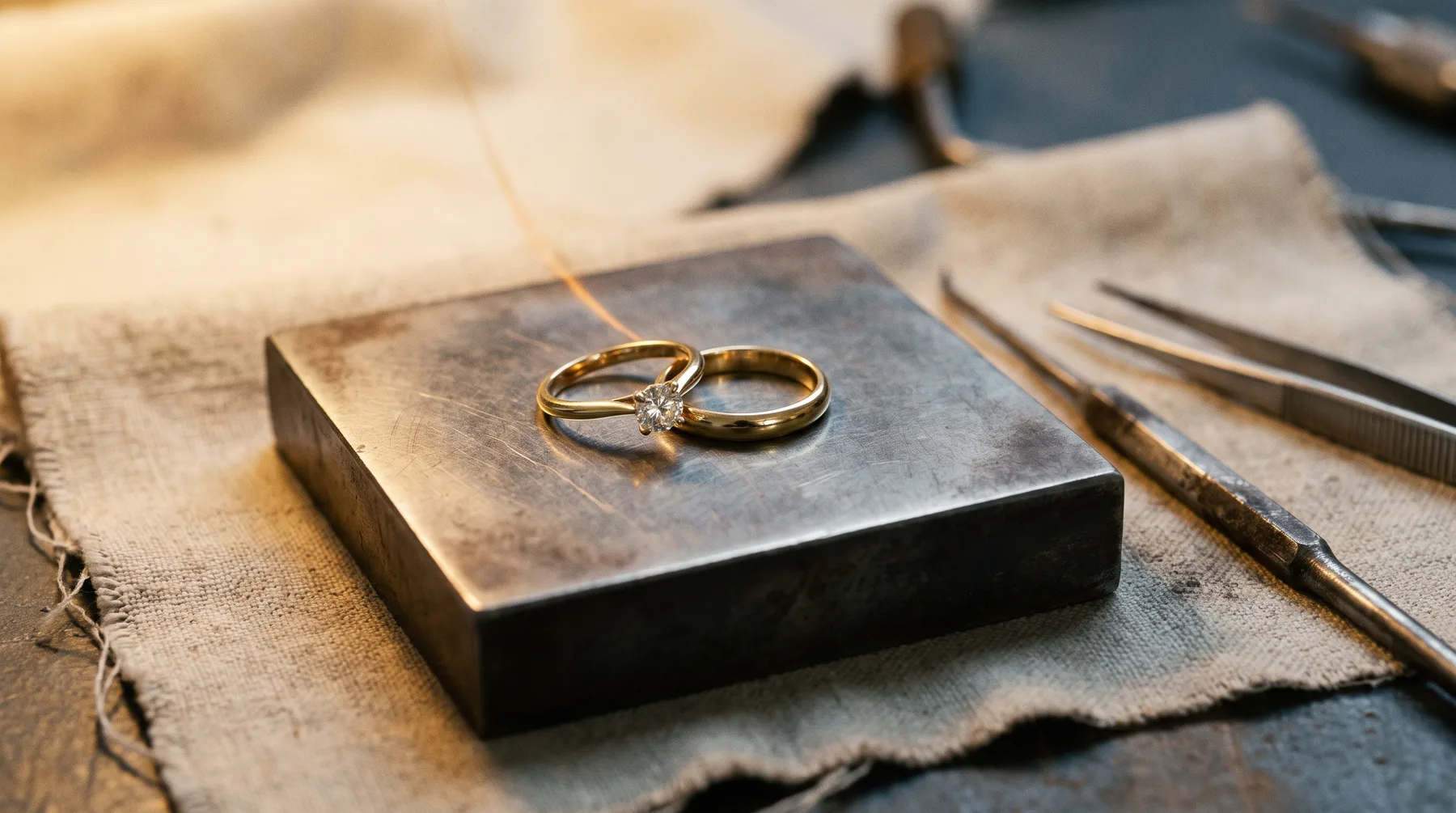
Solder the pair if the two rings are already the right size, already sit flush, are the same metal, and will be worn together every day for good. Leave them separate if any of those is not true. Soldering fixes spinning and stops the rings grinding each other, and it does that by taking away every choice you have not made yet.
Mechanically it is a small job. The bench holds the two rings in alignment (the old shop trick, shared on Ganoksin's Orchid forum, is a dab of super glue at the top while the bottom is soldered), flows a low-temperature solder across the two shanks at the base where the joint hides in the palm, then cleans up the seam and polishes. Many jewelers tack the join only at the bottom rather than along the whole contact, so the rings can be separated later by cutting one seam. Rhodium-plated white gold gets re-plated afterward because the torch and the polish take the plating off.
What is hard to undo:
- Sizing becomes a two-ring job, every time. A soldered pair is sized as one piece: cut through both shanks, stretch or shrink both, close both seams. Both rings move the same amount, together. If only the engagement ring was a half size off, that half size is now also in the band, and if either ring carries stones down the shank (an eternity band, a pavé shank) it may not be sizable at all. In our catalog, 42 percent of the wedding bands that carry a sizable flag are marked "no." Check that flag before you solder, not after.
- Cleaning behind the stone gets harder. The underside of the head, where skin oil and soap collect and dull a diamond from below, is reached from the band side. Once a band is soldered against the gallery, that path is partly blocked. The pair still cleans; it just needs a steam cleaner or an ultrasonic, and a lot of stones should not go in either. See which jewelry survives an ultrasonic before you build a set that depends on one.
- Heat-sensitive stones have to be protected or removed. The Gemological Institute of America (GIA) warns that heat damages emerald "especially by extending existing fractures" and that "high heat or sudden temperature changes" can fracture opal. A competent bench shields or unsets those stones before any torch work, which is extra cost and extra handling.
- Details at the joint are consumed. Milgrain edges, inside engraving, and a hallmark that sits where the solder flows will be softened or lost. Ask the bench exactly where the solder will sit and what it will touch.
- Separating leaves a trace. Cutting a soldered pair apart and refinishing both shanks works, and a good bench makes it nearly invisible, but "nearly" is the honest word. Retail guides that publish prices for the job put the soldering at roughly $50 to $150 in gold as of 2026, platinum costing more because it needs more heat and more finishing time; cutting the pair apart later and refinishing both shanks is a similar bill again.
The good reasons to solder anyway: a thin band that keeps spinning around to the wrong side of a cathedral ring, a pair that has already worn a shiny groove into each other, or a set whose contoured band only sits right in one exact position. For everyone else, a plain straight band and a once-a-year check of the prongs does the same job with none of the commitment; while the ring is on the bench, the same visit covers prong wear and retipping.
Is a stack of bands better than one wedding band?
2 min
A stack is a fine way to buy bands, as long as the first one is a straight band in the engagement ring's metal. Trade press has treated stacking as settled rather than new for years: JCK called stacking bands "a trend with staying power" back in 2018, and a 2026 wedding-band trend piece in National Jeweler, sponsored by the supplier Rio Grande, describes brides treating wedding jewelry "as an evolving collection rather than a single purchase," adding anniversary and milestone bands over time. Both say the same thing from the manufacturer's side: bands are now sold as a category you return to, not a one-time purchase.
The trade perspective the trend pieces leave out is friction. Every ring added to a stack adds two contact surfaces, each of them rubbing at the hardness rates in the table above. A 14k nickel-white band in the middle of a stack of 18k yellow bands will slowly dish out its neighbors. Mixed metals are genuinely popular right now (National Jeweler notes yellow with white gold "remains a popular combination"), and they look good; just put the harder ring on the outside of the stack, away from the engagement ring, or accept that the softer rings are the wear parts of the set.
Three practical rules for a stack that will still sit well in ten years:
- The first band is straight and plain. It is the one that touches the engagement ring, so it needs to fit flush and wear evenly. Contoured bands and chevrons go on the outside, where their curve can frame the set, and where they can be left in the drawer on days you wear only the pair.
- Sizes must agree. A stack of three rings a quarter size apart will never line up, and the loose one will spin to the wrong side. Buy each band in the size that already works, in the same fit (standard or comfort), and resist the quarter-size-up "so it's easy to get over the knuckle" advice at the counter.
- Do not solder a stack. Two rings joined is a set; three or more joined is a cuff that is hard to size, clean, or re-plate without cutting several seams.
The decision rule
1 min
Buy the band in this order. Ask the seller what band width the engagement ring's head clears, in millimeters; that answer tells you whether you need a straight, notched, or contoured band. Then match the metal family and the karat, and if the engagement ring is 18k or platinum, accept the wait for a made-to-order band rather than a 14k look-alike. Then choose a width equal to or a touch under the engagement ring's shank, in standard fit if the band is narrow. Wear the pair separately for a year before deciding on solder. A year of wear shows whether the pair spins or grinds; solder only if it does.
Frequently Asked Questions
2 min
Can I wear a 14k wedding band with an 18k engagement ring?
Yes, though 18k yellow reads slightly richer than 14k side by side. Over years of daily wear the 18k ring, the softer of the two, will wear slightly faster on the side touching the band. If the band is 14k nickel white gold the difference is much larger, because that alloy is almost twice as hard as 18k yellow. Match karat when you can; when you cannot, put the harder ring where its wear matters least.
Does the wedding band go on the inside or the outside of the engagement ring?
Tradition puts the wedding band first on the finger, closer to the hand, with the engagement ring outside it. Fit decides more than tradition does: if the band only sits flush against one shoulder of the engagement ring, wear it on that side. Many people also move the band outside when the engagement ring has a low head that would otherwise pin the band in place.
Do curved wedding bands look strange worn alone?
A deeply curved or chevron band usually does; a gently contoured or notched band usually does not. If you plan to wear the band by itself for work or travel, choose a notched or lightly curved band, or wear a strongly curved one with the curve rotated toward the palm.
Can a soldered wedding set be resized?
Yes, as one piece, with both rings cut and moved the same amount. If either ring has stones set down the shank it may not be sizable at all, which is also true before soldering. Some jewelers prefer to separate the pair, size each ring, and re-solder, which costs more and refinishes the joint.
Will a platinum band damage a gold engagement ring?
Not quickly. Annealed platinum alloys sit near 110 to 135 HV, about the same as 14k yellow gold, and platinum work-hardens as it is worn, so over many years the gold ring tends to be the one that loses metal. Matching platinum to platinum avoids the question, and keeps sizing and soldering simple, since the two metals need different solders and different heat.