
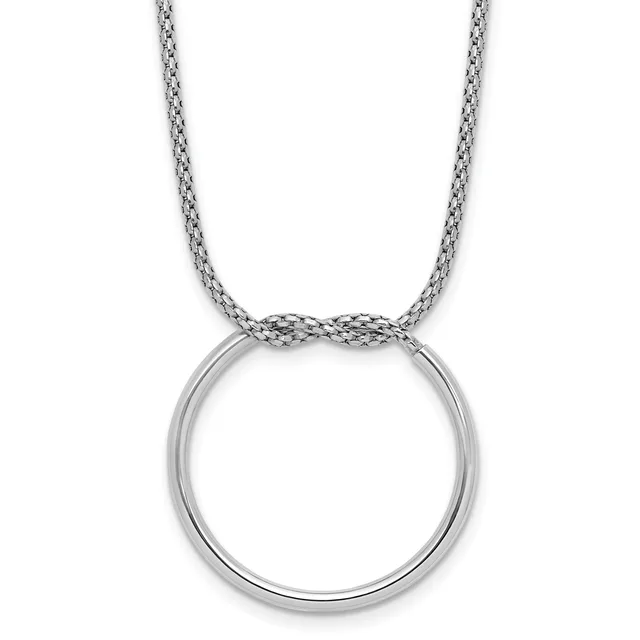
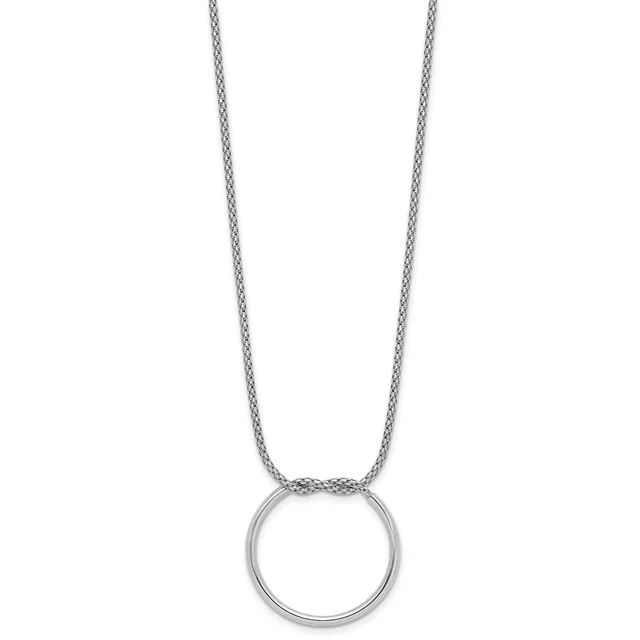
What makes a necklace contemporary
The pieces here share a design sensibility that favors restraint: shapes are deliberate, proportions are considered, and ornament is kept to what earns its place. The result is jewelry that reads as intentional without demanding attention — a pendant you reach for on a Tuesday as readily as a Saturday.
Pendants and how to wear them
A pendant necklace puts a single focal point at the neckline, so its length matters as much as its face. An adjustable chain lets you shift that point to suit the neckline you're wearing — higher for a deep V, lower for a crew. When a chain length is fixed, measure against a necklace you already own and wear comfortably; a tape measure along the collarbone is less reliable than a known reference piece.
Caring for fine-metal pendants
Fine metal holds up to daily life but benefits from a few habits. Remove pendants before swimming, bathing, or applying fragrance — chlorine, salt, and alcohol accelerate surface wear. Store each piece separately or in a soft pouch so the pendant face doesn't pick up scratches from other jewelry. A gentle wipe with a lint-free cloth after wearing is enough for routine maintenance.
Frequently asked questions
Are these necklaces suitable for daily wear?
Yes — the pendants here are built with everyday use in mind. Keeping them away from water, fragrance, and abrasive surfaces will preserve their finish over time.
How does an adjustable chain work in practice?
An adjustable chain has a sliding or multiple-loop closure that lets you set the length without a second clasp. This makes it easy to shift the pendant's position to suit different necklines.
What's the best way to choose a pendant length?
Hold a tape measure or a piece of string to your collarbone and let it fall to roughly where you'd like the pendant to sit. Comparing that measurement to a necklace you already wear comfortably gives a reliable reference.
Can I layer a pendant from this category with other necklaces?
Contemporary pendants with clean silhouettes tend to layer well. Varying chain lengths by at least two inches helps each piece read on its own rather than clustering together.